
An 1877 drawing of the world supported on the backs of four elephants, themselves resting on the back of a turtle.
World Turtle
The World Turtle, also called the Cosmic Turtle, is a mytheme of a giant turtle supporting or containing the world, found in Hinduism, Chinese mythology, and the mythologies of some indigenous peoples of the Americas.
Measuring Divine Endurance Across Billions of Years
Around 1500, the author Jñānarāja invoked a striking proportional comparison in Siddhantasundara to defend the cosmic reptile's endurance. If a common vulture can balance a serpent during a single prahara of three hours, divine capability easily scales to colossal lengths. Consequently, a deity manifest as a tortoise can reliably support the entire Earth across a kalpa lasting billions of years.
From Wikipedia · CC BY-SA 4.0
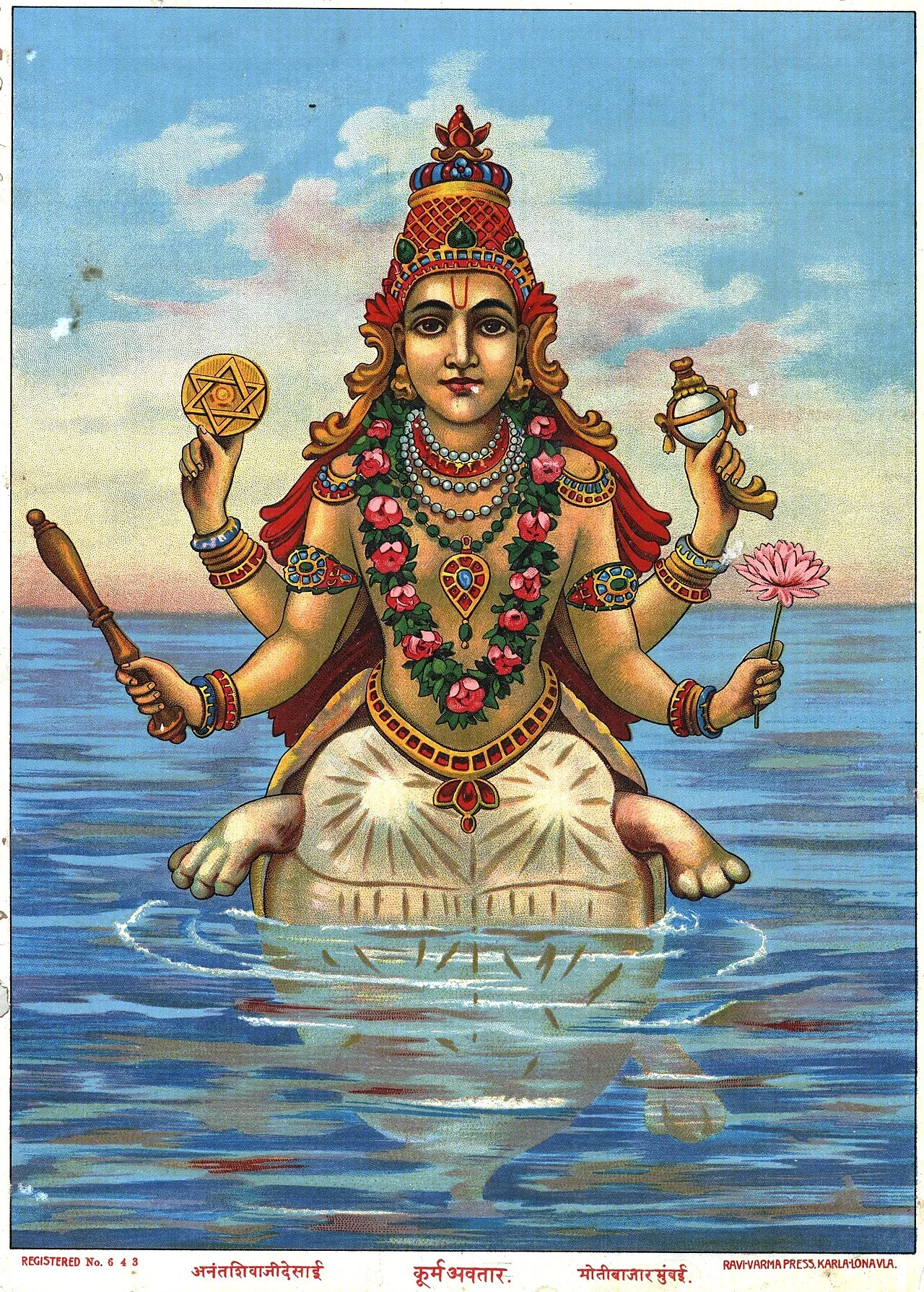
Kurma Avatar by Raja Ravi Varma
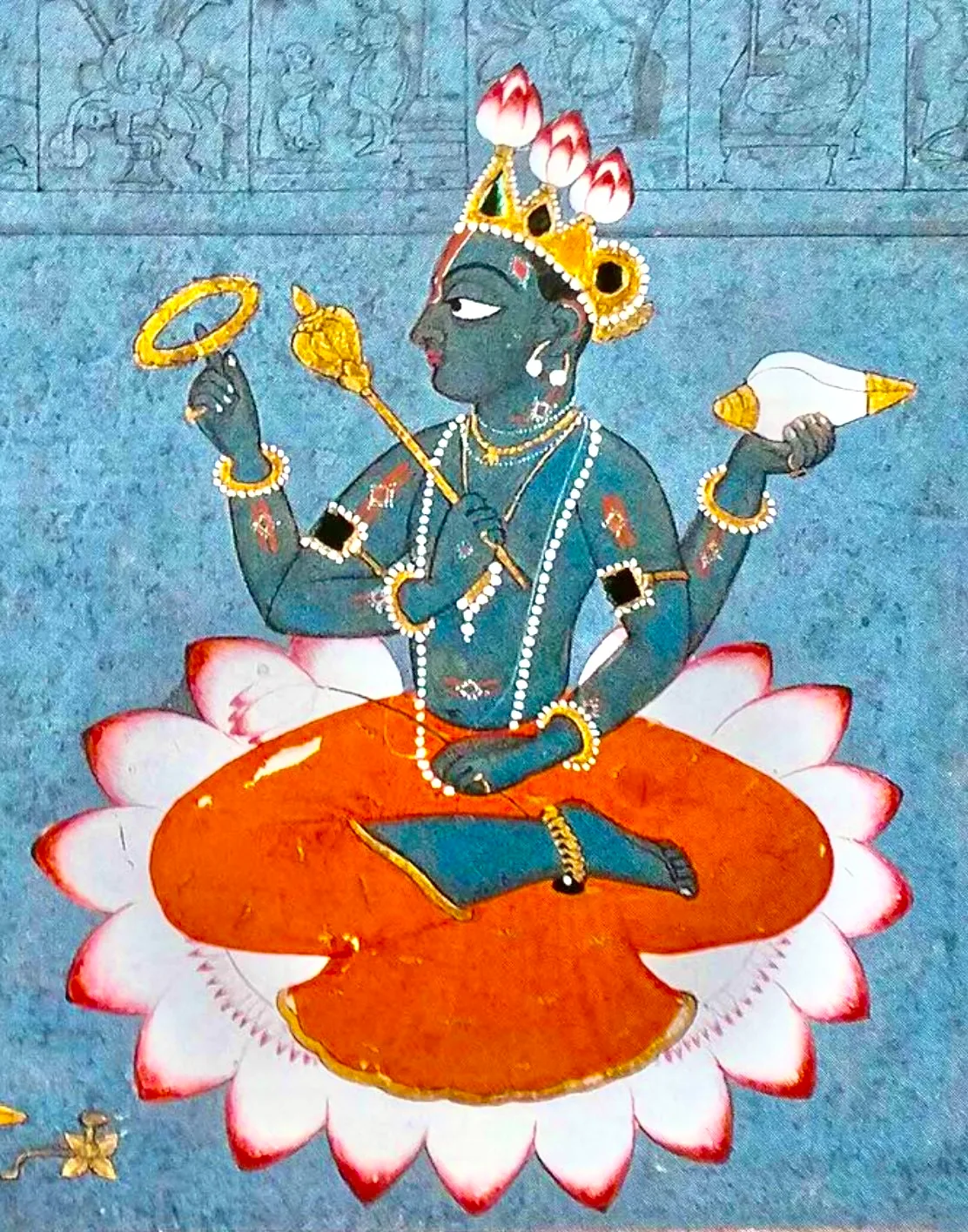
Closeup of Vishnu, seated in the lotus position on a lotus. From depiction of the poet Jayadeva bowing to Vishnu, Gouache on paper Pahari, The very picture of devotion, bare-bodied, head bowed, legs crossed and hands folded, Jayadeva stands at left, with the implements of worship placed before the lotus-seat of Vishnu who sits there, blessing the poet.
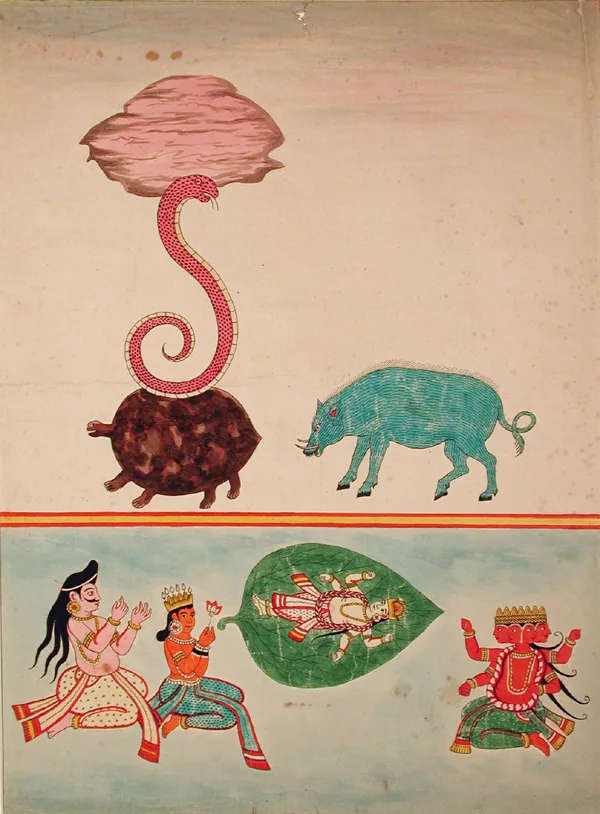
Kurma with Sesa holding the Earth (left), Varaha (right), and Vishnu (below, centre).
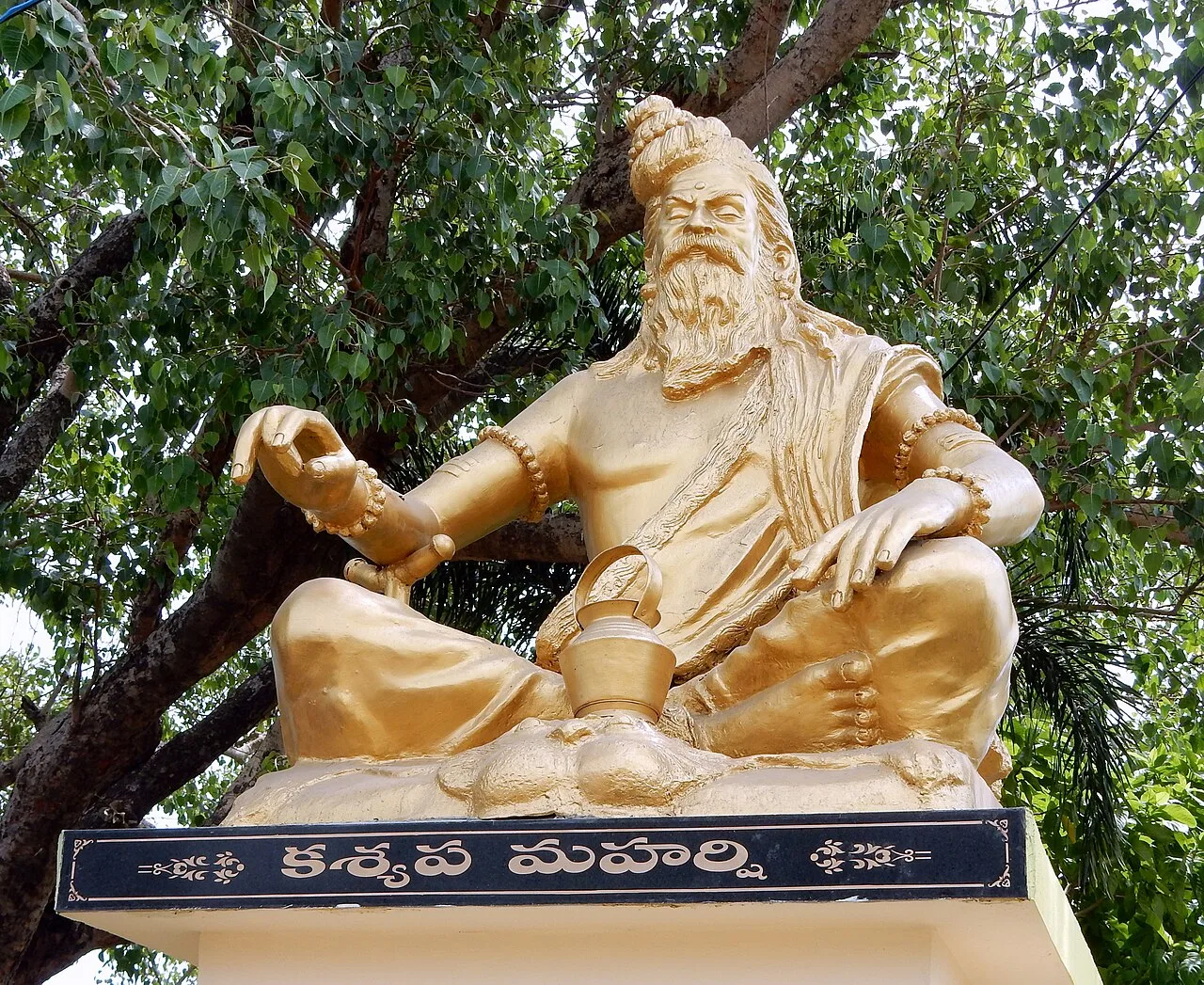
Kashyapa Muni, one of the Saptarishi (Seven Rishis) during the reign of the sixth (and current) Manu, Chakshusha.
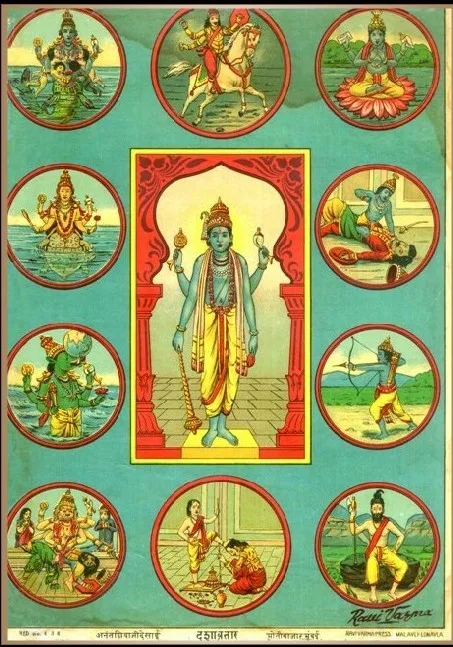
the Dashavatara, or ten principle avatars of Vishnu.
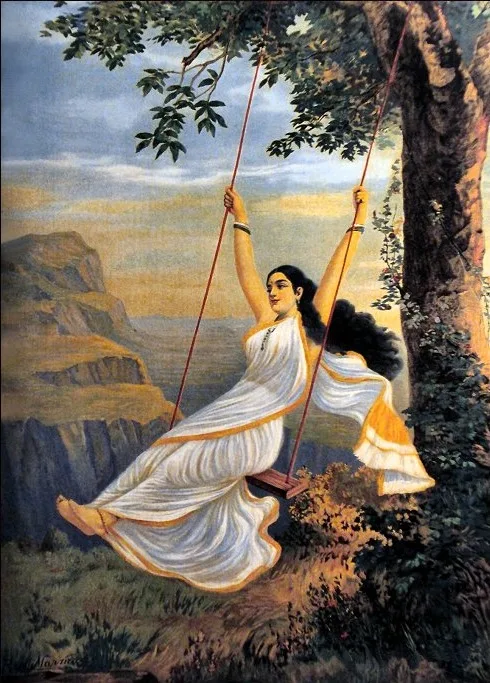
Mohini, the female enchantress avatar of Vishnu.
Kurma
Kurma is the second avatar of the Hindu preserver deity, Vishnu. He prominently appears in the legend of the churning of the Ocean of Milk, referred to as the Samudra Manthana.
Creator Deity's Deeds Transferred to Vishnu
While Kurma is widely known as an avatar of Vishnu, earlier Vedic texts identify the tortoise with Prajapati. In the Shatapatha Brahmana, the creator deity assumes this form to bring forth all living creatures. As the popularity of Brahma declined, the attributes and deeds of the creator were gradually transferred to Vishnu.
From Wikipedia · CC BY-SA 4.0
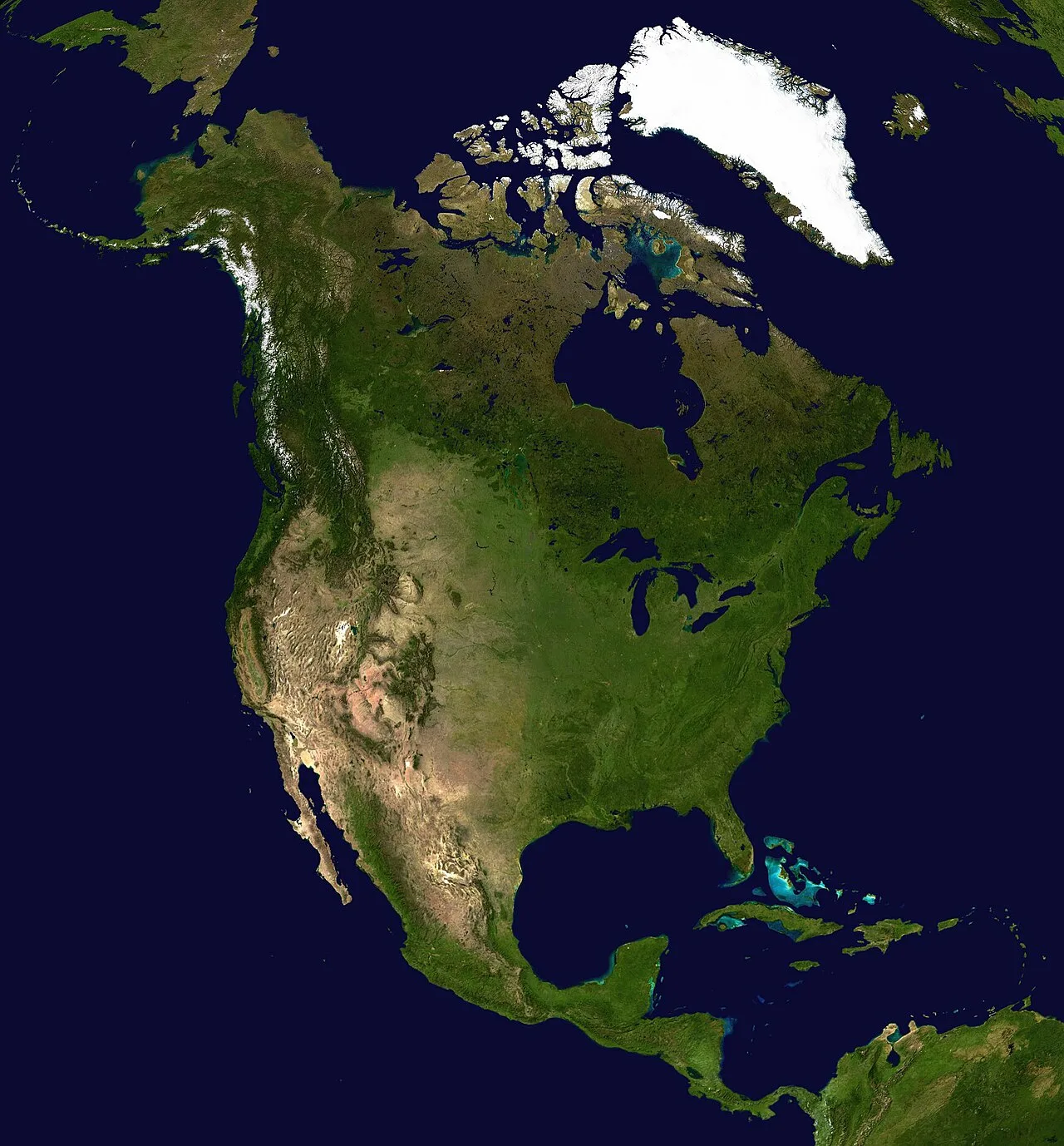
Satellite imagery of Turtle Island (North America)

Sky Woman (1936), by Seneca artist Ernest Smith, depicts the story of Turtle Island.
Turtle Island
Turtle Island is a name used by some Indigenous peoples of the Americas to refer to Earth or North America, based on an oral history of the Northeastern Woodlands.
The Manhattan Encounter of October 1679
European colonists first transcribed the Lenape creation account during an interview on October 16, 1679. Recorded in the journal of Labadist missionary Jasper Danckaerts, the narrative was shared by Tantaqué, a Hackensack elder visiting the Fort James area in Lower Manhattan. This early encounter documented an Indigenous cosmology centered on the Great Turtle long before modern geographic boundaries took shape.
From Wikipedia · CC BY-SA 4.0
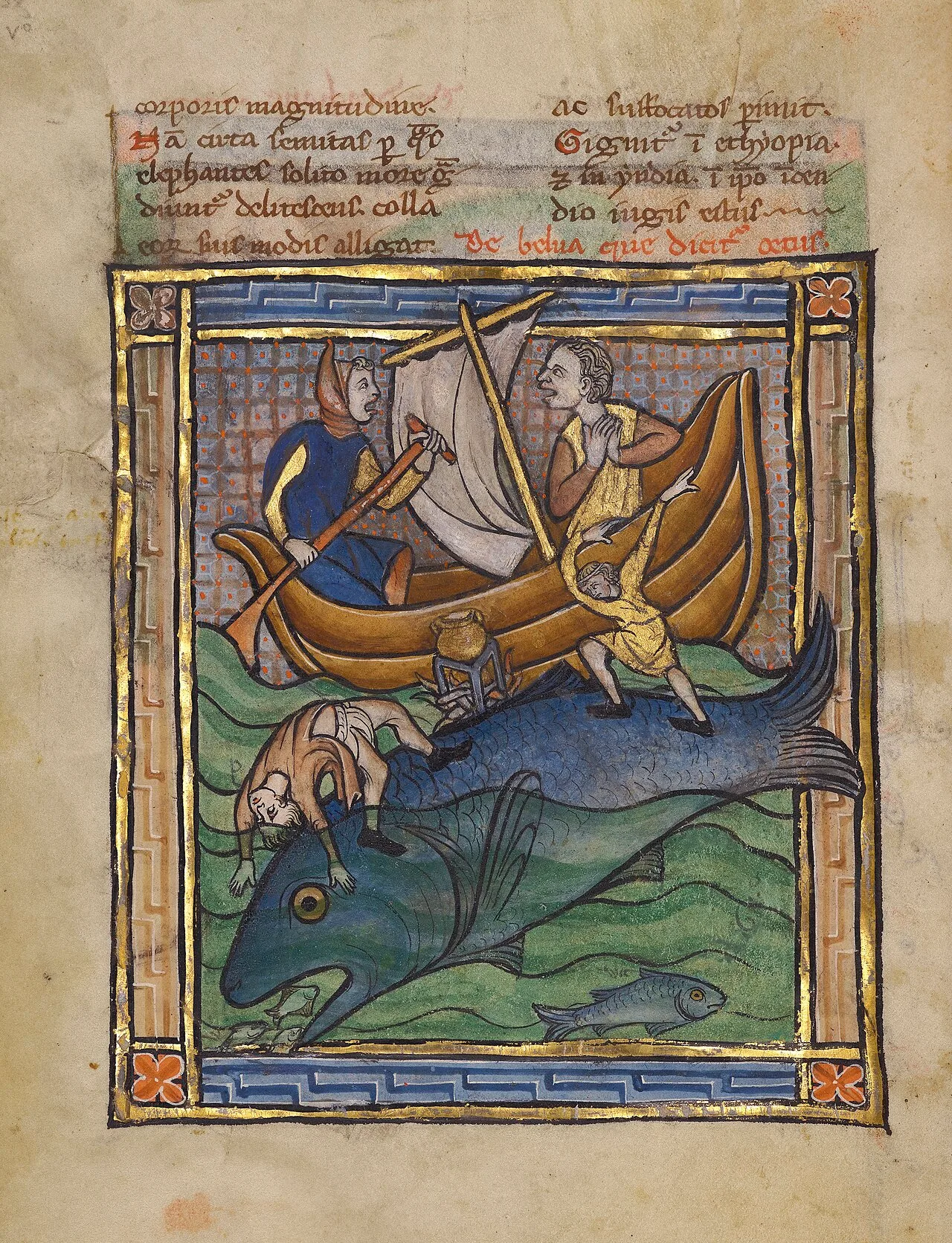
An Aspidochelone from a French manuscript, c. 1270. J. Paul Getty Museum
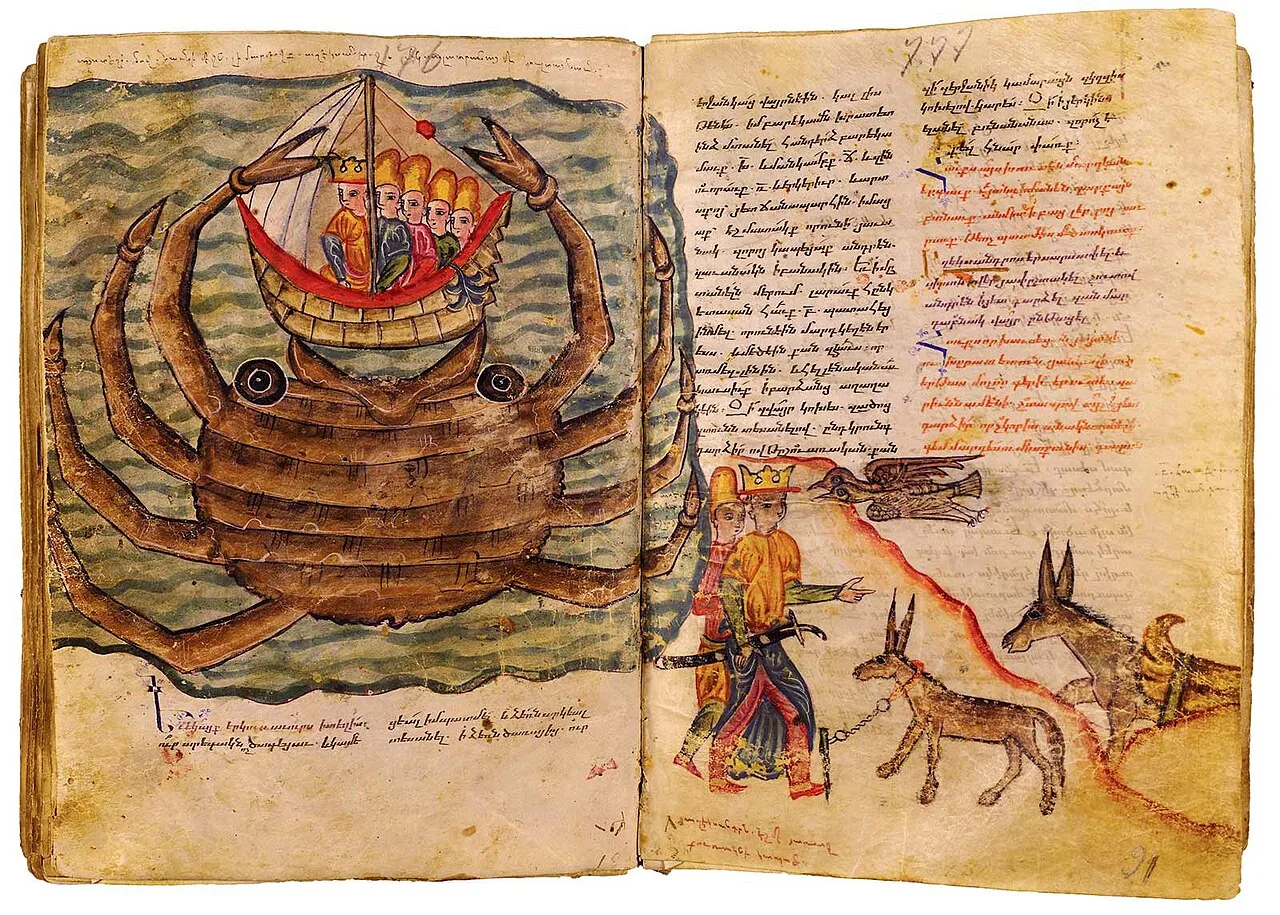
Alexander Romance, Armenian manuscript, 1538–1544
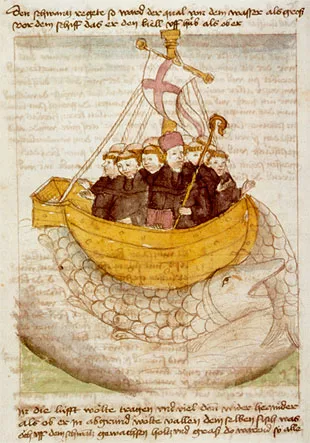
Brendan and his monks' ship is carried by a giant fish in a German manuscript.
Aspidochelone
The aspidochelone is a fabled sea creature from the Physiologus and medieval bestiaries, described as a giant whale, vast sea turtle, or spined monster so huge that it is often mistaken for an island.
Deceptive Shores and the Allegory of the Adversary
The aspidochelone derives its name from the Greek words for shield or asp and turtle. Early Christian tradition, beginning with the second-century Physiologus, framed this beast not merely as a hazard of navigation, but as an emblem of spiritual ruin. The creature invites sailors onto its shell only to plunge them into the deep once they kindle fires. Within medieval bestiaries, this fatal trick directly symbolizes Satan deceiving souls before devouring them.
From Wikipedia · CC BY-SA 4.0
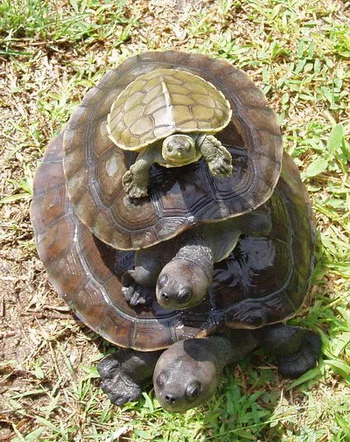
The saying holds that the world is supported by an infinite stack of increasingly larger turtles.
Four World Elephants resting on a World Turtle

William James
Turtles all the way down
Turtles all the way down is an expression of the problem of infinite regress, alluding to the mythological idea of a World Turtle that supports a flat Earth on its back.
Jesuit Transmission of the Nine-Cornered World
The cosmological imagery of animals holding up the world entered Western discourse through Renaissance travel accounts of Indian thought. Jesuit Emanuel da Veiga documented the belief on 18 September 1599 while writing from Chandagiri. Samuel Purchas later popularized the motif in 1613/1626, recording a nine-cornered Earth supported by seven elephants standing upon tortoises borne by an unknown foundation.
From Wikipedia · CC BY-SA 4.0

Eco shop

The Turtle House by the German architect and designer Kurt Völtzke (Atelier Color, Chemnitz) at El Gouna (Red Sea, Egypt)

A bas-relief from Angkor Wat, Cambodia, shows Samudra manthan-Vishnu in the center and his turtle Avatar Kurma below

A bixi holding Kangxi Emperor's stele near Marco Polo Bridge, Beijing

The stone turtle carries stela on its back Văn Miếu in Hanoi, Vietnam.

Sea turtle, Australia
Cultural depictions of turtles
Turtles are frequently depicted in popular culture as easygoing, patient, and wise creatures, serving as an emblem of longevity and stability in many cultures around the world.
Oceanic Wandering Behind the Sedentary Façade
While folklore around the world casts the turtle as an immovable, slow-paced emblem of stability, biological reality tells a different story. In human imagination, their heavy shells and deliberate movements suggest a strictly sedentary existence. Marine species challenge this peaceful domestic image by frequently migrating over large distances in oceans.
From Wikipedia · CC BY-SA 4.0
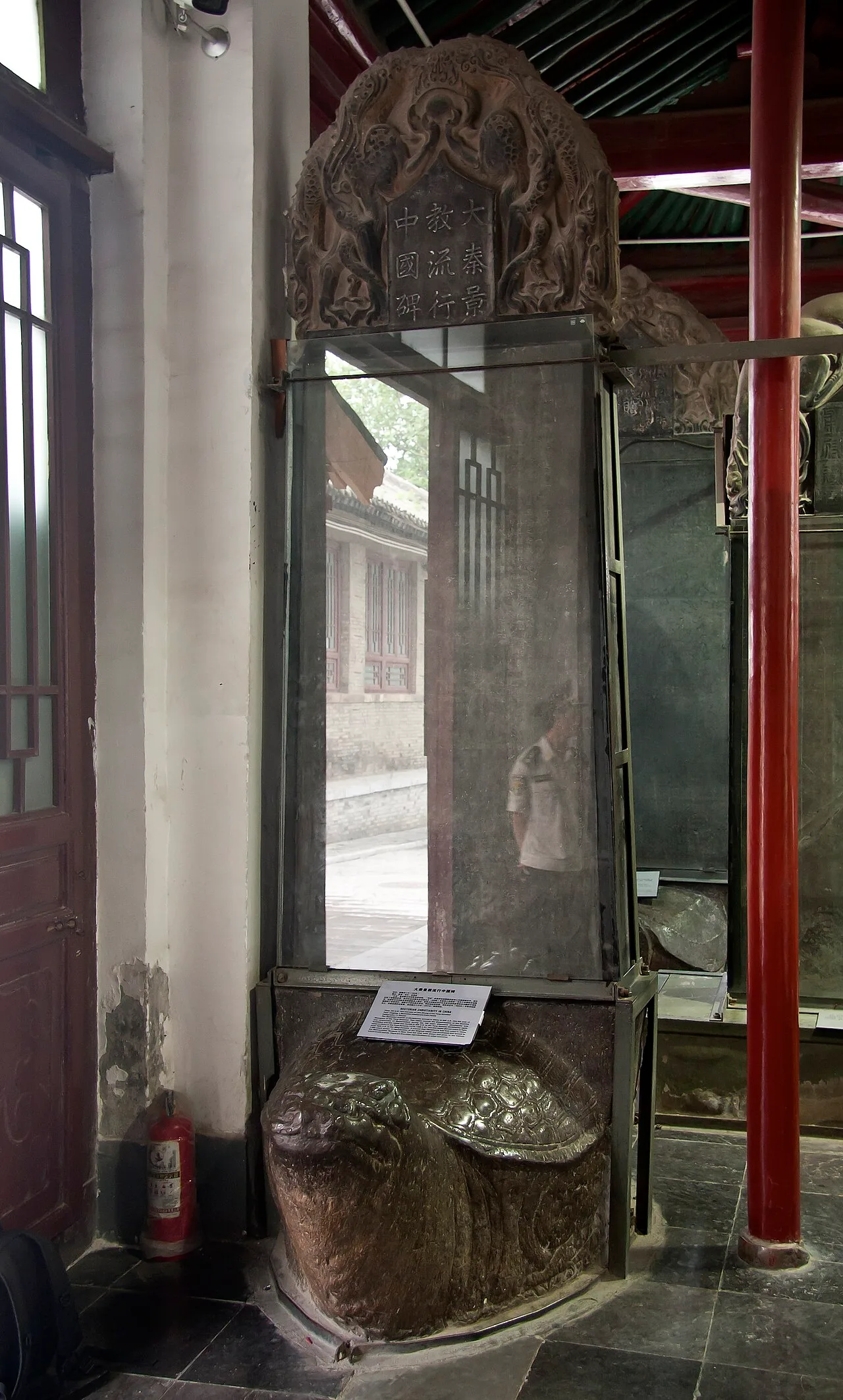
Sculpted c. 1810, donated 1936
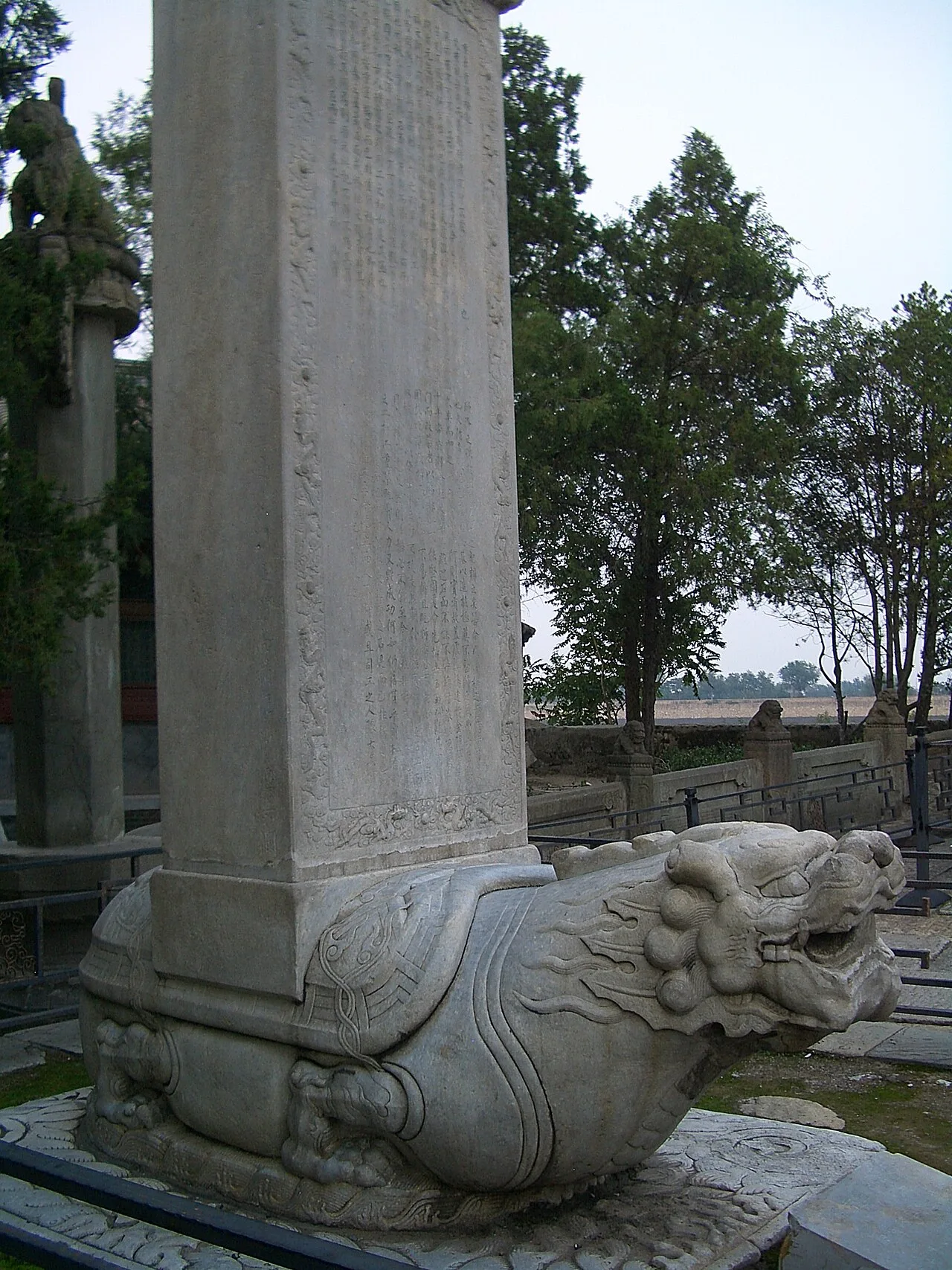
A dragon-headed bixi with a stele in memory of the Qianlong Emperor's rebuilding of the Marco Polo Bridge, Beijing, c. 1785
![Turtle in Thiên Mụ Temple, Hue, Vietnam, 1715[21]](https://nwjvzop1xgplmzvt.public.blob.vercel-storage.com/wikifeed/bixi/2-b882a837b6.webp)
Turtle in Thiên Mụ Temple, Hue, Vietnam, 1715[21]
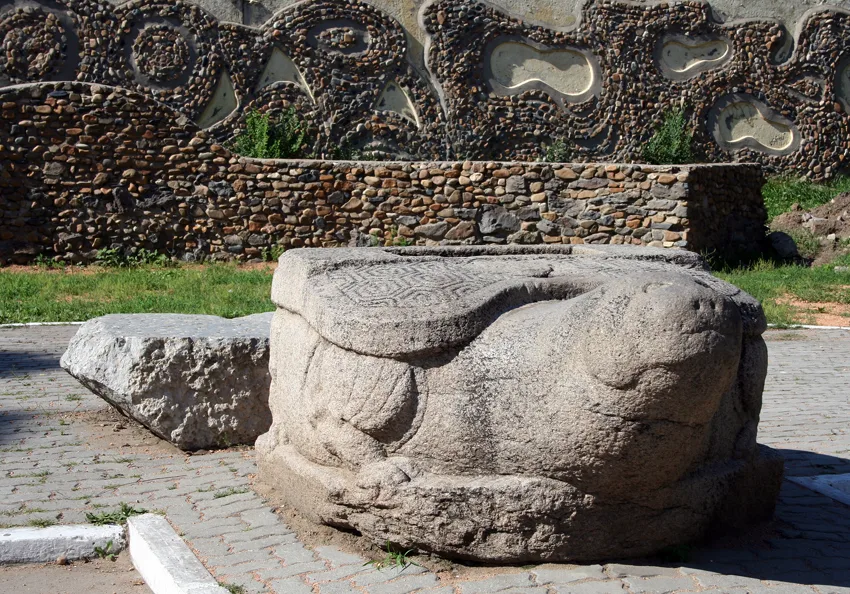
Ussuriysk, Jin dynasty (1115-1234)
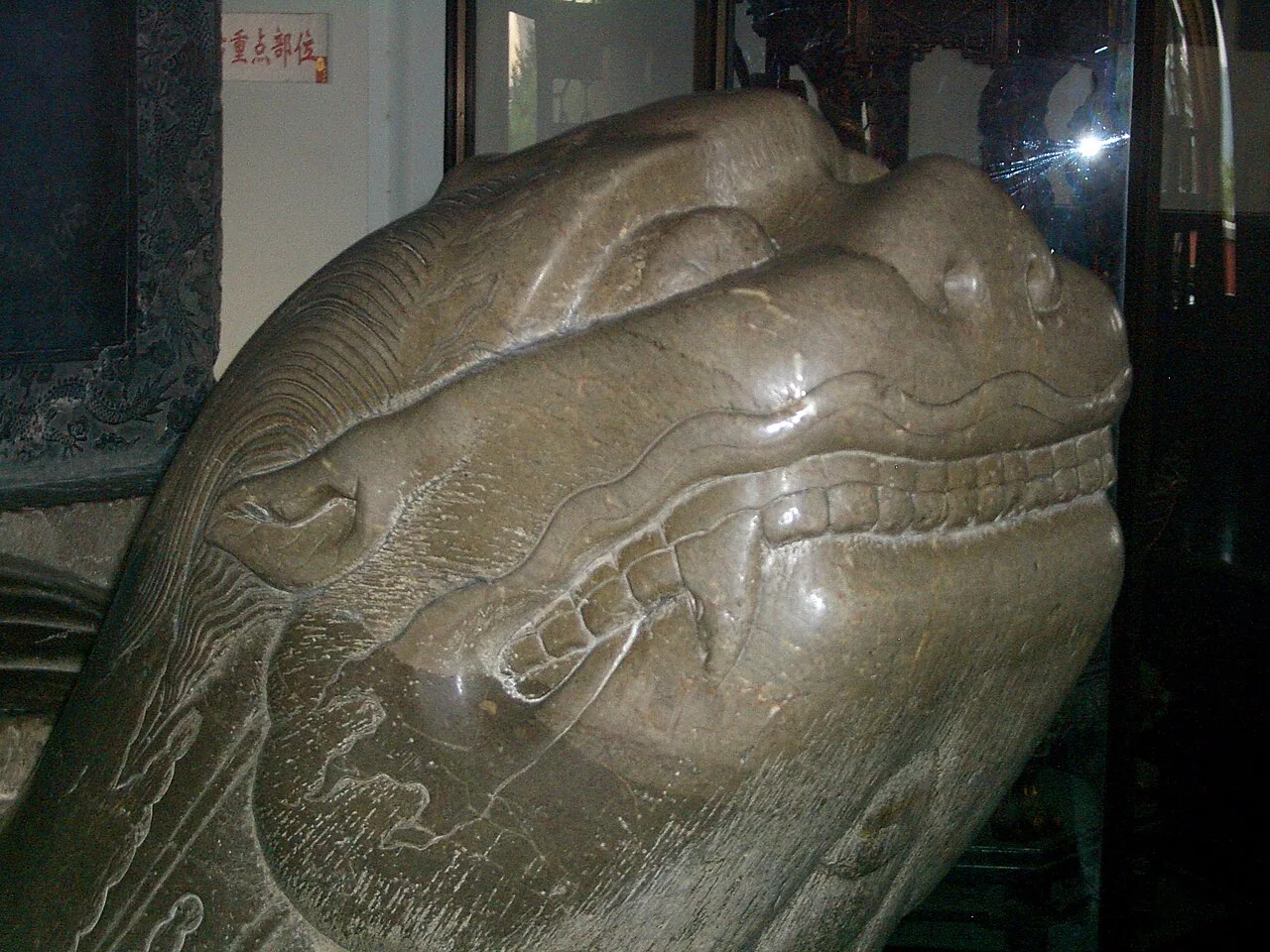
Drum Tower, Nanjing. Commemorates visit by the Kangxi Emperor, 1684

World War II monument in Wanping Castle, Beijing, 1995
Bixi
Bixi is a figure from Chinese mythology and one of the nine sons of the Dragon King, depicted as a dragon with a turtle shell and used in stone sculptures as a decorative plinth for steles.
Anatomical Drift from Pond Turtles to Fanged Dragon Hybrids
Stone pedestals began as naturalistic representations of actual aquatic turtles during the Han and Six Dynasties periods. Over centuries, the statuary drifted away from realistic biology, sprouting small ears, leaf-like carapace carvings, and prominent teeth in the early Ming period. By the mid-Qing dynasty in the 18th century, these creatures completed their morphological transition into hybrid, dragon-headed beasts.
From Wikipedia · CC BY-SA 4.0