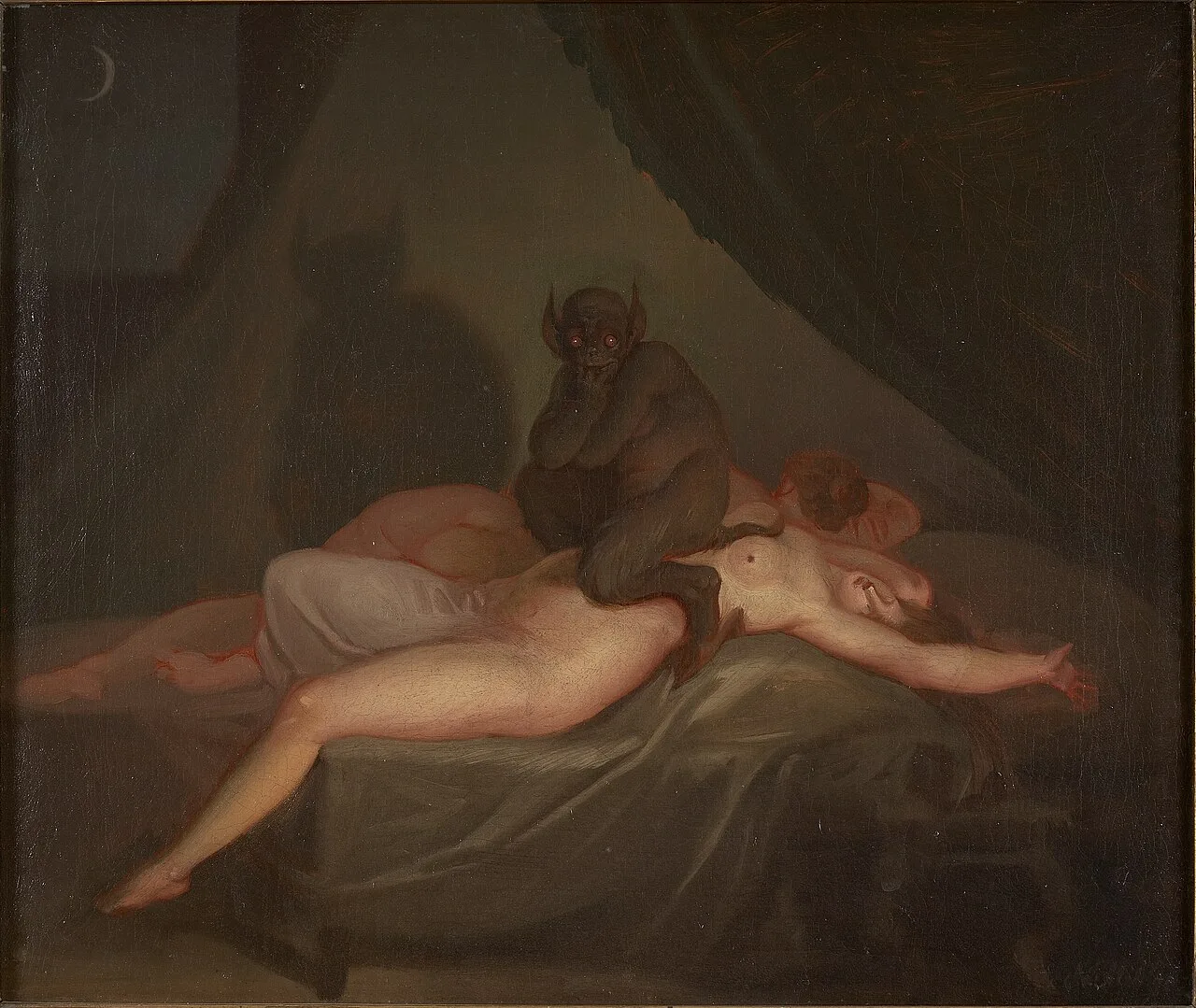
Nachtmahr (Abildgaard)
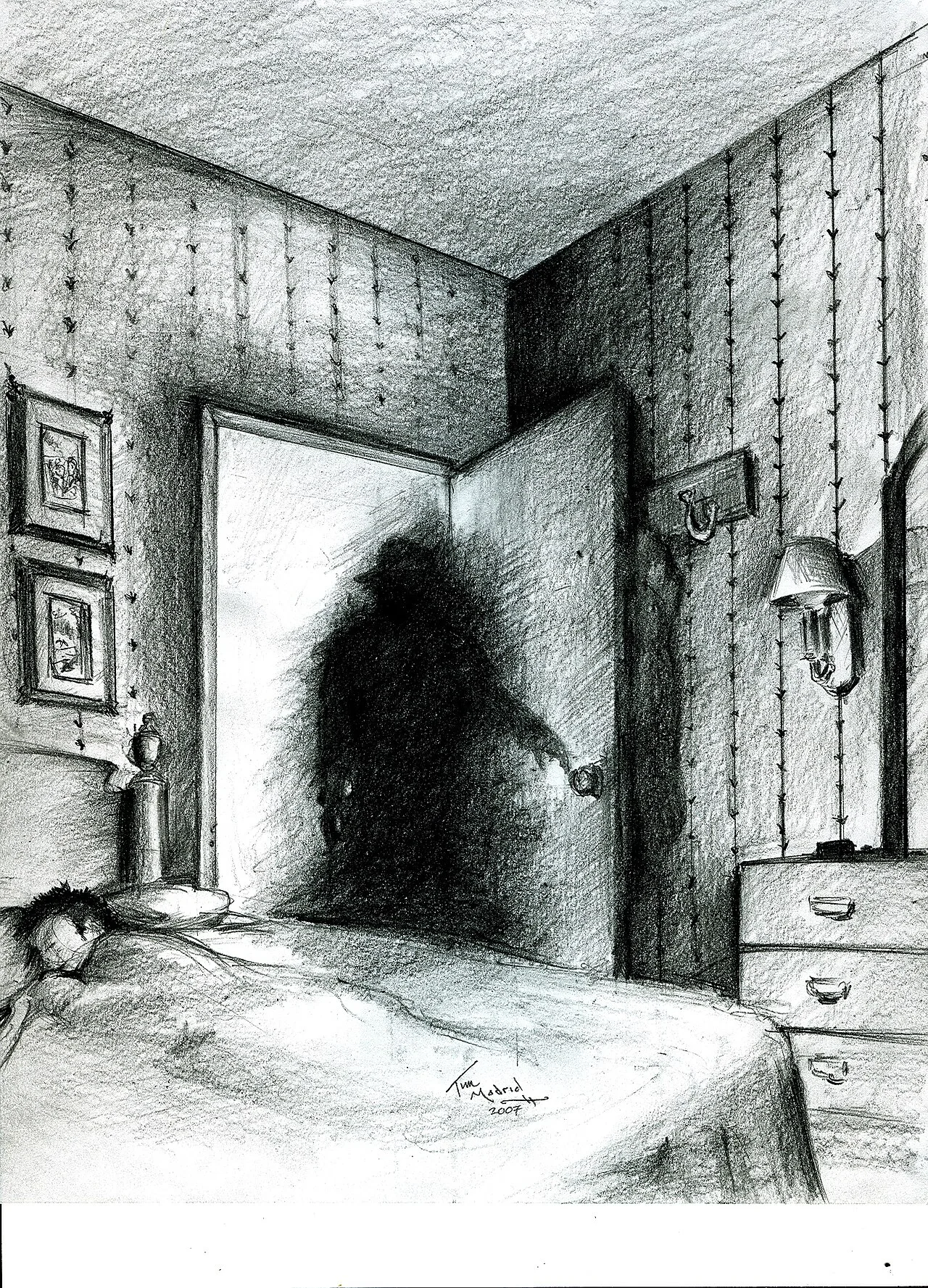
Illustration of a shadow person.
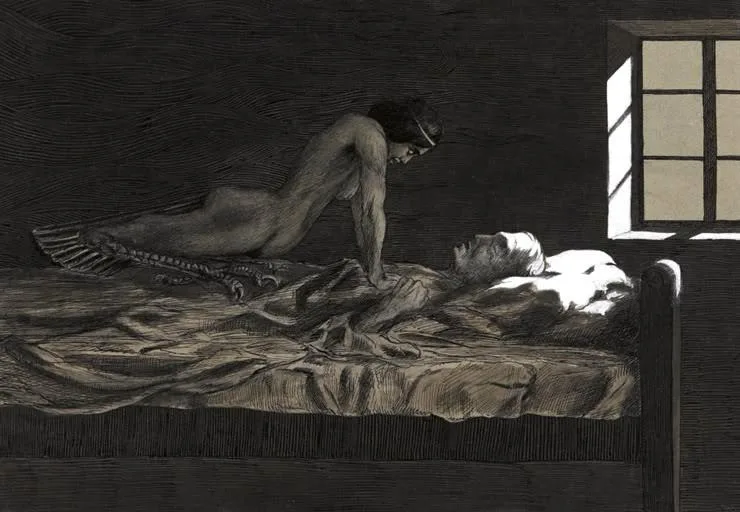
A picture of a succubus-like vision. My Dream, My Bad Dream, 1915, by Fritz Schwimbeck
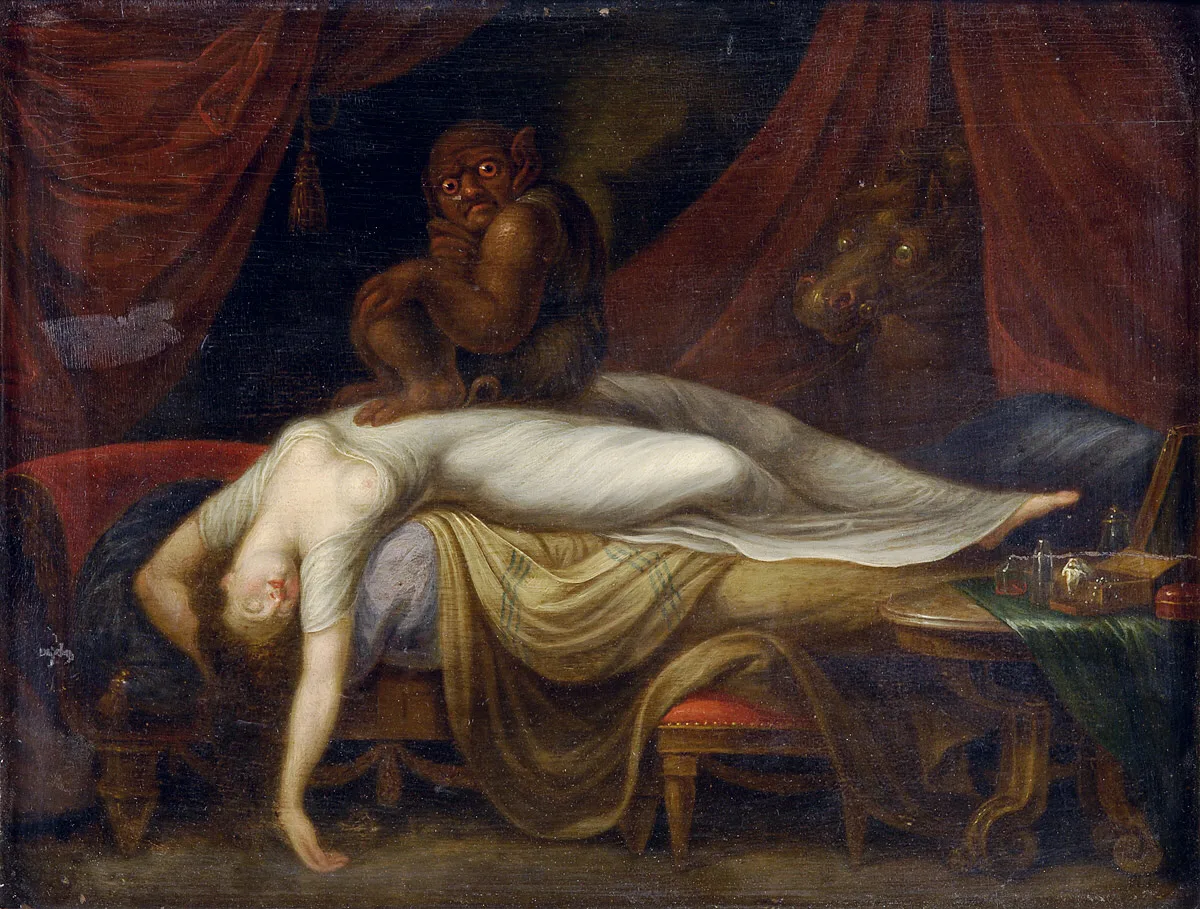
A 19th century version of Füssli's The Nightmare (1781)
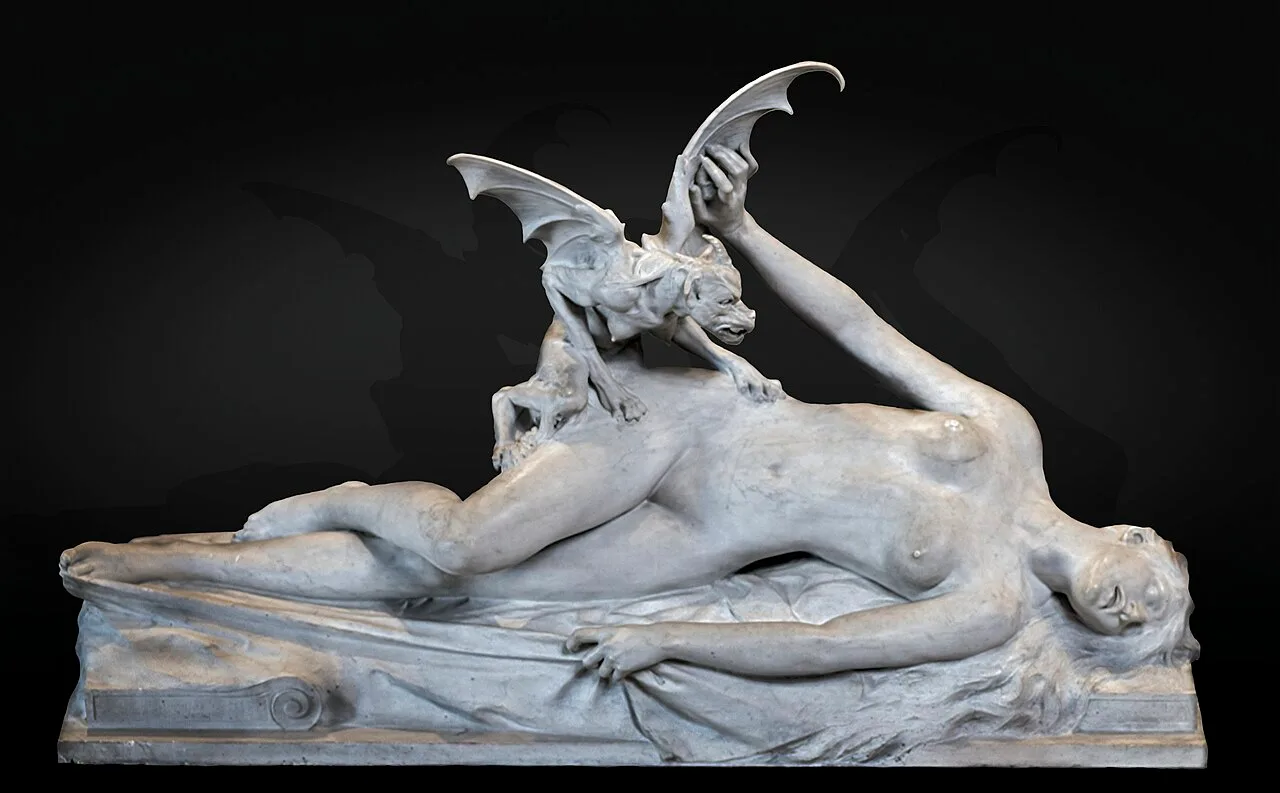
Le Cauchemar (The Nightmare), by Eugène Thivier (1894)
Sleep paralysis
Sleep paralysis is a state during waking up or falling asleep in which a person is conscious but completely paralyzed. Episodes may involve hallucinations and fear, generally lasting a few minutes.
Visual Tracking Behind Locked Limbs
Although sufferers feel entirely immobilized, the motor shutdown during an episode is not absolute. Electrooculogram (EOG) traces demonstrate that eye movements remain functional even while voluntary speech is suspended. This discrepancy occurs because cholinergic sleep "on" neural populations overpower serotonergic arousal signals, maintaining the physical atonia of REM sleep while conscious awareness returns.
From Wikipedia · CC BY-SA 4.0
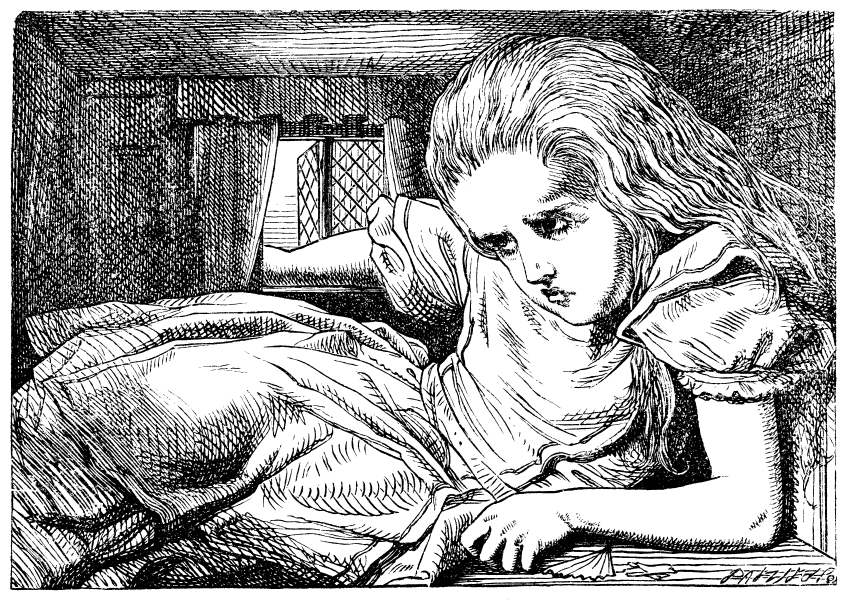
Illustration from Lewis Carroll's Alice's Adventures in Wonderland. Alice is positioned awkwardly with her weight supported partially by her left forearm, which rests on the floor and spans nearly half of the room's length. Her head is ducked beneath the low ceiling and her right arm reaches outside, resting on an open window's sill. The folds of Alice's dress occupy much of the remaining free space in the room.
Alice in Wonderland syndrome
Alice in Wonderland syndrome, also known as Todd's syndrome or dysmetropsia, is a neurological disorder that distorts perception.
Lucidity Amidst Severe Perceptual Illusion
Patients who experience dramatic somatic distortions do not lose their fundamental grip on reality. Unlike individuals undergoing psychotic episodes, people with Alice in Wonderland syndrome remain acutely aware that their hallucinations are sensory errors rather than physical facts. This cognitive lucidity helps clinicians differentiate the syndrome from primary psychiatric conditions during differential diagnosis.
From Wikipedia · CC BY-SA 4.0
An artist's representation of how some people may see phosphenes by retinal stimulation
Phosphene
A phosphene is the phenomenon of seeing light without light entering the eye.
Inverted Rings and Rubbed Eyes
Mechanical forces applied directly to the eye trick the visual system into seeing light without external illumination. Isaac Newton documented this by pressing the side of his eye, generating a colored ring of light on the opposite side. Such pressure activates retinal ganglion cells just as genuine light waves would. People also routinely experience similar flashes when sneezing, coughing deeply, or standing up too quickly.
From Wikipedia · CC BY-SA 4.0

CEV noise simulation

CEV noise simulation with multiple colors (Purple, Green, Yellow)

CEV noise simulation with multiple colors and flashing dot
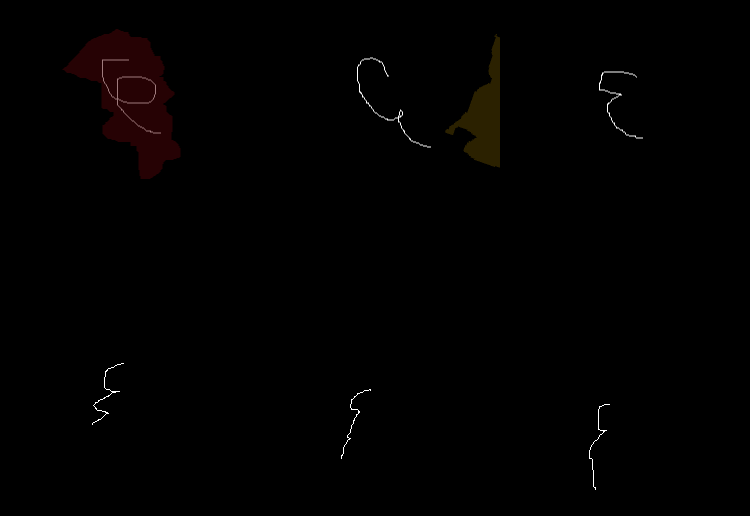
Level 3 CEV simulation without noise

CEV noise simulation with disappearing flashing image

Level 5 CEV simulation
Closed-eye hallucination
Closed-eye hallucinations and closed-eye visualizations (CEV) are hallucinations that occur when one's eyes are closed or when one is in a darkened room.
The Blood Filtered Beneath Eyelids
Even in ordinary waking consciousness, closing the eyes reveals an active field of visual noise rather than an unchanging void. In illuminated rooms, light penetrating the eyelids takes on a dark red hue after passing through blood vessels. With regular practice, actively observing this pointillistic motion allows it to linger as a translucent overlay on physical objects even after reopening the eyes.
From Wikipedia · CC BY-SA 4.0
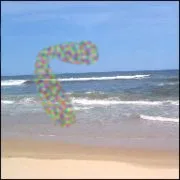
ScintillatingScotoma3
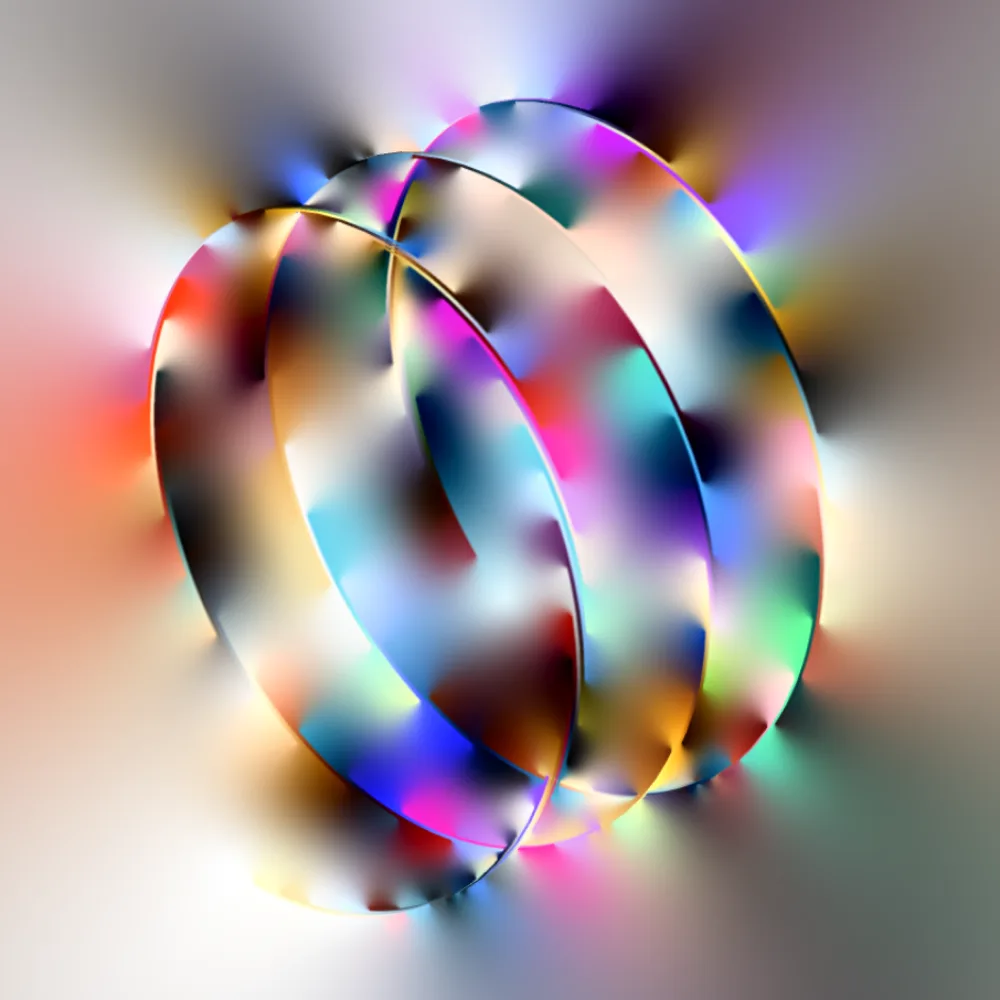
Still image from an artist's exploration that triggered in many viewers the visual experience of a migraine aura or scintillating scotoma.

Artist's depiction of a scintillating scotoma, exhibiting a flashing visual pattern similar to dazzle camouflage used during WWI.
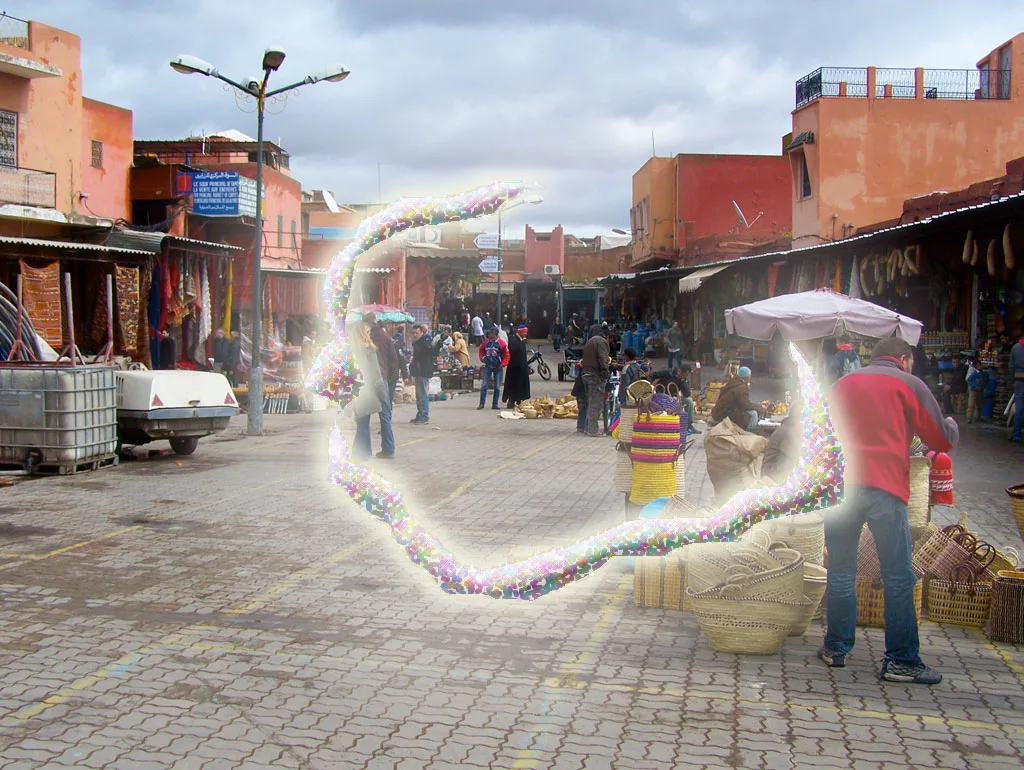
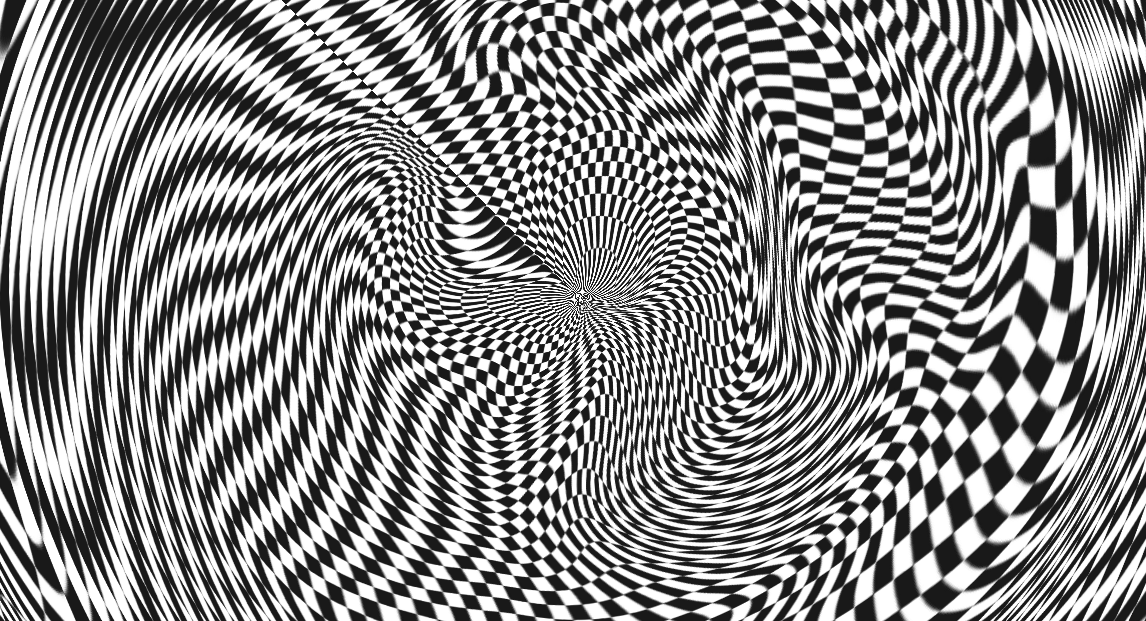
An artist's depiction of a scintillating scotoma with a bilateral arc

Flickering animation of a scintillating scotoma, where the scintillations were of a zigzag pattern starting in the center of vision, surrounded by a somewhat larger scotoma area with distortion of shapes but otherwise melting into the background similarly to the physiological blind spot

A depiction of a scintillating scotoma that was almost a spiral, with distortion of shapes but otherwise melting into the background similarly to the physiological blind spot. This depiction shows the type of patterning that some have described as similar to Widmanstätten patterns.
Scintillating scotoma
Scintillating scotoma is a visual aura originating from the brain that may precede a migraine headache or occur without one.
Occipital Cortex Origins Over Ocular Malfunction
Visual disruptions often lead individuals to assume their retinas or eyeballs have suffered damage. However, scintillating scotomas stem entirely from the abnormal functioning of the occipital cortex at the back of the brain. Because the neurological disruption is cerebral rather than ocular, it is classified as an entirely distinct disease from retinal migraine, which remains strictly monocular.
From Wikipedia · CC BY-SA 4.0

A hearing aid such as this one may be used to help alleviate MES in some patients.
Musical ear syndrome
Musical ear syndrome (MES) is a condition where people with hearing loss develop auditory hallucinations, often experiencing music or sounds without an external source.
Sensory Deprivation Fabricating Songs
When acquired deafness creates an acoustic void, the auditory cortex becomes hypersensitive due to sensory deprivation. Rather than remaining silent, the brain manufactures phantom music to plug this sensory deficit, mirroring how visual cortex strokes prompt hallucinated imagery. This neural release phenomenon causes sufferers to perceive internal fabrications as external musical sounds.
From Wikipedia · CC BY-SA 4.0