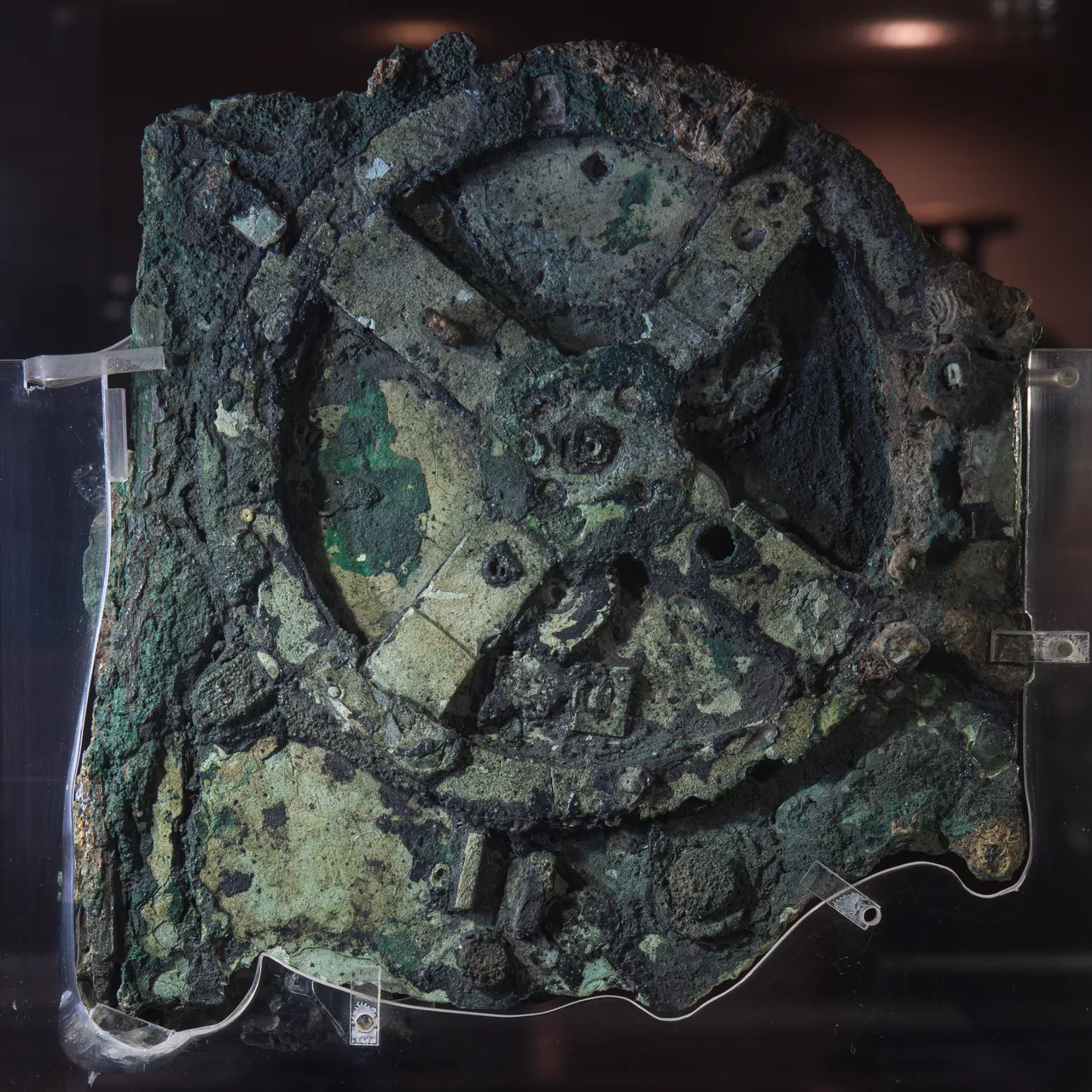
Antikythera Fragment A (Front)
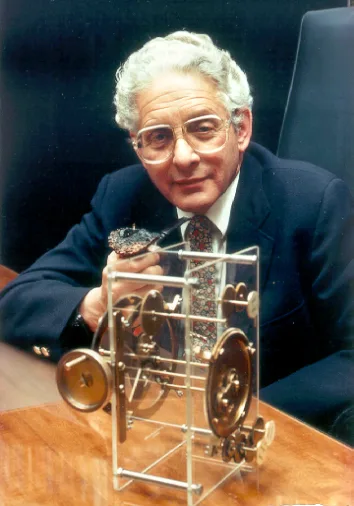
Derek J. de Solla Price (1922–1983) with a model of the Antikythera mechanism
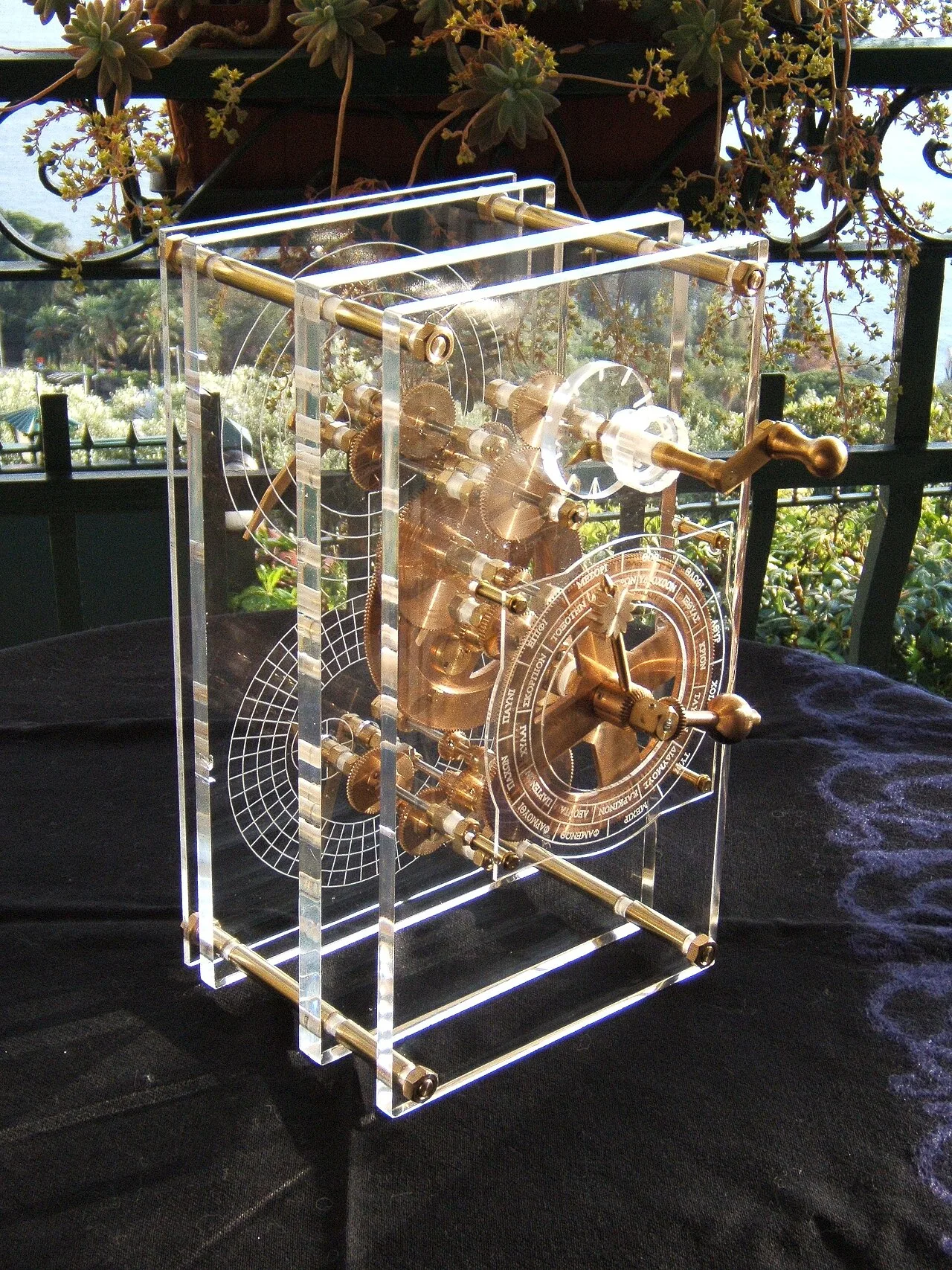
Front panel of a 2007 re-creation
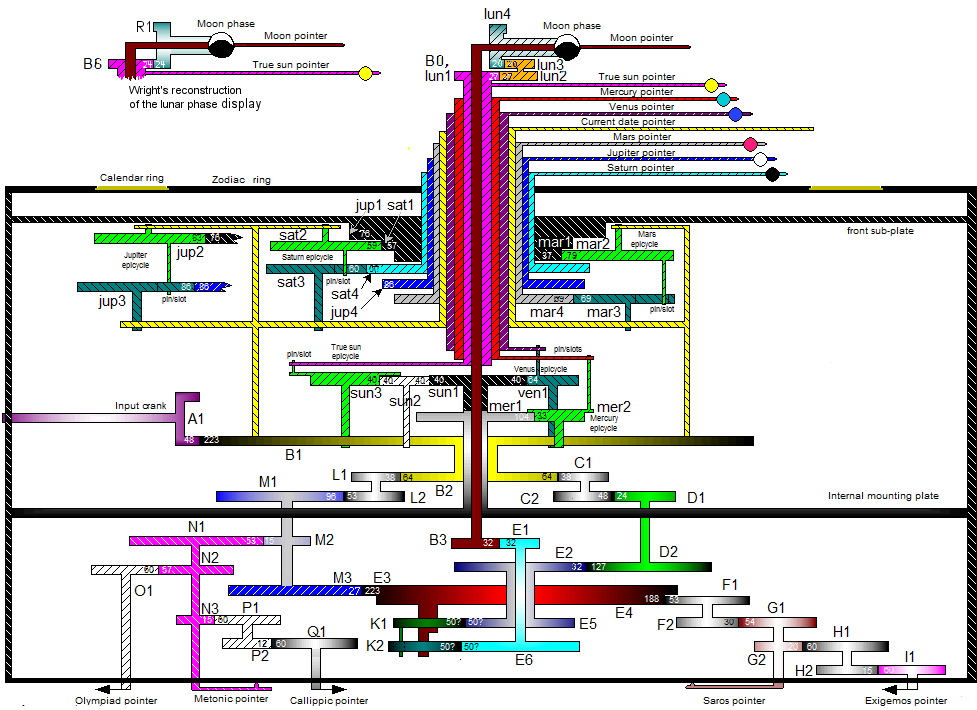
A hypothetical schematic representation of the gearing of the Antikythera Mechanism, including the 2012 published interpretation of existing gearing, gearing added to complete known functions, and proposed gearing to accomplish additional functions, namely true sun pointer and pointers for the five then-known planets, as proposed by Freeth and Jones, 2012.[7] Based also upon similar drawing in the Freeth 2006 Supplement[17] and Wright 2005, Epicycles Part 2.[80] Proposed (as opposed to known from the artefact) gearing crosshatched.
![2012 Freeth et al. proposal[7]](https://nwjvzop1xgplmzvt.public.blob.vercel-storage.com/wikifeed/antikythera-mechanism/4-c8ab91055c.webp)
2012 Freeth et al. proposal[7]
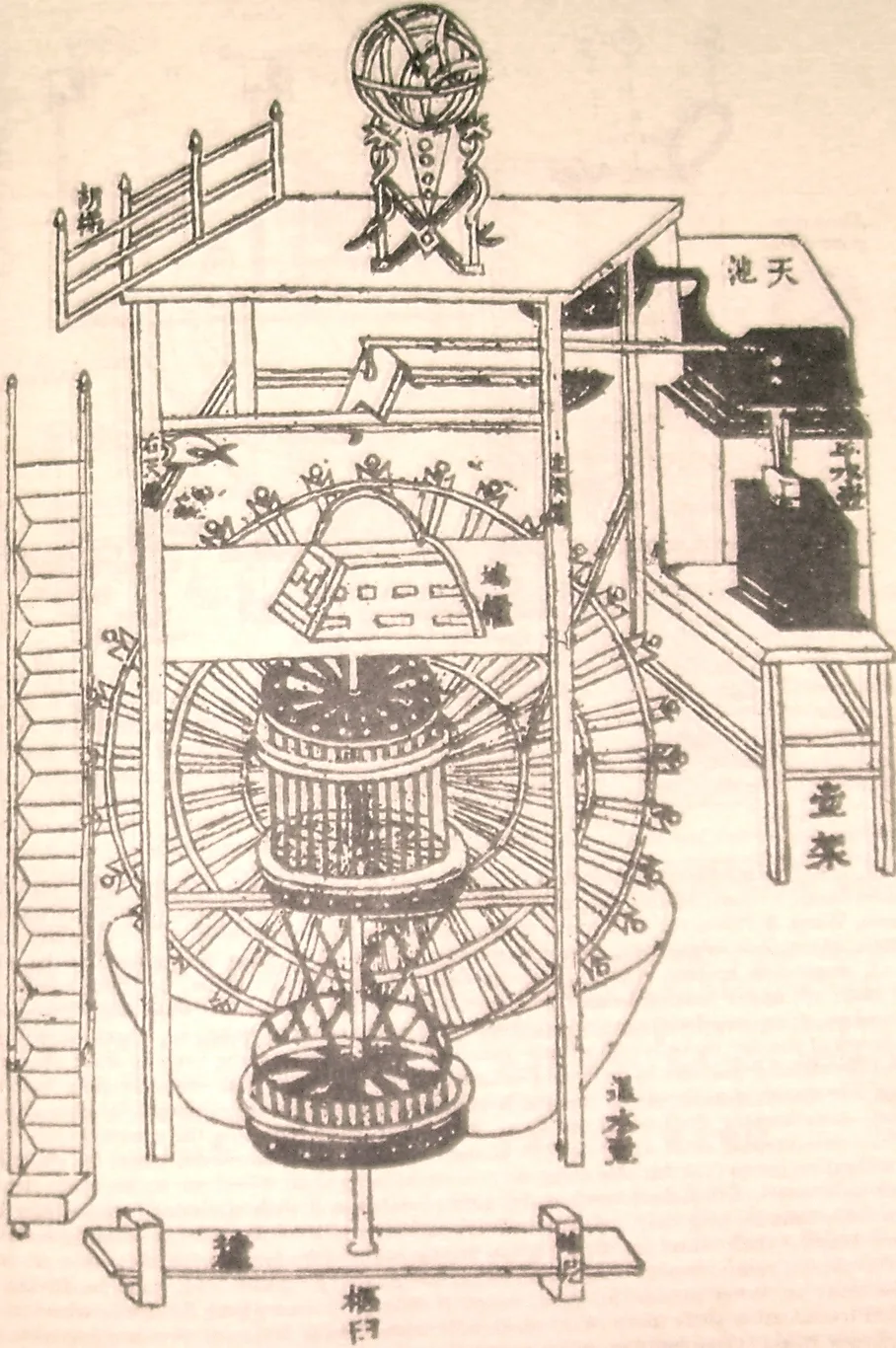
Su Song's Clock Tower
Antikythera mechanism
The Antikythera mechanism is an ancient Greek hand-powered orrery and the oldest known example of an analogue computer, built in the 2nd century BC and discovered in 1901.
The Anachronism in the Storage Room
When the corroded bronze lump arrived at the museum, curators initially ignored it while assembling more obvious statues. On 17 May 1902, archaeologist Valerios Stais and his cousin Spyridon Stais discovered a gear wheel embedded inside the fragment. Most scholars dismissed the artifact as prochronistic, believing the mechanical complexity was far too advanced for the era of the shipwreck.
From Wikipedia · CC BY-SA 4.0

An illustration of Hero's aeolipile

A classroom model of an aeolipile
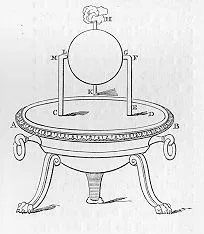
Illustration from Hero's Pneumatica
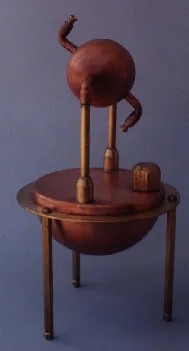
A modern replica of Hero's aeolipile.

A large reconstruction of Heron's aeolipile at Kotsanas Museum of Ancient Greek Technology in Athens, Greece.
Aeolipile
An aeolipile, also known as a Hero's engine, is a simple, bladeless radial steam turbine which spins when the central water container is heated.
A Ball Named for the Master of Winds
The name aeolipile combines the Ancient Greek name Aeolus and the Latin word pila to mean the ball of Aeolus. Named after the Greek god of the air and wind, the device functions as a bladeless radial steam turbine. Heating water in the central container creates pressurized steam jets that discharge through bent nozzles to spin the spherical vessel.
From Wikipedia · CC BY-SA 4.0

Executed example of a Heron's fountain in operation

Diagram of a functioning Heron's fountain

Simplified Heron's fountain principle

Halite fountain made by joining a half-bottle of dense liquid (dark blue) to a bottle of less dense liquid (light blue) with a spout.[3]

A reconstruction of Heron's fountain, at the Kotsanas Museum of Ancient Greek Technology, in Athens.
Heron's fountain
Heron's fountain is a hydraulic machine invented by 1st-century AD mathematician and physicist Heron of Alexandria. Today, it is used in physics classes to demonstrate principles of hydraulics and pneumatics.
Ancient Roots of Pneumatic Play
Ancient mechanics often evolved alongside whimsical entertainment rather than strictly industrial engineering. The 1st century AD inventor, mathematician, and physicist Heron of Alexandria studied air and steam pressure while crafting water-spurting toys alongside describing the first steam engine. Today, these historical devices serve as foundational classroom demonstrations of pneumatics and hydraulics.
From Wikipedia · CC BY-SA 4.0
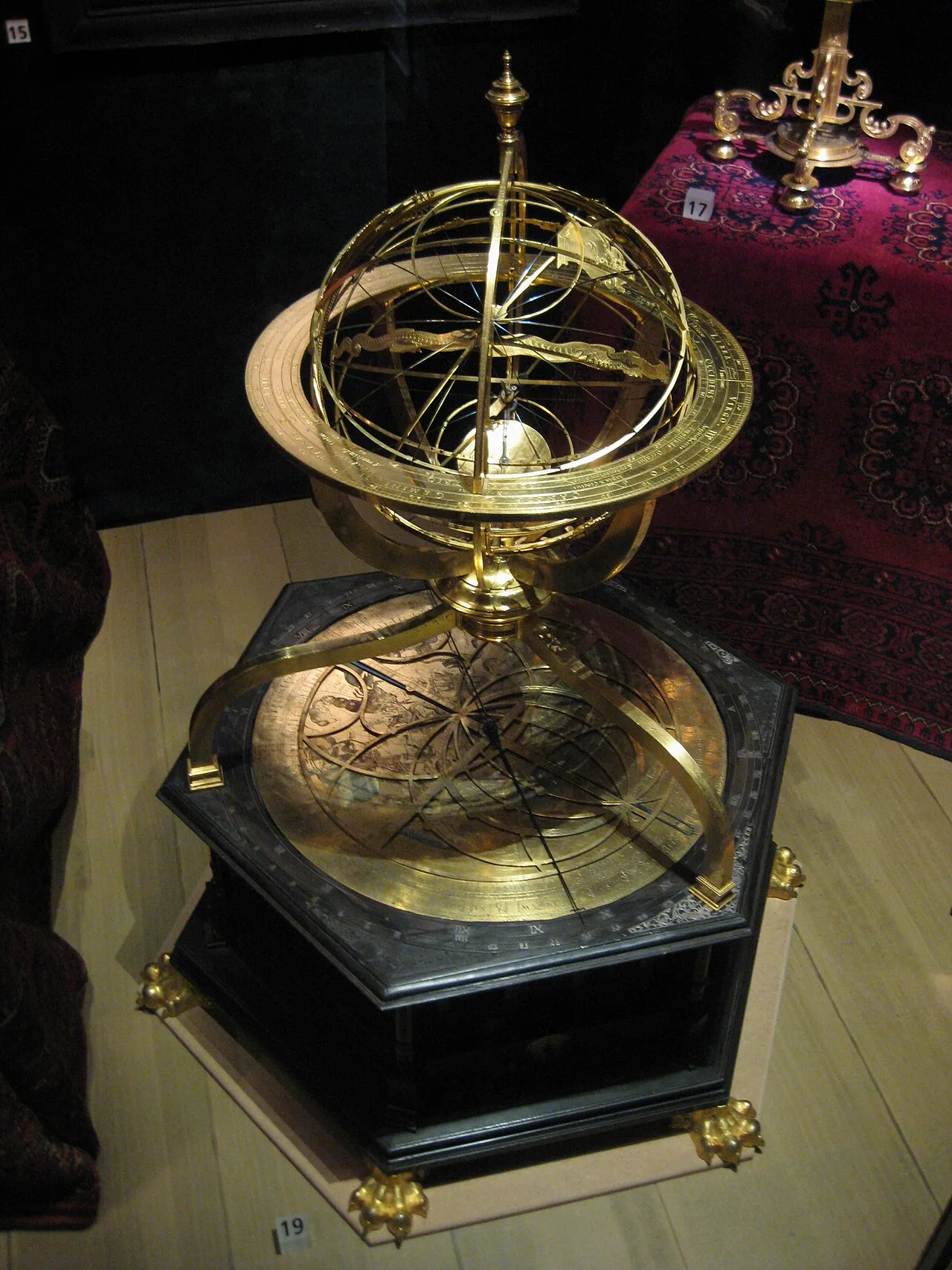
Jost Bürgi and Antonius Eisenhoit: Armillary sphere with astronomical clock, made in 1585 in Kassel, now at Nordiska Museet in Stockholm

Chinese Armillary sphere at Beijing Capital International Airport Ziwei Chenheng Aug-2010
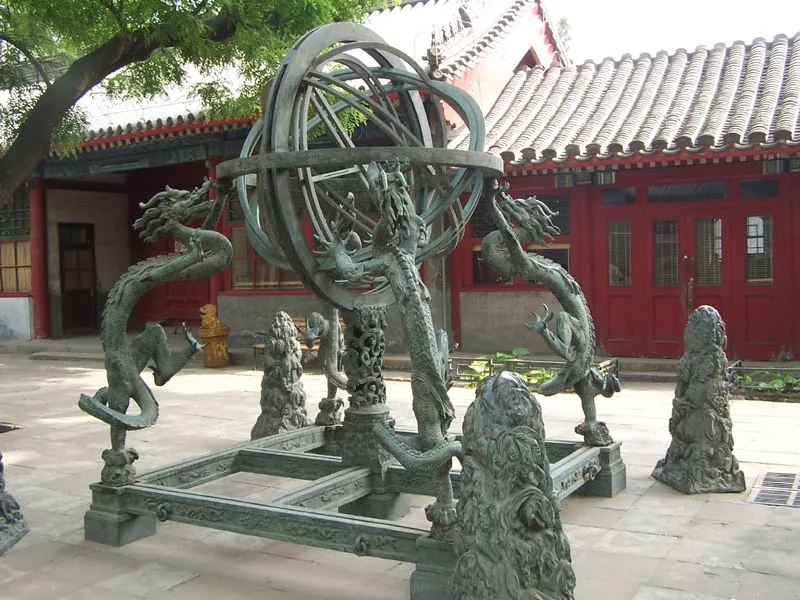
Armillary sphere at Beijing Ancient Observatory, replica of an original from the Ming dynasty

Armillary sphere at the Garh Palace, Kota

Tycho Brahe's zodiacal armillary sphere, from his Astronomiae Instauratae Mechanica (Wandesburg, 1598), p. 36.

Allegory of the Arts, by Francesco de Mura, c. 1750
Armillary sphere
An armillary sphere is a model of objects in the sky consisting of a spherical framework of rings, centered on Earth or the Sun, representing celestial longitude, latitude, and features such as the ecliptic.
Two Cosms in One Crank
Rather than enforcing a single astronomical dogma, complex armillary spheres could demonstrate two opposing cosmological frameworks through simple gear selection. Engaging the winch on one axis held the terrestrial globe stationary while the celestial framework rotated around it to model apparent celestial motion. Shifting the winch to another axis rotated the earth while keeping the sun and moon at rest, proving both real and apparent motions produce identical horizon risings.
From Wikipedia · CC BY-SA 4.0
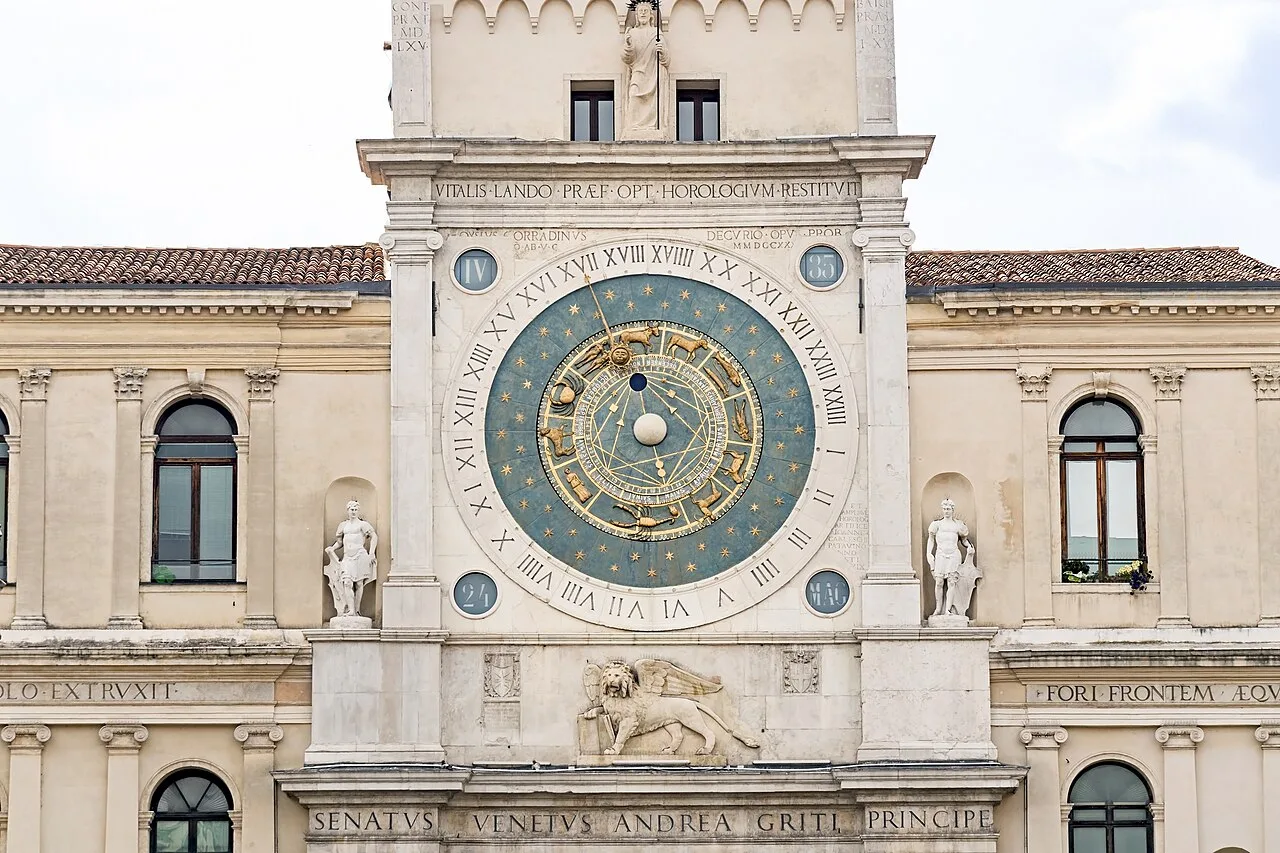
Astronomical clock by Novello Dondi Padova
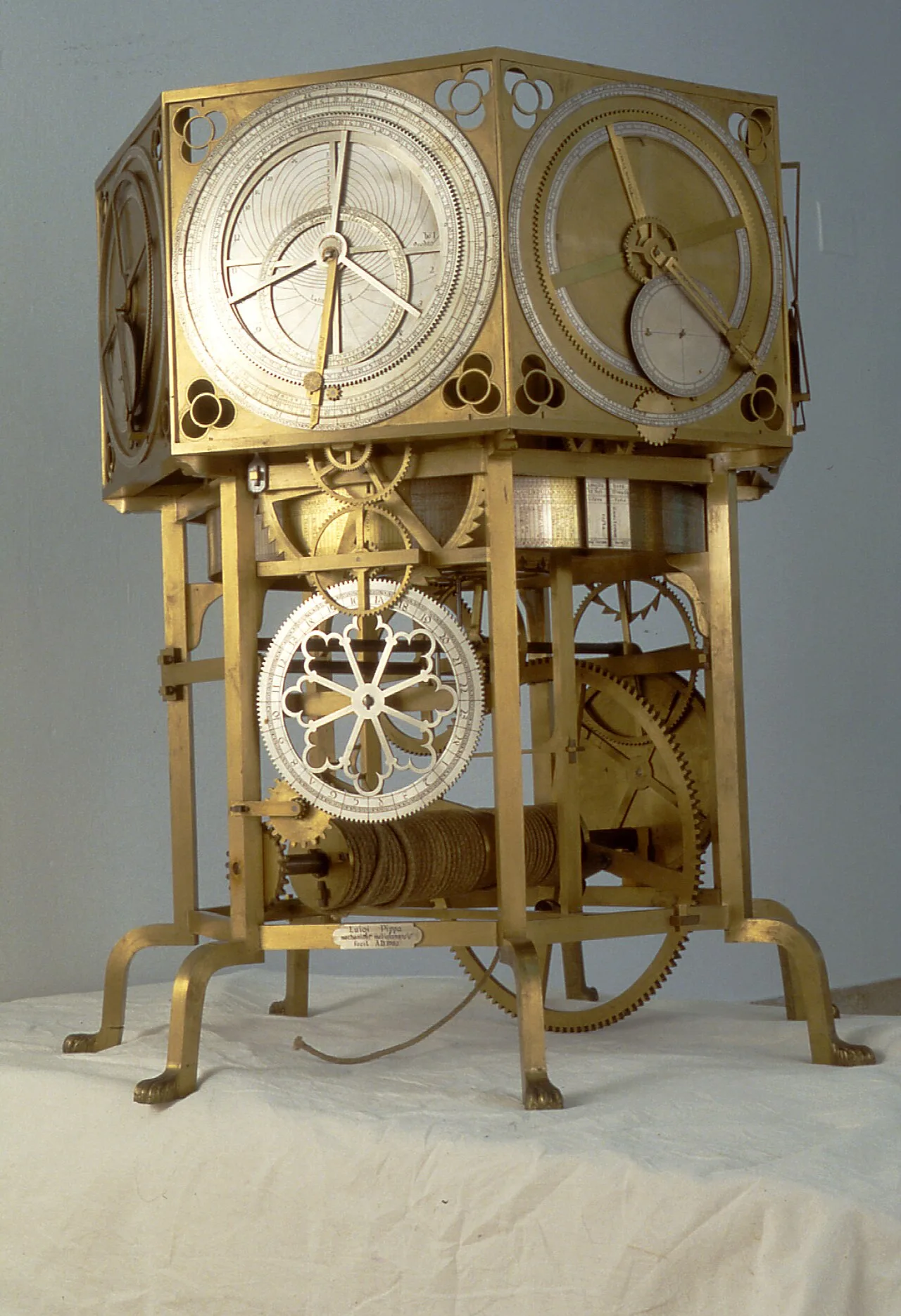
The astrarium made by the Italian astronomer and physician Giovanni Dondi dell'Orologio showed the hour, the yearly calendar, and the movement of the planets, Sun and Moon.Above is a modern reconstruction in the Museo Nazionale Scienza e Tecnologia Leonardo da Vinci in Milan, Italy; it is about three feet high.
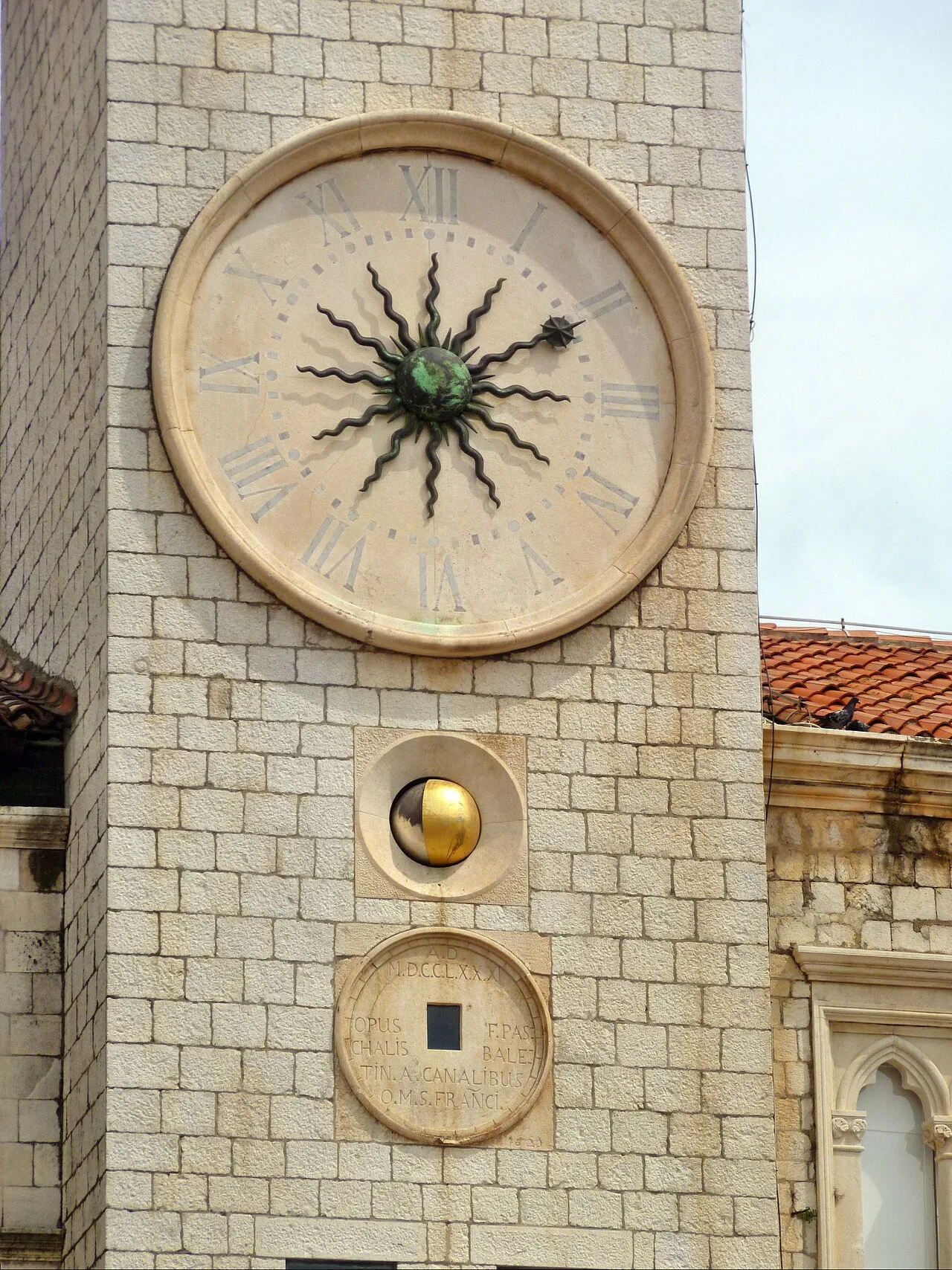
Dubrovnik
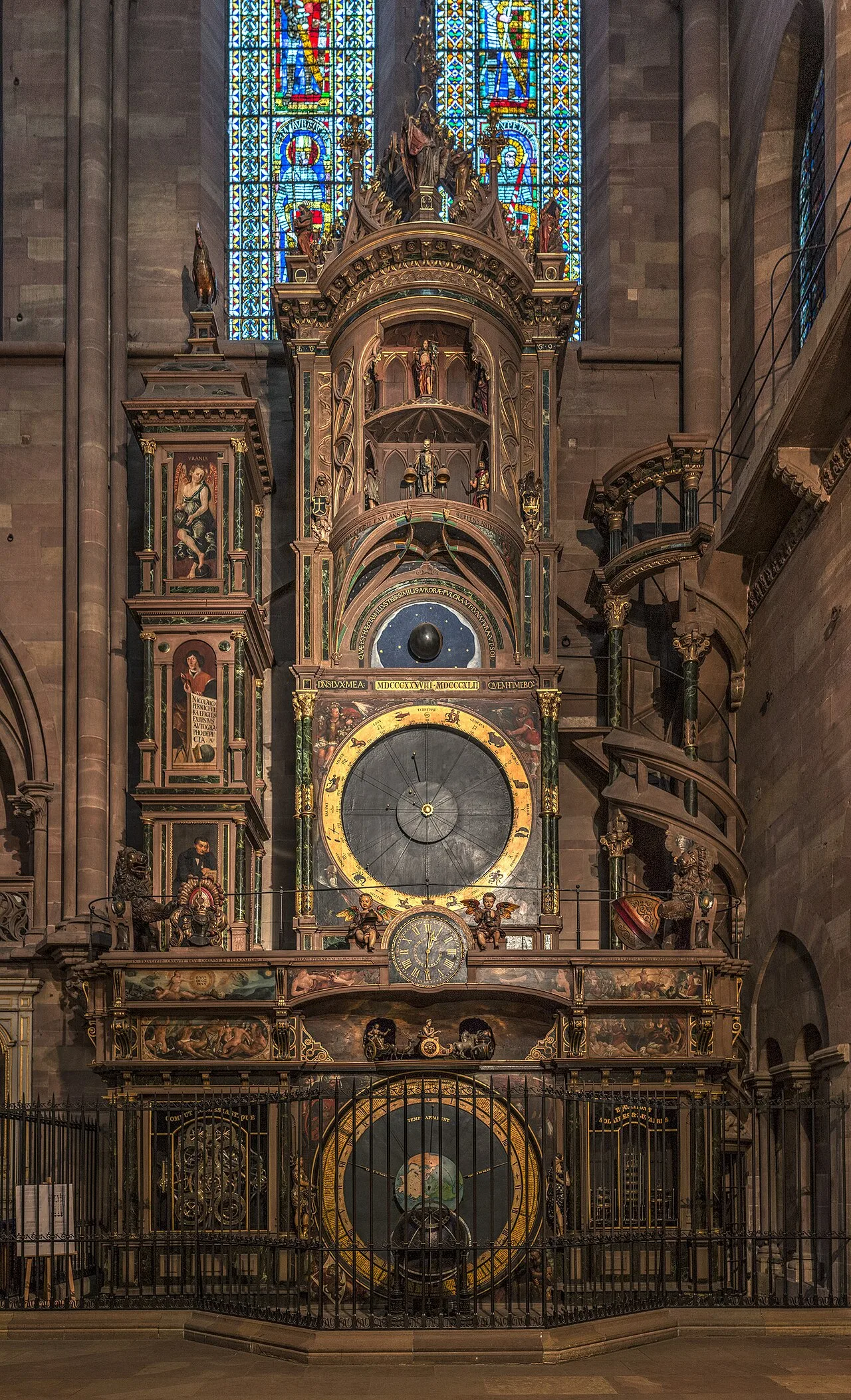
Strasbourg astronomical clock in Strasbourg Cathedral

Padua

Nottebäck church clock
Astronomical clock
An astronomical clock is a clock with special mechanisms and dials to display astronomical information, such as the relative positions of the Sun, Moon, zodiacal constellations, and major planets.
Cosmic Modeling Before Timekeeping
Mechanical clocks were not originally conceived as practical timekeepers, but rather as moving models of the cosmos. As historian Lynn White Jr. of Princeton University observed, early European mechanisms were designed as monumental exhibitions of cosmic patterns rather than everyday chronometers. This heritage connects medieval clockwork directly back to the Antikythera mechanism, an ancient analog computer developed as a precursor to astronomical clocks.
From Wikipedia · CC BY-SA 4.0
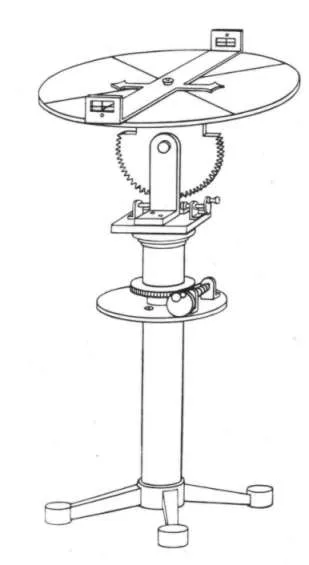
Graphic reconstruction of the dioptra, by Venturi, in 1814. (An incorrect interpretation of Heron's description)
Dioptra
A dioptra is a classical astronomical and surveying instrument dating from the 3rd century BC, consisting of a sighting tube or a rod with a sight at both ends attached to a stand.
Mapping Constellations with Sighting Tubes and Protractors
Greek astronomers first utilized the dioptra in the 3rd century BC as a precision instrument to chart celestial bodies. Both Euclid and Geminus referenced the device in their astronomical treatises. By aligning a sighting tube or double-ended rod with stars, observers could read specific angles off attached protractors. This transformed observational stargazing into a quantified geometric science.
From Wikipedia · CC BY-SA 4.0
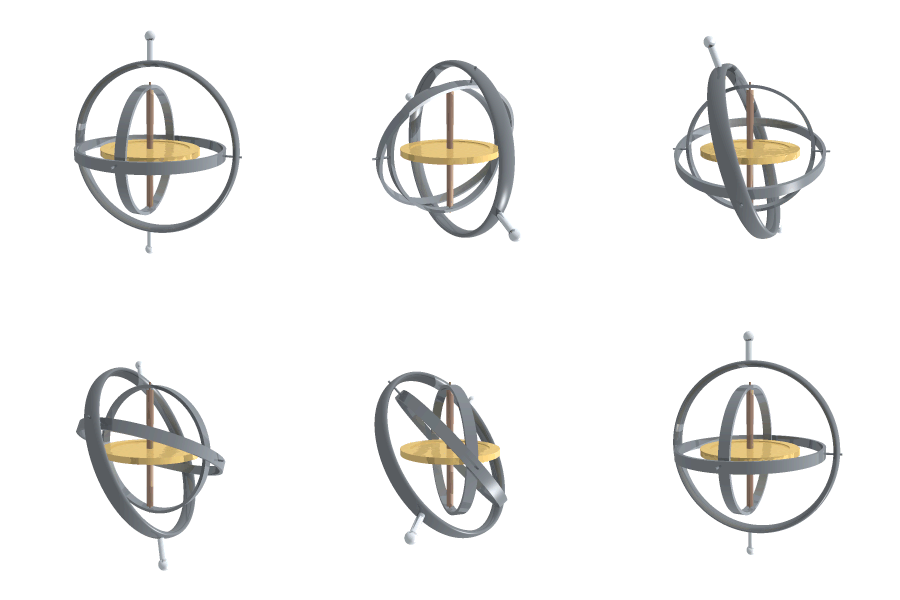
Illustration of a simple three-axis gimbal set; the center ring can be vertically fixed
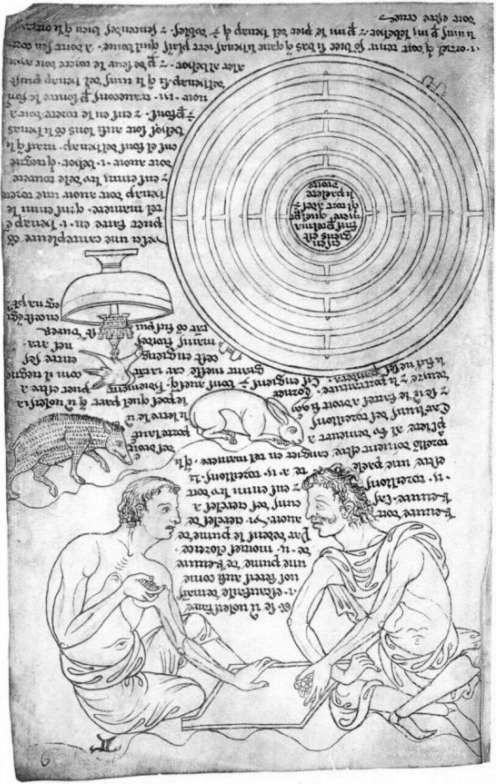
Cardan suspension in Villard de Honnecourt's sketchbook (ca. 1230)
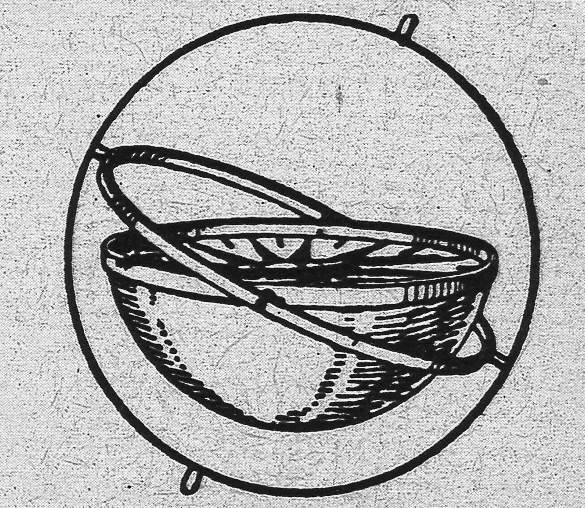
Early modern dry compass suspended by gimbals (1570)
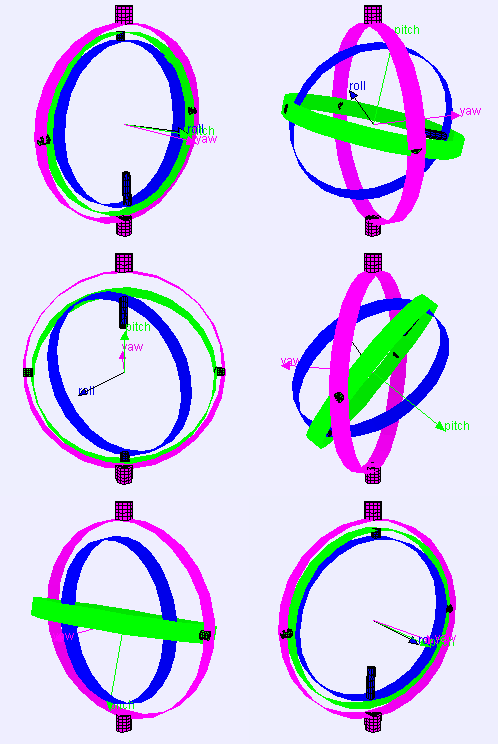
In a set of three gimbals mounted together, each offers a degree of freedom: roll, pitch and yaw
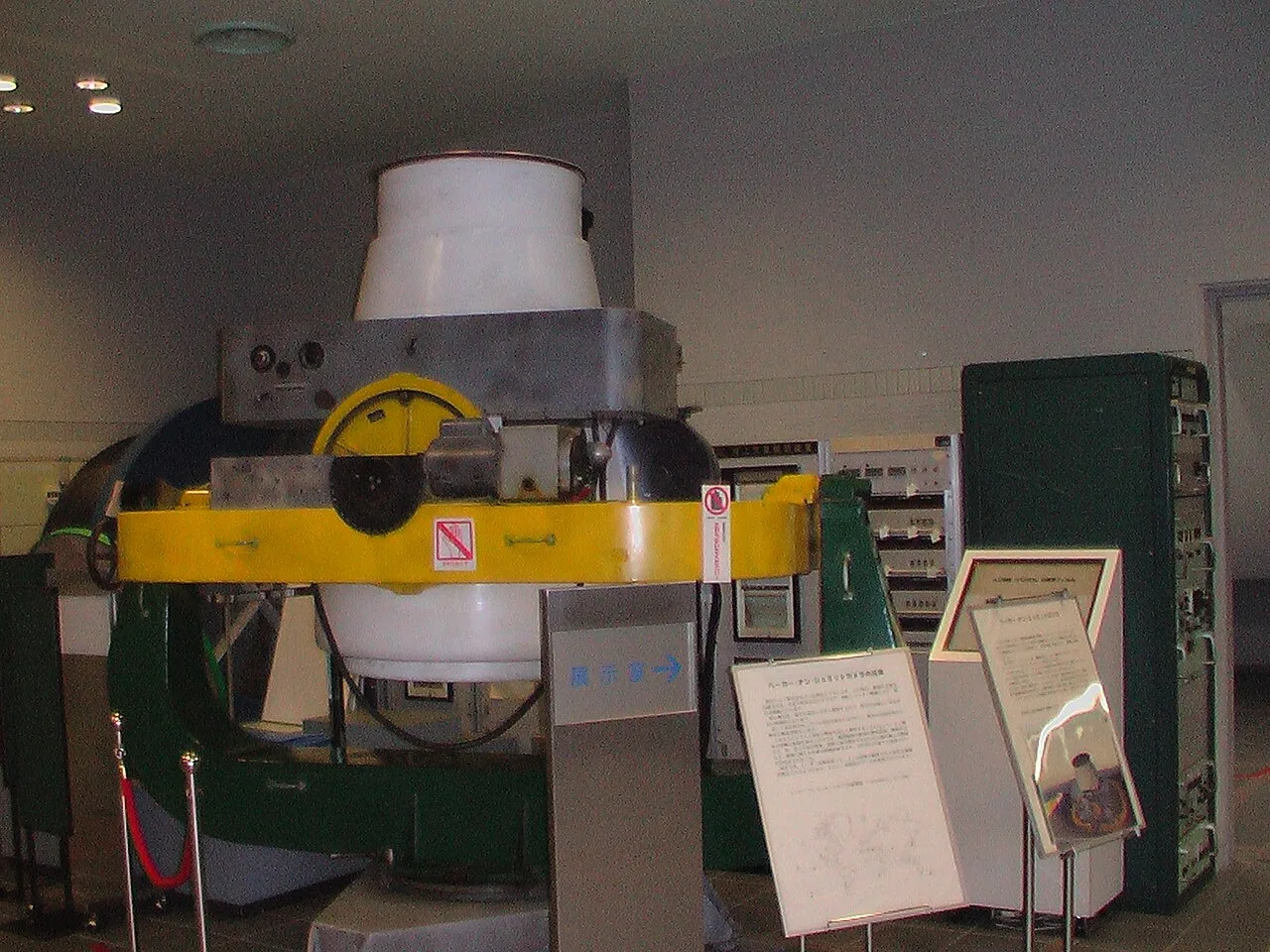
A Baker-Nunn satellite-tracking camera on an altitude-altitude-azimuth mount
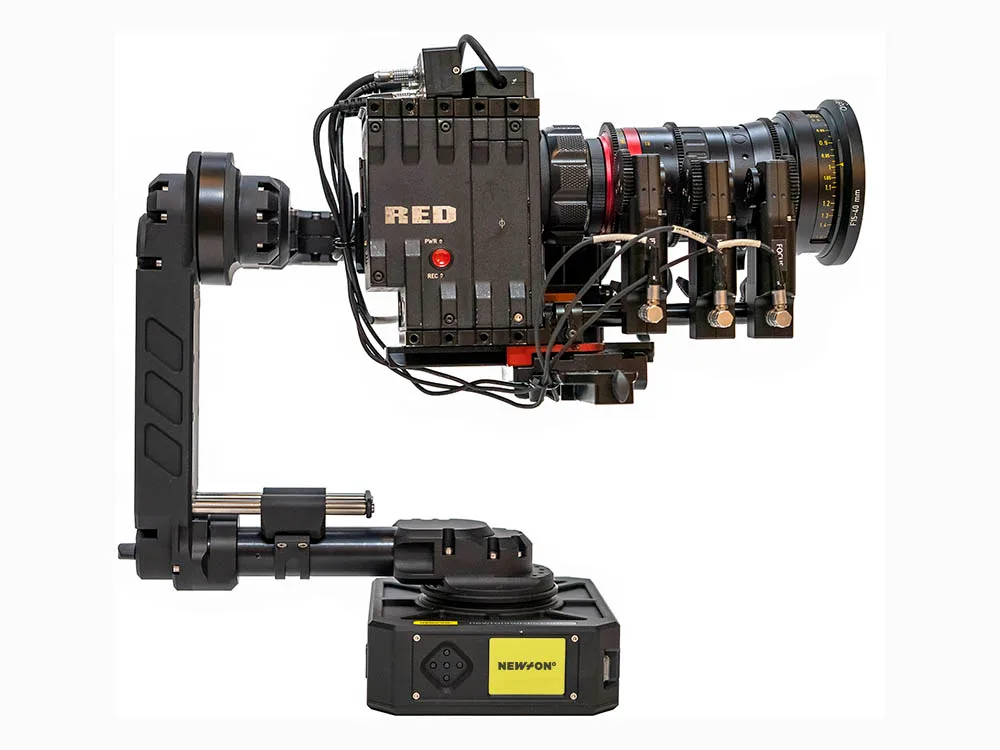
NEWTON S2 gimbal for remote control and 3-axis stabilization of a RED camera, Teradek lens motors and Angénieux lens
Gimbal
A gimbal is a pivoted support that permits rotation of an object about an axis.
The Misattributed Italian Eponym and an Ancient Greek Ink Pot
The Cardan suspension takes its name from Gerolamo Cardano (1501–1576), yet the Italian mathematician never claimed to have invented the device. Centuries earlier, Philo of Byzantium described an eight-sided ink pot with openings on every face. Suspended by concentric metal rings at its center, the inkwell stayed upright regardless of how the vessel was turned, allowing a pen to be dipped without any ink spilling out.
From Wikipedia · CC BY-SA 4.0

The gnomon is the triangular blade in this sundial.

A gnomon as in Euclid book II
![Invariant snail in the subtraction of gnomons (Hero's definition)[3]](https://upload.wikimedia.org/wikipedia/commons/c/c7/Chiocciola30s9m.gif?utm_source=en.wikipedia.org&utm_campaign=imageinfo&utm_content=thumbnail_unscaled)
Invariant snail in the subtraction of gnomons (Hero's definition)[3]

The gnomon projection on the floor of the Santa Maria del Fiore Cathedral during the solstice on 21 June 2012

Gnomon situated on the wall of a building facing Tiradentes Square, Curitiba, Brazil

Gnomon in use on the moon during Apollo 15
Gnomon
A gnomon is the part of a sundial that casts a shadow. The term is used for a variety of purposes in mathematics and other fields, typically to measure directions, position, or time.
Painted Taosi Sticks and Calendar Construction
Ancient Chinese astronomers turned simple shadows into navigational and calendrical tools over four millennia ago. Excavations at the archeological site of Taosi revealed a painted stick dating to 2300 BC, making it the oldest known gnomon in China. Subsequent generations used these shadow measurements across the second millennium BC onward to establish seasonal changes, calculate geographical latitude, and guide orientation.
From Wikipedia · CC BY-SA 4.0
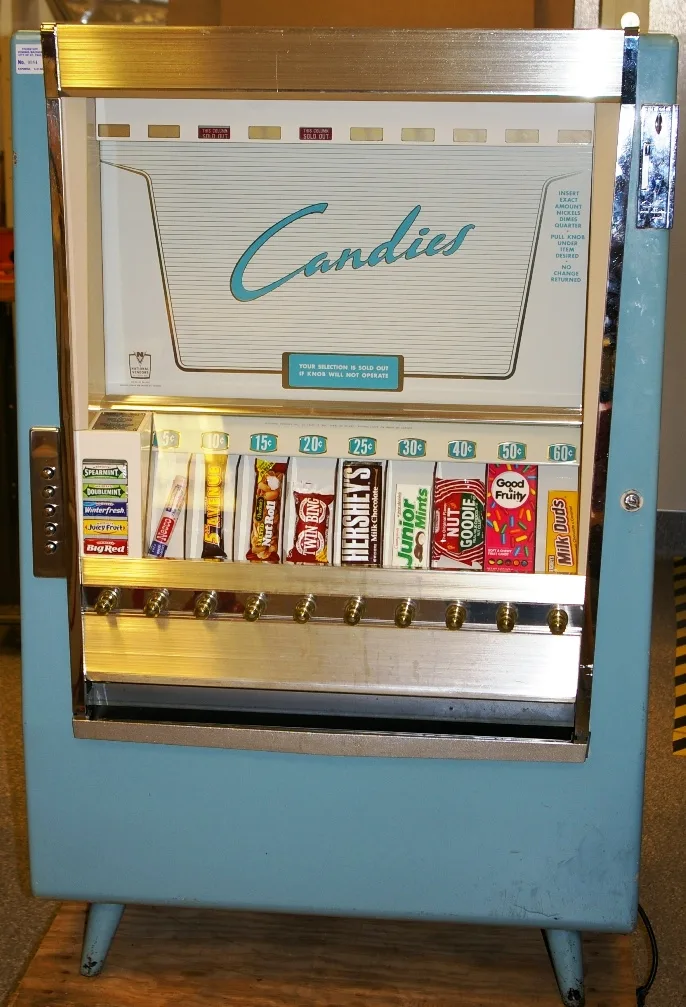
A snack food vending machine made in 1952
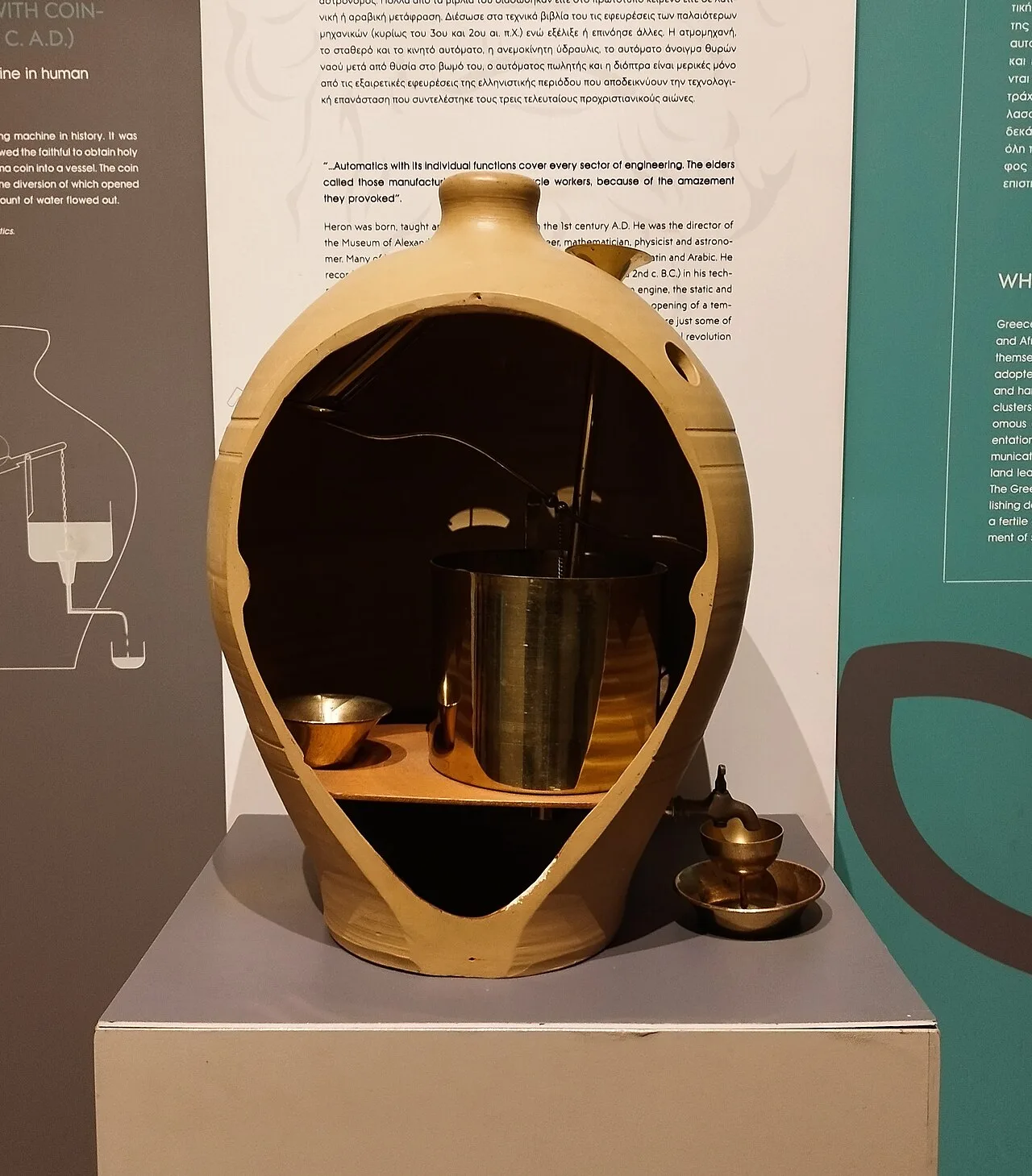
A reconstruction of an ancient vending machine in Kotsanas Museum of Ancient Greek Technology, Athens, Greece
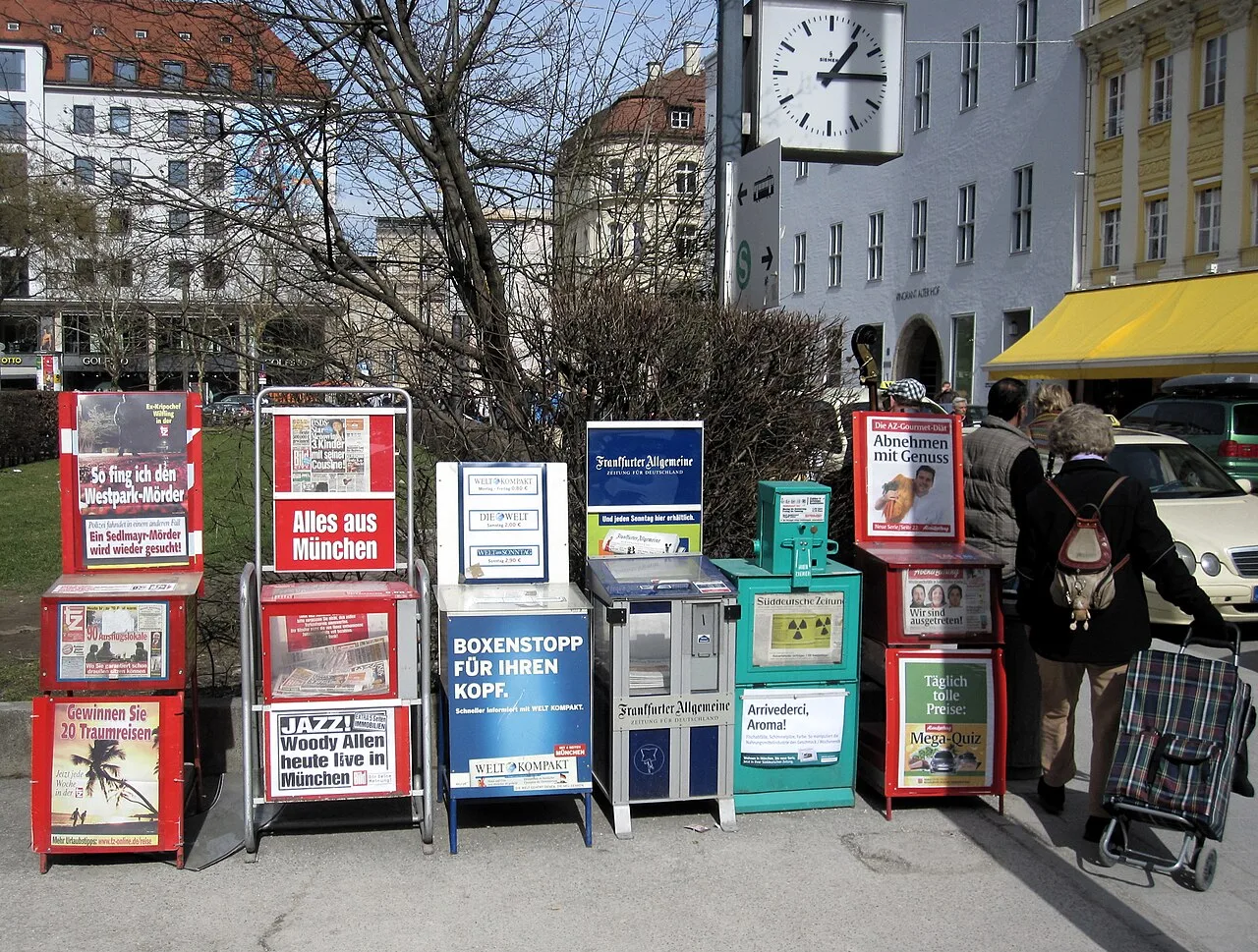
Newspaper vending machines in Munich
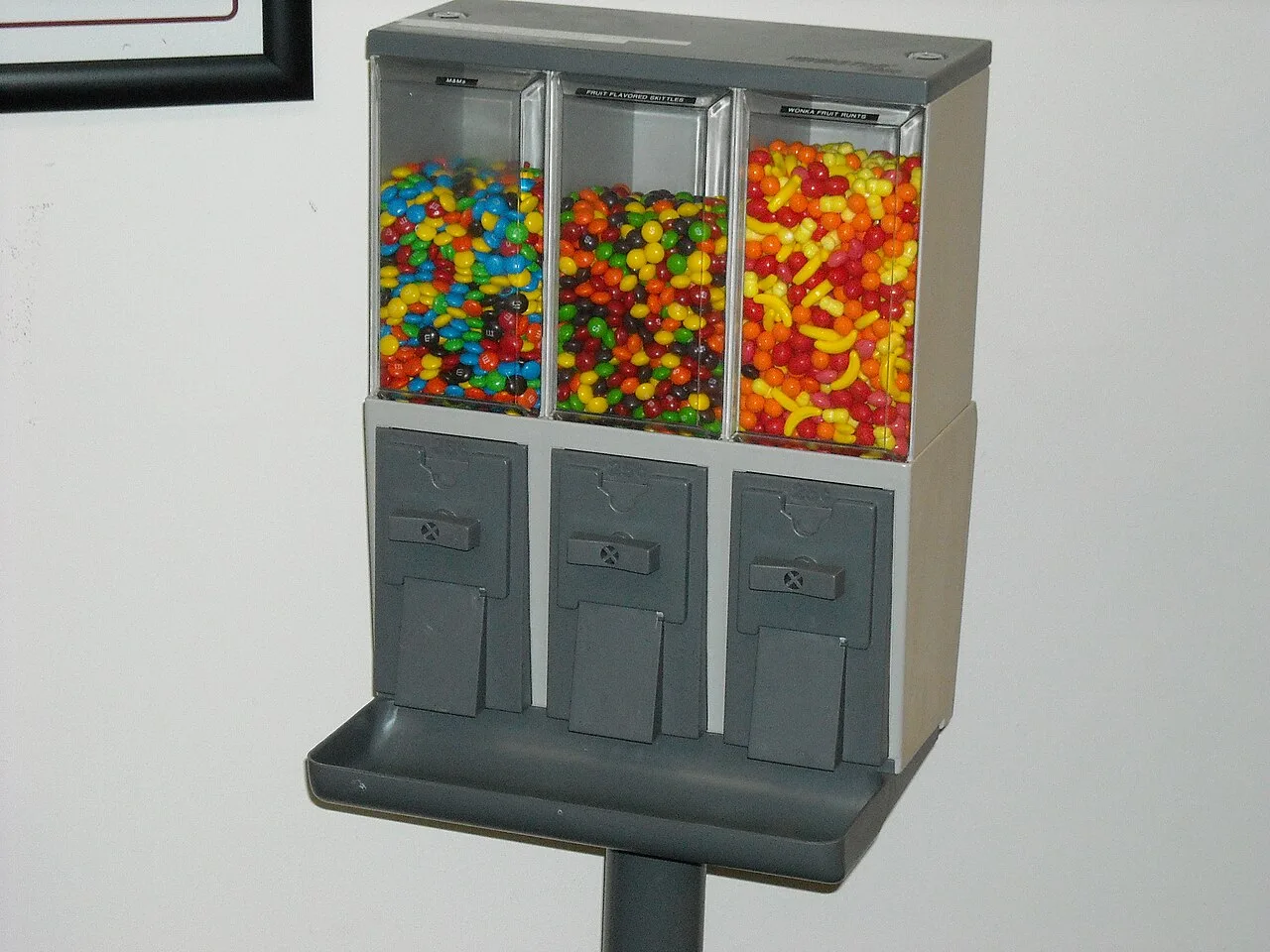
Bulk vending: a bulk candy machine containing M&M's, Skittles, and Runts

The Biblio-Mat book vending machine

A prize vending machine in Haikou, Hainan, China
Vending machine
A vending machine is an automated machine that dispenses items such as snacks, beverages, cigarettes, and lottery tickets to consumers after cash, a credit card, or other forms of payment are inserted.
Sanctified Fluid Dispensed by Counterweight Levers
Automated commerce originated in the ancient world as a mechanism for dispensing ritual liquids. In 1st century AD Roman Egypt, the mathematician Hero of Alexandria engineered a device that distributed wine or holy water. A dropped coin fell onto an interior pan, depressing a lever that opened a valve until the coin slid off. This counterweight mechanism established the fundamental mechanical principles of automated vending millennia before modern electronics.
From Wikipedia · CC BY-SA 4.0
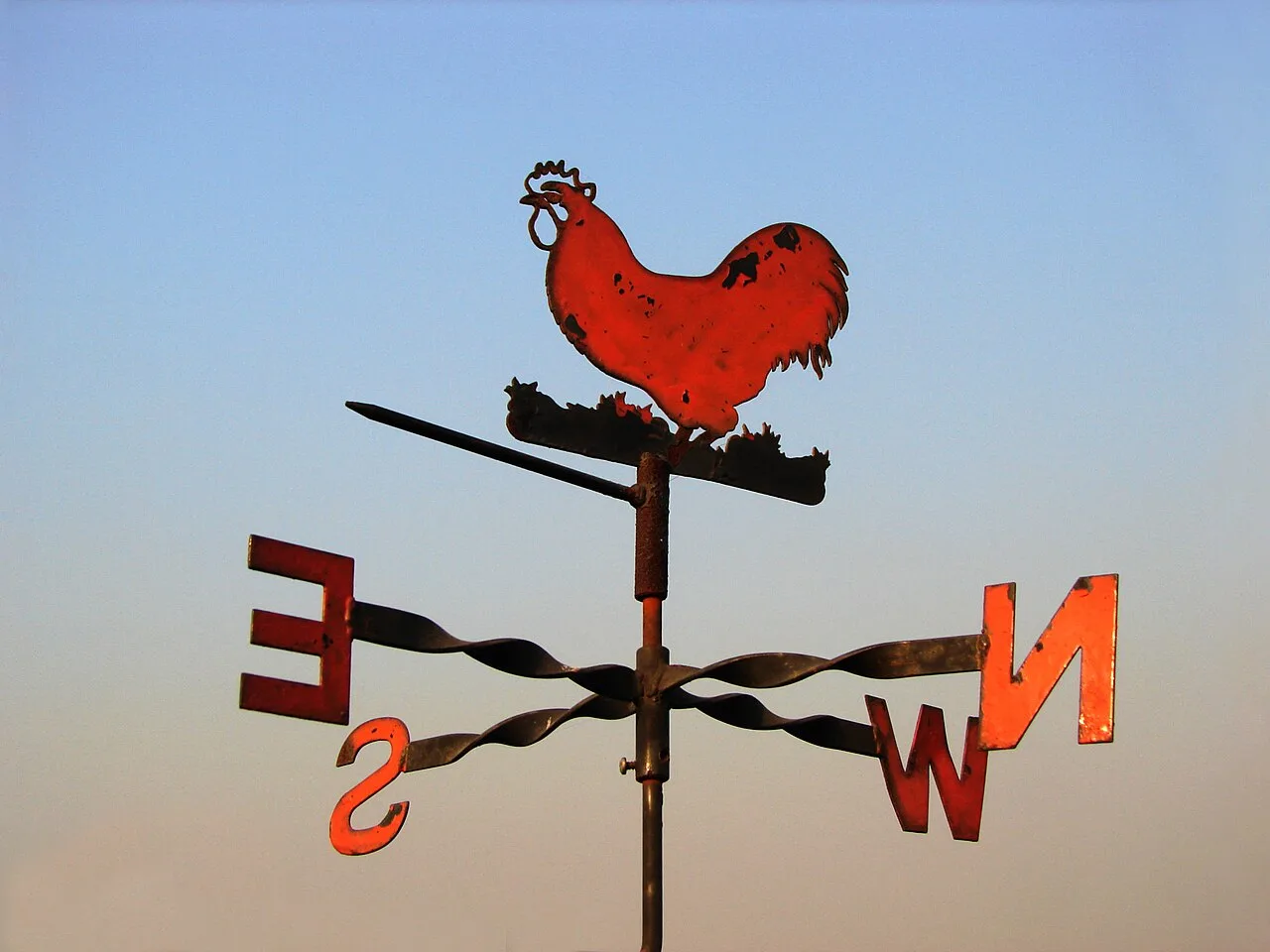
A cockerel is a traditional figure used as a vane placed on top of the cardinal directions.
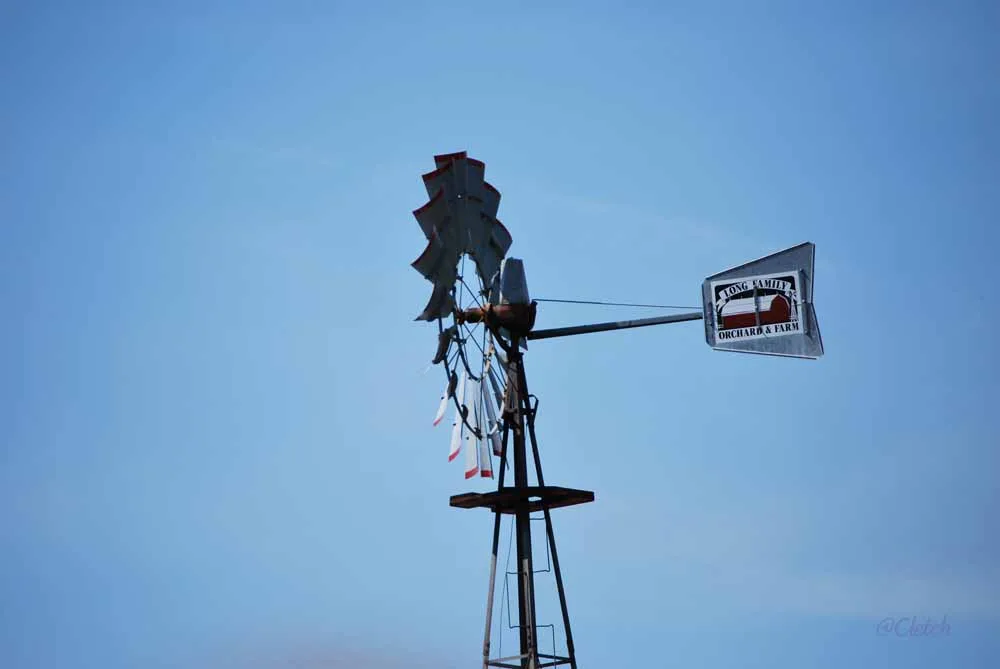
Wind vanes feature on small horizontal-axis wind turbines
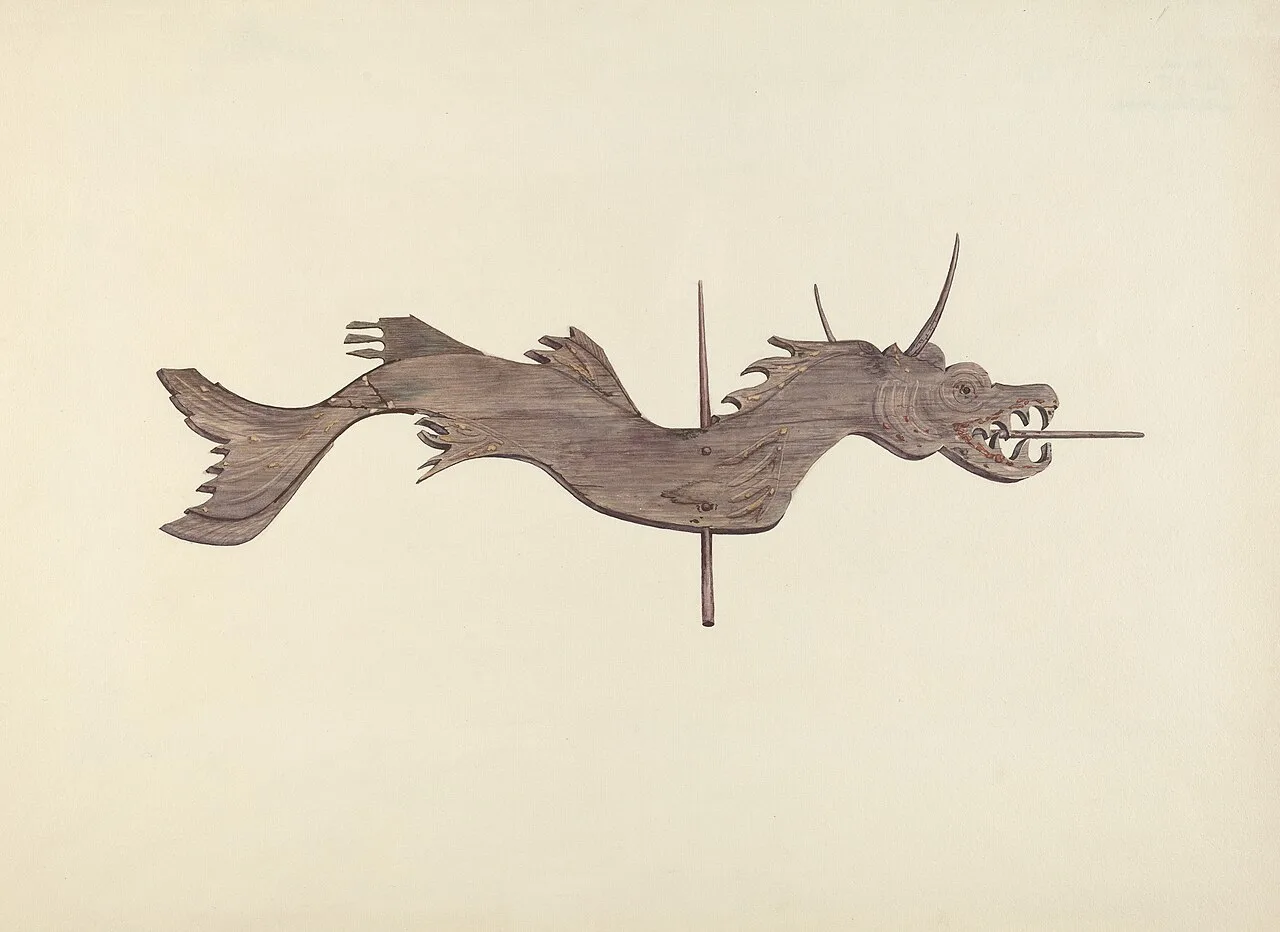
Dragon weather vane from the Index to American Design, National Gallery of Art.
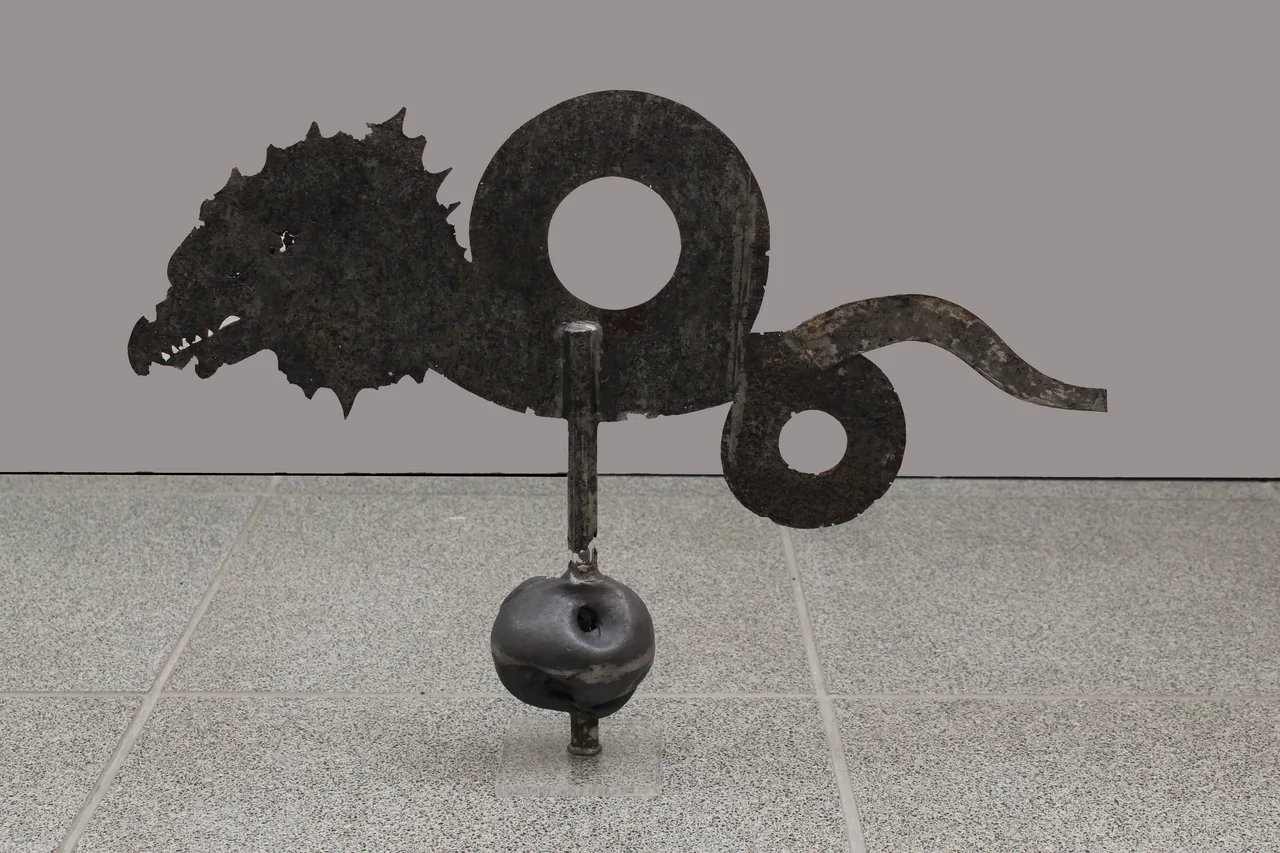
Creuë gibbet weather vane dating from the 17th century (France)
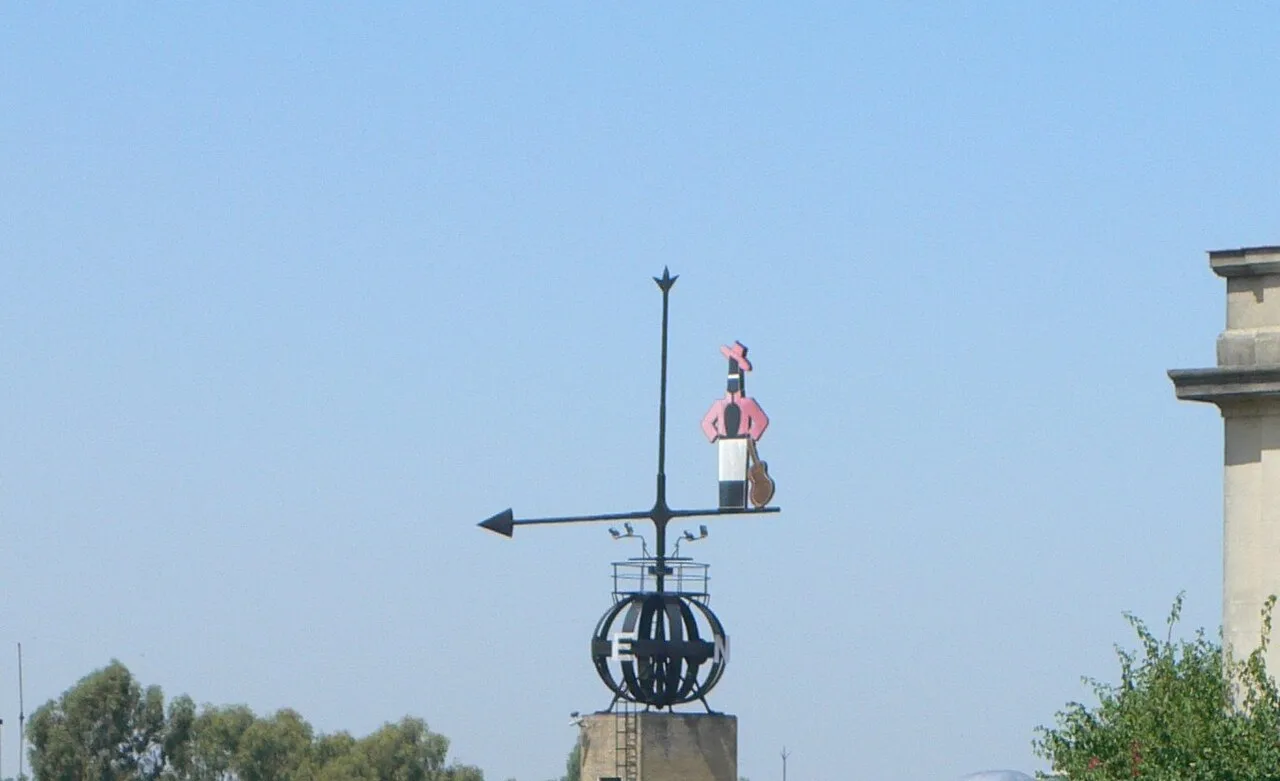
Tío Pepe weather vane in Jerez, Guinness world record of the largest weather vane that works
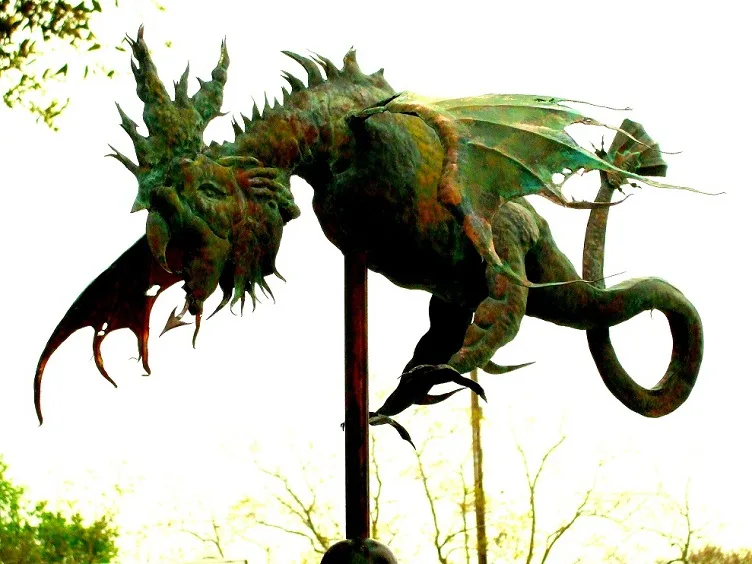
Weathercock with verdigris patina
Weather vane
A wind vane, weather vane, or weathercock is a type of anemoscope used for showing the direction of the wind, typically used as an architectural ornament at the highest point of a building.
Classical Horology Integrated with Wind Direction
In Hellenistic Athens, wind monitoring was integrated into civic timekeeping on an architectural scale. Built around 50 BC, the eight-metre-high Tower of the Winds featured a bronze Triton weather vane holding a rod to indicate changing directions. Below this figure, friezes portrayed eight Greek wind deities, while the structure simultaneously functioned as a timepiece using exterior sundials and an interior water clock.
From Wikipedia · CC BY-SA 4.0