![The elephant clock in a manuscript by Al-Jazari (1206 AD) from The Book of Knowledge of Ingenious Mechanical Devices.[1]](https://nwjvzop1xgplmzvt.public.blob.vercel-storage.com/wikifeed/elephant-clock/0-675478677c.webp)
The elephant clock in a manuscript by Al-Jazari (1206 AD) from The Book of Knowledge of Ingenious Mechanical Devices.[1]
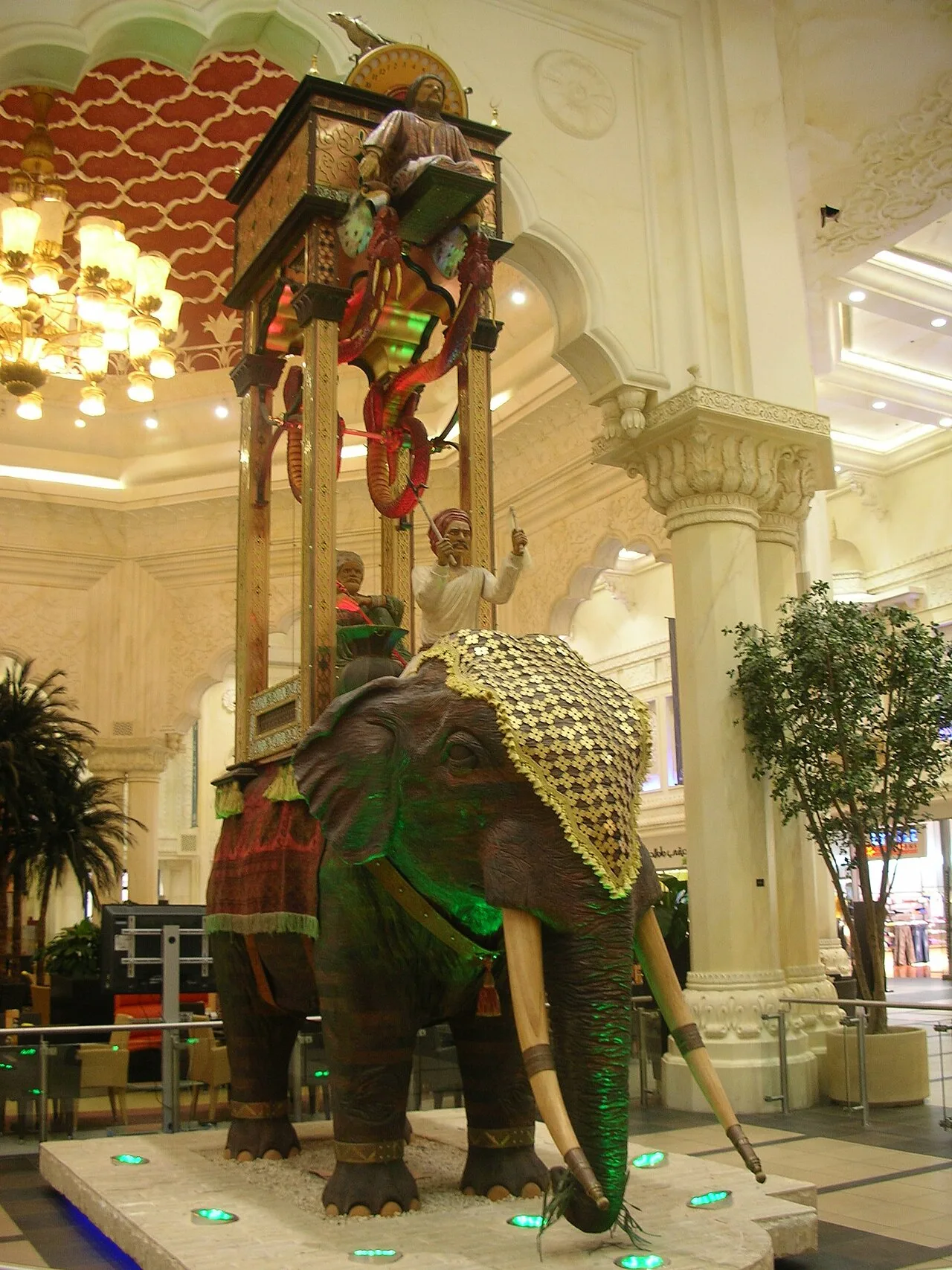
A reproduction of the elephant clock in the Ibn Battuta Mall, Dubai.
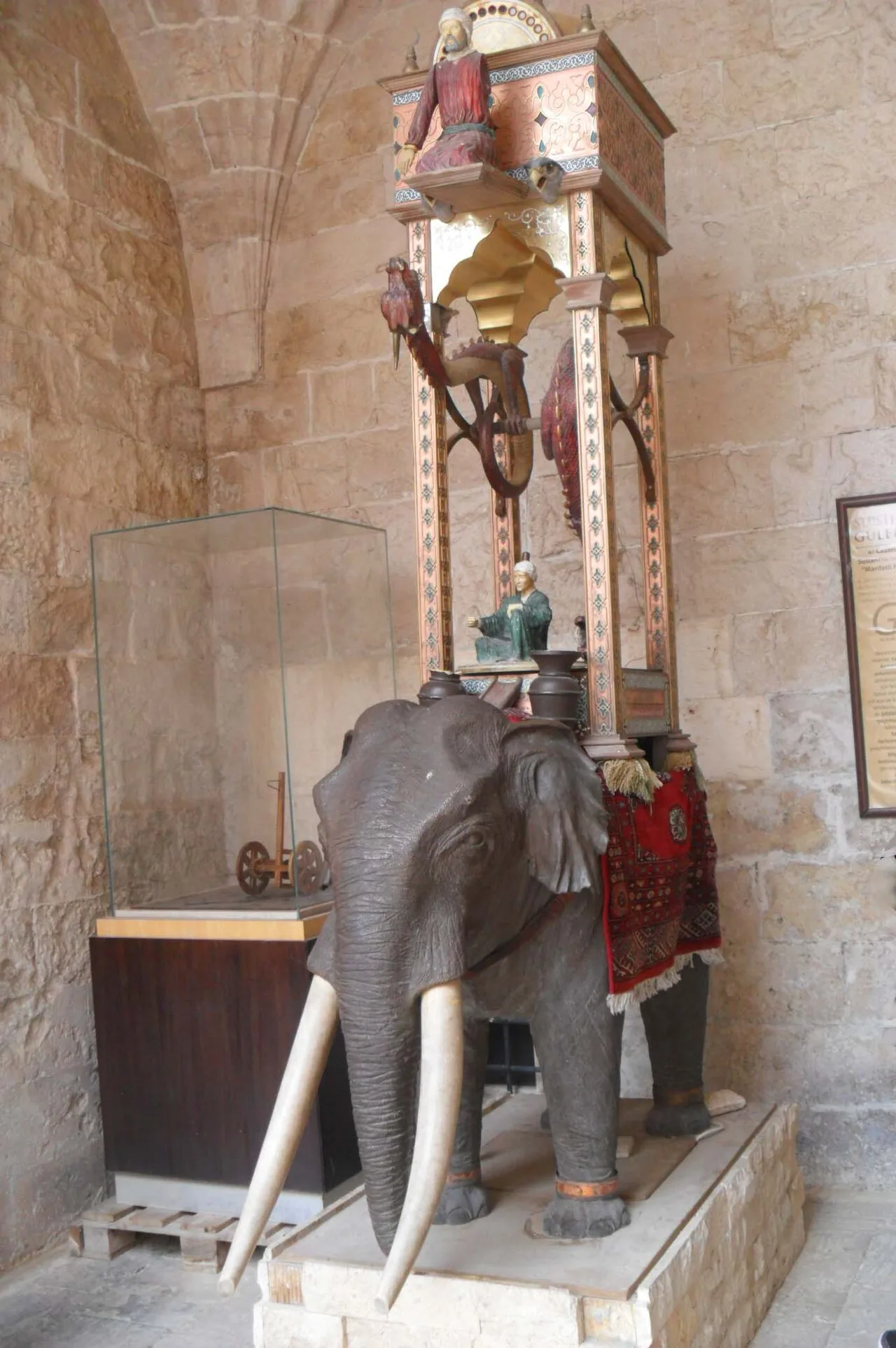
A reproduction in Kasımiye Medrese, Mardin, Turkey
Elephant clock
The elephant clock was a water clock invented by the medieval Islamic engineer Ismail al-Jazari, detailed in his Book of Knowledge of Ingenious Mechanical Devices.
Ingenious Devices of a Twelfth-Century Engineer
The medieval Islamic engineer Ismail al-Jazari, active during the period of 1136–1206, conceptualized an intricate water clock disguised as an elephant. He preserved this ingenious design within his seminal manuscript, The Book of Knowledge of Ingenious Mechanical Devices. The detailed schematics demonstrated how mechanical energy, hydraulics, and artistic figures could unite into an automated visual spectacle.
From Wikipedia · CC BY-SA 4.0

The Euphonia (The London Journal, 1870)
Euphonia (device)
The Euphonia was a nineteenth-century talking machine created by the Austrian inventor Joseph Faber.
Twenty-Five Years of Labor Reduced to Ashes
Joseph Faber spent decades developing his intricate acoustic talking machine before presenting it to the public. Despite investing so much time into the contraption, Faber destroyed an earlier version of the invention in 1844. He later rebuilt the device, exhibiting it in Philadelphia in 1845 and London's Egyptian Hall in 1846.
From Wikipedia · CC BY-SA 4.0
![Gonzalo, Torres's son (left), showing the automaton to Norbert Wiener at the 1951 Paris Cybernetic Conference[1]](https://upload.wikimedia.org/wikipedia/commons/5/55/Gonzalo_showing_El_Ajedrecista_to_Norbert_Wiener.jpg?utm_source=en.wikipedia.org&utm_campaign=imageinfo&utm_content=thumbnail_unscaled)
Gonzalo, Torres's son (left), showing the automaton to Norbert Wiener at the 1951 Paris Cybernetic Conference[1]

"El Ajedrecista" #1 close up

El Ajedrecista #2 front view

"El Ajedrecista" #2 interior view

"El Ajedrecista" #2 interior view, close up
El Ajedrecista
El Ajedrecista is a chess-playing automaton designed by Spanish engineer Leonardo Torres Quevedo and first demonstrated in 1913.
Exposing the Illusion of Concealed Grandmasters
Legendary historical chess contraptions like the Mechanical Turk, Mephisto, and Ajeeb famously relied on concealed human players operating hidden levers. Leonardo Torres Quevedo shattered this long legacy of stage illusions by engineering El Ajedrecista as a genuinely autonomous machine capable of playing without human guidance. This landmark achievement is widely regarded as the first computer game in history, anticipating algorithmic computer chess programs by decades.
From Wikipedia · CC BY-SA 4.0

Eric rebuilt in 2017

George, a later model of Eric, taking breakfast with his inventor William Richards in Berlin, 1930
Eric (robot)
Eric was the first British robot, built in 1928 by First World War veteran Captain William Richards and aircraft engineer Alan Reffell.
A Royal Cancellation Yields a Tin Stand-In
Britain's first robot materialized out of an event organizer's sheer exasperation. When George VI cancelled his scheduled appearance in 1928, Captain William Richards stepped in with an audacious alternative. Richards, serving as secretary of the Exhibition of the Society of Model Engineers, pledged to build a tin substitute to address the Royal Horticultural Hall.
From Wikipedia · CC BY-SA 4.0

Makoto Nishimura (left of Gakutensoku) and one of his assistants, Bōji Nagao, pose with the robot.
Gakutensoku
Gakutensoku, the first robot built in the East, was designed and manufactured in Osaka in the late 1920s by biologist Makoto Nishimura.
Reimagining the Machine as a Gentle Companion
Early science fiction often framed mechanical creations as subjugated laborers destined to revolt. Biologist Makoto Nishimura directly challenged the dystopian view popularized in Karel Čapek's play R.U.R. by designing an artificial human. Instead of creating a servant, he envisioned a machine that would celebrate nature, serve as a friend, and act as an inspirational guide for humanity.
From Wikipedia · CC BY-SA 4.0

Replicas of Elektro the moto-man and his little dog Sparko
Elektro
Elektro is a robot built by engineers at the Westinghouse Electric Corporation's Mansfield, Ohio, facility between 1937 and 1938.
Midwest Industrial Roots in Mansfield
Long before modern robotics became commonplace, a team of industrial engineers constructed an early mechanical humanoid in Ohio. J.M. Barnett, Jack Weeks Sr., Harold Gorsuch, and other engineers built Elektro at the Westinghouse Electric Corporation's Mansfield, Ohio, facility. Their ambitious engineering project took shape between 1937 and 1938, creating one of the earliest celebrity robots in technological history.
From Wikipedia · CC BY-SA 4.0
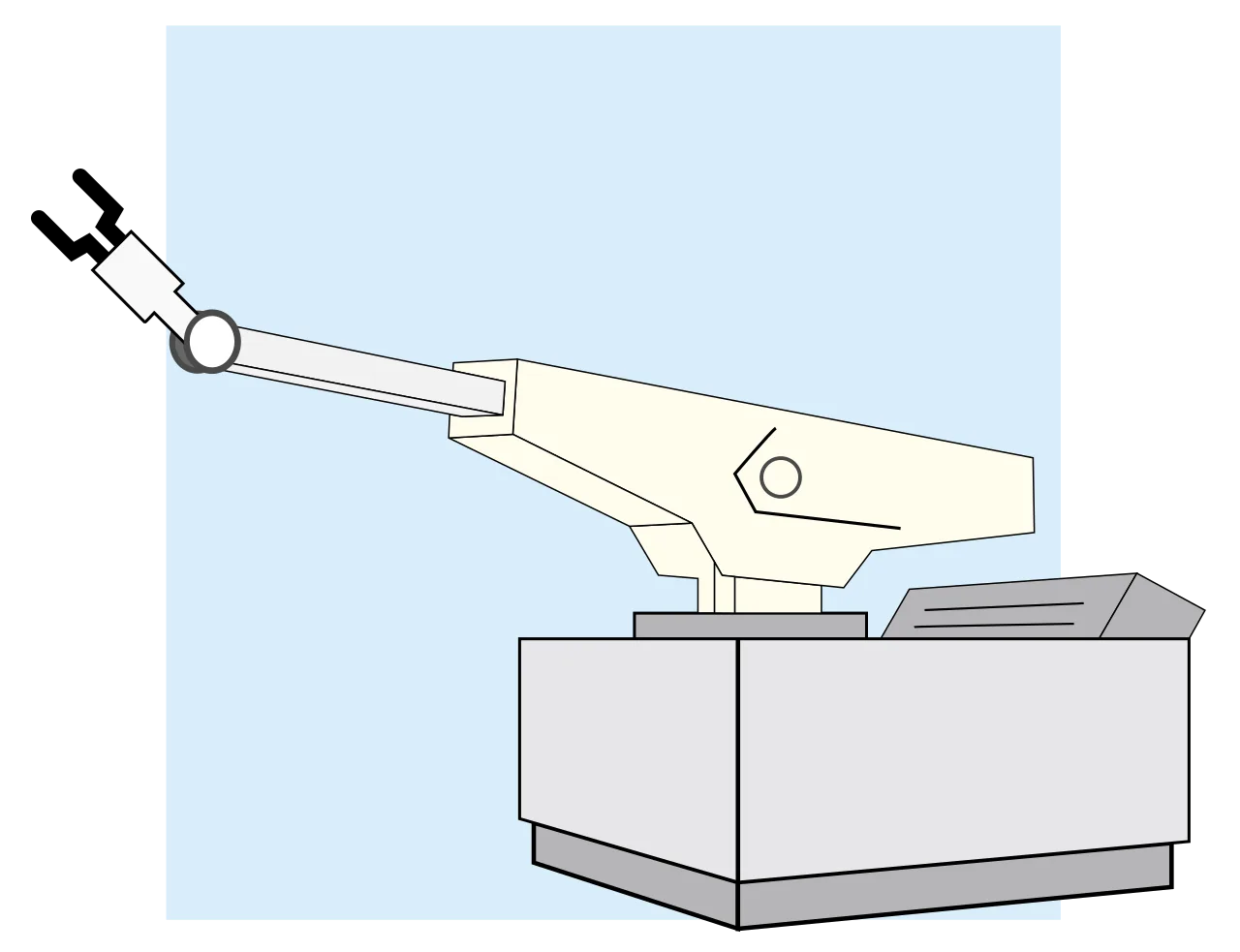
Sketch of a Unimate robot
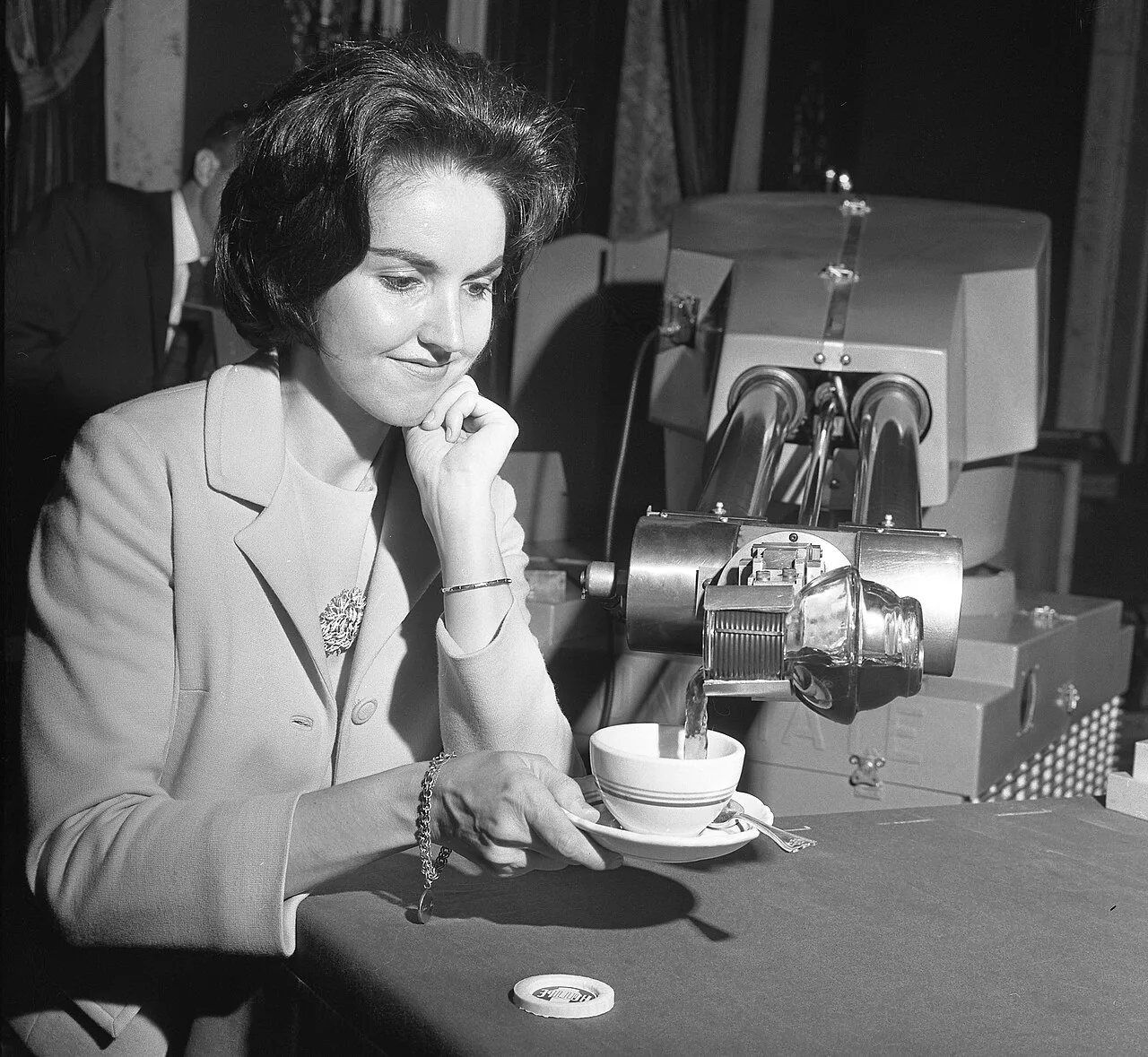
Unimate pouring coffee for a human, 1967
Unimate
Unimate was the first industrial robot.
Media Recording Roots Behind Industrial Robotics
George Devol lacked an academic pedigree, drawing instead on his practical engineering background in media technologies. His prior work in optical sound recording for film and magnetic sensing in high-speed printing directly informed his robotic designs. Partnering with Joseph Engelberger, he established Unimation as the world's first robot manufacturing enterprise.
From Wikipedia · CC BY-SA 4.0
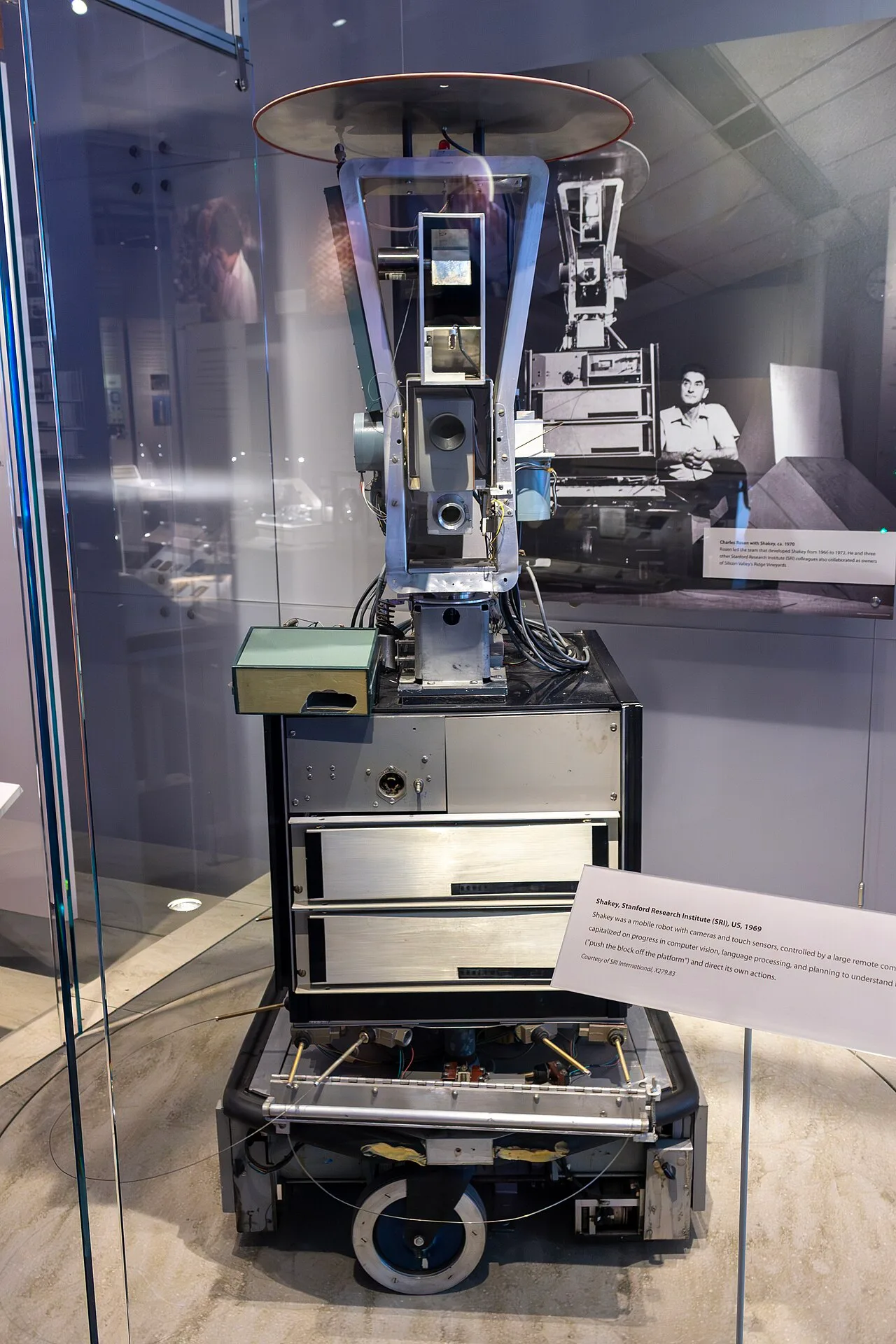
SRI Shakey robot, 1969, Computer History Museum
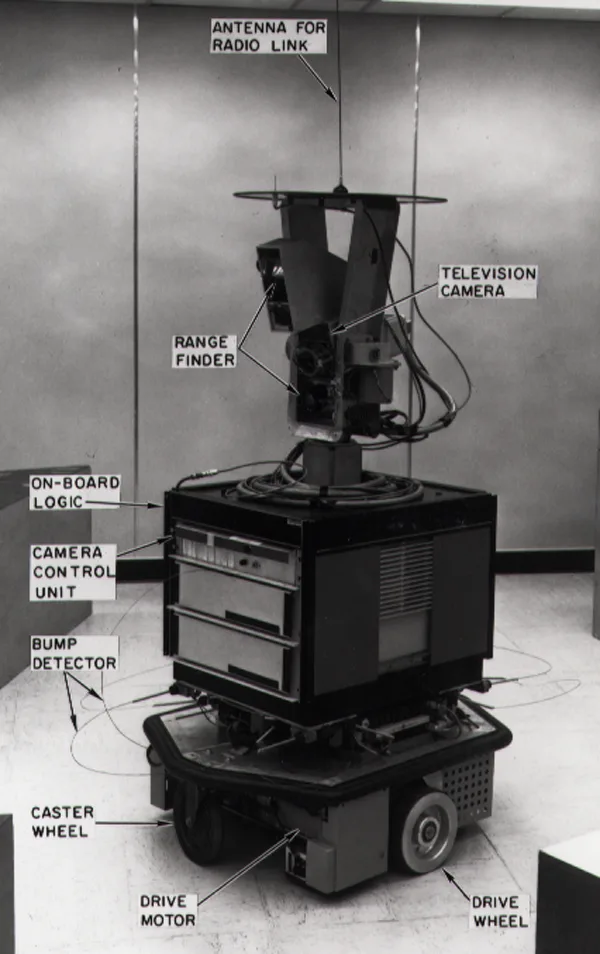
Shakey in 1972
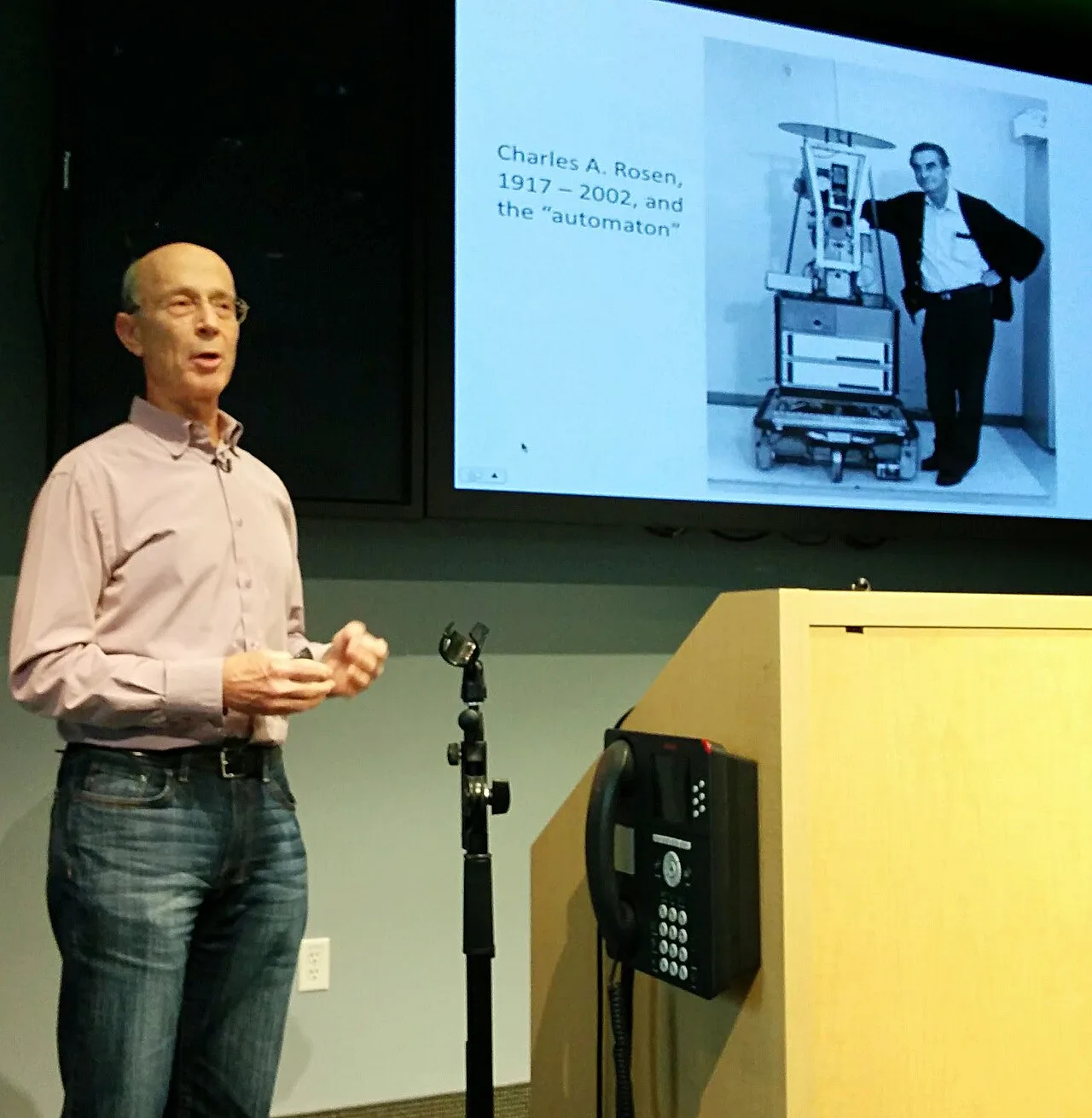
Peter Hart discussed Shakey's firsts in a talk at Google in February 2015.
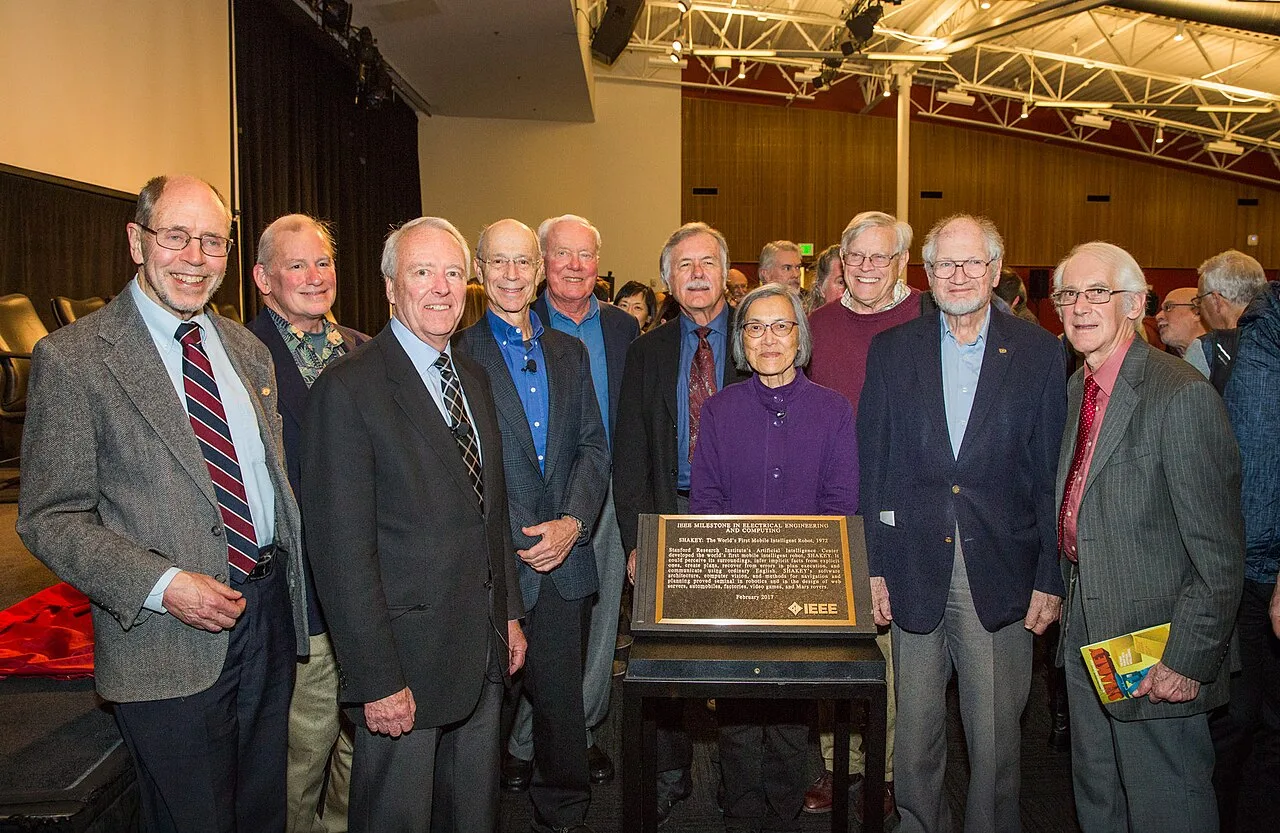
Shakey's creators at the IEEE Milestone award event at the Computer History Museum, February 2017: (from left) Richard O. Duda, Tom Garvey, IEEE President Elect Jim Jeffries, Peter E. Hart, Nils J. Nilsson, Richard Fikes, Helen Chan Wolff, Claude Fennema, Bertram Raphael, Mike Wilber.
Shakey the robot
Shakey the Robot was the first general-purpose mobile robot able to reason about its own actions and break down commands into basic chunks.
A Month of Greek Names Cast Aside
Engineers spent a month debating elevated classical names for the machine before settling on something blunt. The robot's tall stature and unstable trembling motion inspired a colleague to discard lofty titles in favor of a literal description. That candid assessment stuck, naming the pioneer machine Shakey.
From Wikipedia · CC BY-SA 4.0

Asimo logo

ASIMO at the Tokyo Motor Show

ASIMO environment sensor suite

Pairs of black markings used for autonomous navigation

Foot padding, called "Floor Reaction Control", accounts for small surface irregularities

ASIMO conducting an orchestra
ASIMO
ASIMO (Advanced Step in Innovative Mobility) is a humanoid robot created by Honda in 2000.
Calibrating Machine Stature for Human Homes
Rather than building a towering machine, engineers sized ASIMO at a modest 130 cm and 54 kg. Honda determined that this specific height range—above 120 cm yet below average adult stature—optimized interaction with standard living environments. This compact build allowed the humanoid to easily reach everyday fixtures like door knobs and light switches without intimidating occupants.
From Wikipedia · CC BY-SA 4.0