
Xiyou

Golden statues of the White Dragon Horse, Sha Wujing, Sun Wukong, Tang Sanzang, and Zhu Bajie at the Rua Yai City Pillar Shrine in Suphan Buri, Thailand

Sun Wukong and Princess Iron Fan, as depicted in the 1592 Journey to the West, Shidetang Hall of Jinling edition
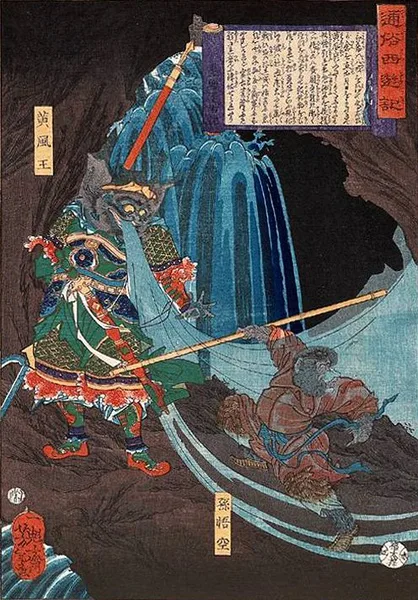
Sun Wukong fighting a wind demon

Sun Wukong's shrine at Thien Hau Temple, Ho Chi Minh City, Vietnam

Cartoon-style models of Monkey King on the streets of Lianyungang
Sun Wukong
Sun Wukong, also known as the Monkey King, is a literary and religious figure best known as one of the main characters in the 16th-century Chinese novel Journey to the West.
Folk Veterinary Belief Behind a Heavenly Demotion
Sun Wukong's appointment as keeper of the heavenly stables was not merely an arbitrary insult devised by the Jade Emperor. The position bìmǎwēn was a direct pun rooted in the folk belief that keeping a monkey in stables prevented horses from contracting diseases. Believing he had been granted an honorable, high-ranking post, the monkey only rebelled upon discovering that the title was a patronizing disguise for an ordinary stable boy.
From Wikipedia · CC BY-SA 4.0
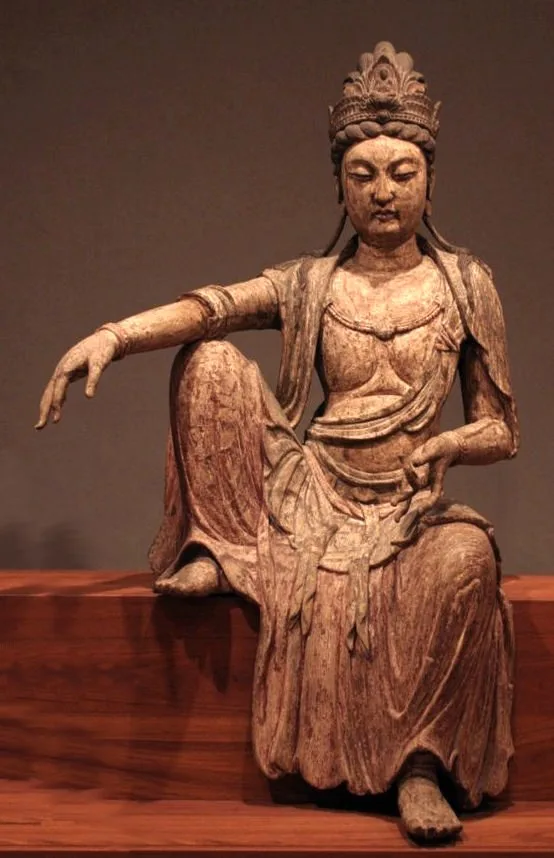
Kuan-yan bodhisattva, Northern Sung dynasty, China, c. 1025, wood, Honolulu Academy of Arts
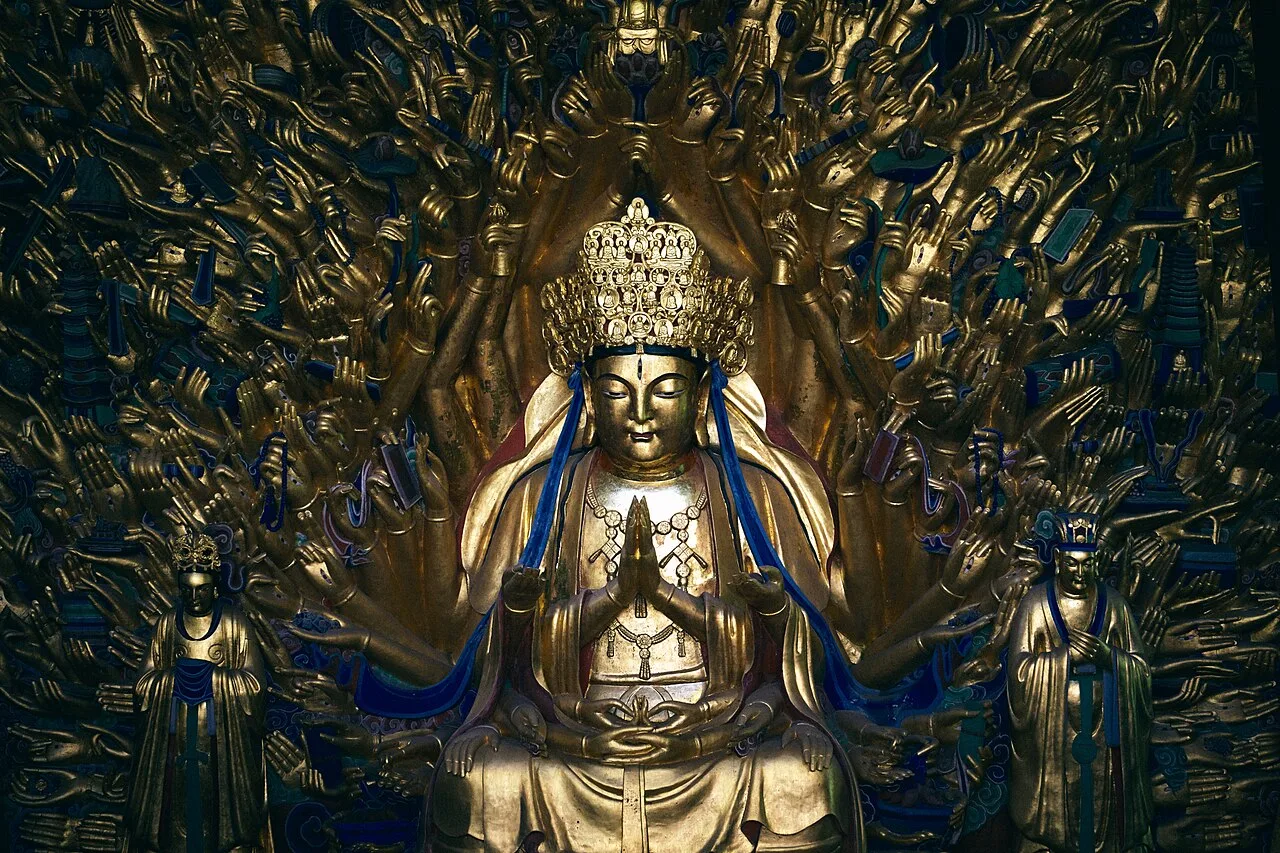
Tang dynasty (618-907) rock statue of the Thousand-Armed Guanyin (Qianshou Guanyin) at Baodingshan at the Dazu Rock Carving in Chongqing, China.
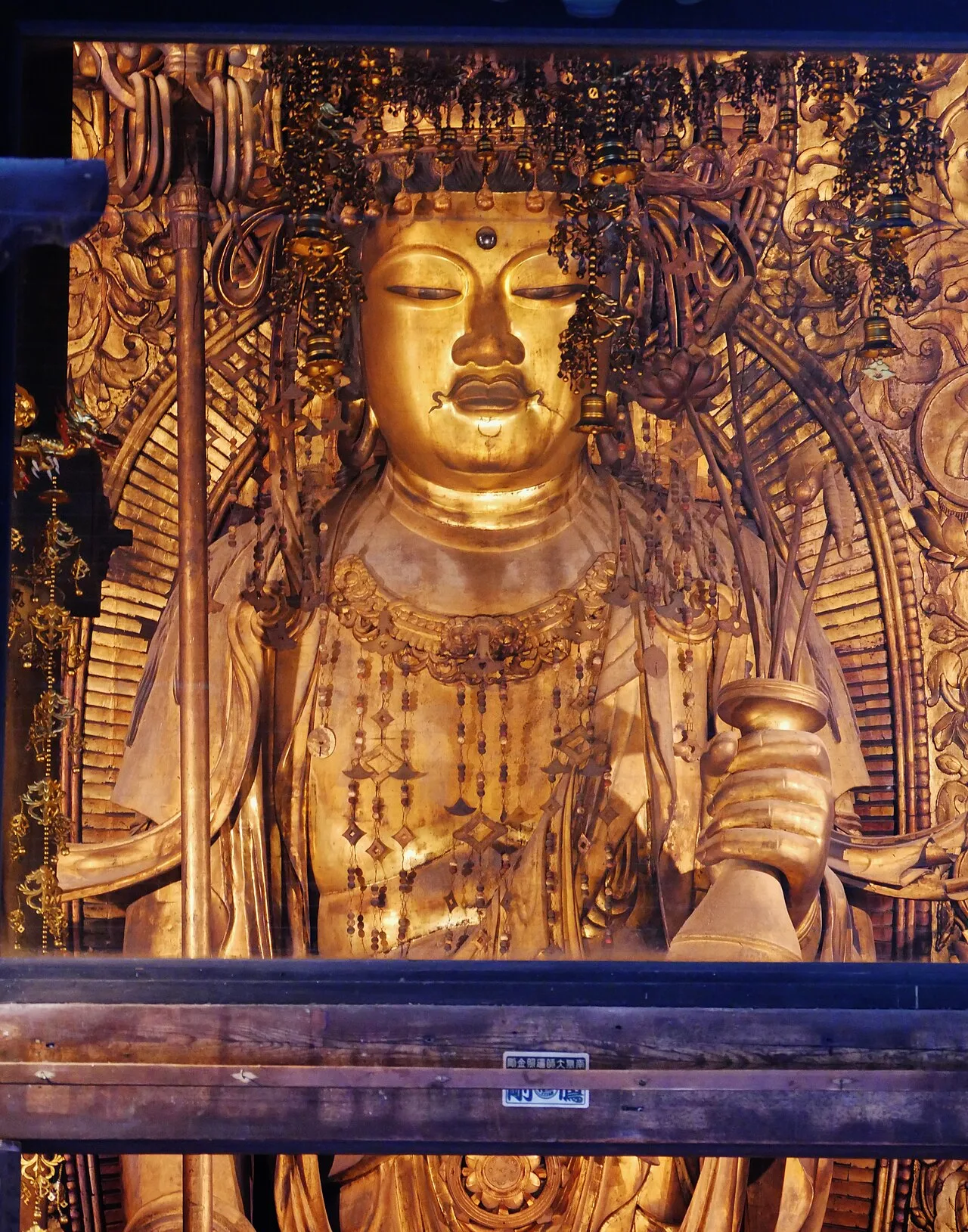
Muromachi period (1336 - 1573) statue of Jūichimen Kannon (Thousand-Armed Kannon) located at the hondō of Hasadera in Sakurai, Nara, Japan. Carved in 1538.
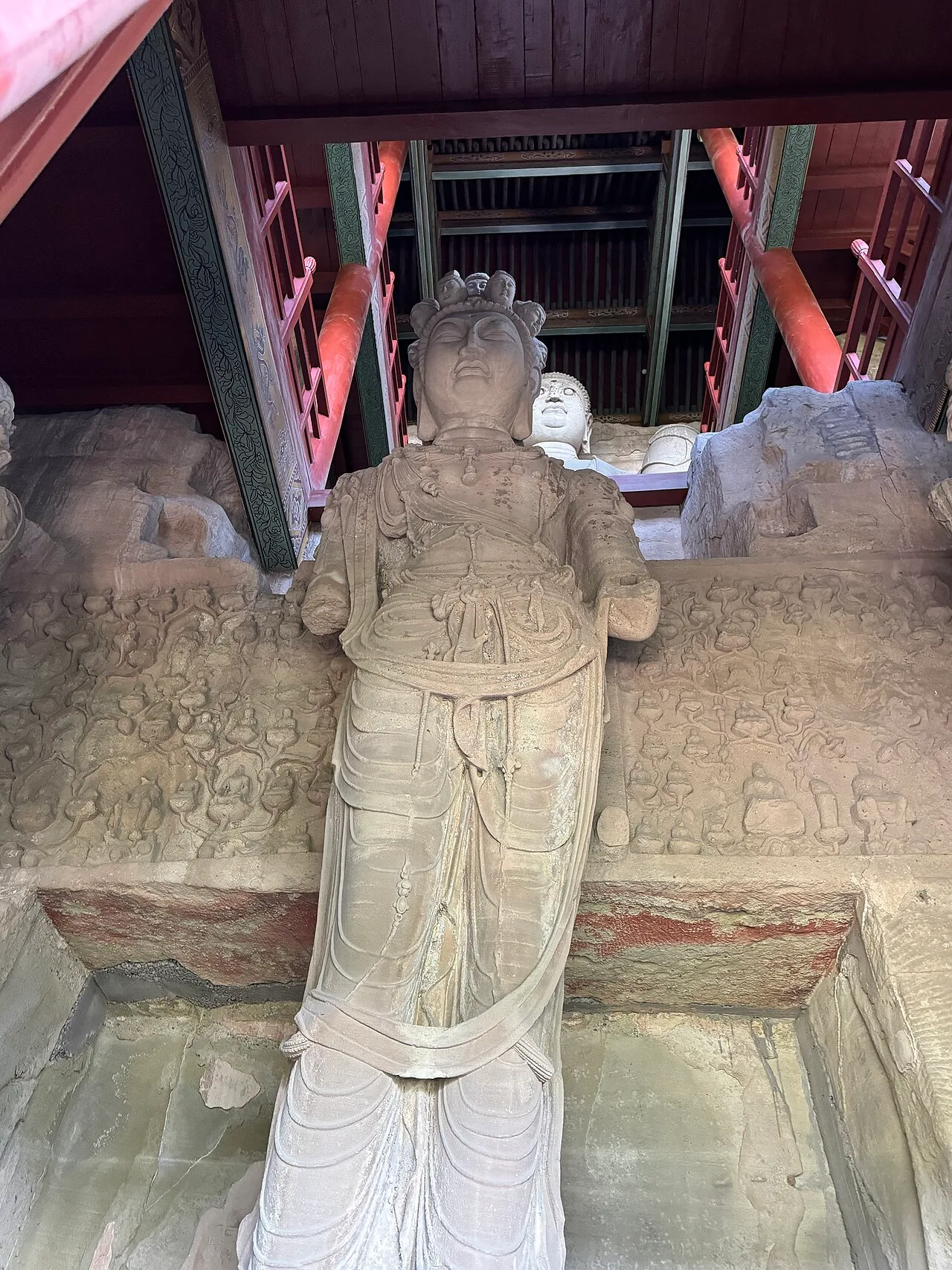
Statue of Shiyimian Guanyin, flanked by the Bodhisattvas Wenshu and Puxian at Tianlongshan Grottoes in Shanxi, China.
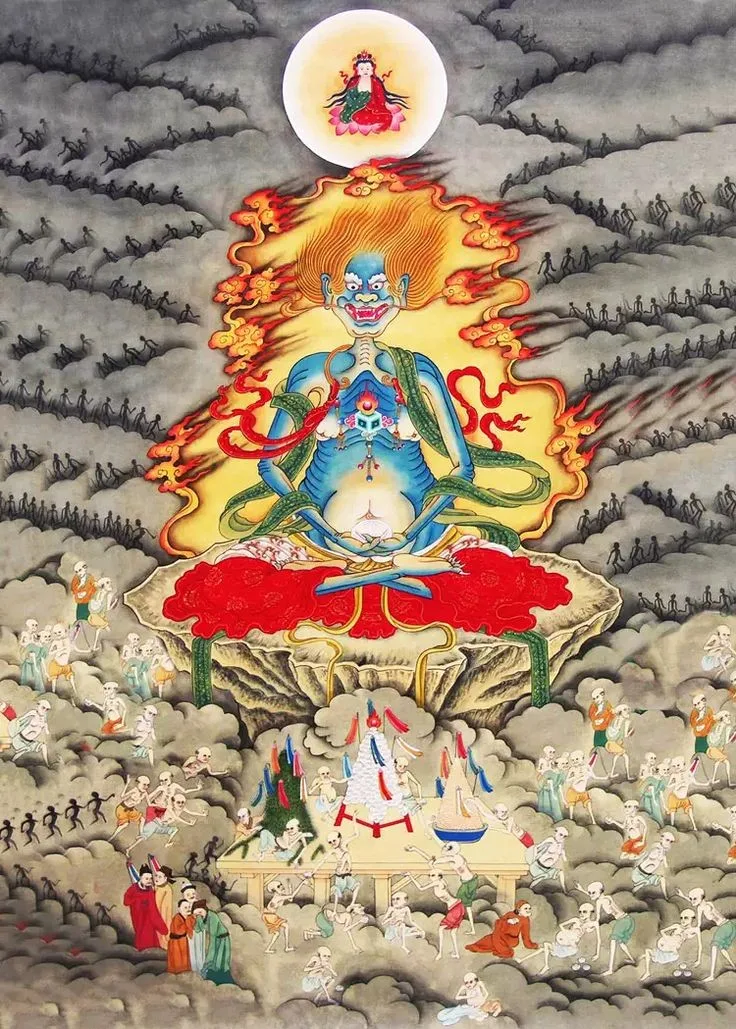
Ming dynasty (1368 - 1644) Shuilu ritual painting of Mianran Dashi, a manifestation of Guanyin as a hungry ghost king from Baoning Temple in Shanxi, China.
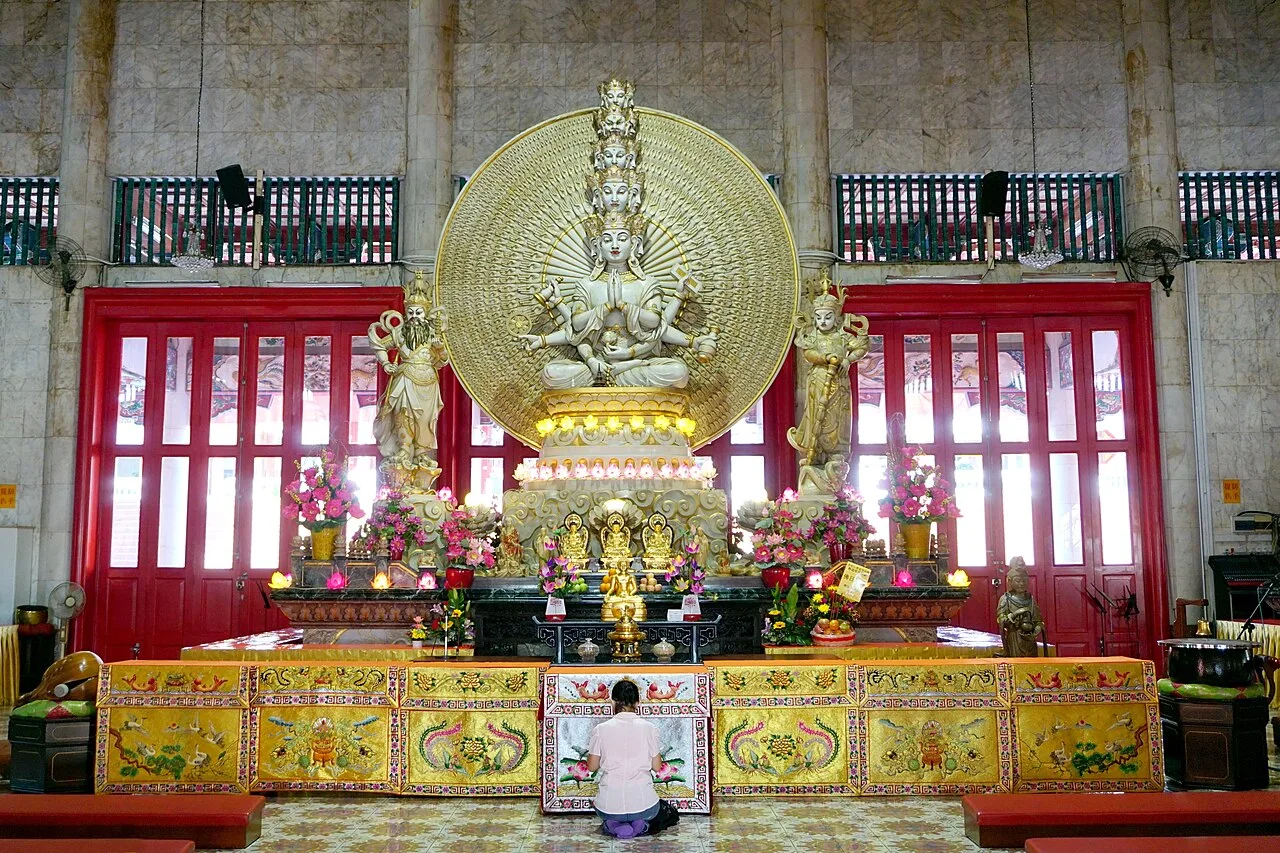
Statue of Qianshou Qianyan Guanyin flanked by the dharmapalas Weituo and Qielan at Kong Meng San Phor Kark See Monastery in Singapore.
Guanyin
Guanyin is a Chinese name for Avalokiteśvara, the Bodhisattva associated with compassion, commonly depicted as female in East Asia since about the 12th century.
Fifth-Century Roots of the Sound Perceiver
Fifth-century Sanskrit fragments reveal that Avalokitasvara was the deity's original name, containing the morpheme svara to mean 'sound perceiver.' Early scholars assumed Chinese translators had mistakenly corrupted Avalokiteśvara, but that later title with the ending -īśvara did not appear in Sanskrit until the seventh century. This linguistically authentic title precisely matches the Chinese translation Guānyīn. Across Asian languages, these ancient textual foundations established the bodhisattva's primary identity as a listener to worldly cries.
From Wikipedia · CC BY-SA 4.0
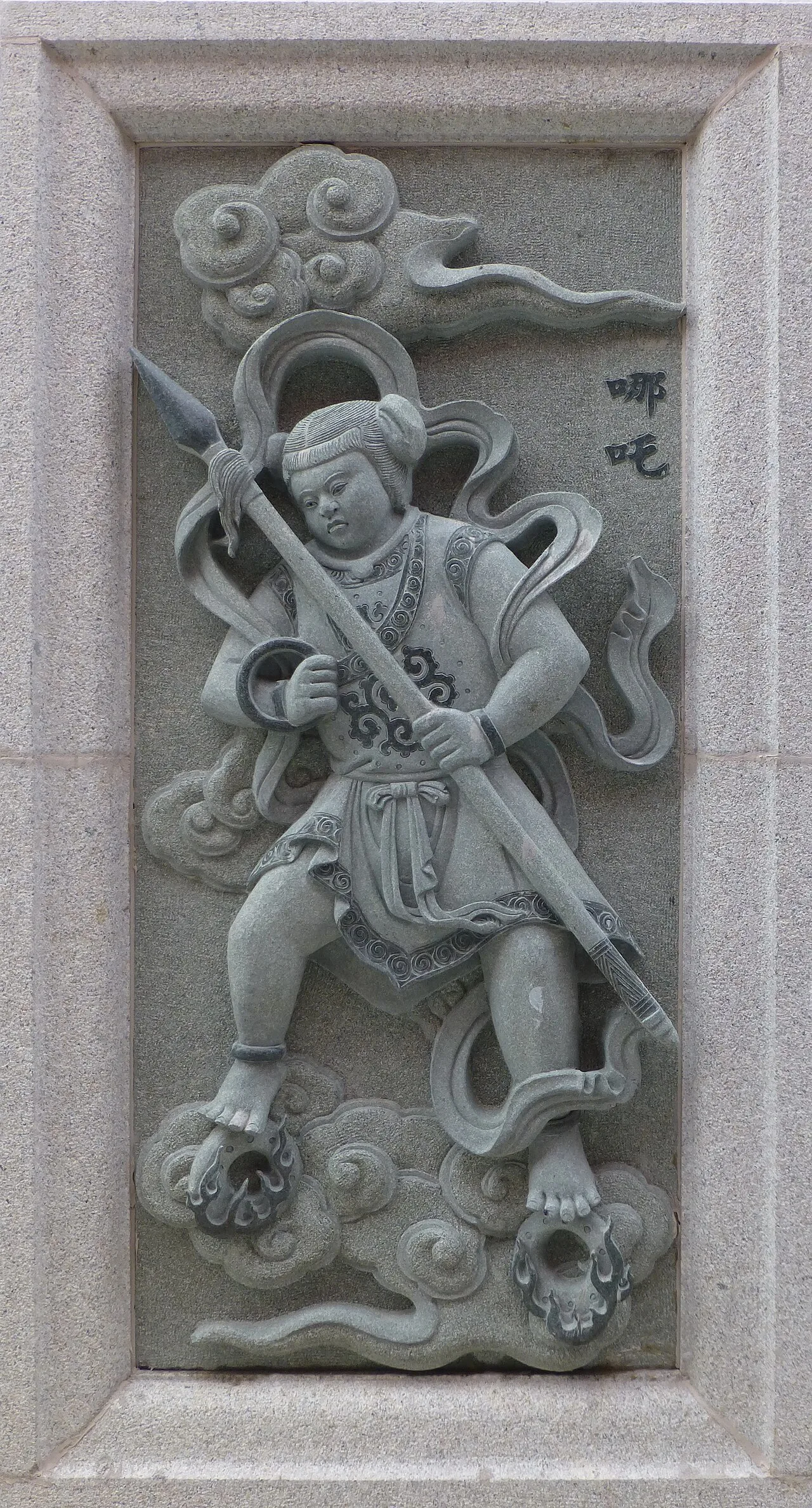
Ping Sien Si - 008 Nezha (deity) (15513109434)

Na Tcha Temple of the Centre of Macau, a Nezha temple behind the Ruins of St. Paul, in Macau.

Figurines of Nezha (and Ao Bing) as they appear in the film Ne Zha and its sequel.
Nezha
Nezha is a protection deity in Taoism, Buddhism, Confucianism, and Chinese folk religion.
The Three-Year Gestation and the Slashed Ball of Flesh
Lady Yin gave birth to an alarming anomaly after gestating for three years and six months. Believing his wife had delivered a demon, Li Jing attacked the mysterious ball of flesh with his sword. The slashed sphere split open, allowing Nezha to emerge immediately as an ambulatory boy rather than a helpless newborn.
From Wikipedia · CC BY-SA 4.0

玉皇大帝畫像
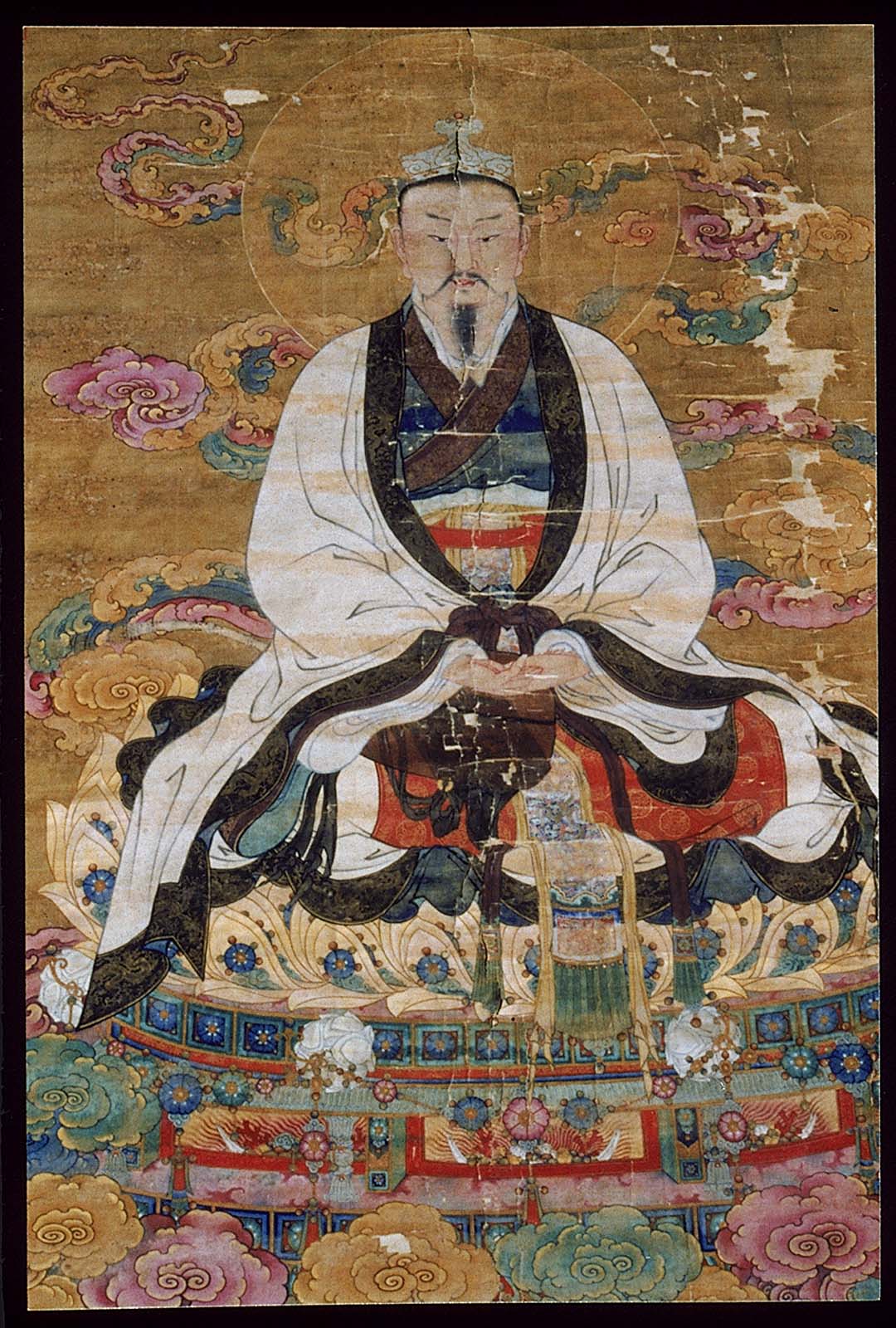
Portrait of the Jade Emperor, 16th century, Ming dynasty (Museum of Fine Arts, Boston)

Ritual participants carry the statue of Jade Emperor in a sedan chair at a sacrificial procession in Shanxi, 2016.
![Thni Kong Tnua in Air Itam, Penang, Malaysia was specifically built in honor of the Jade Emperor.[12]](https://upload.wikimedia.org/wikipedia/commons/thumb/e/e2/Thni_Kong_Tnua%2C_Air_Itam%2C_Penang.jpg/1280px-Thni_Kong_Tnua%2C_Air_Itam%2C_Penang.jpg?utm_source=en.wikipedia.org&utm_campaign=imageinfo&utm_content=thumbnail)
Thni Kong Tnua in Air Itam, Penang, Malaysia was specifically built in honor of the Jade Emperor.[12]

Ming dynasty statue of Jade Emperor at Yuhuang Temple, Fucheng.

Yuk Wong Po Tin in A Kung Ngam, Hong Kong.
Jade Emperor
In Chinese myths and folk religion, the Jade Emperor or Yudi is one of the representations of the primordial god. In Taoist theology, he is the assistant of Yuanshi Tianzun, one of the Three Pure Ones.
A Three-Hundred-Million-Year Path to Golden Immortality
Achieving absolute cosmic authority required an extraordinary duration of ascetic cultivation rather than immediate divine right. Attaining Golden Immortality took 1,750 eons, with each individual eon spanning 129,600 years. An additional one hundred million years of rigorous practice followed before the sovereign attained his title, capping a spiritual journey that lasted for about 327 million years.
From Wikipedia · CC BY-SA 4.0
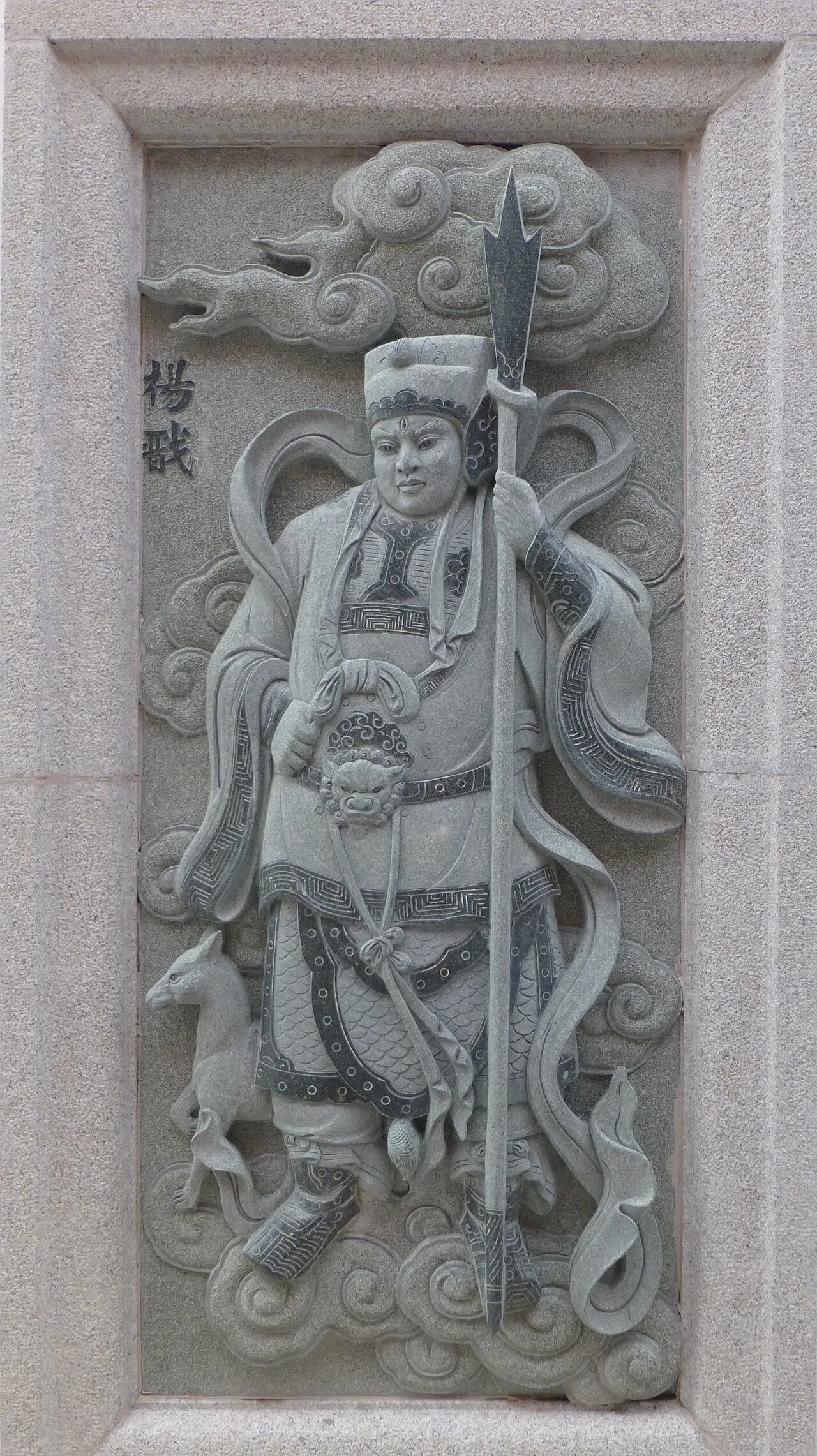
Ping Sien Si - 011 Yang Jian (Erlang Shen) (15949358169)
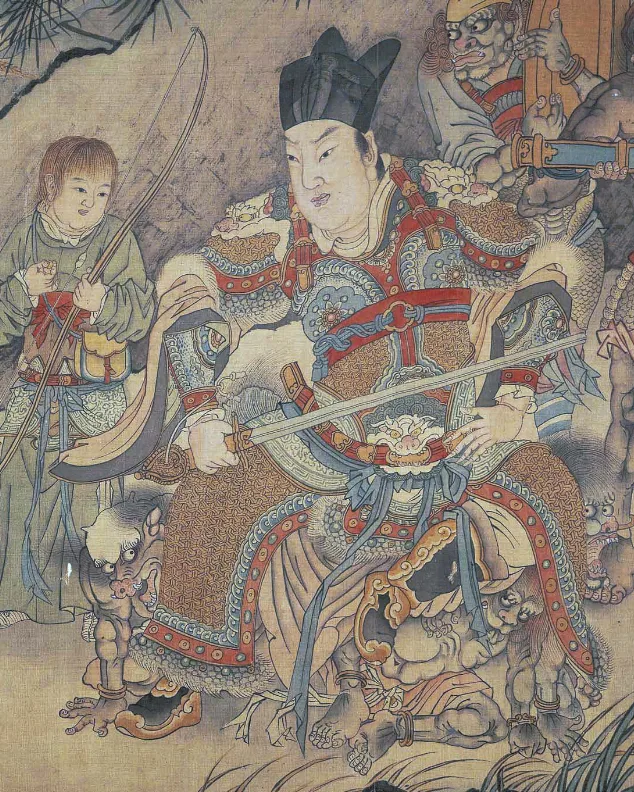
Erlang on a Soushan scroll, a genre of paintings depicting him searching the mountains for demons. Ming dynasty, 15th century
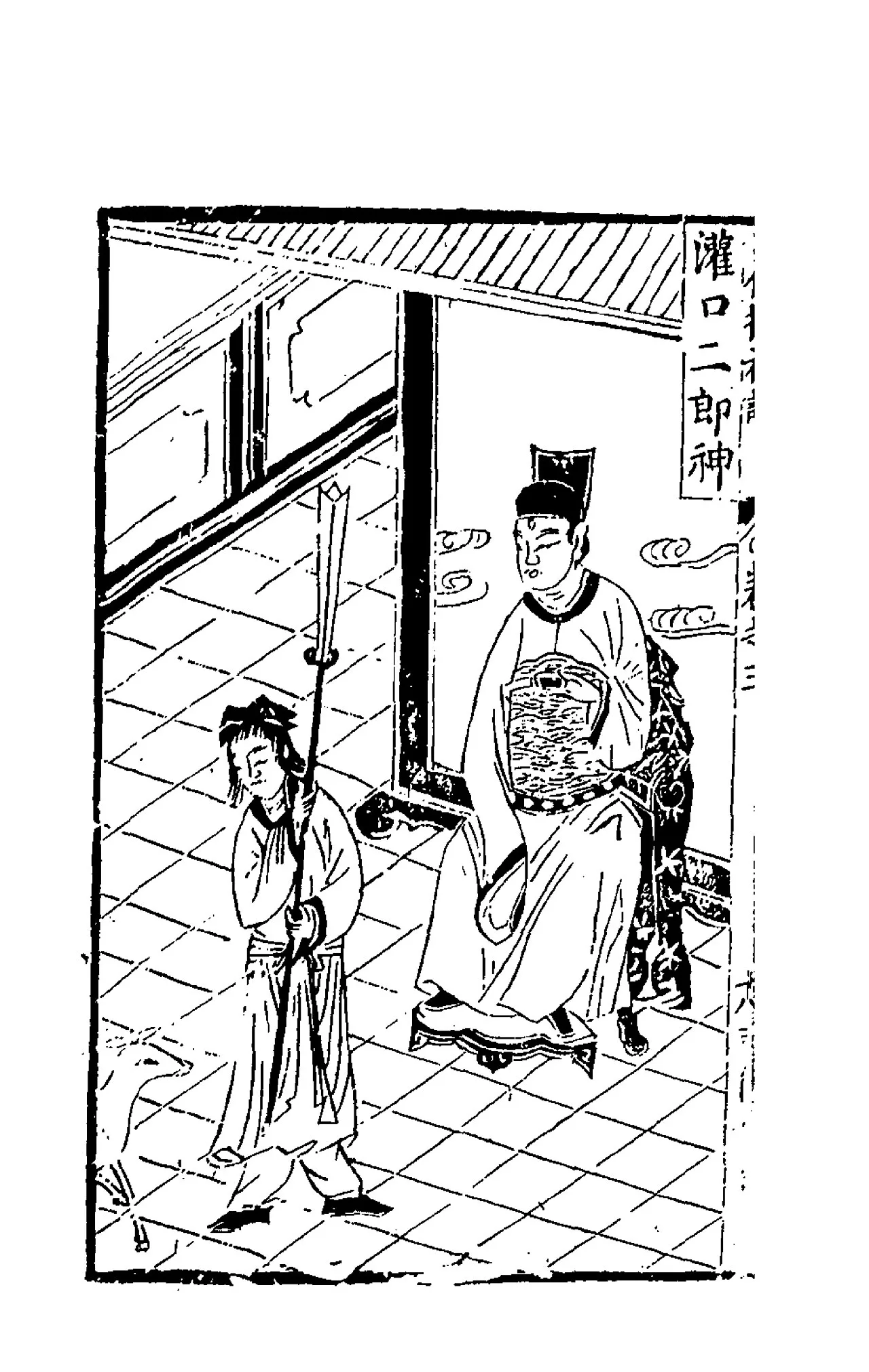
Erlang Shen of Guankou, from an illustrated Ming Dynasty edition of In Search of the Supernatural
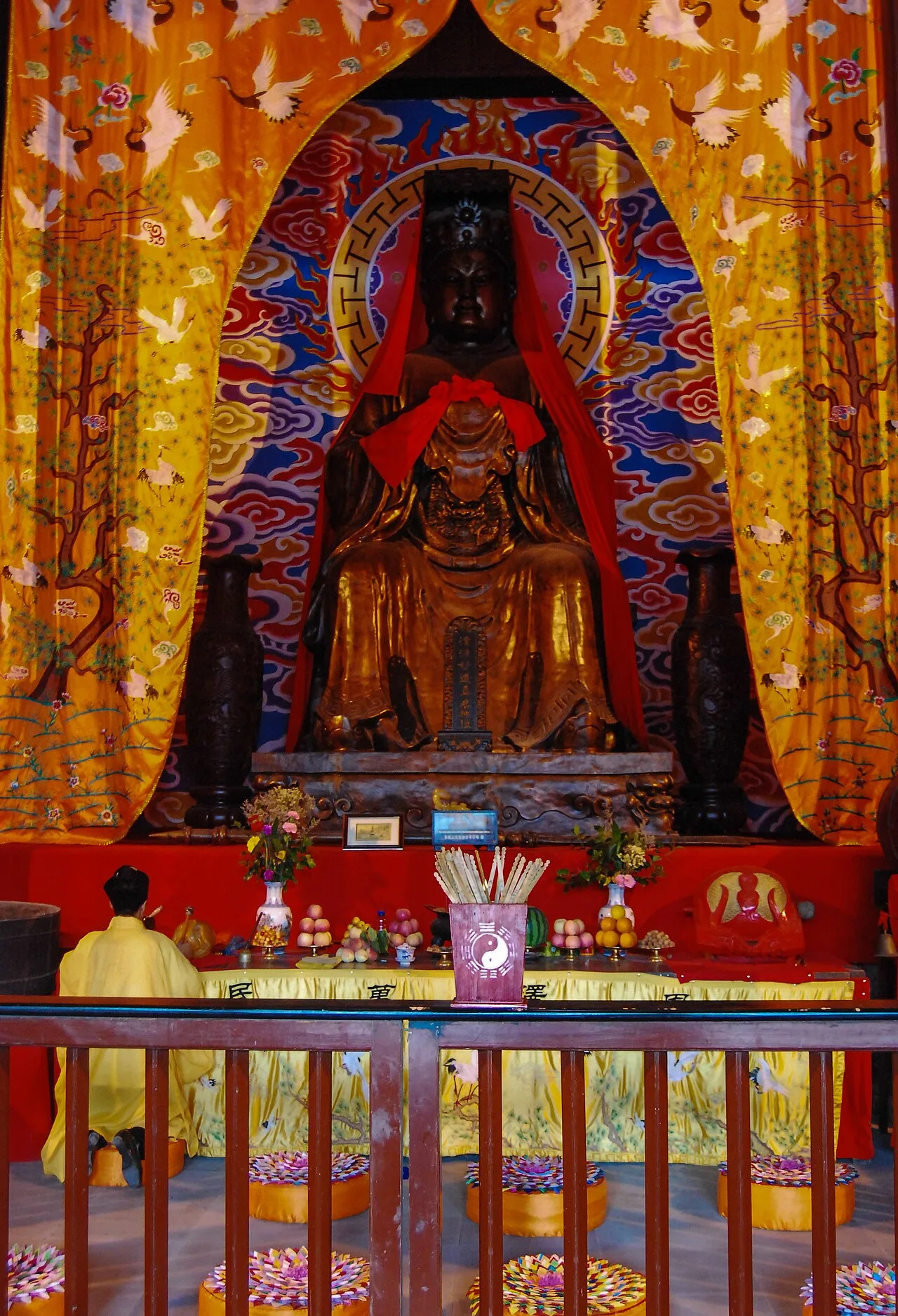
Statue of Erlang inside Erwang Temple, at Dujiangyan, Sichuan
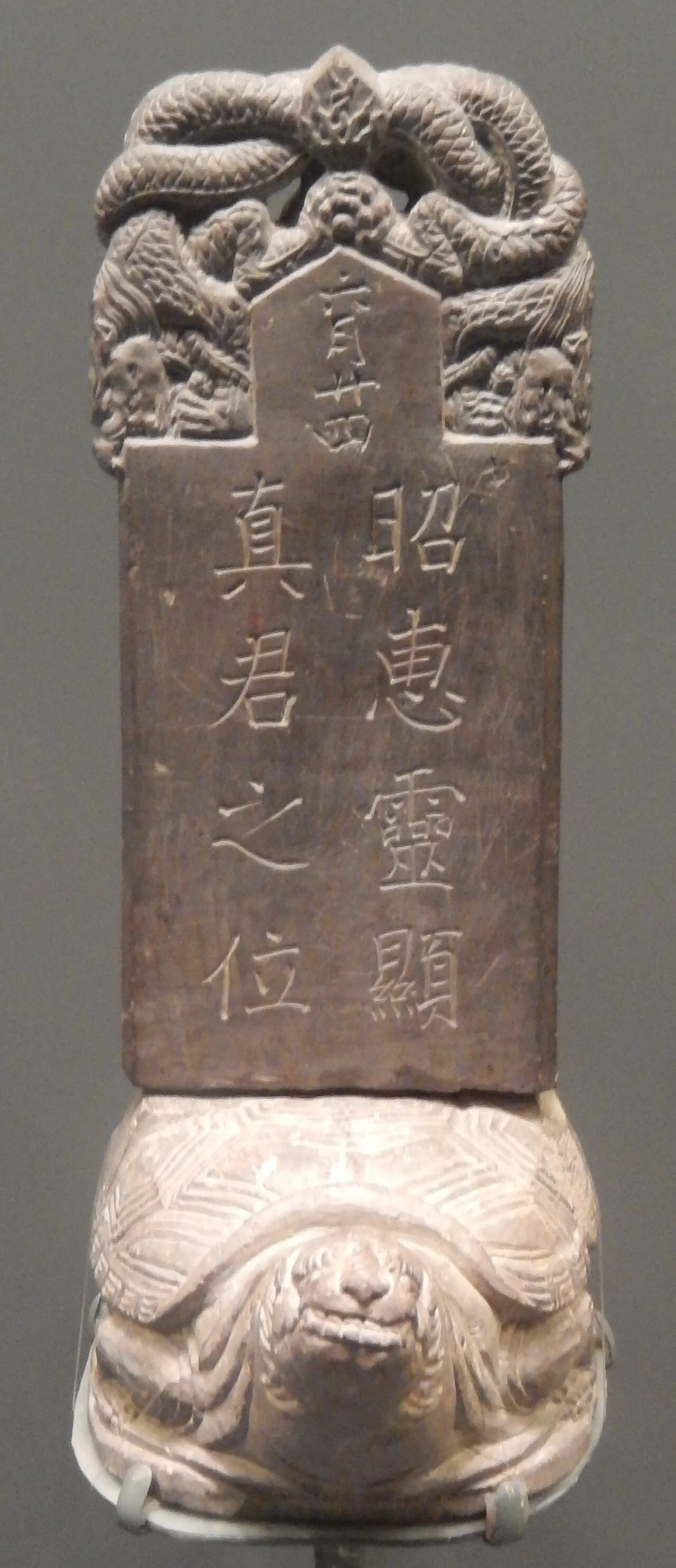
Stele dedicated to Erlang Shen, from Beijing, Yuan dynasty (1271–1368)
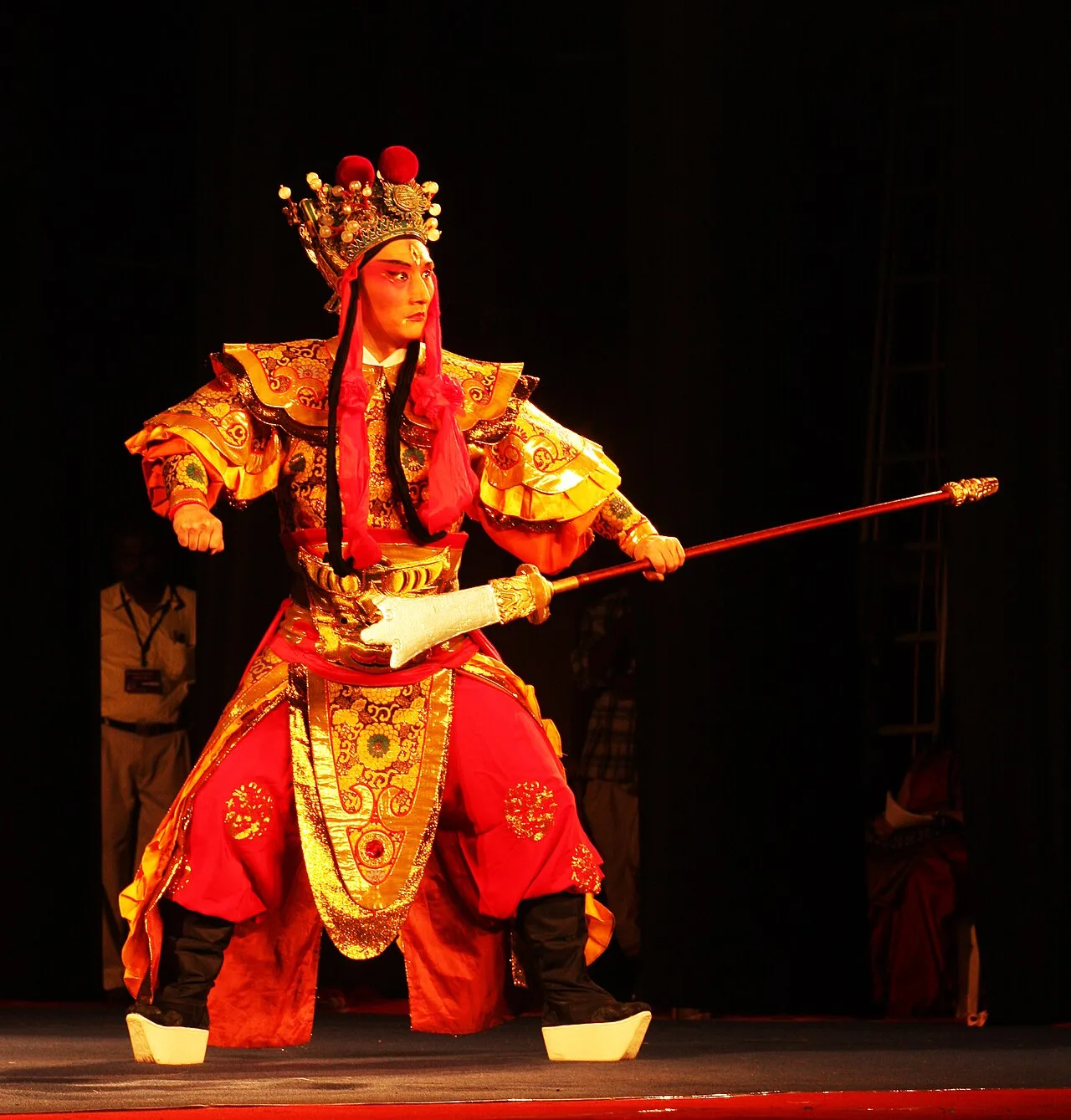
Erlang Shen portrayed by a Beijing opera actor
Erlang Shen
Erlang Shen is a god in Chinese folk religion and Daoism associated with water, justice, warriorhood, hunting, and demon subdual, commonly depicted as a young man with a third, truth-seeing eye.
Transforming Ancient Water Engineering into Dragon-Slaying Legend
Erlang Shen originated primarily from Li Erlang, the second son of Qin dynasty hydraulic engineer Li Bing. Together, they designed the complex irrigation system that prevented the Min River from flooding the Chengdu Plain. Local storytelling gradually transformed this civil engineering feat into a mythic battle, culminating in Li Erlang capturing a sacrificial river dragon and securing it under the Dragon-Taming Temple.
From Wikipedia · CC BY-SA 4.0
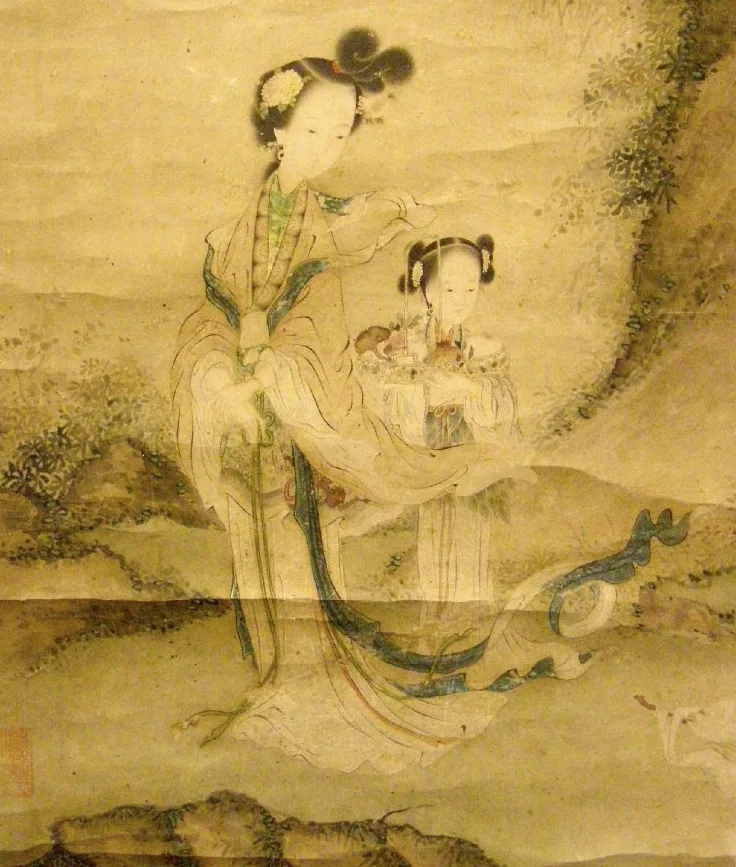
Detail of Xie Wenli's painting of Xi Wangmu
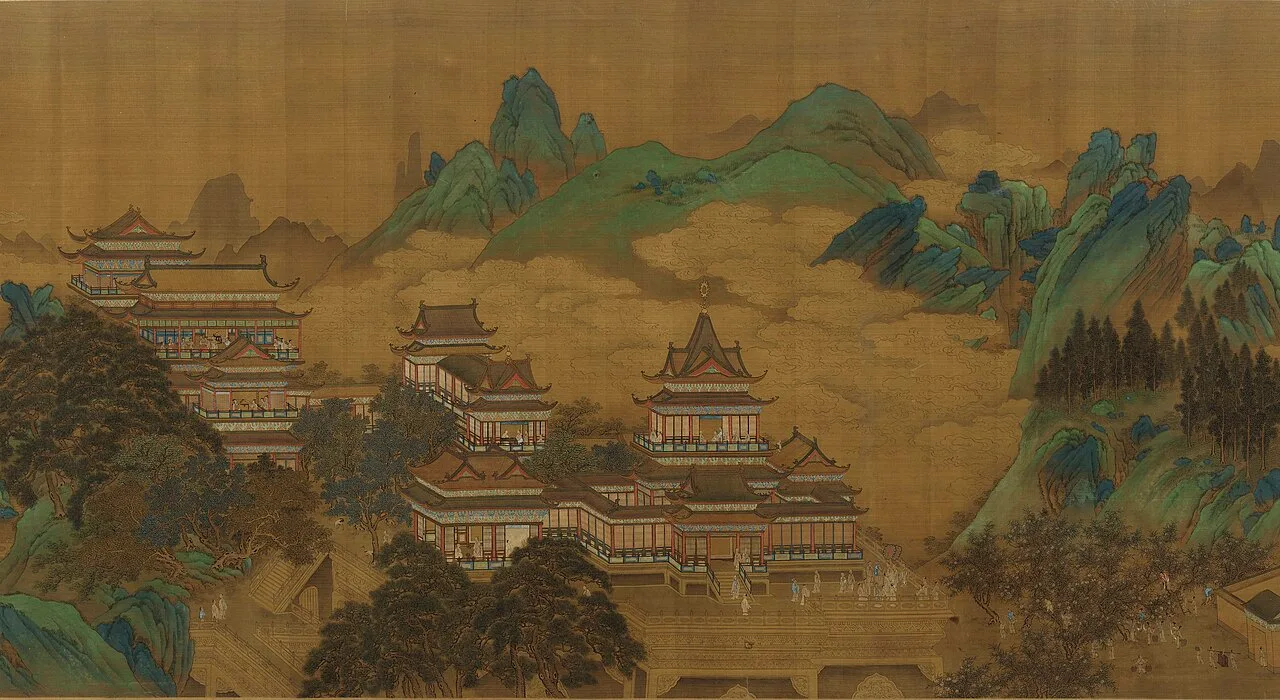
Peach Festival of the Queen Mother of the West, Ming dynasty painting, early 17th century
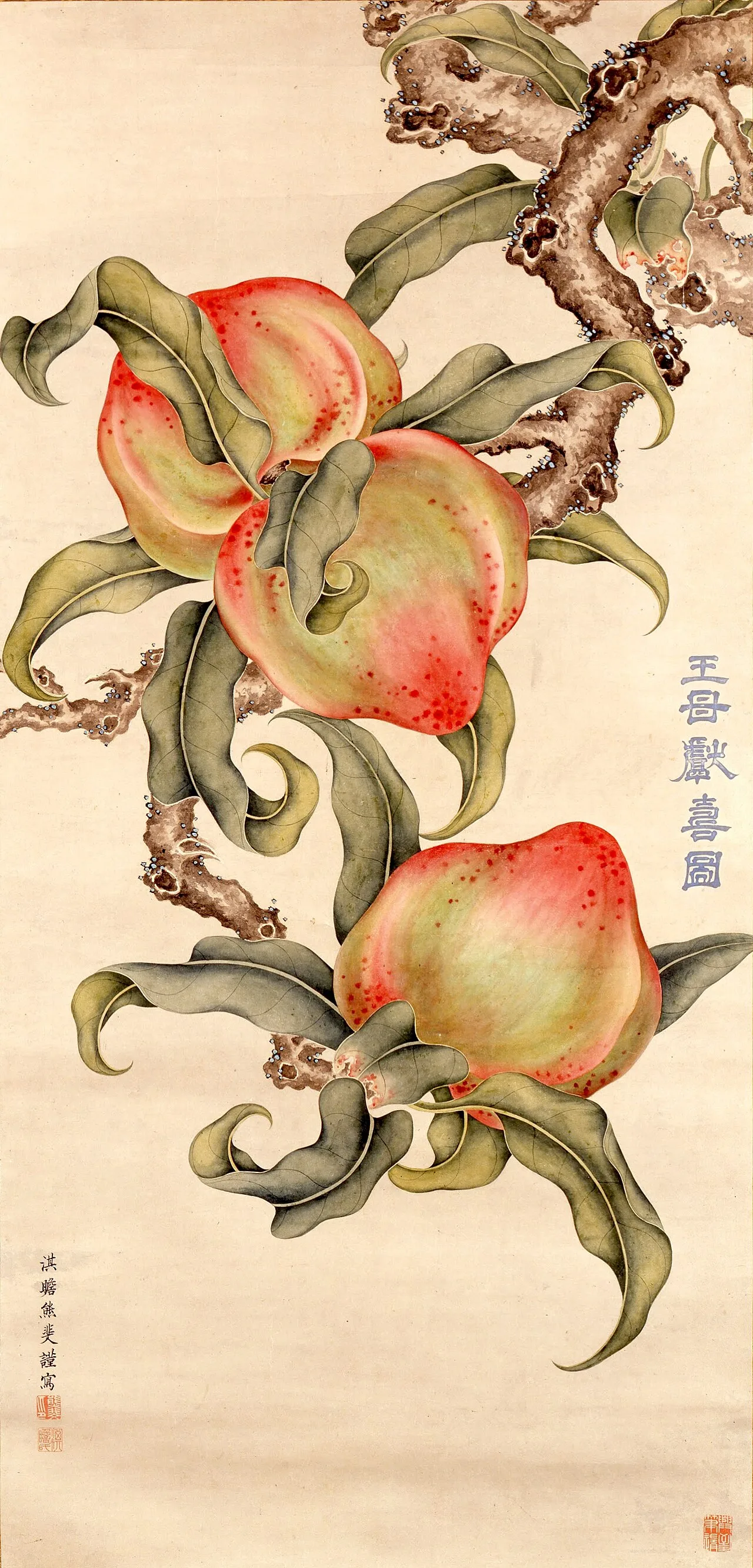
Xiwangmu's Peaches of Immortality, Japanese painting by Kumashiro Yūhi, circa 1750

Han Dynasty stone-relief (Xiwangmu sitting in between tiger and dragon)

Xiwangmu on porcelain, Qing dynasty

Xiwangmu meeting with a Chinese regent, likely King Mu of Zhou or Emperor Wu of Han
Queen Mother of the West
The Queen Mother of the West is a mother goddess in Chinese religion and mythology, also worshipped later in neighbouring countries and attested from ancient times.
Ferocious Fangs of an Archaic Death Deity
Long before she became associated with tranquil peach orchards, the Queen Mother was recorded in the Zhou dynasty Classic of Mountains and Seas as a terrifying figure with tiger teeth. She commanded savage beasts and unleashed catastrophic pestilences upon the human realm. This ferocious ruler also held dominion over Jiutian Xuannü, the goddess of war and sex, demonstrating a lethal primal power far removed from her later benevolent portrayal.
From Wikipedia · CC BY-SA 4.0

海龍王, British Museum

Four Dragon Kings, Qing dynasty.

Temple of the Dragon King of the South Sea in Sanya, Hainan.

The Dragon Kings of the Four Seas at the Grand Matsu Temple in Tainan.

Censer of leaping carp transforming into dragon. Unknown artist. China 17th century, Ming Dynasty, Phoenix Art Museum.

Nagas guarding a Buddhist stupa to ward off evil spirits, Thailand.
Dragon King
The Dragon King, also known as the Dragon God, is a water and weather god in Asian mythology regarded as the dispenser of rain and the divine ruler of all bodies of water.
Severe Supplication and Tormented Lizards
Communities across Asia devised visceral methods to compel dragons to release water during periods of drought. In ancient Korea, Buddhist monks would sometimes burn their forearms or fingers in supplication for rain. During a ritual called Seokcheok-dongja, children would deliberately torment a lizard to induce the dragon it symbolized to bring rain.
From Wikipedia · CC BY-SA 4.0

The battle of the Bull King and Sun Wukong. Painting in the Long Corridor of the Summer Palace in Beijing.
Bull Demon King
Bull Demon King, also known as the Ox King, is a demon character from the 16th-century novel Journey to the West. He is the husband of Princess Iron Fan and the father of Red Boy.
Superior Rank Among the Seven Sages
Long before clashing over the Flaming Mountains, the Bull Demon King commanded supreme authority among demonic royalty. He stood as the senior sworn brother above Sun Wukong and five other demon rulers, including the Saurian Demon King and Roc Demon King. Claiming the title Great Sage Who Pacifies Heaven, he positioned himself as an equal to celestial powers.
From Wikipedia · CC BY-SA 4.0
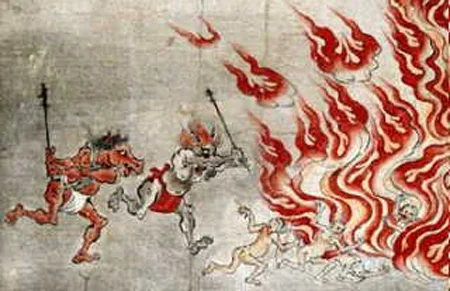
Ox-Head and Horse-Face in the Hell Scroll at Seattle Asian Art Museum
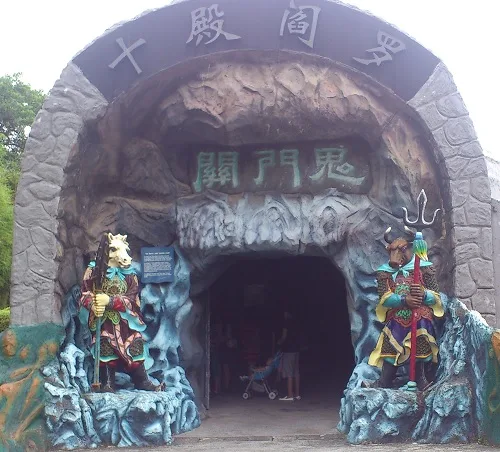
Entrance to the "Ten Courts of Hell" attraction in Haw Par Villa, Singapore. The Ox-Headed (right) and Horse-Faced (left) Hell Guards stand guard at the entrance.
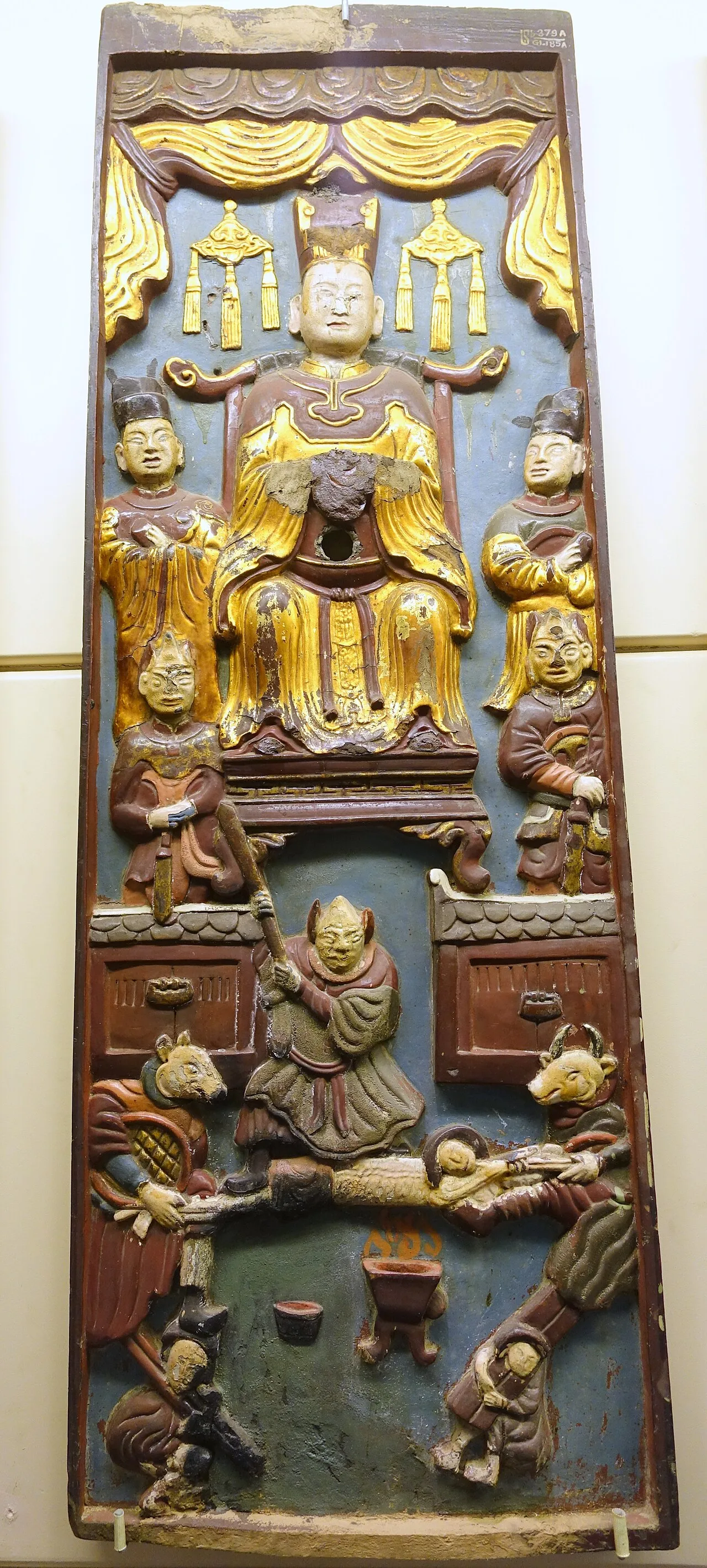
The Ox-Head and Horse-Face in a painting of a hell scene
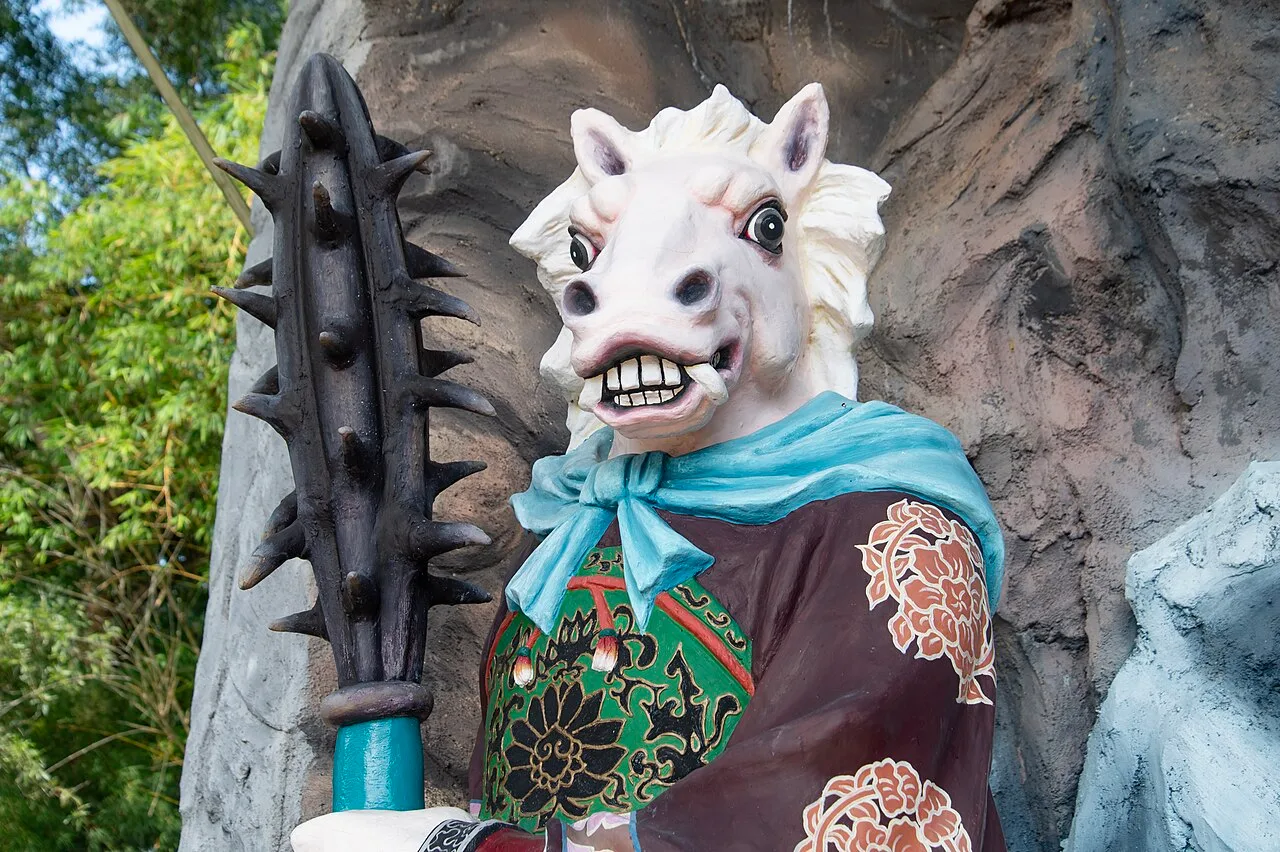
Close-up of the statue of Horse-Face at Haw Par Villa, Singapore.
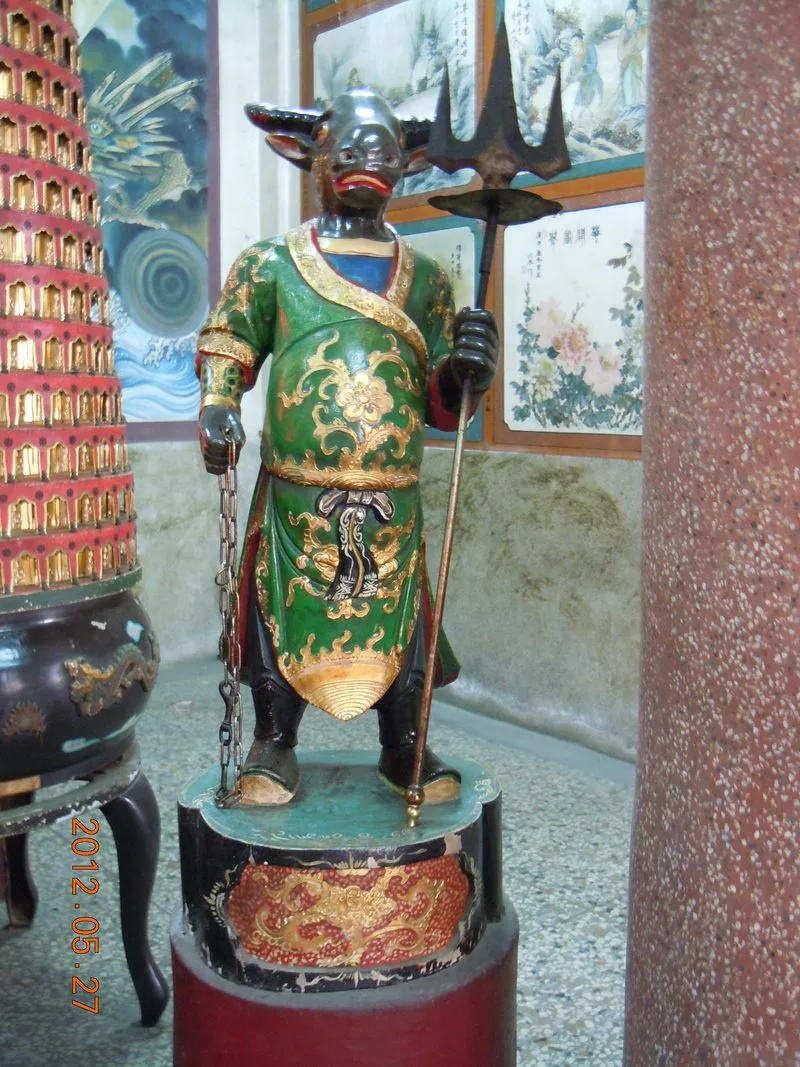
Statue of Ox-Head in Taiwan.
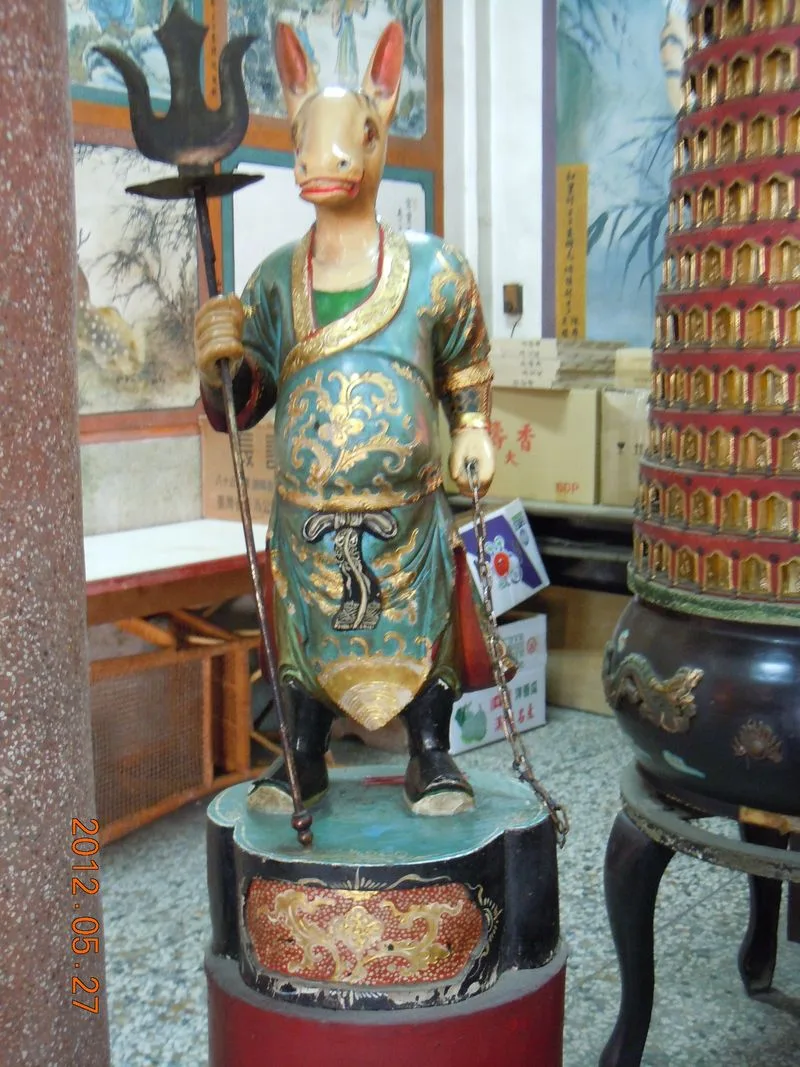
Statue of Horse-Face in Taiwan.
Ox-Head and Horse-Face
Ox-Head and Horse-Face are two guardians of the underworld in Chinese mythology who have human bodies with the head of an ox and the face of a horse.
Chimerical Gatekeepers at Death's Threshold
Human souls crossing into the realm of the dead immediately meet a pair of distinct chimerical figures. Both guardians possess human bodies topped with animal visages, specifically the head of an ox and the face of a horse. Acting as the initial welcoming committee of the afterlife, they personally escort the deceased into the underworld.
From Wikipedia · CC BY-SA 4.0
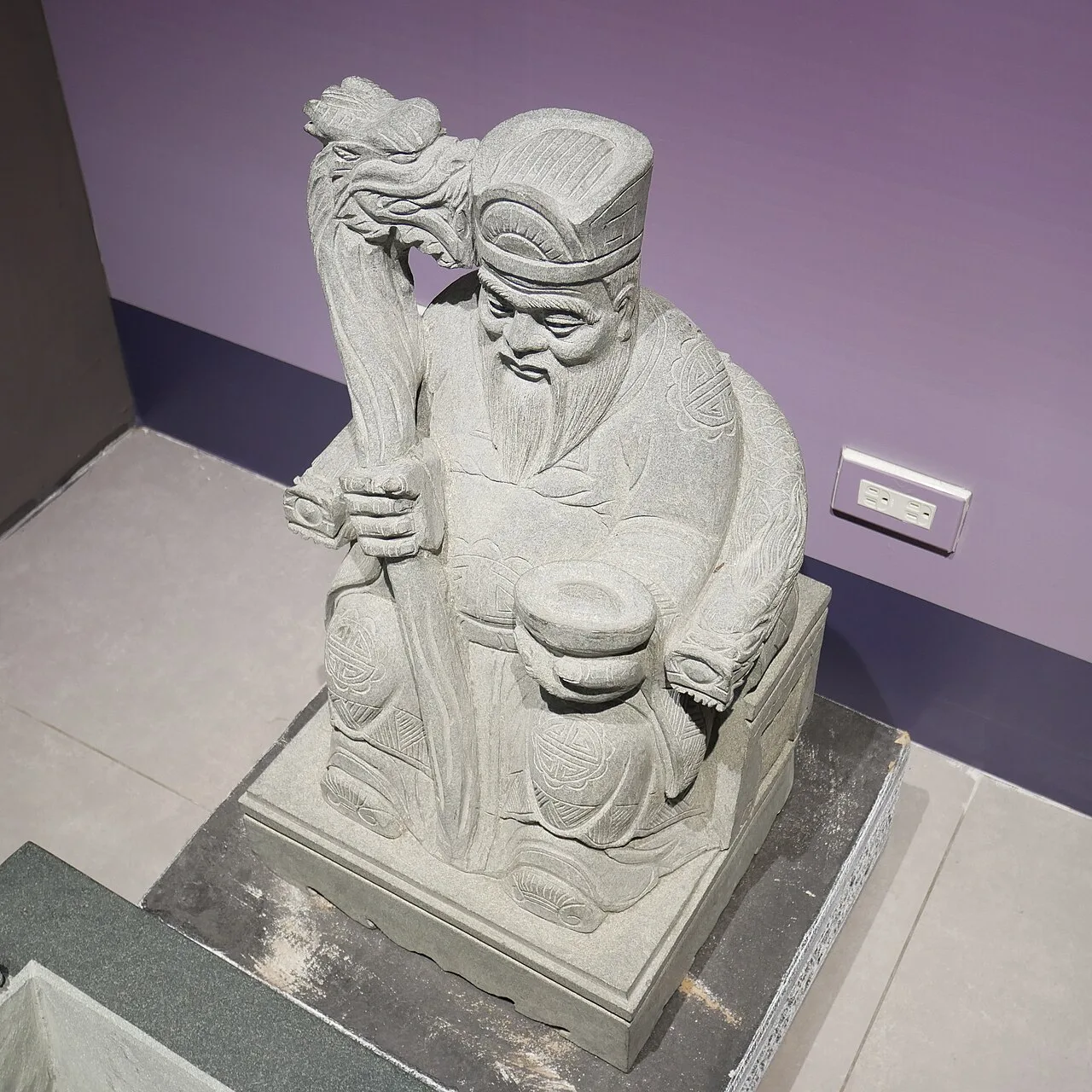
桃園市土地公文化館 土地公神像 20200321

Etymology of Sheshen. Both characters are religious in nature
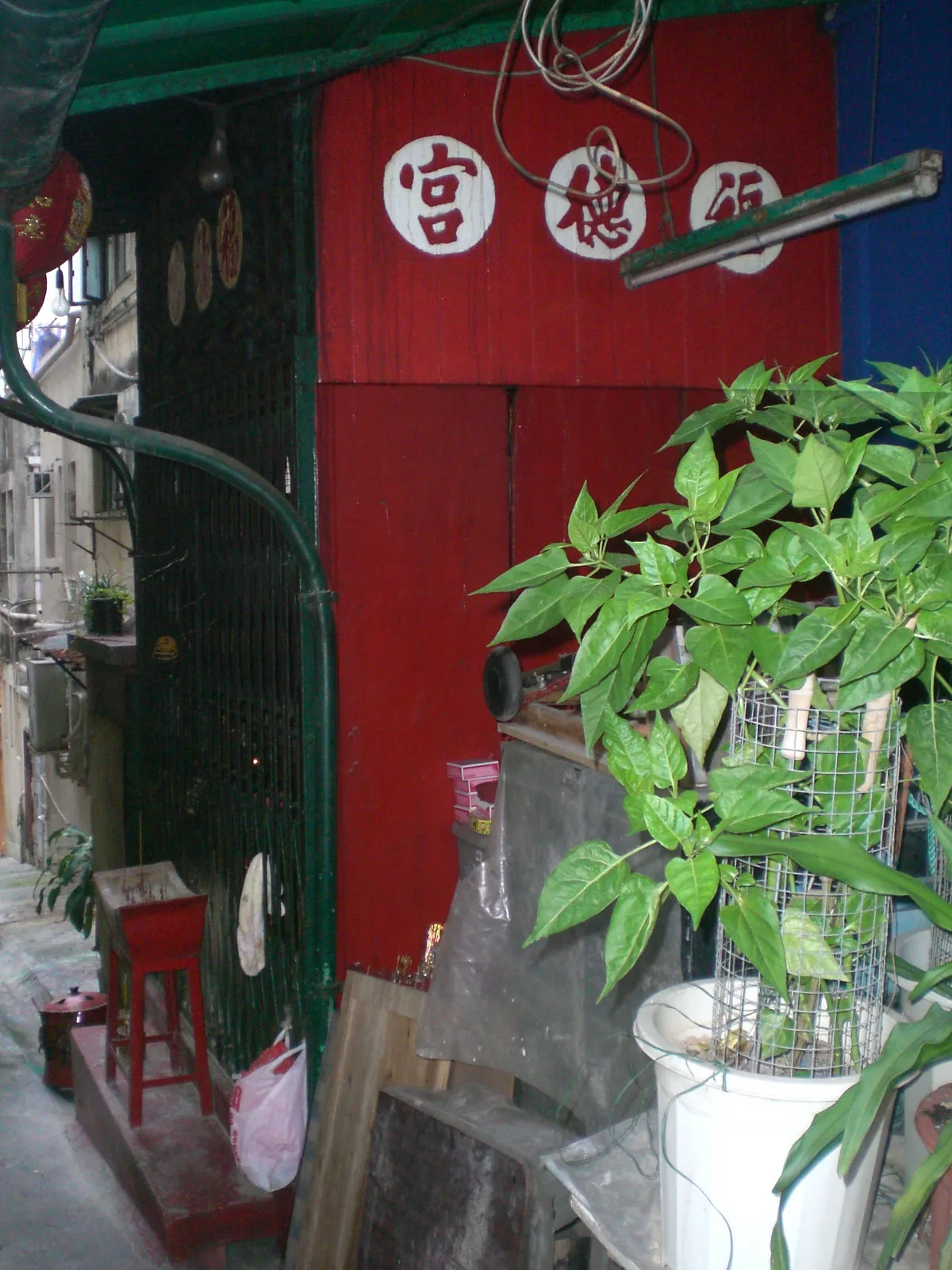
A Tudigong Temple in Sheung Wan, Hong Kong.
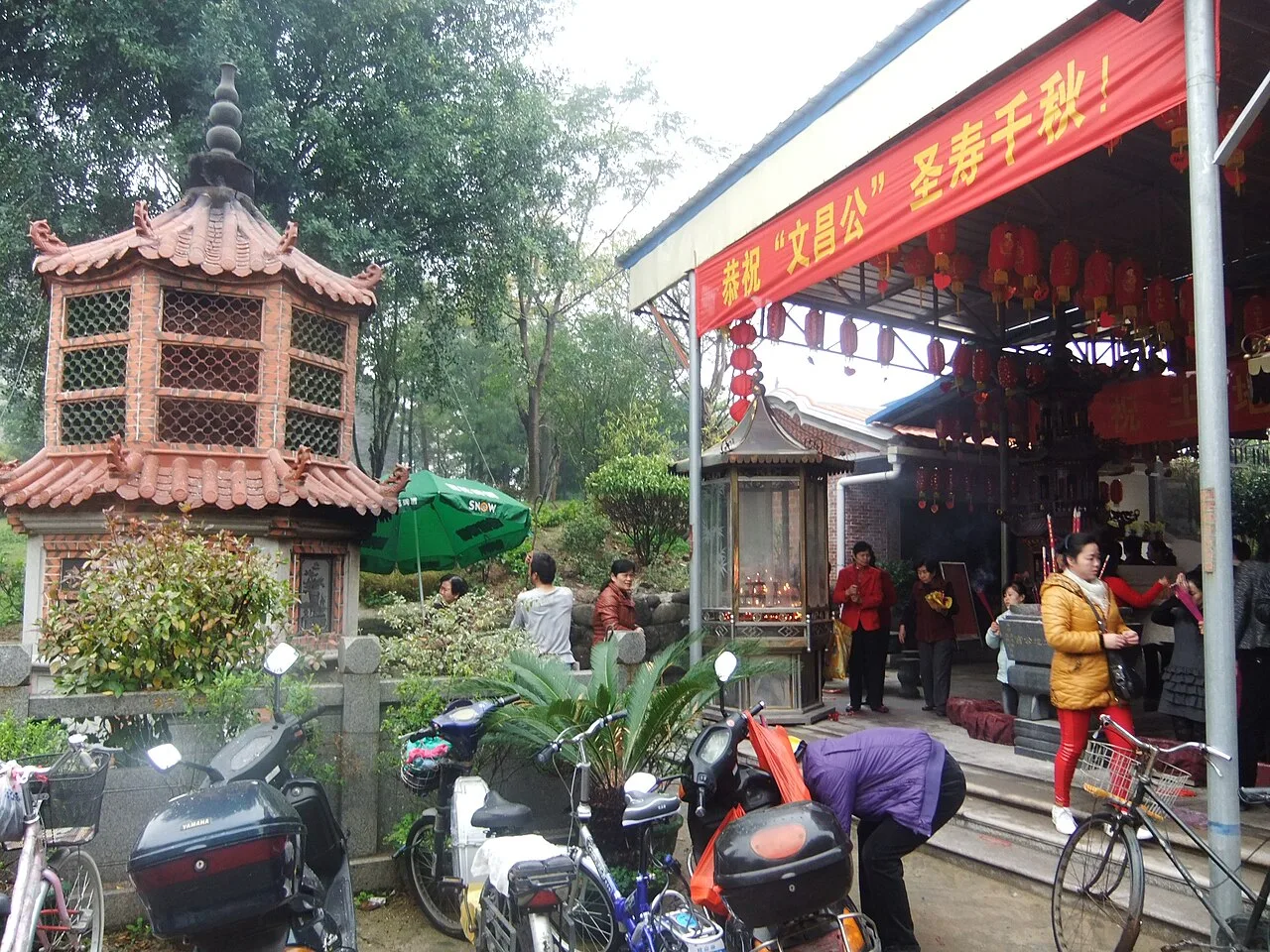
A Tudigong temple in Quanzhou, Fujian.
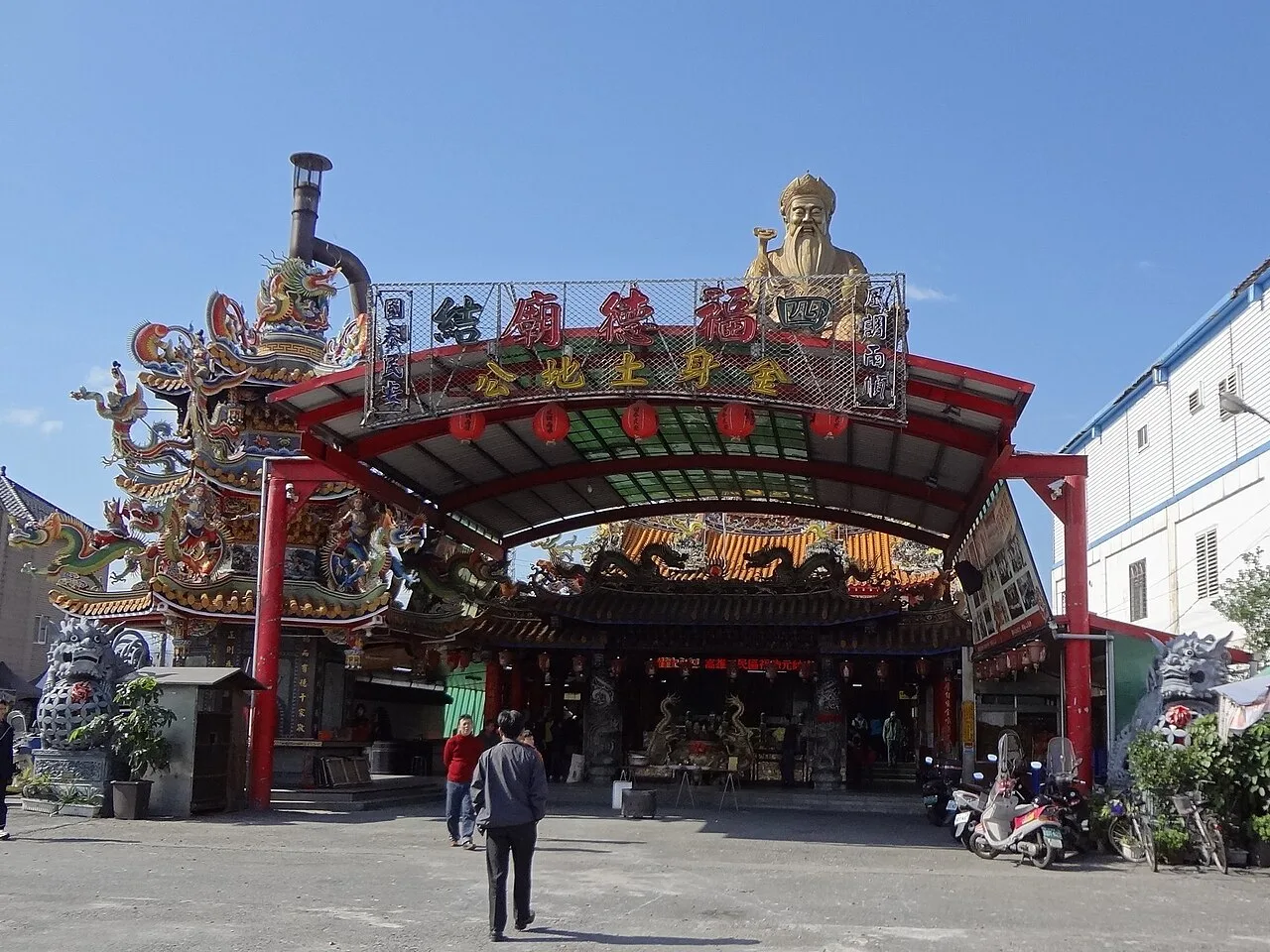
A temple dedicated to Fude in Wujie, Yilan, Taiwan.
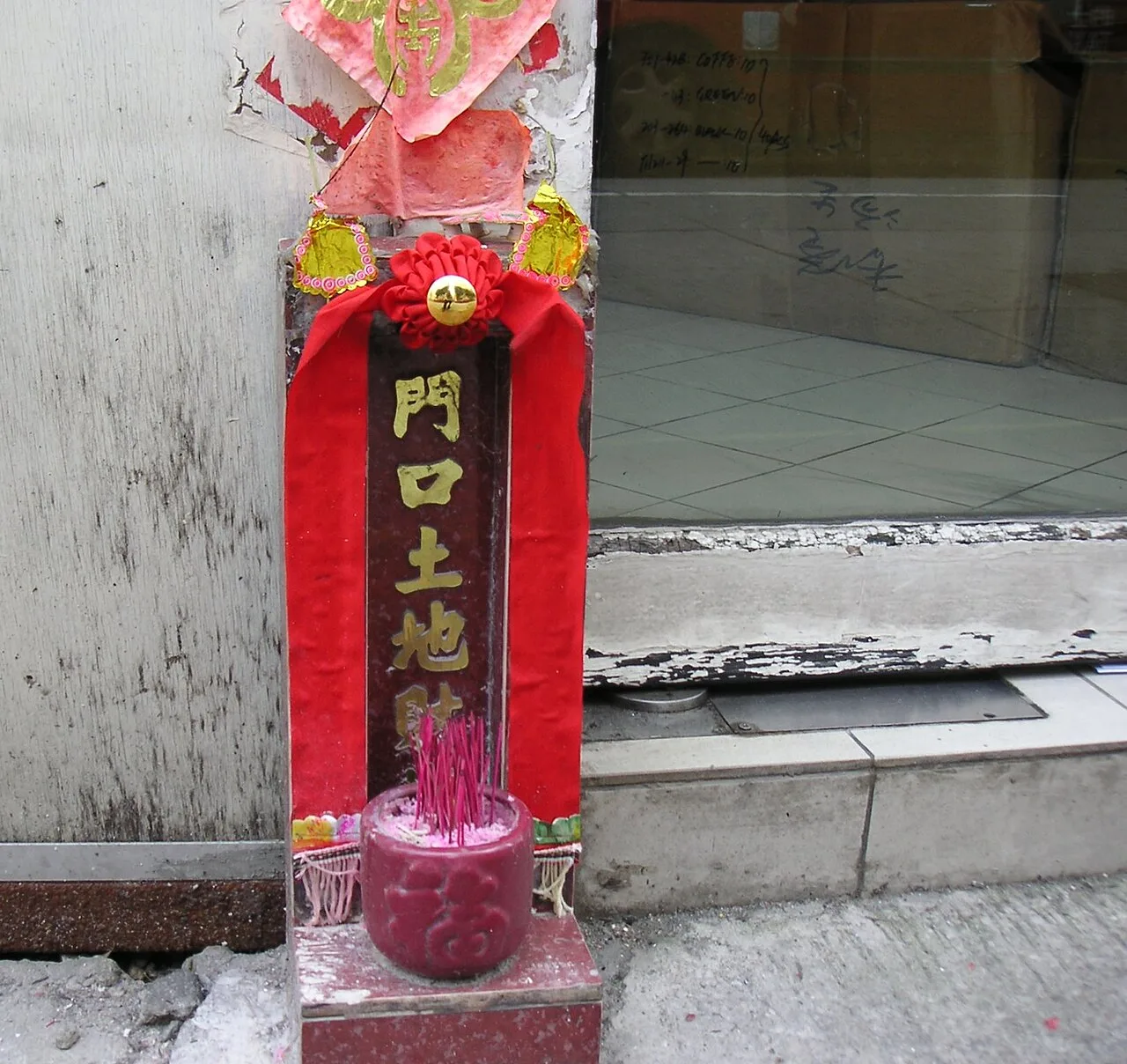
A doorway spirit tablet dedicated to Tudigong in Hong Kong. It invokes Tudigong to bring blessings.
Tudigong
A Tudigong is a Chinese tutelary deity of a specific location and its human community, venerated in Chinese folk religion, Buddhism, Confucianism, and Taoism.
The Divine Etymology Behind Modern Socialism and Sociology
The Chinese character she, ubiquitous today in secular compound words like sociology and socialism, originally represented a deity of the soil. Historically, the character combined ancient symbols for divinity and earth to denote a land deity before evolving toward general concepts of society. Early sacrificial offerings made to these Sheshen spirits eventually transitioned over time directly into the common veneration of Tudigong.
From Wikipedia · CC BY-SA 4.0
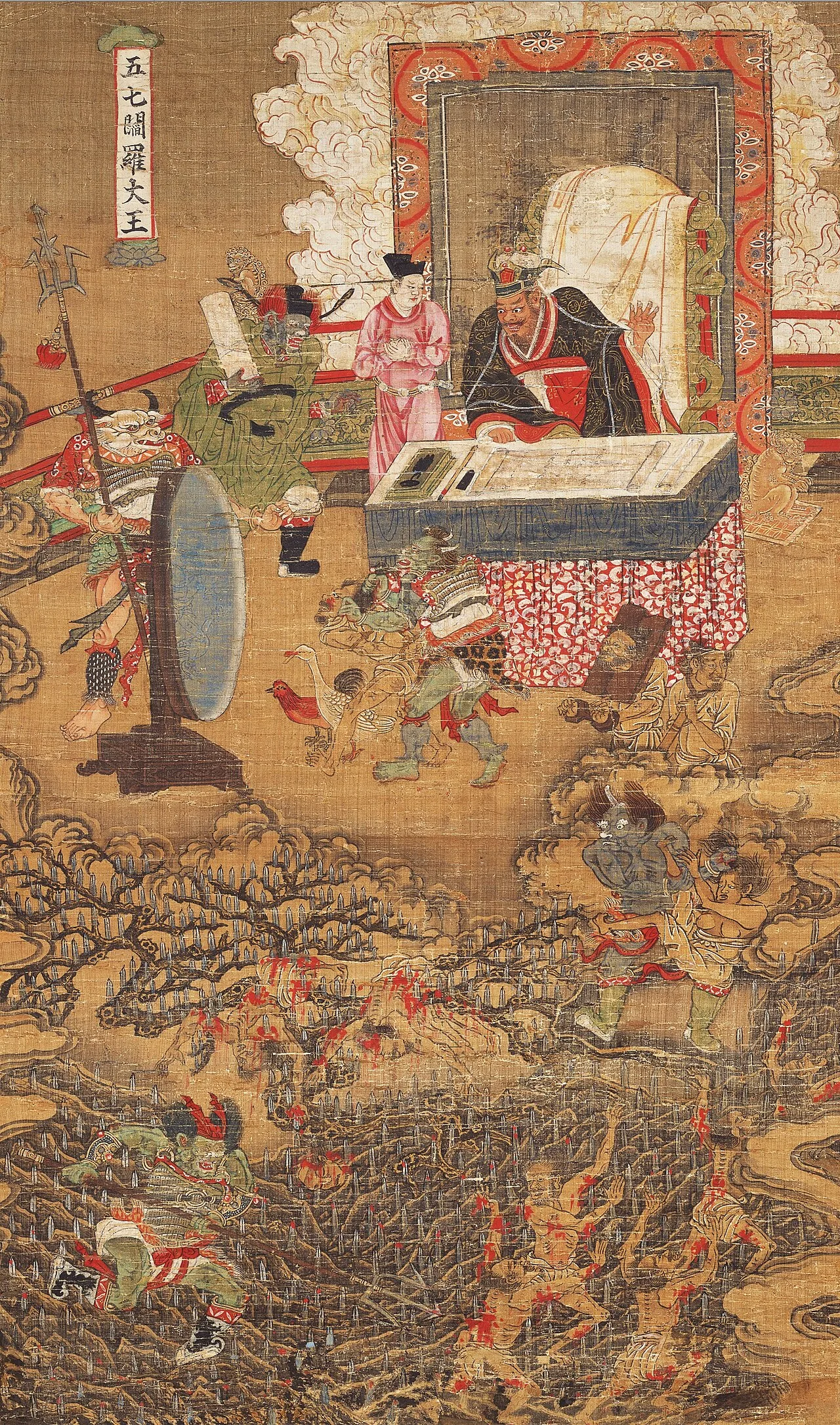
A depiction of Yanluo, one of the Ten Kings of Hell.
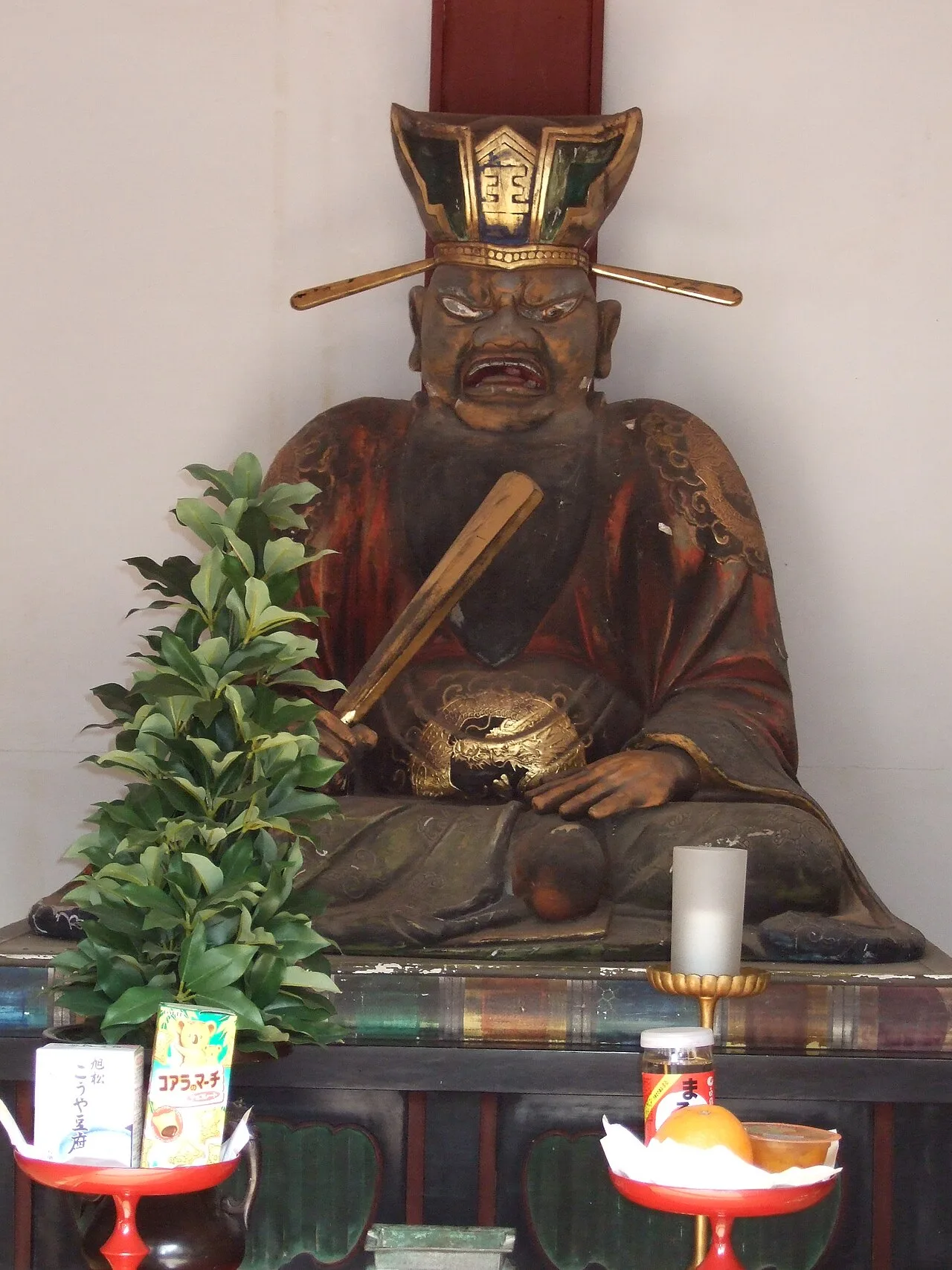
Statue of Yanluo (Enma) at Nariai-ji in Miyazu, Kyoto Prefecture, Japan.
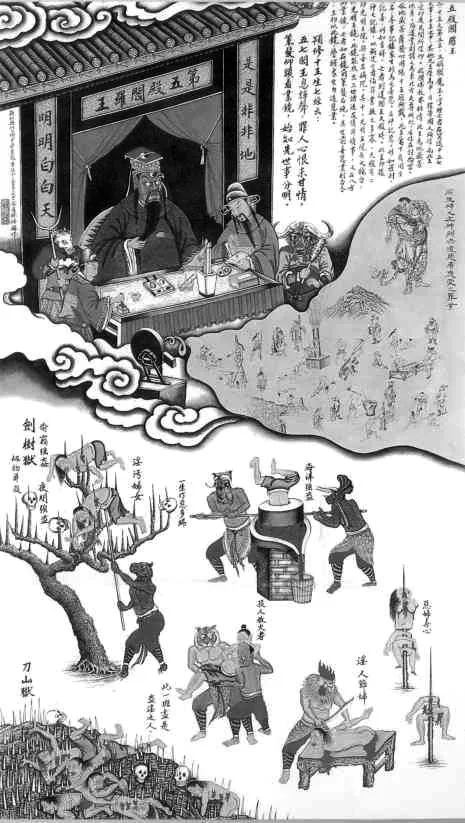
Chinese illustration of Yanluo Wang as a local judge
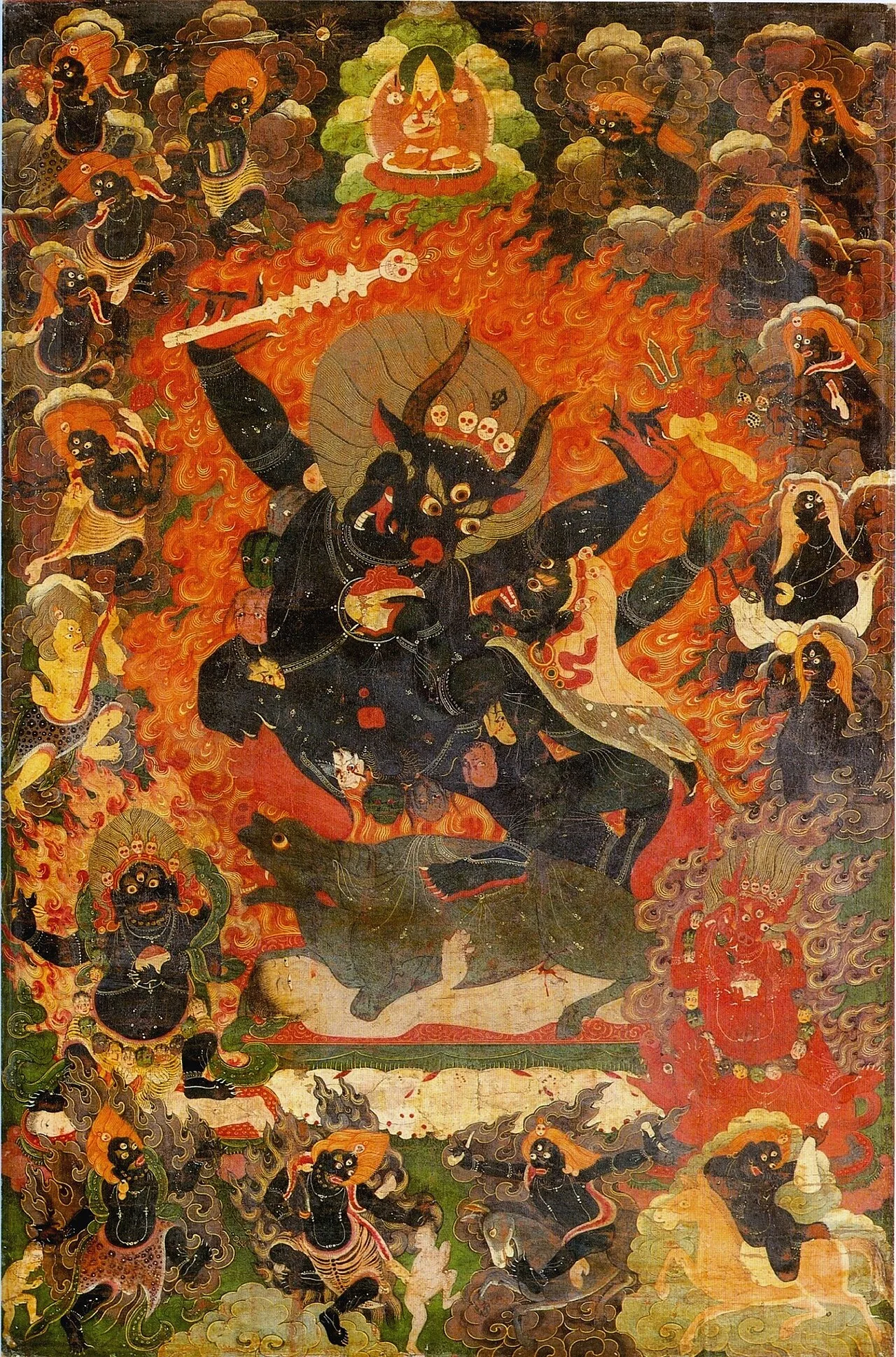
Yama, mid-17th century, Tibet
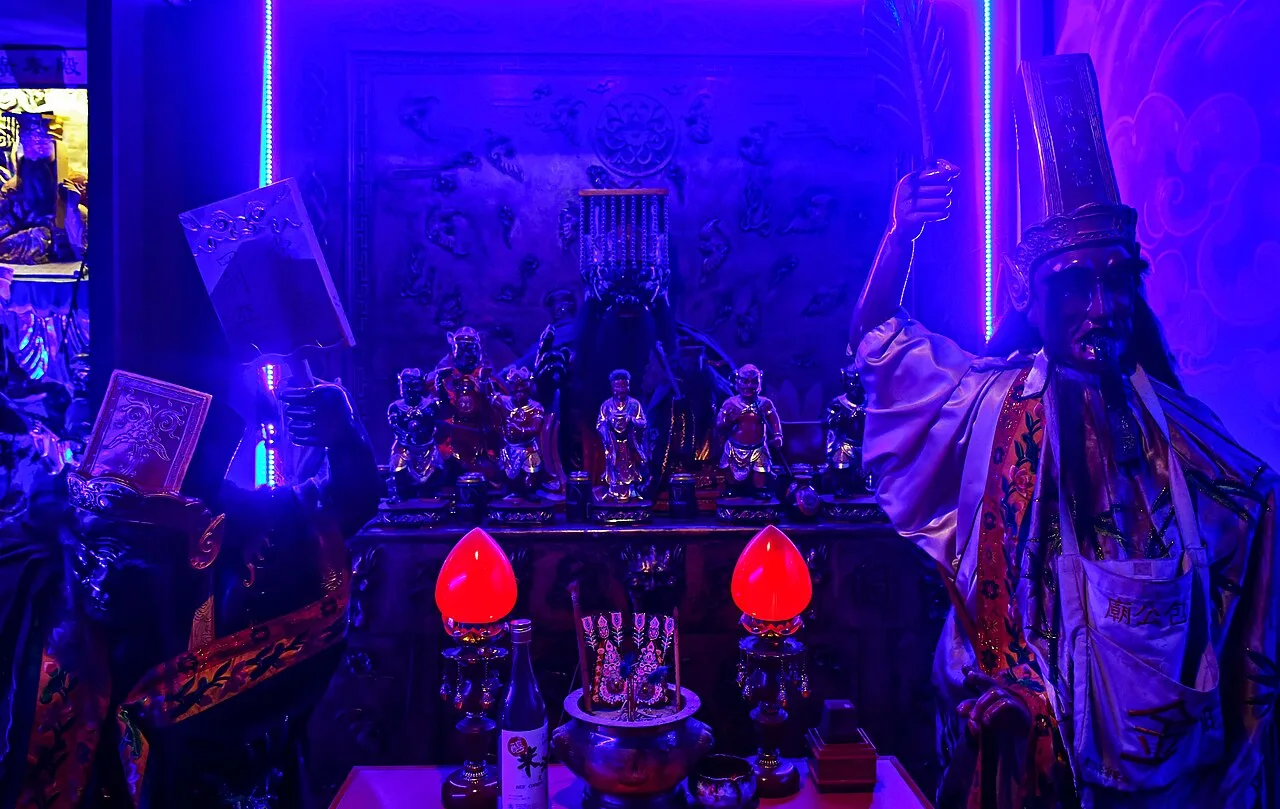
Bao Zheng depicted as Yanluo Wang at Bao Gong Temple, Singapore.
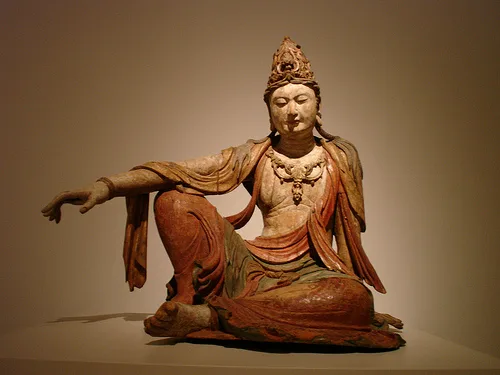
Guanyin 00
Yanluo Wang
In Chinese culture and religion, Yanluo Wang is the god of death and the ruler of Diyu, overseeing the Ten Kings of Hell in its capital of Youdu.
Political Portraiture on Hell Money
Portrayed with a scowling red face, bulging eyes, and a judge's crown bearing the character for king, Yanluo Wang serves as the fifth judge in the underworld. His distinctive appearance bridges ancient temple traditions and modern rituals. Rather than featuring political rulers or statesmen, traditional Chinese hell money prints his likeness in the exact position reserved for heads of state on standard currency.
From Wikipedia · CC BY-SA 4.0