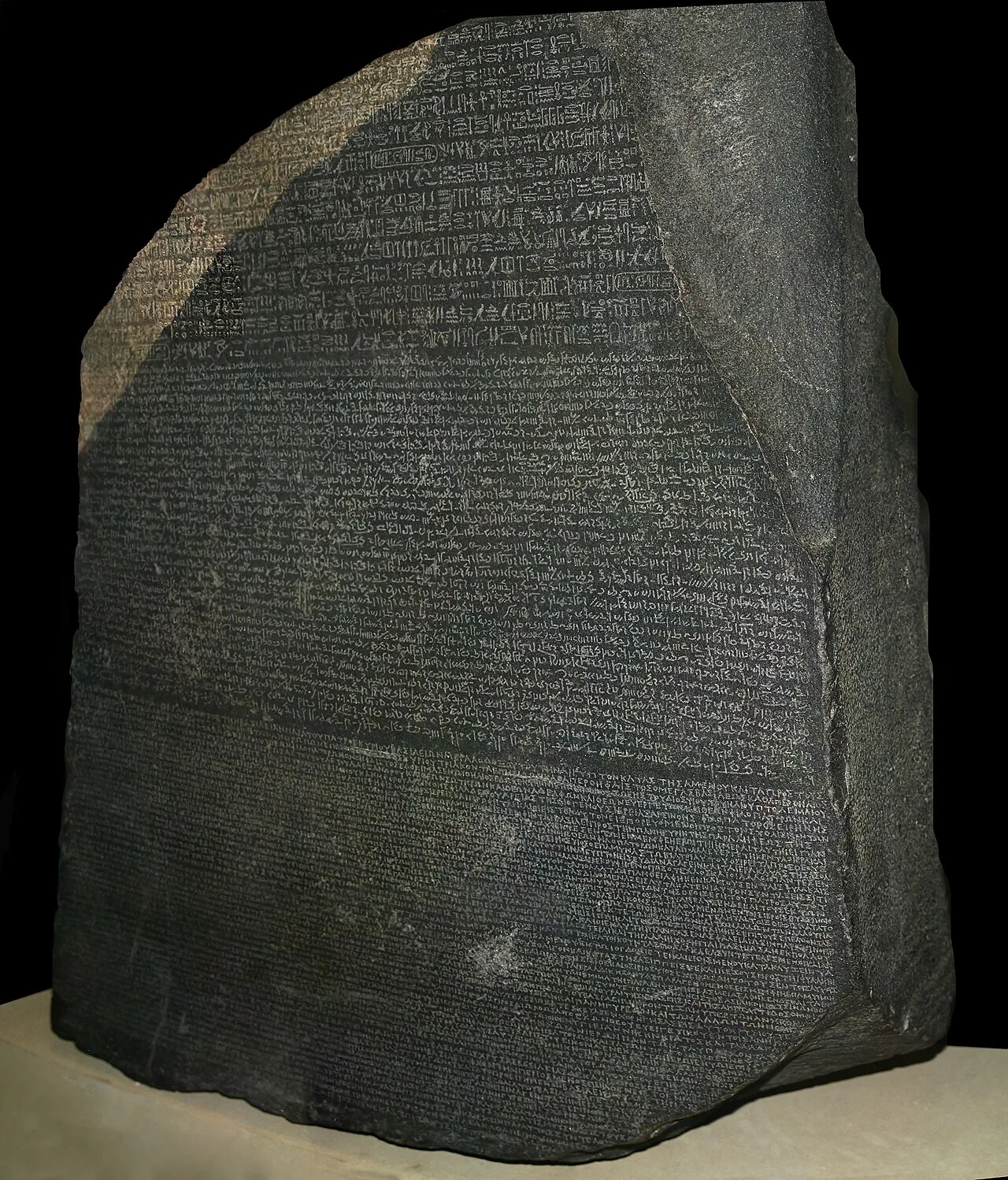
Rosetta Stone
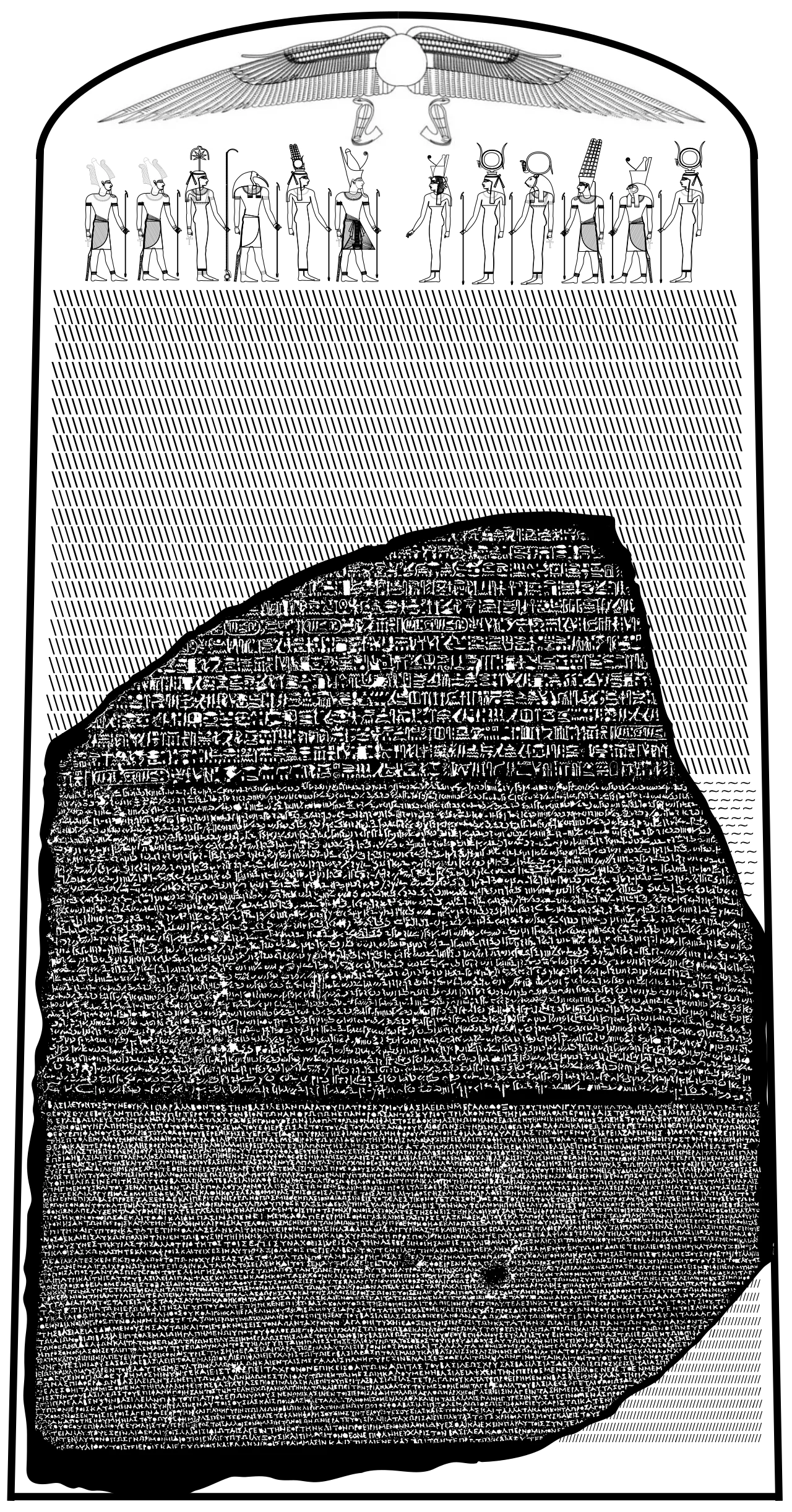
One possible reconstruction of the original stele
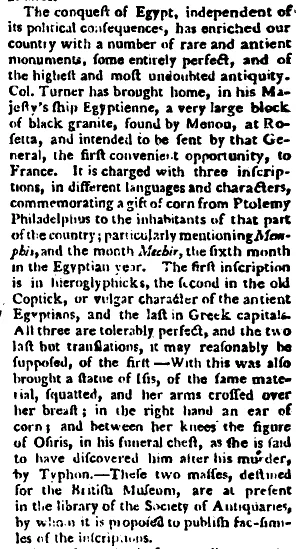
Report of the arrival of the Rosetta Stone in England in The Gentleman's Magazine, 1802
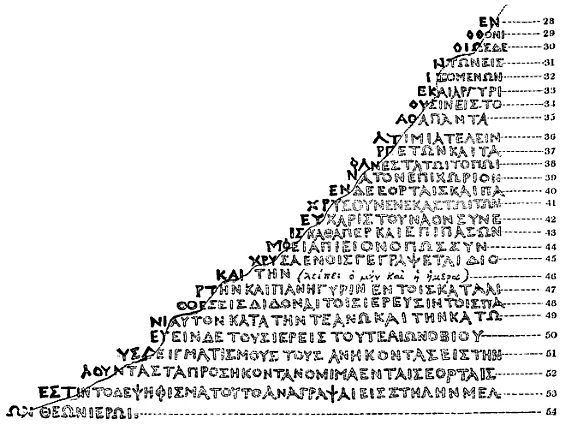
Richard Porson's suggested reconstruction of the missing Greek text (1803)
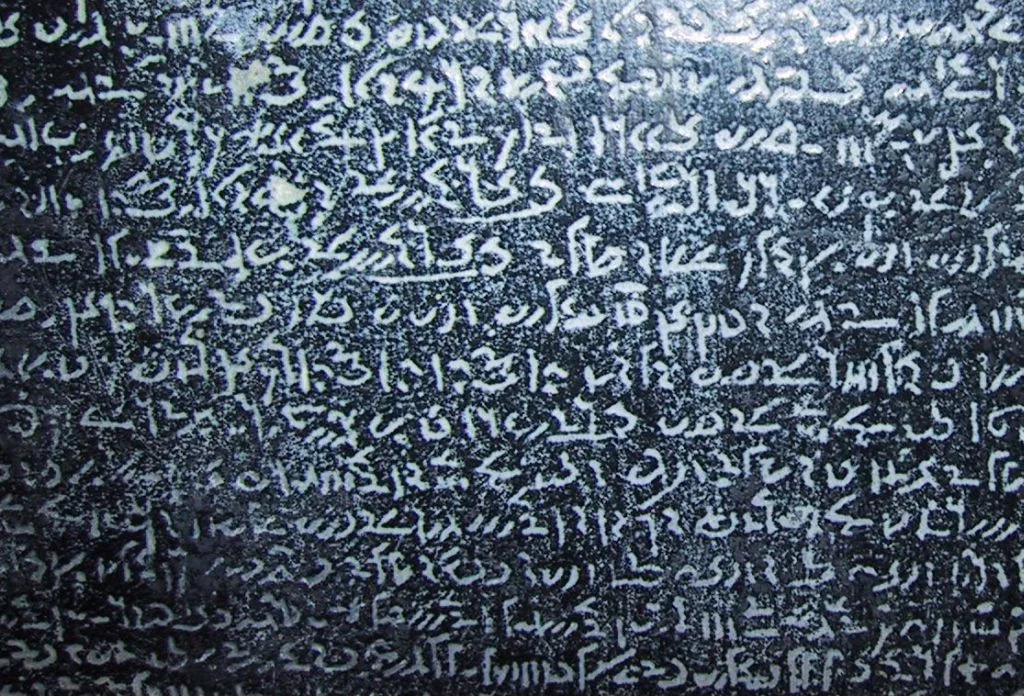
Replica of the Demotic texts
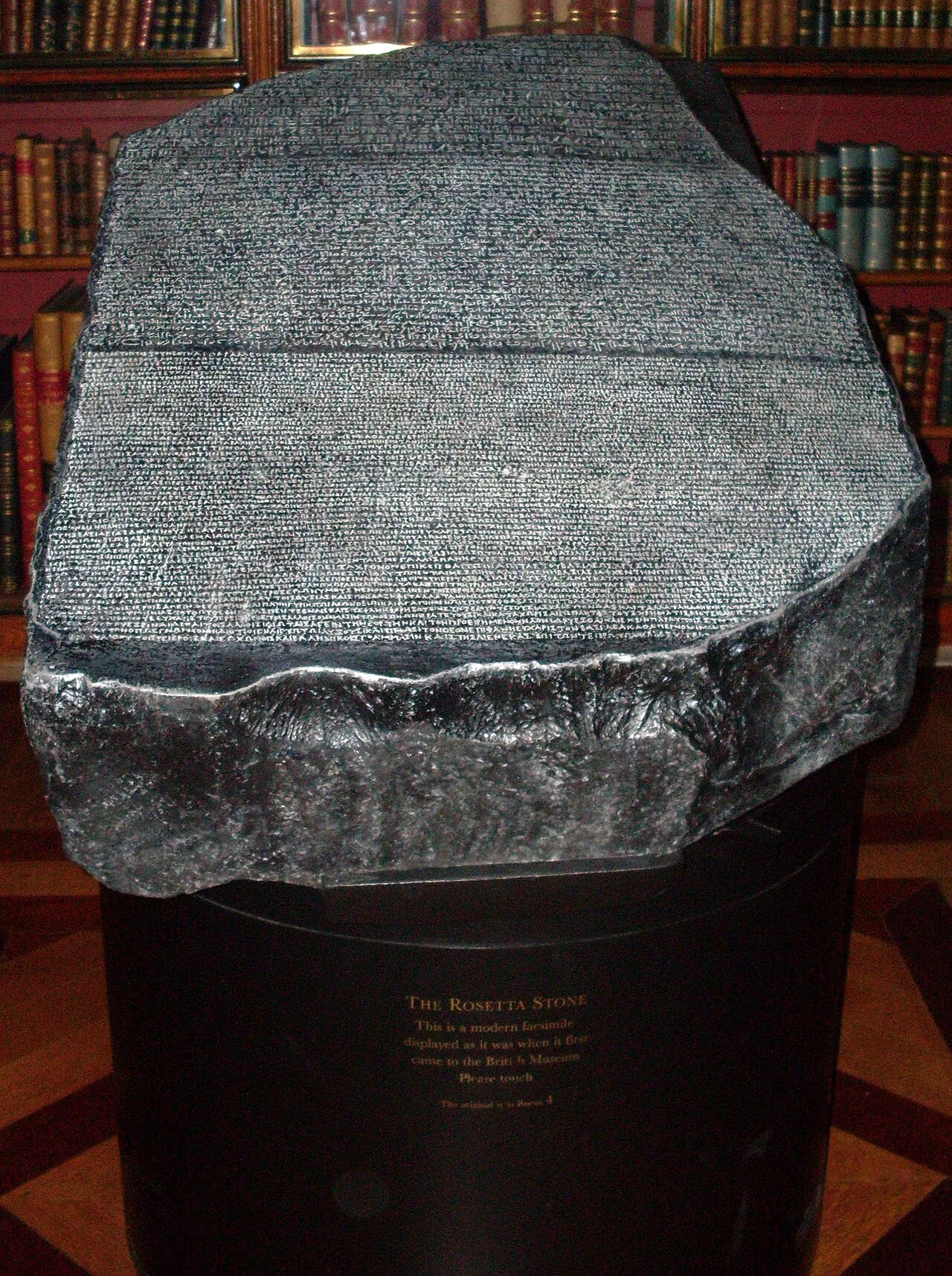
Replica of the Rosetta Stone, displayed as the original used to be, available to touch, in what was the King's Library of the British Museum, now the Enlightenment Gallery
Rosetta Stone
The Rosetta Stone is an ancient granodiorite stele inscribed with a 196 BC decree in three scripts, which proved key to deciphering Ancient Egyptian.
Carnauba Wax and the False Basalt Identity
Museum treatments inadvertently obscured the true geology of the Rosetta Stone for nearly two centuries. Curators applied white chalk to make the inscriptions legible and coated the surface in carnauba wax to guard against visitors' fingers. This layer darkened the slab into what many misidentified as black basalt. A cleaning in 1999 finally removed these additions, exposing the original dark grey rock, its crystalline sparkle, and a distinctive pink vein.
From Wikipedia · CC BY-SA 4.0
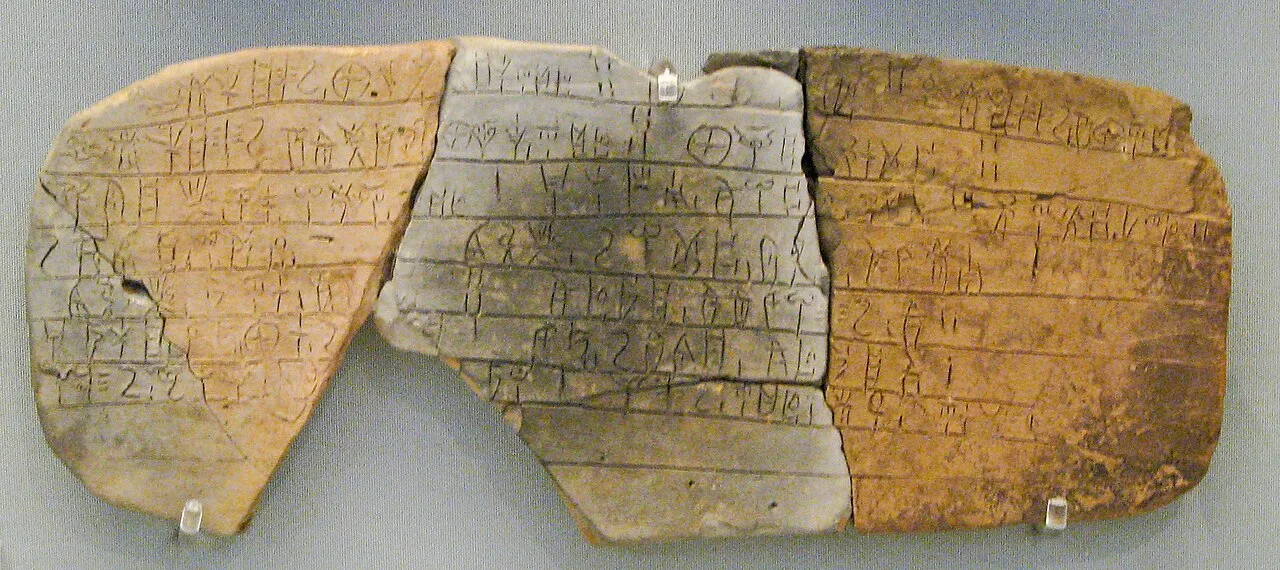
NAMA Linear B tablet of Pylos
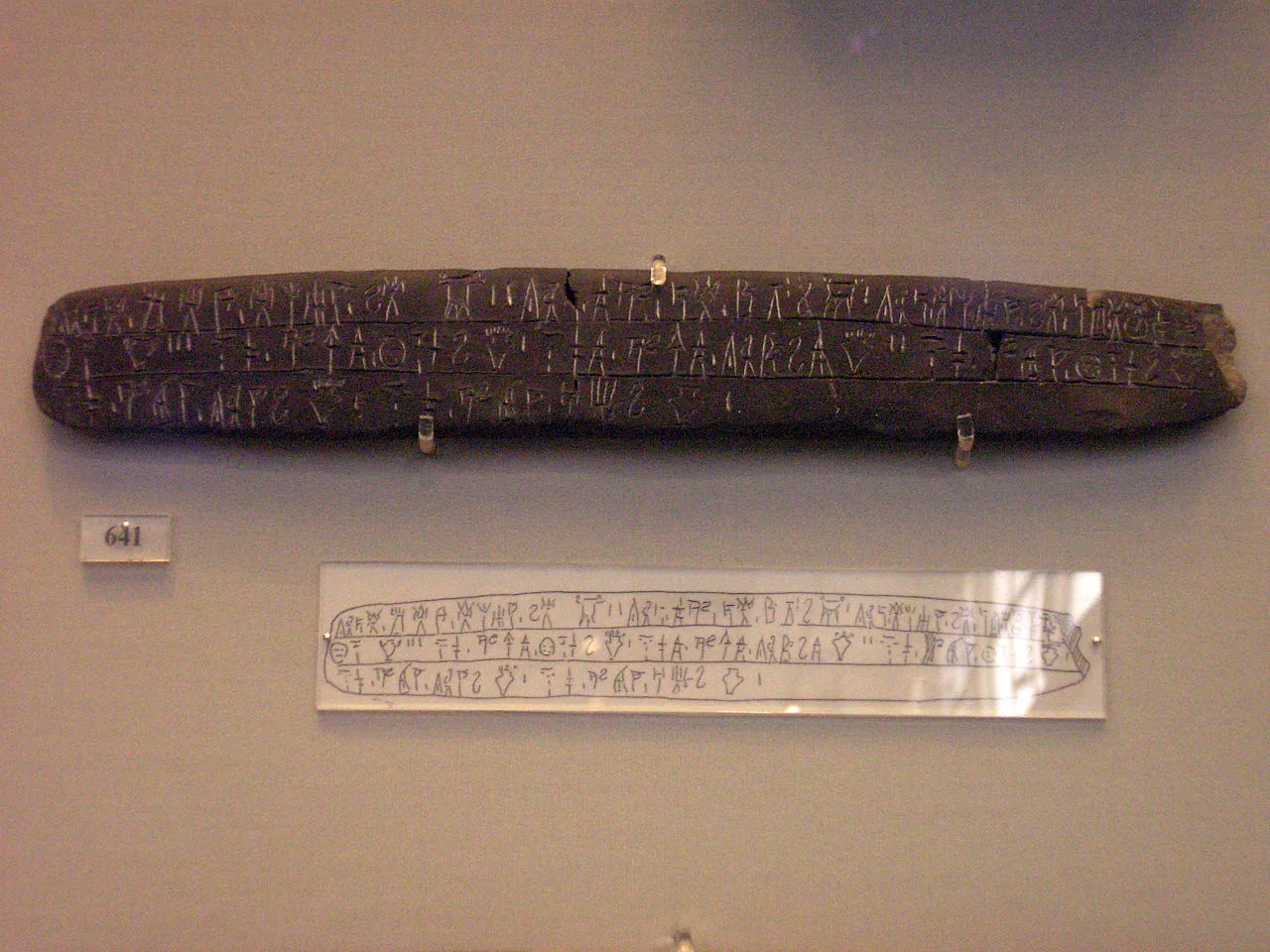
The Tripod tablet, discovered by Carl Blegen at the Palace of Nestor, Pylos, in 1952

Tablet KN Fp 13, discovered by Arthur Evans
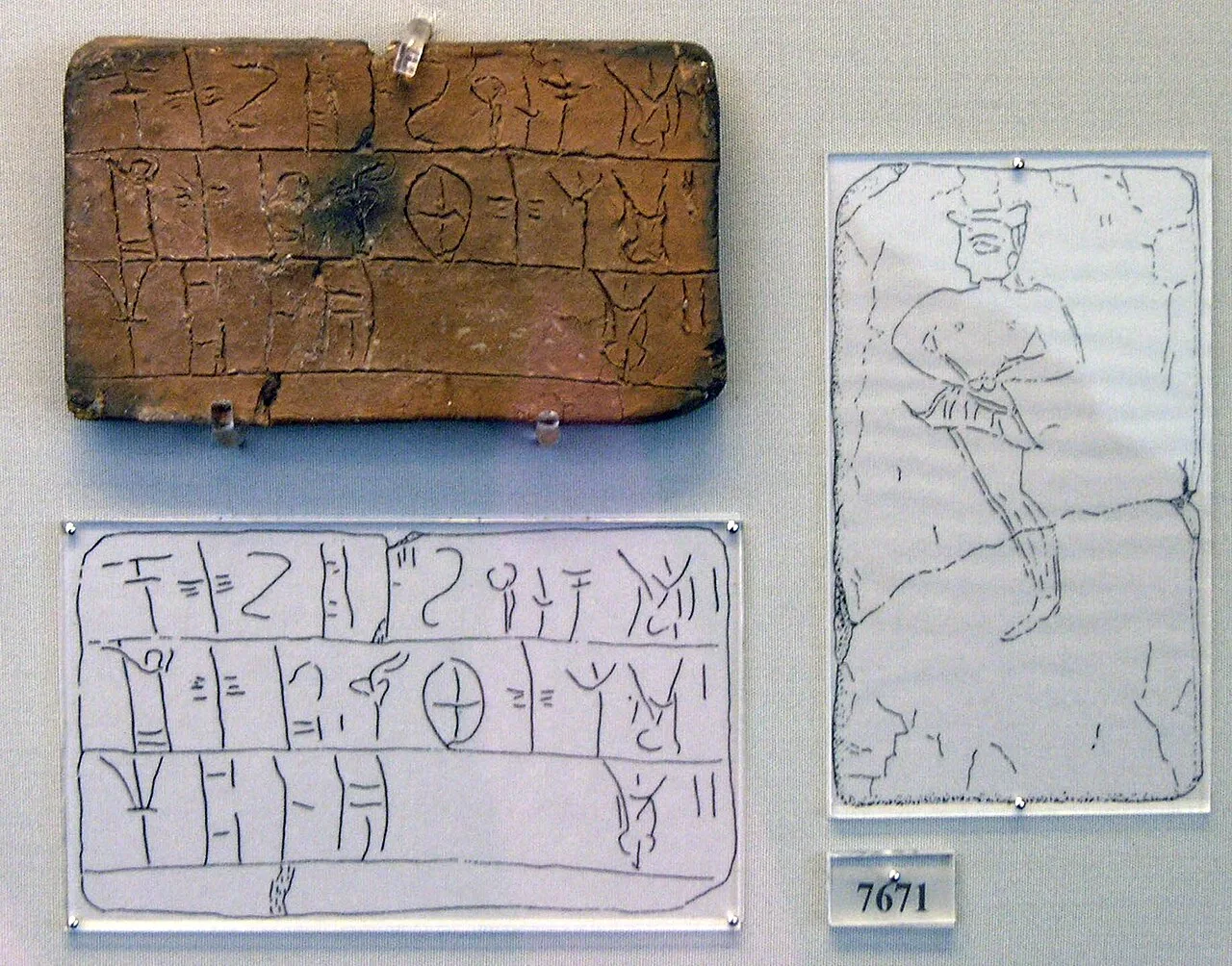
Tablet MY Oe 106 (obverse) exhibited at the Greek National Archaeological Museum.Bottom: tracing of the inscription (obverse).Right: Tracing of the reverse side depicting a male figure.
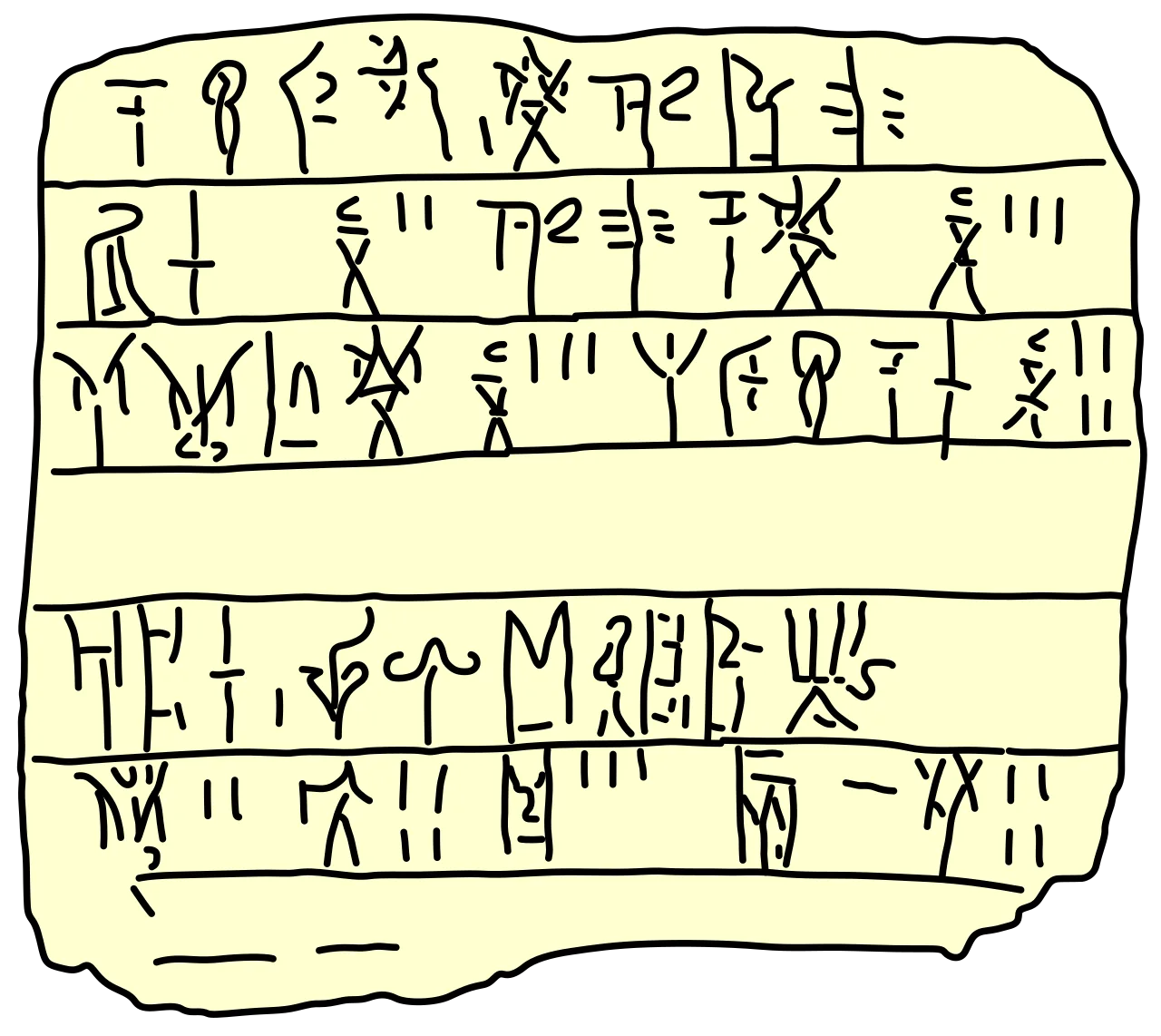
Illustration of a Linear B tablet from Pylos
Linear B
Linear B is a syllabic script used for writing Mycenaean Greek, the earliest attested form of the Greek language.
Preservation Through Destructive Conflagration
Mycenaean administrative records were never intended to serve as permanent historical archives. When the palatial centers collapsed in warfare and disaster, the intense fires that consumed the buildings baked and hardened the raw clay tablets. This catastrophic burning ironically preserved thousands of routine palace inventories that otherwise would have disintegrated and vanished over the centuries.
From Wikipedia · CC BY-SA 4.0
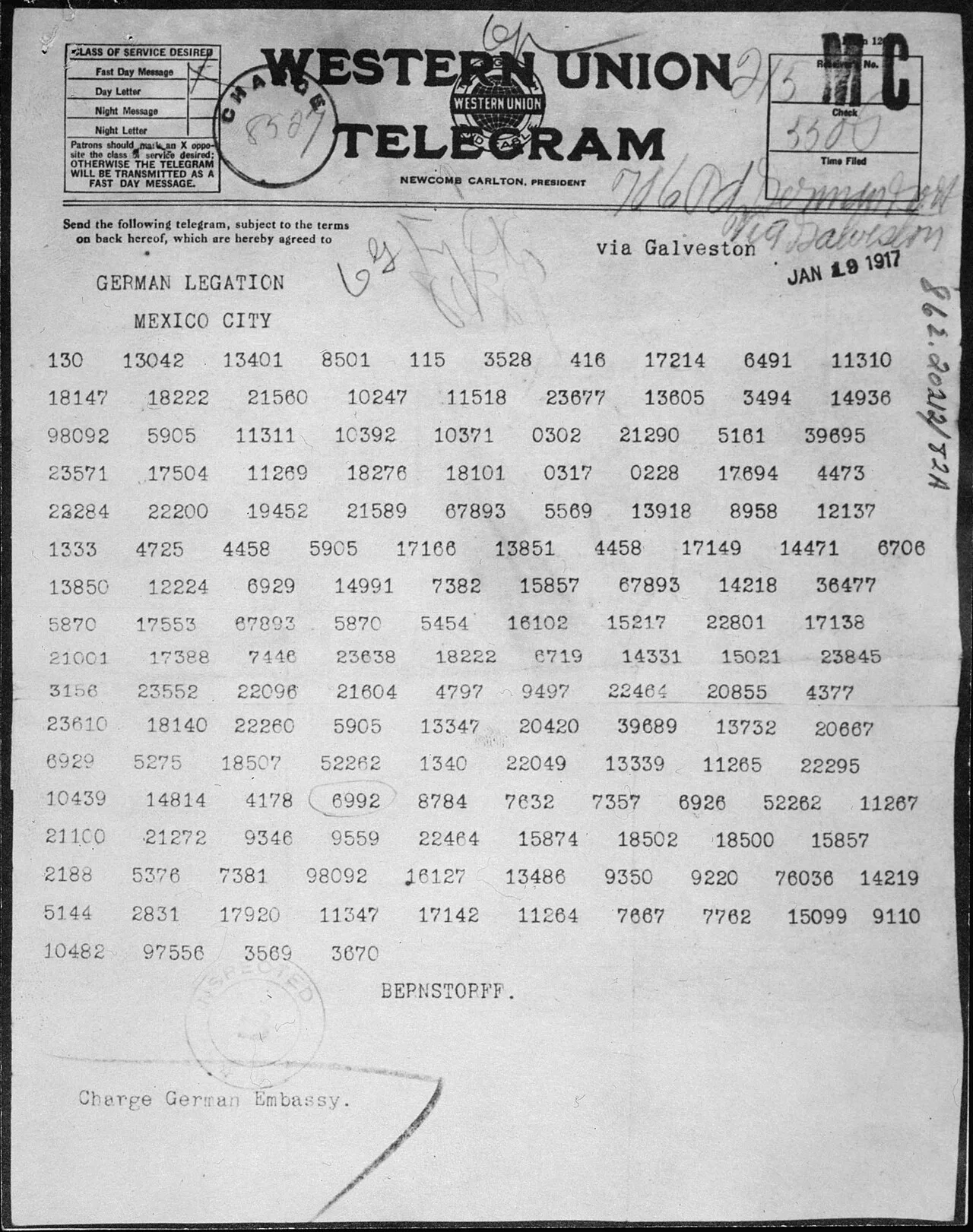
The Zimmermann telegram as it was sent from Washington, D.C., to Ambassador Heinrich von Eckardt, the German ambassador to Mexico.
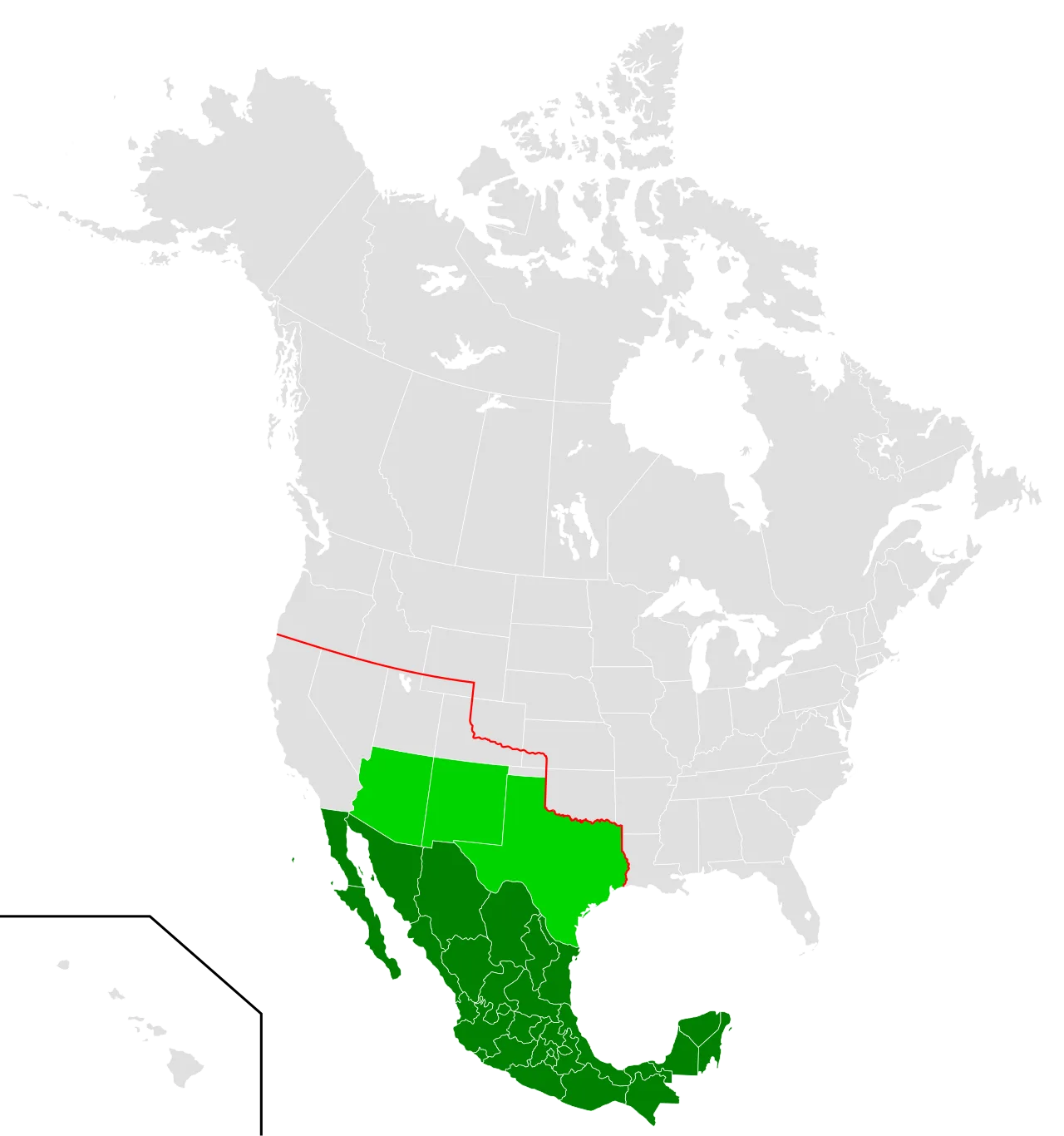
Mexico in 1916 (in dark green); territory promised to Mexico in the Zimmermann telegram (in light green); and the pre-1836 Mexican territory (red line)
![The Mexican Telegraph Company building in Galveston through which the Zimmermann telegram was relayed[19]](https://nwjvzop1xgplmzvt.public.blob.vercel-storage.com/wikifeed/zimmermann-telegram/2-2f73f6cb01.webp)
The Mexican Telegraph Company building in Galveston through which the Zimmermann telegram was relayed[19]
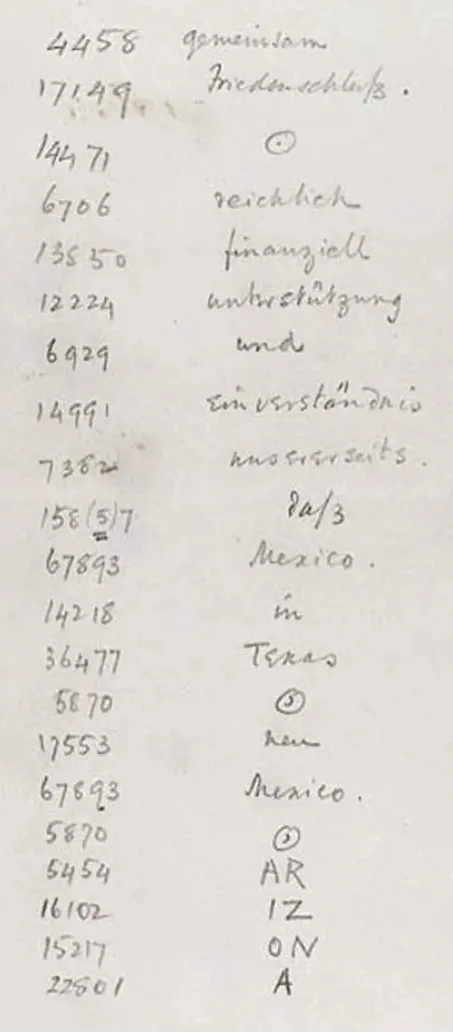
A portion of the telegram as decrypted by British Naval Intelligence codebreakers. Since the word Arizona was not in the German codebook, it had to be split into phonetic syllables.
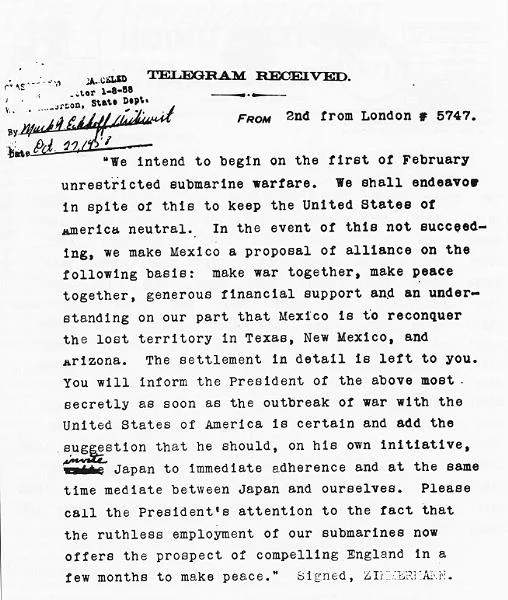
The telegram, completely decrypted and translated
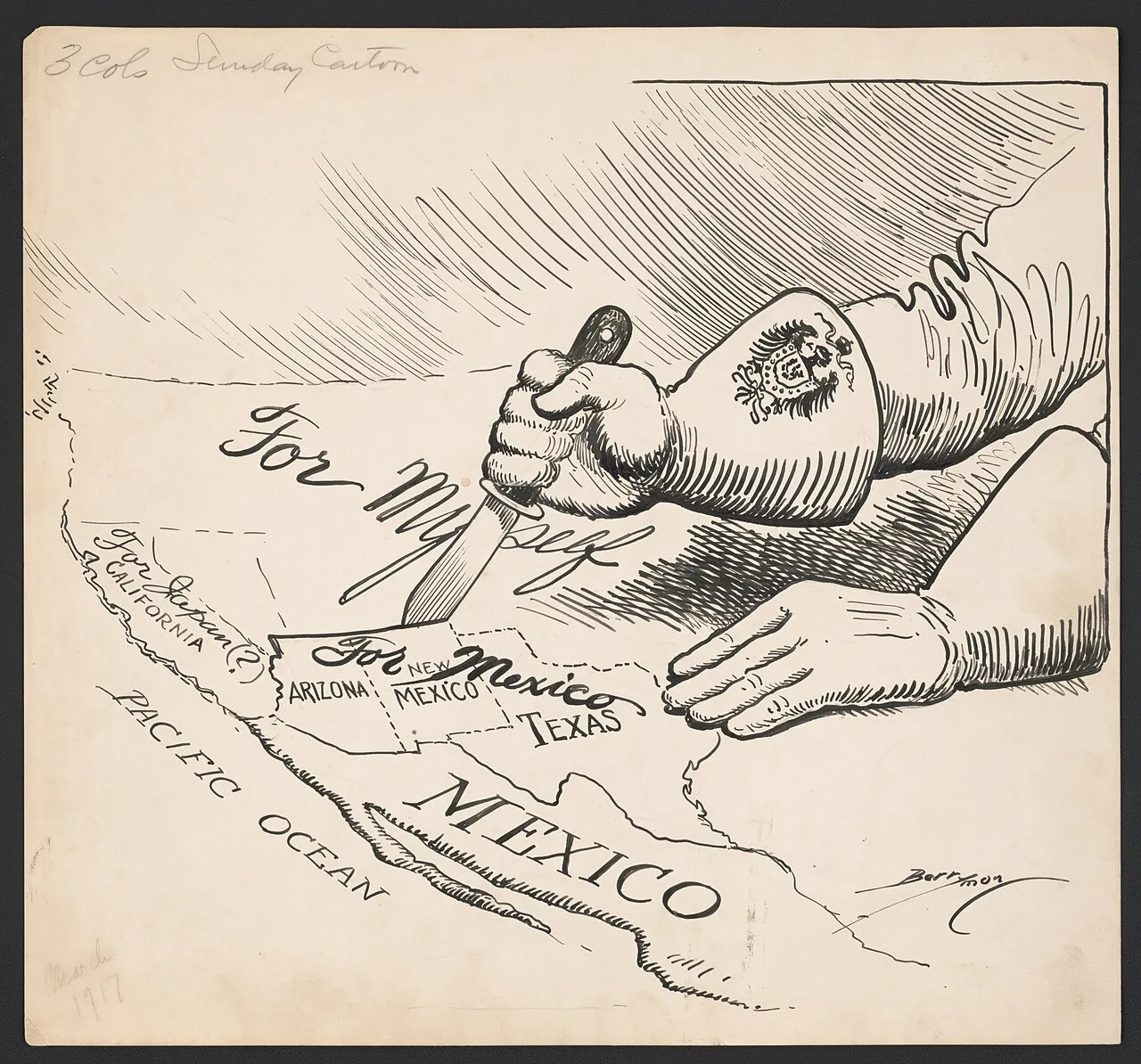
1917 political cartoon about the Zimmermann telegram
Zimmermann Telegram
The Zimmermann Telegram was a secret 1917 German diplomatic proposal for a military alliance with Mexico should the United States enter World War I against Germany.
An Abandoned Codebook in Afghanistan
The British interception of the telegram hinged on a distant military failure in Central Asia. British intelligence could not have broken the transmission without the codebook abandoned by Wilhelm Wassmuss during the Niedermayer–Hentig Expedition to Afghanistan. Recovered by Allied forces, this single document provided the essential foundation that allowed the British to decrypt the Zimmermann telegram.
From Wikipedia · CC BY-SA 4.0
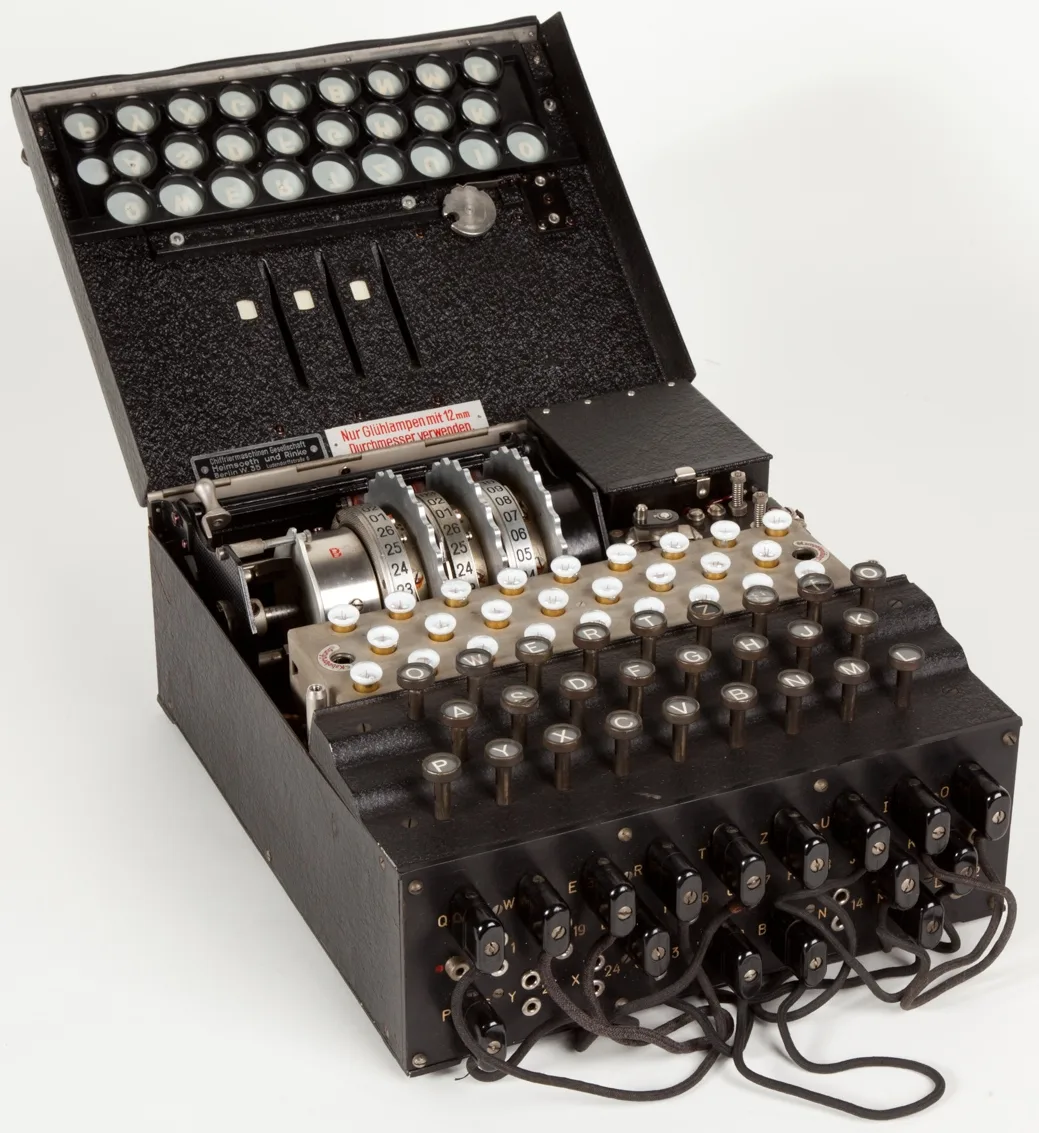
Military Model Enigma I, in use from 1930
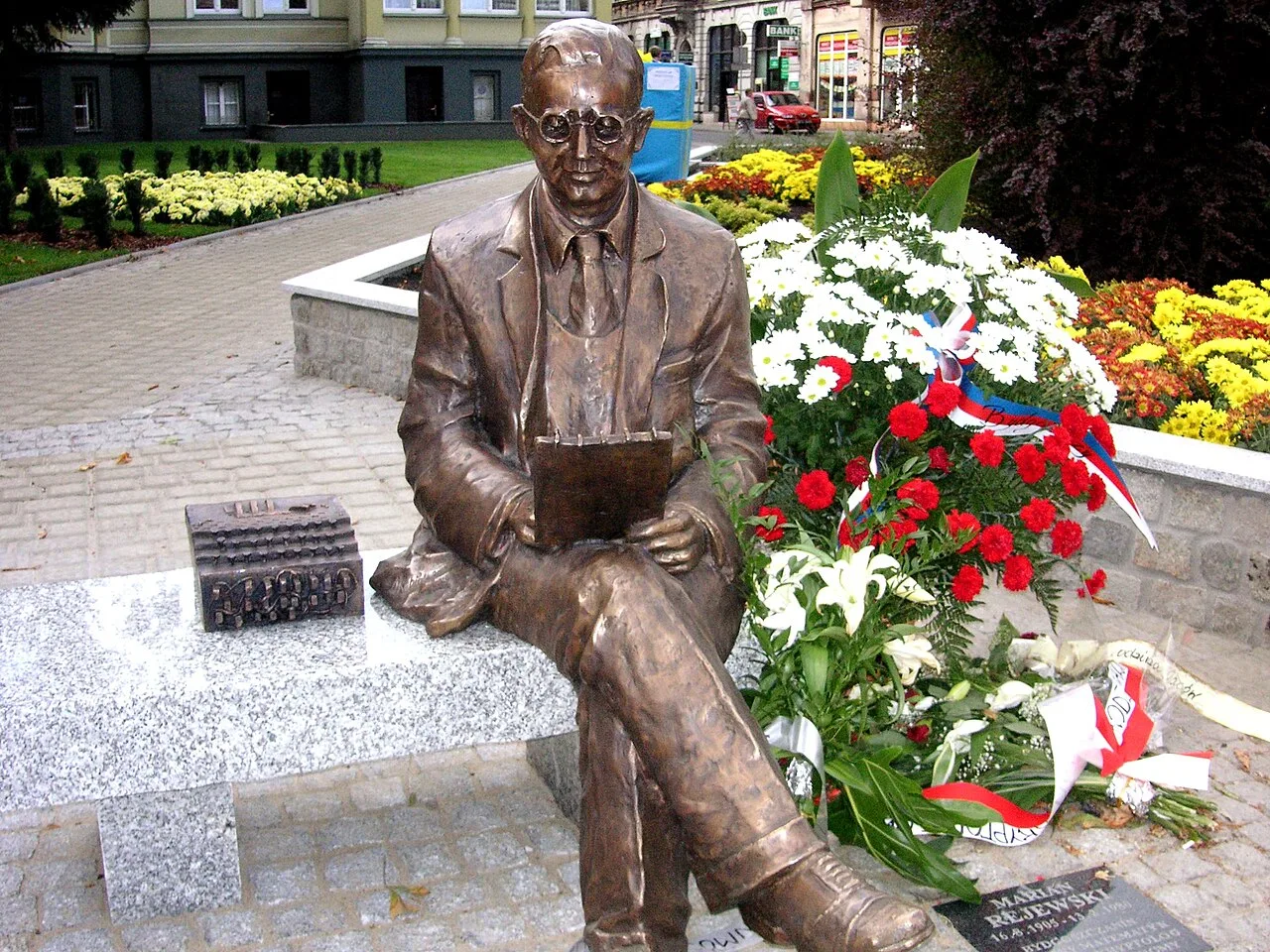
A memorial in Bydgoszcz, Poland, to Marian Rejewski, the mathematician who, in 1932, first broke Enigma and, in July 1939, helped educate the French and British about Polish methods of Enigma decryption
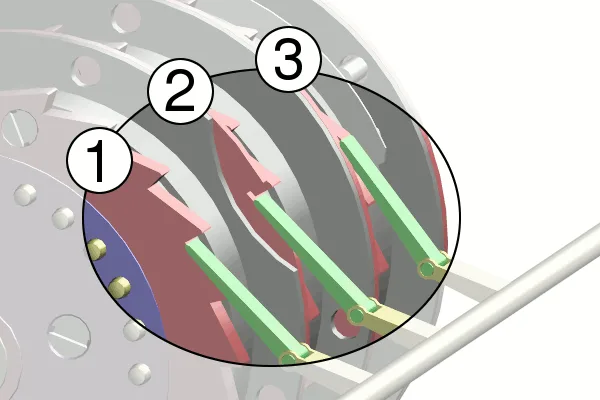
The Enigma stepping motion seen from the side away from the operator. All three ratchet pawls (green) push in unison as a key is depressed. For the first rotor (1), which to the operator is the right-hand rotor, the ratchet (red) is always engaged, and steps with each keypress. Here, the middle rotor (2) is engaged, because the notch in the first rotor is aligned with the pawl; it will step (turn over) with the first rotor. The third rotor (3) is not engaged, because the notch in the second rotor is not aligned to the pawl, so it will not engage with the rachet.
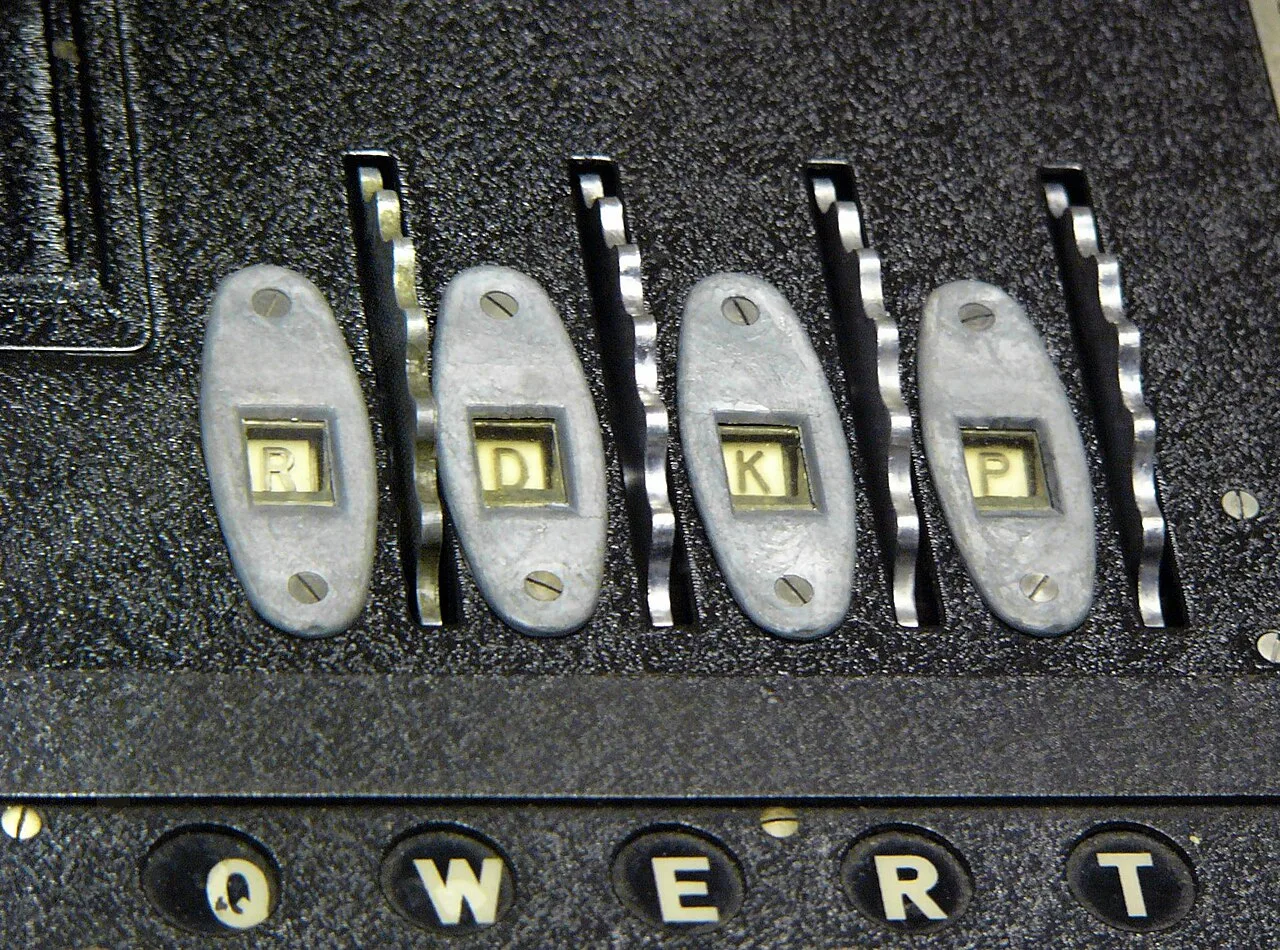
With the inner lid down, the Enigma was ready for use. The finger wheels of the rotors protruded through the lid, allowing the operator to set the rotors, and their current position, here RDKP, was visible to the operator through a set of windows.
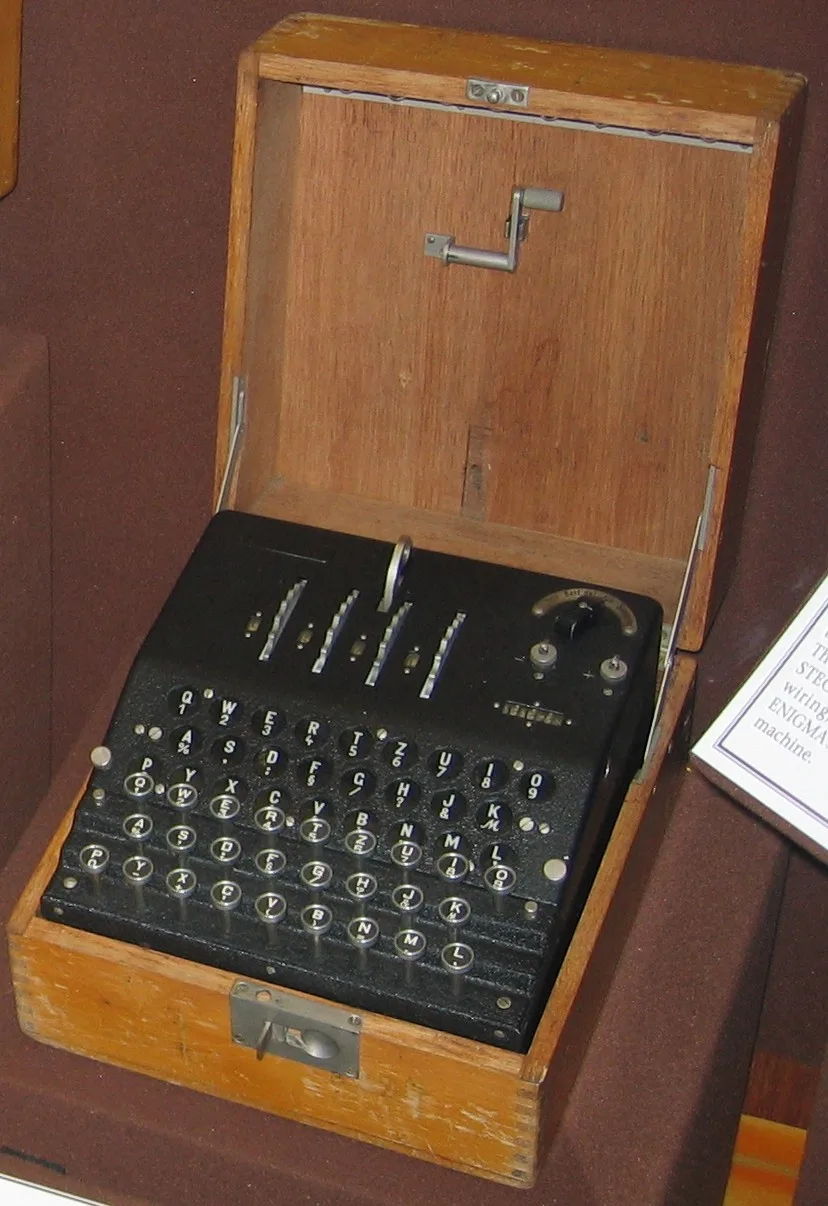
Enigma G, used by the Abwehr, had four rotors, no plugboard, and multiple notches on the rotors.
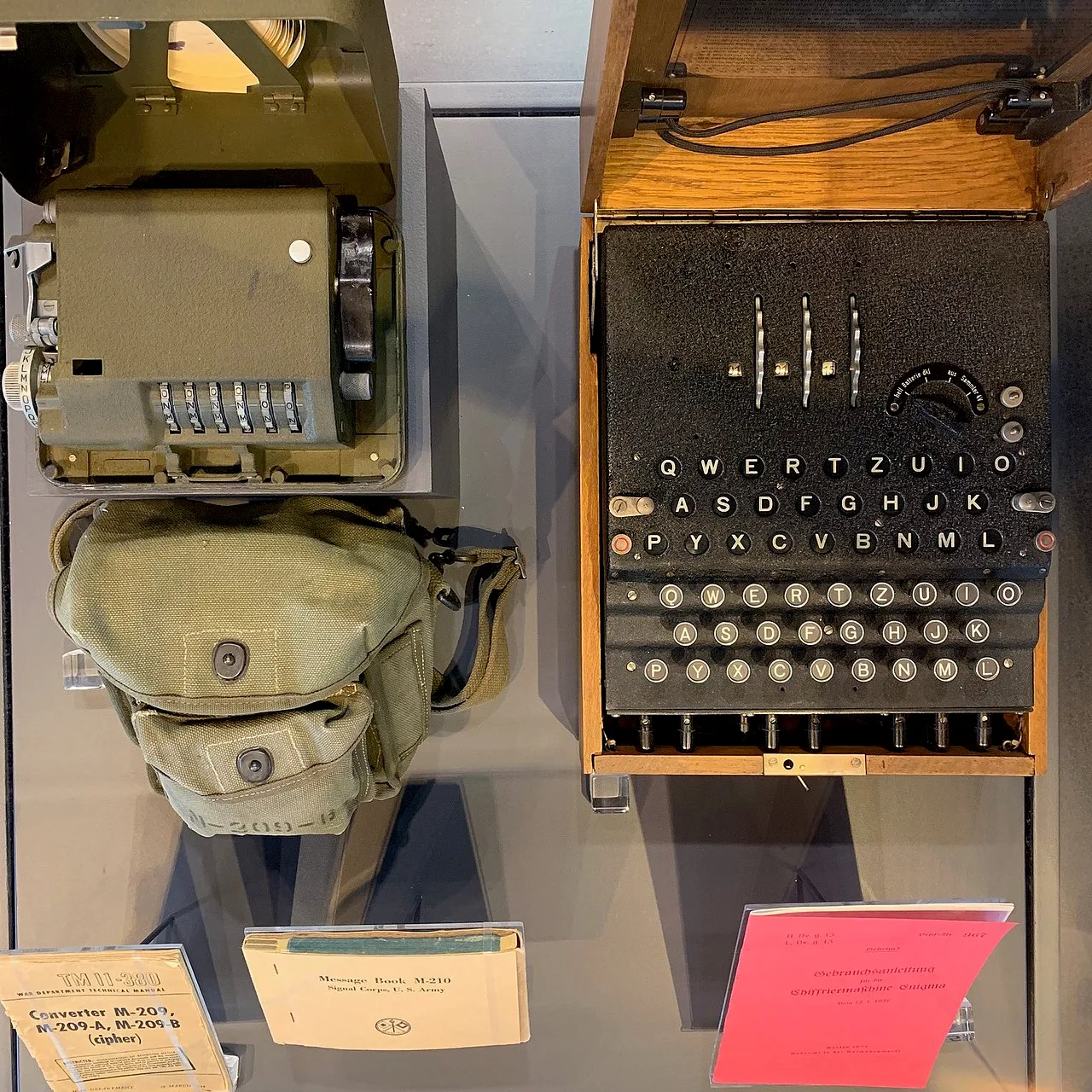
Surviving three-rotor Enigma on display at Discovery Park of America in Union City, Tennessee, US
Enigma machine
The Enigma machine is a cipher device used in the early to mid-20th century to protect communications, extensively employed by Nazi Germany during World War II to encipher top-secret messages.
The Bulky 110-Pound Commercial Predecessor
The earliest iterations of the cipher device were targeted directly at commercial rather than military clients. Introduced at the Congress of the International Postal Union in 1924, the Enigma Handelsmaschine incorporated a complete typewriter into its bulky frame. The resulting apparatus measured 65×45×38 cm and weighed about 50 kilograms (110 lb). This heavy design stood in stark contrast to the compact military models that were later adopted.
From Wikipedia · CC BY-SA 4.0
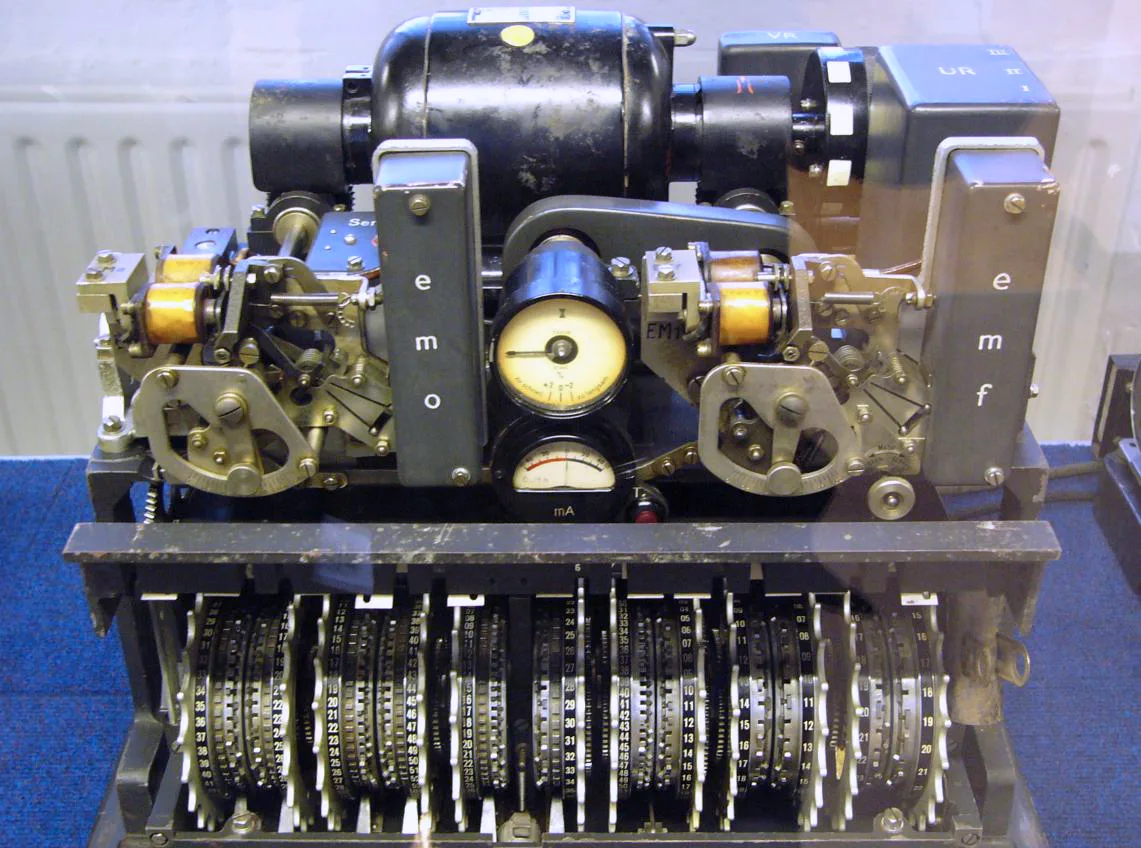
The Lorenz SZ42 machine with its covers removed. Bletchley Park museum
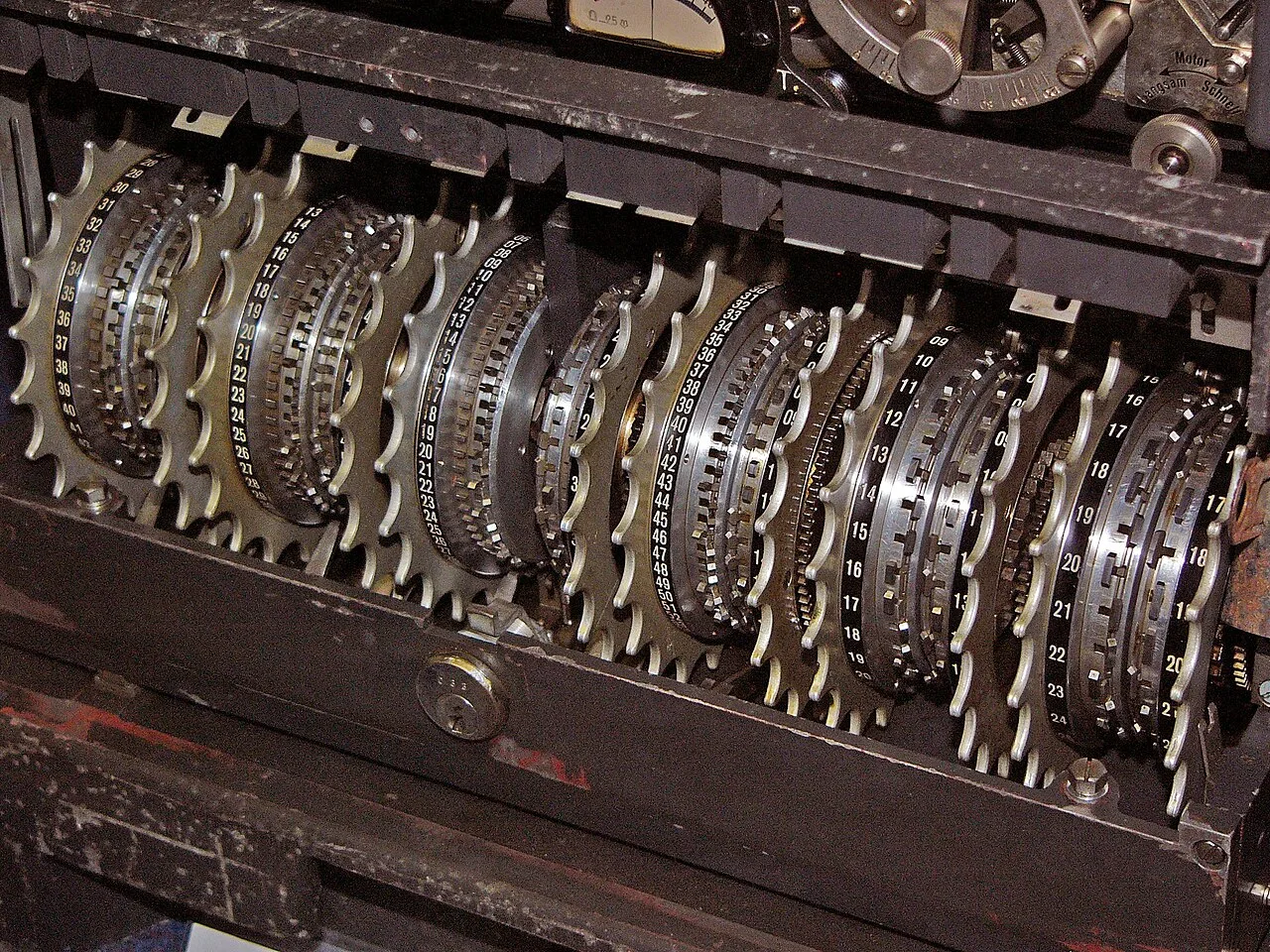
The Lorenz SZ machines had 12 wheels each with a different number of cams (or "pins"). OKW/Chiwheel name A B C D E F G H I K L M BP wheelname[15] ψ1 ψ2 ψ3 ψ4 ψ5 μ37 μ61 χ1 χ2 χ3 χ4 χ5 Number ofcams (pins) 43 47 51 53 59 37 61 41 31 29 26 23
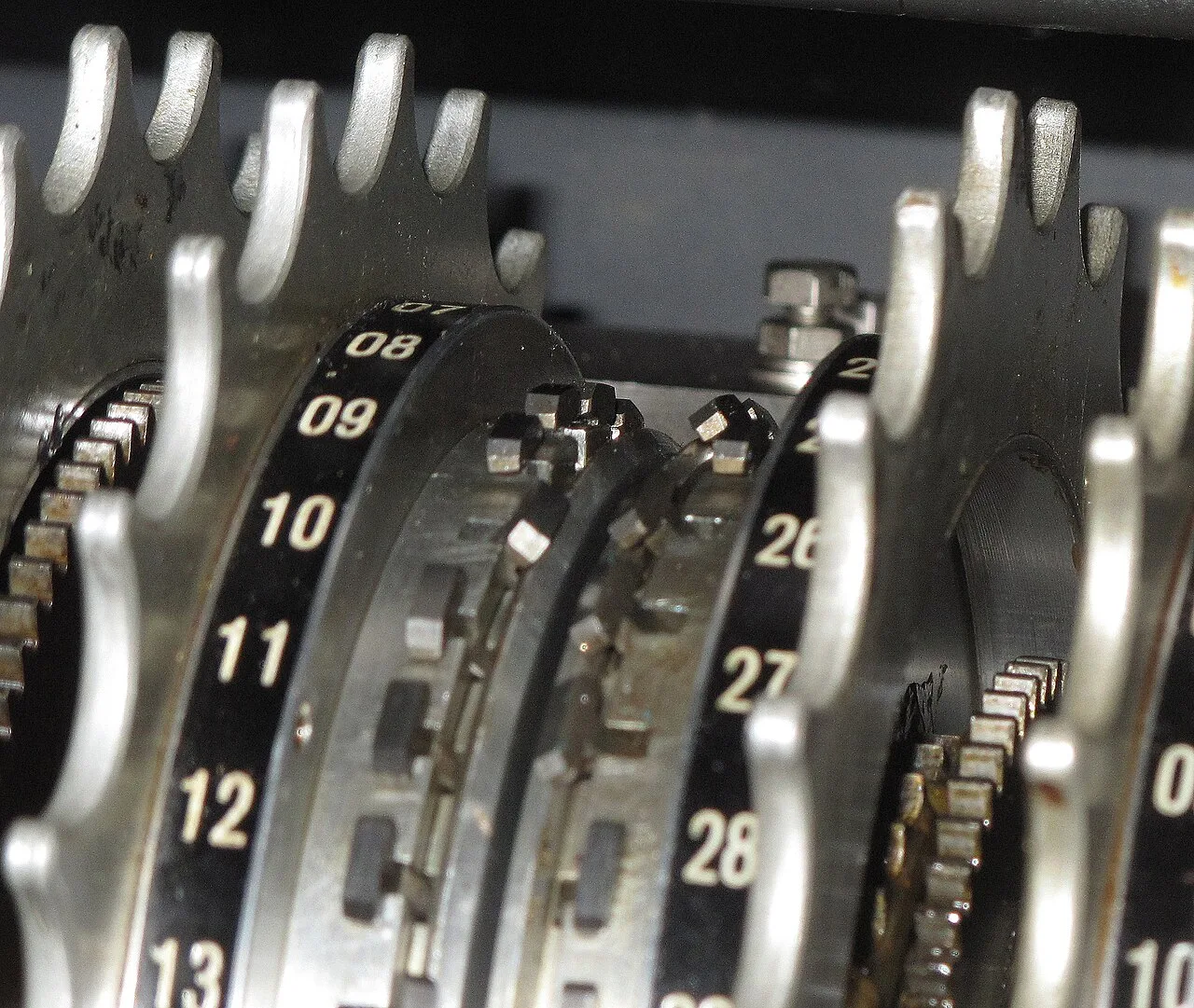
Cams on wheels 9 and 10 showing their raised (active) and lowered (inactive) positions. An active cam reversed the value of a bit (0→1 and 1→0).
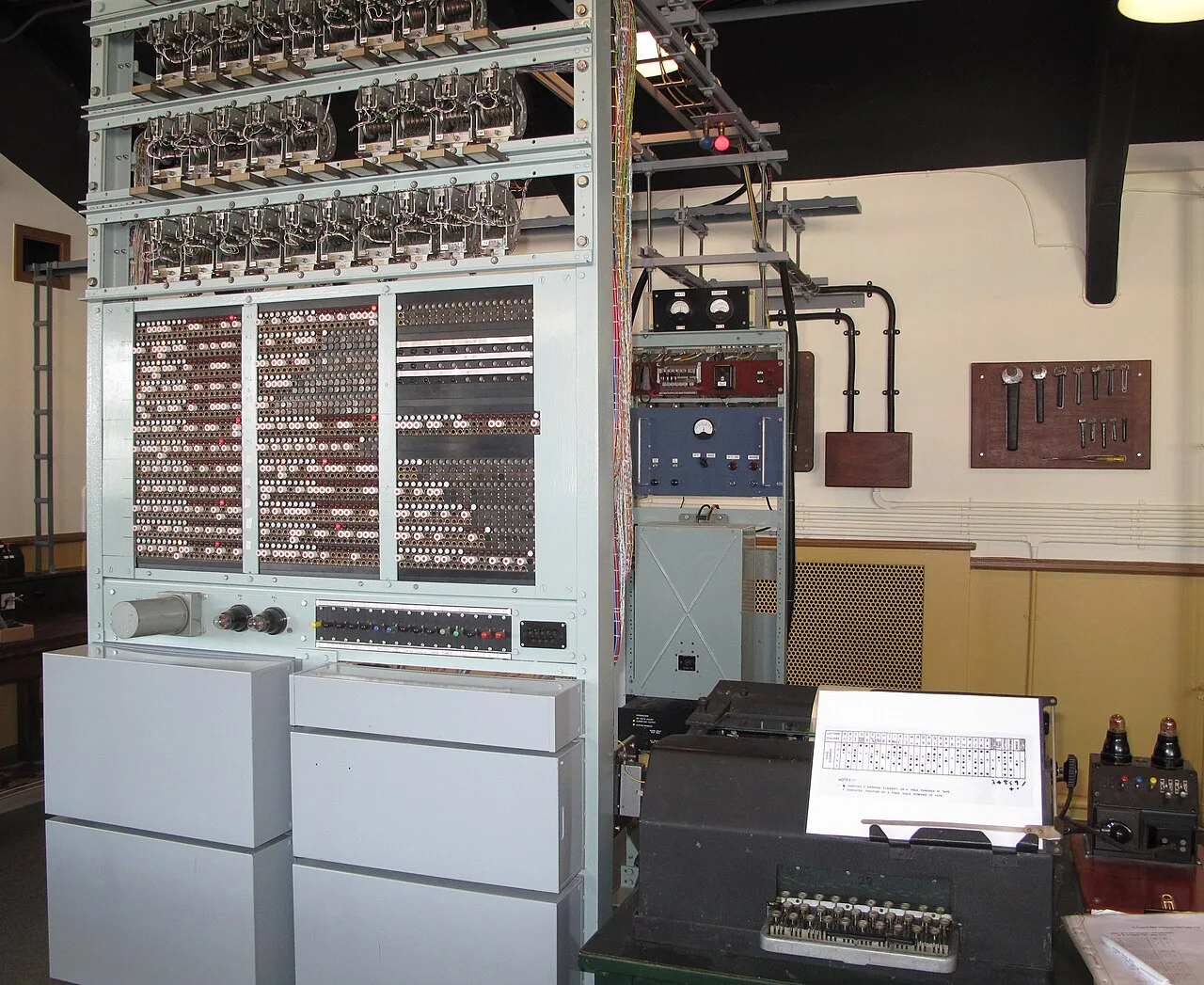
A rebuilt British Tunny at The National Museum of Computing, Bletchley Park. It emulated the functions of the Lorenz SZ40/42, producing printed cleartext from ciphertext input.
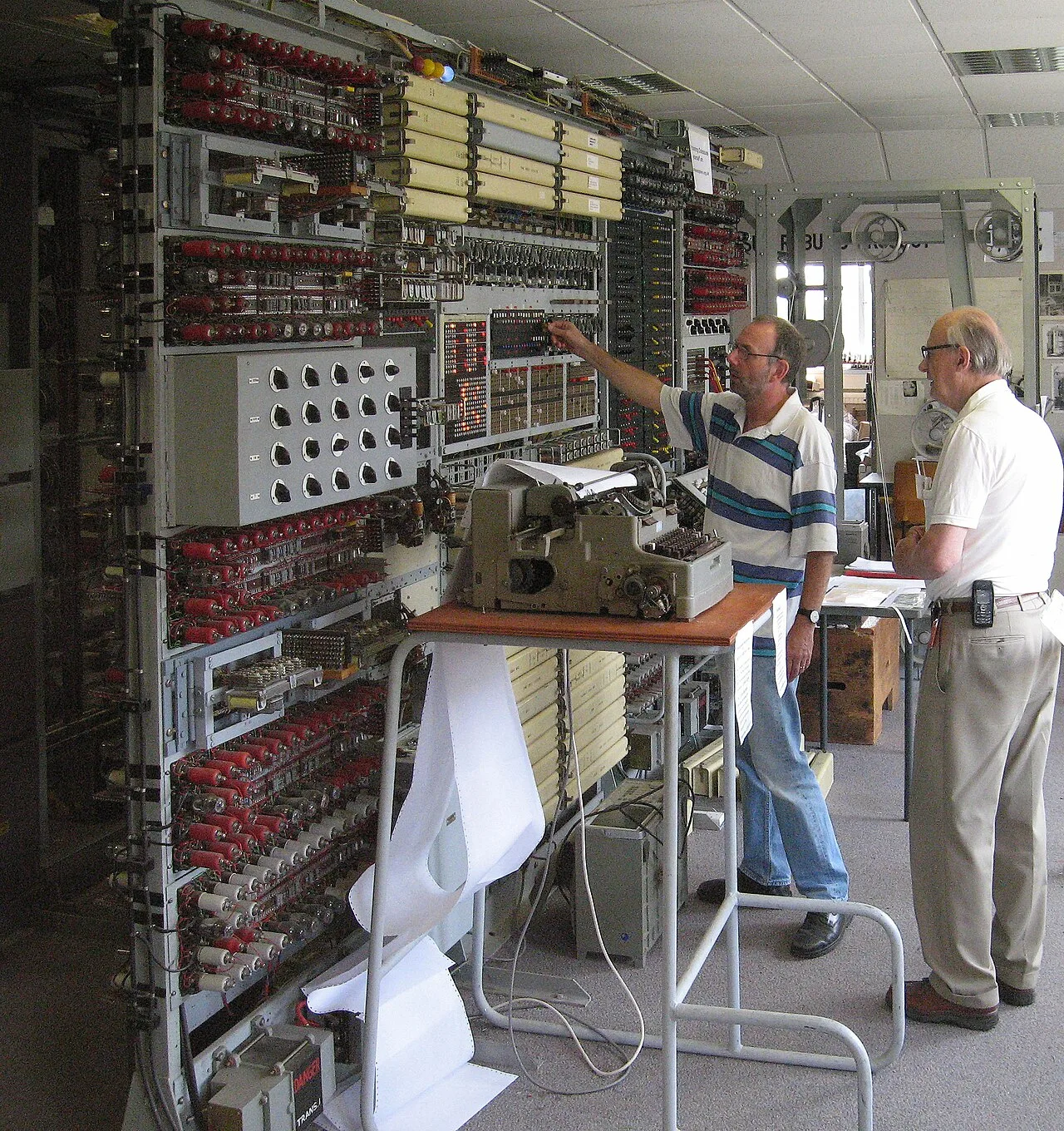
A team led by Tony Sale (right) reconstructed a Colossus (Mark II) at Bletchley Park. Here, in 2006, Sale supervises the breaking of an enciphered message with the completed machine.
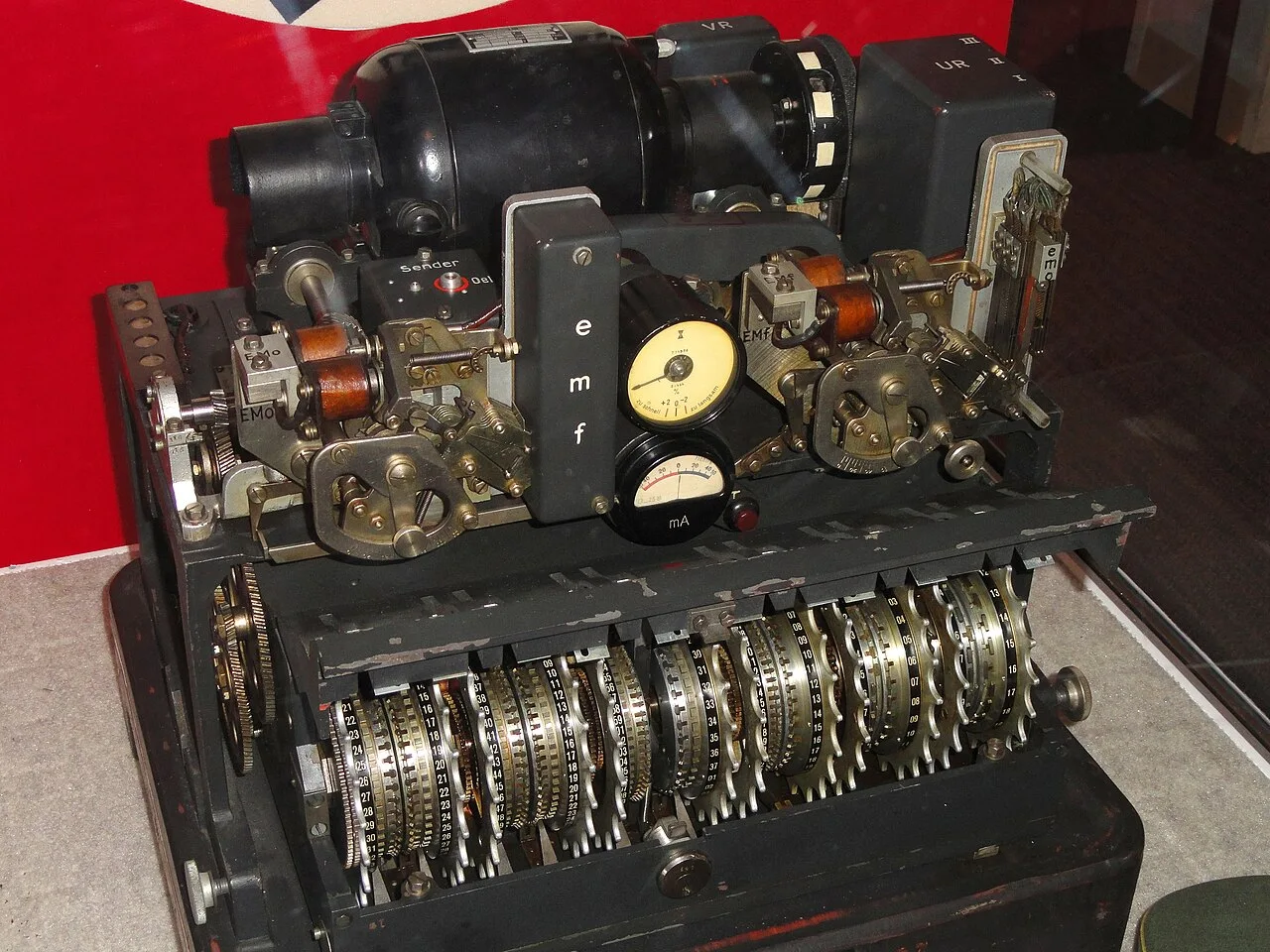
A Tunny (Lorenz) machine on display at the National Cryptologic Museum, Fort Meade, Maryland, USA
Lorenz cipher
The Lorenz SZ40, SZ42a and SZ42b were German rotor stream cipher machines developed by C. Lorenz AG and used by the German Army during World War II.
A Careless Retransmission Between Athens and Vienna
On 30 August 1941, an operator transmitted a 4,000-character message from Athens to Vienna that failed to arrive correctly. When asked to retransmit, the sender made a catastrophic error by reusing the exact key settings "HQIBPEXEZMUG". Compounding the slip, the sender edited the second transmission with abbreviations, generating a cryptographic depth that exposed the underlying keystream to Allied codebreakers.
From Wikipedia · CC BY-SA 4.0
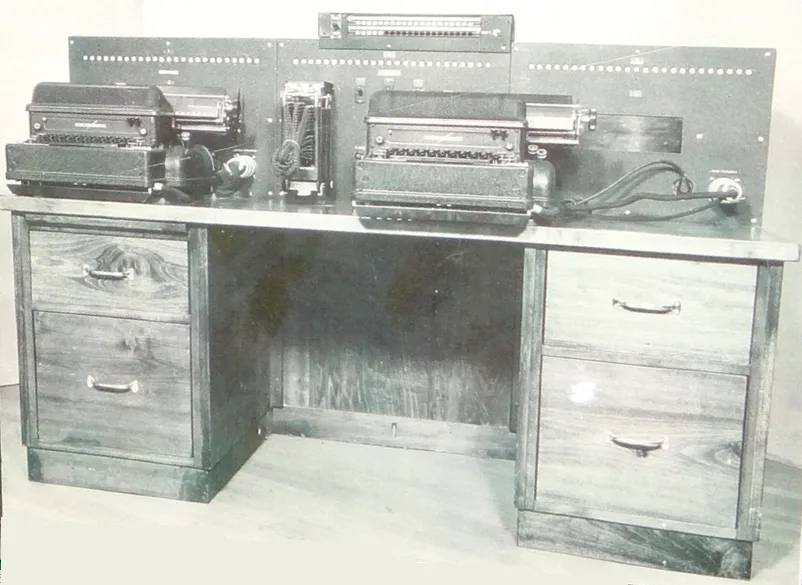
Analog of the Japanese Type B Cipher Machine (codenamed Purple) built by the U.S. Army Signal Intelligence Service
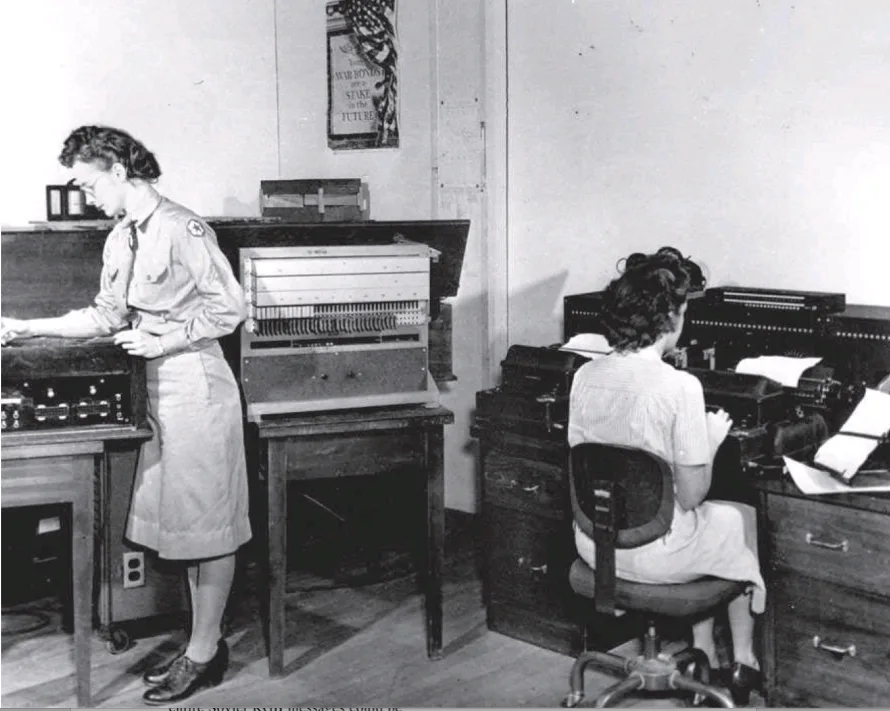
Purple analog equipment in use
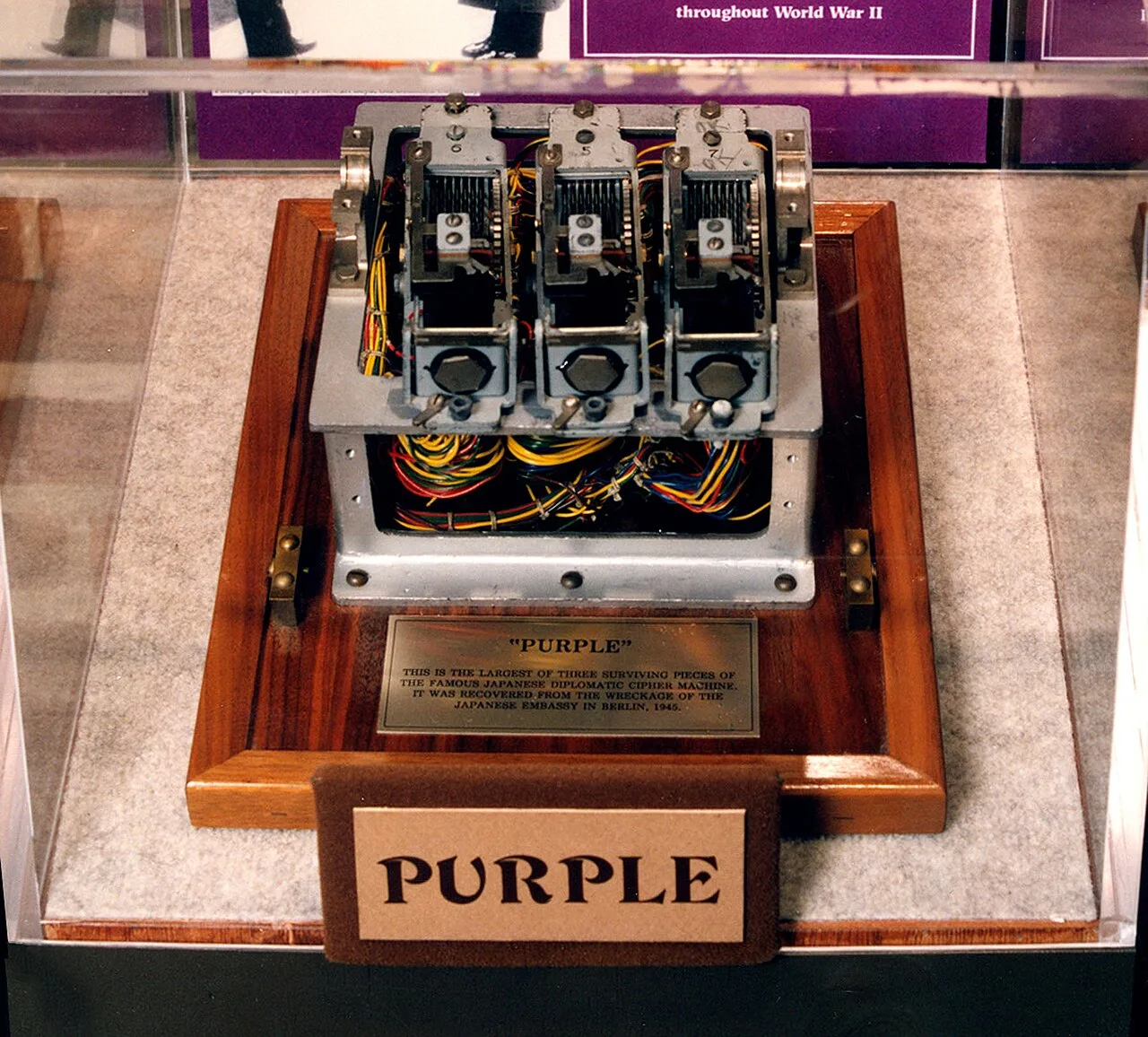
Fragment of a Type 97 "Purple" cipher machine recovered from the Japanese embassy in Berlin at the end of World War II. Purple code was reverse engineered by the United States Army's Signal Intelligence Service in 1940.
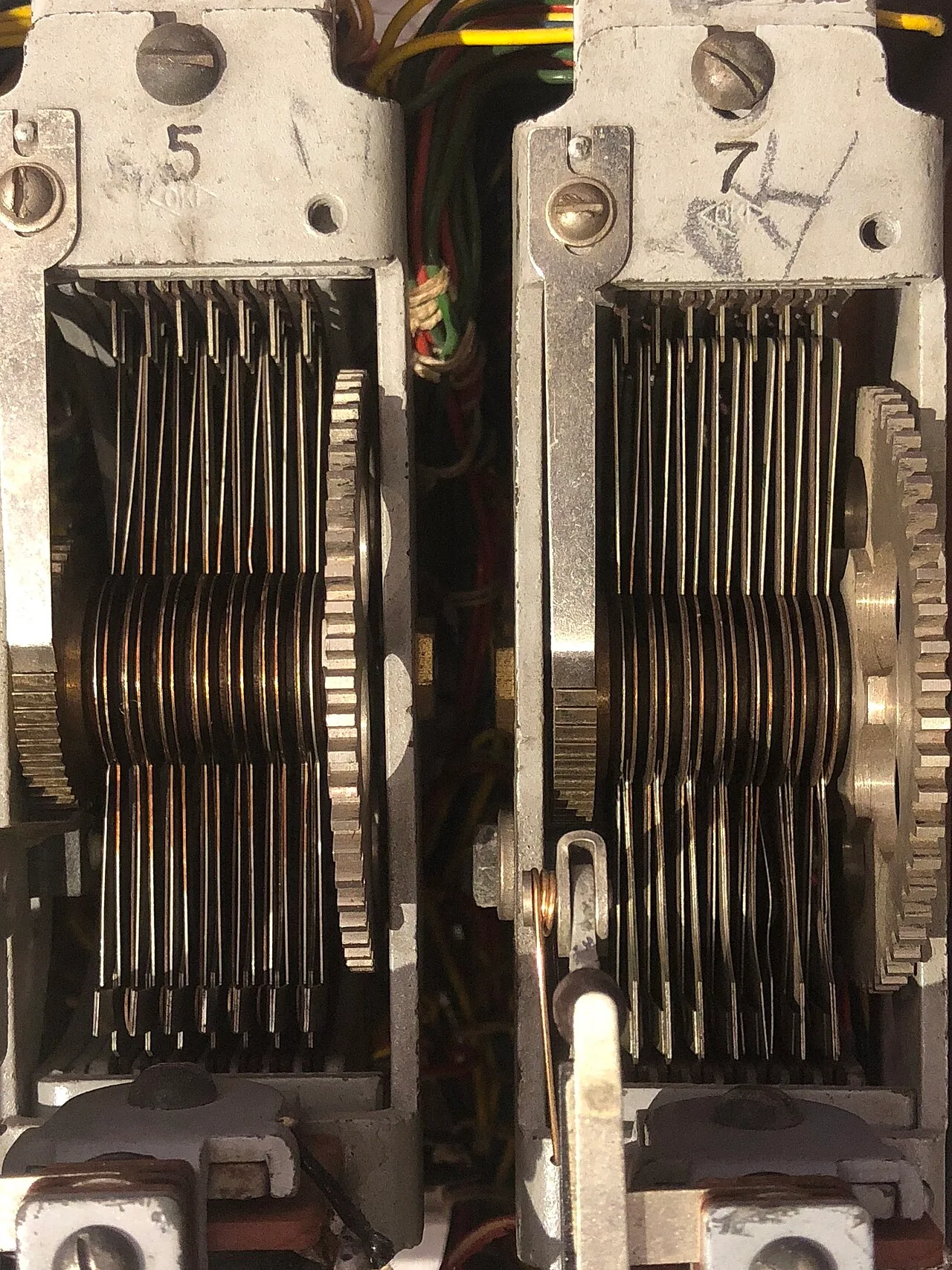
Close up of fragment's stepping switches showing seven contact layers
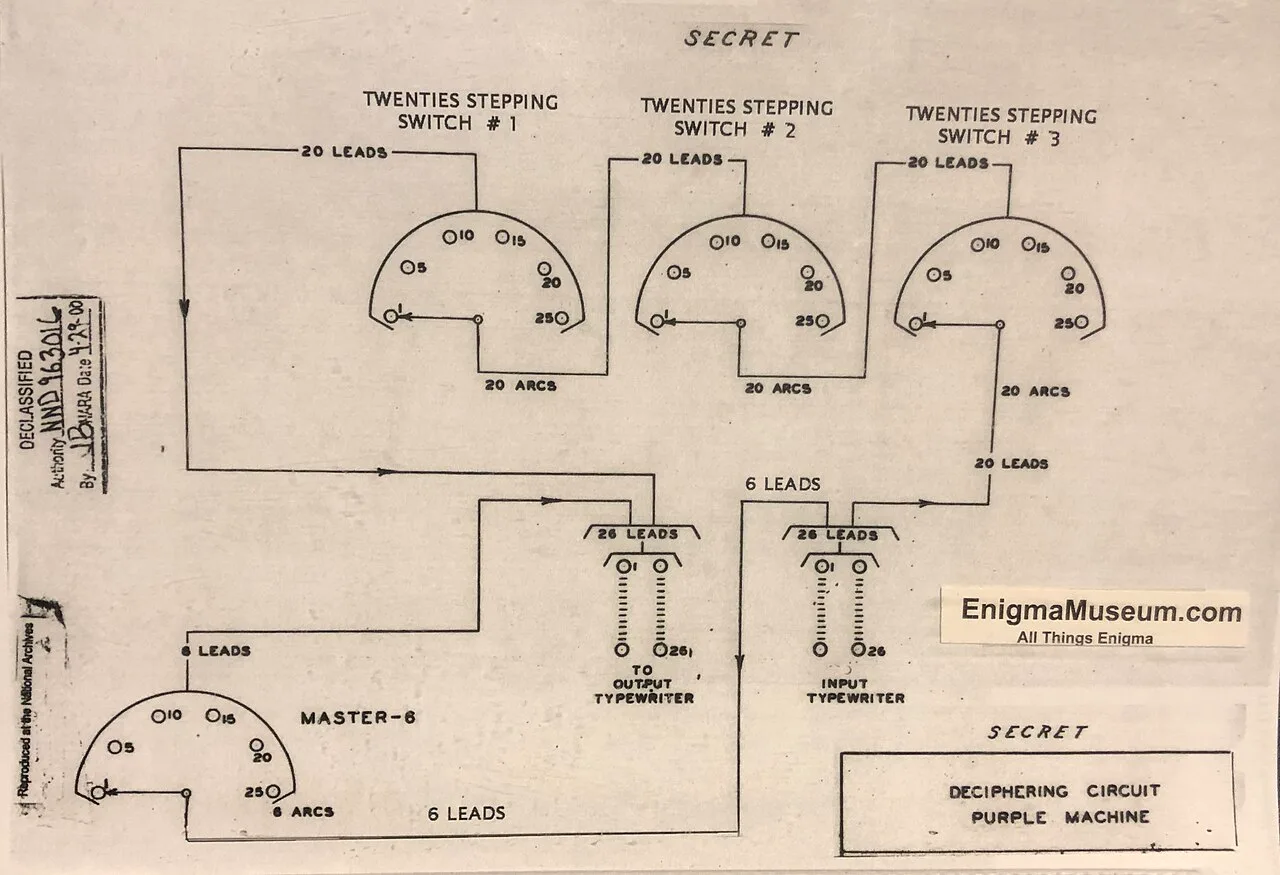
Schematic diagram of SIS Purple analog machine
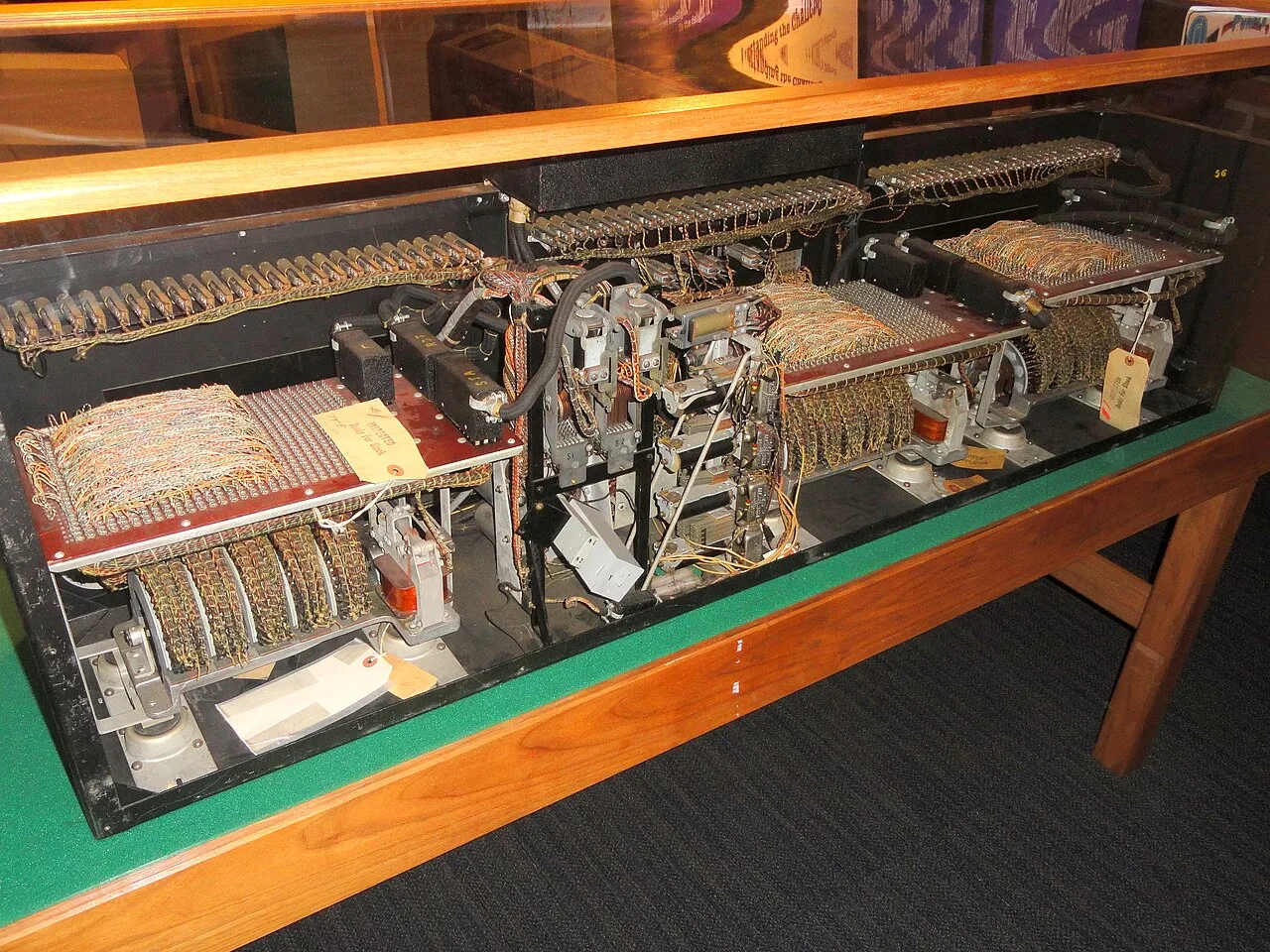
Internal wiring of the improved U.S. Army PURPLE analog. All three stepping motor stages for the "twenties letters" are shown. The three large rectangular panels with many wires implement the substitution matrices for each stage. Each twenties stepping switch is located beneath its wiring panel. The stepping switches for the sixes letters are near the middle.
Purple (cipher machine)
The System 97 Typewriter for European Characters, codenamed Purple by the United States, was an electromechanical encryption machine used by the Japanese Foreign Office during World War II.
Mathematician's False Confidence
Japanese officials sought an unbreakable diplomatic cipher machine to protect their most sensitive communications. However, the Navy believed the Purple machine was sufficiently secure and avoided making revisions to improve its defense. This complacency stemmed from the advice of Teiji Takagi, a mathematician who lacked cryptanalysis experience. Consequently, Japanese authorities completely failed to notice the vulnerabilities in their cipher machines.
From Wikipedia · CC BY-SA 4.0
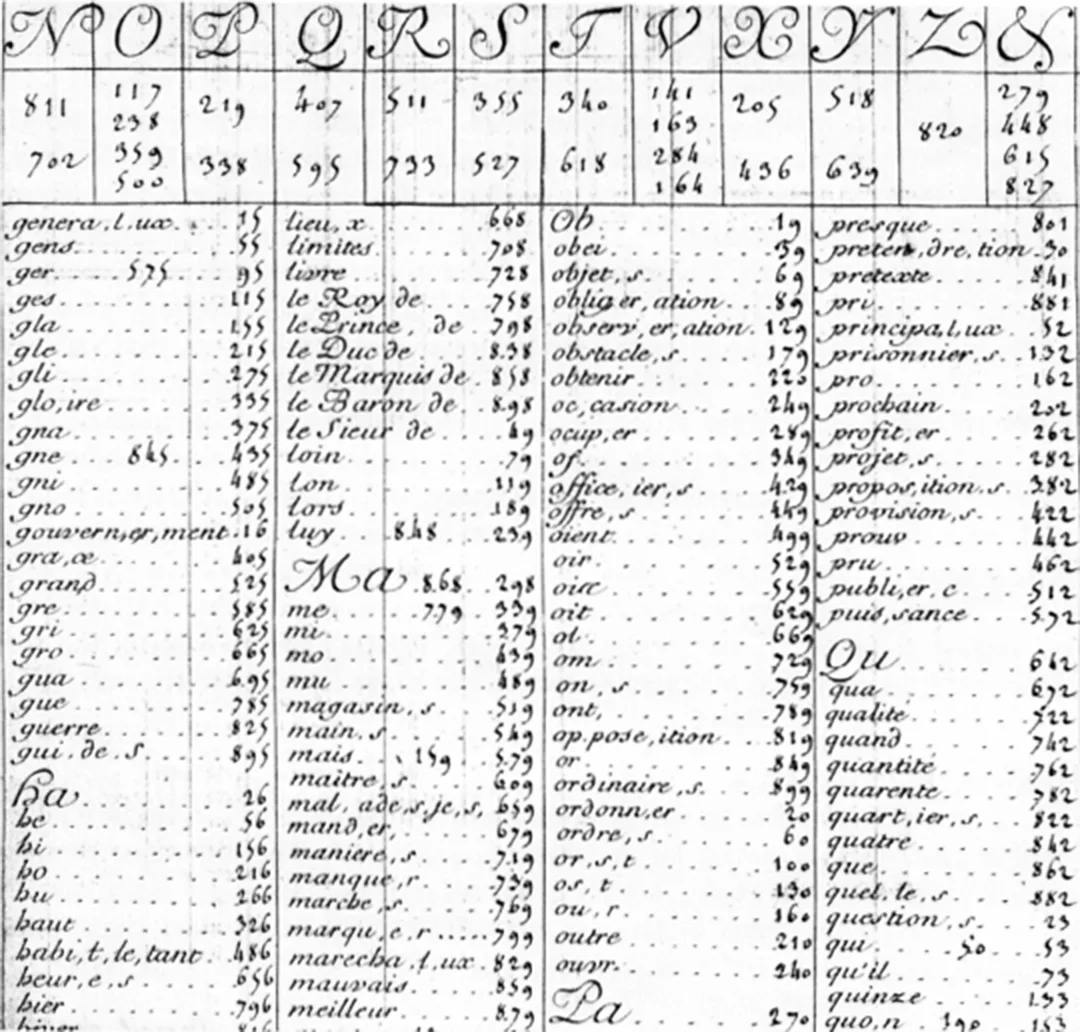
One of many nomenclators used to encode the Great Cipher.
Great Cipher
The Great Cipher was a nomenclator cipher developed by the Rossignols, who served French monarchs as cryptographers, and was reputed to be unbreakable.
A Captured Letter at Réalmont
Antoine Rossignol revealed his formidable cryptographic talent in 1626 when French forces intercepted an encrypted enemy communication. The captured message indicated that the besieged Huguenots could no longer maintain their defense of Réalmont against the surrounding army. By deciphering the secret dispatch by the end of the day, Rossignol handed the French military decisive tactical leverage. The French promptly returned the plaintext message to the garrison, compelling an immediate surrender.
From Wikipedia · CC BY-SA 4.0
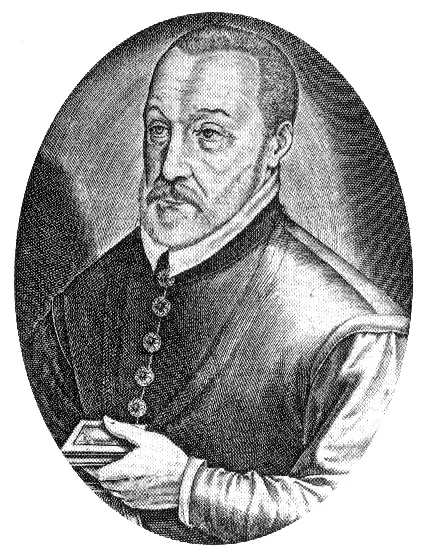
The Vigenère cipher is named after Blaise de Vigenère (pictured), although Giovan Battista Bellaso had invented it before Vigenère described his autokey cipher.
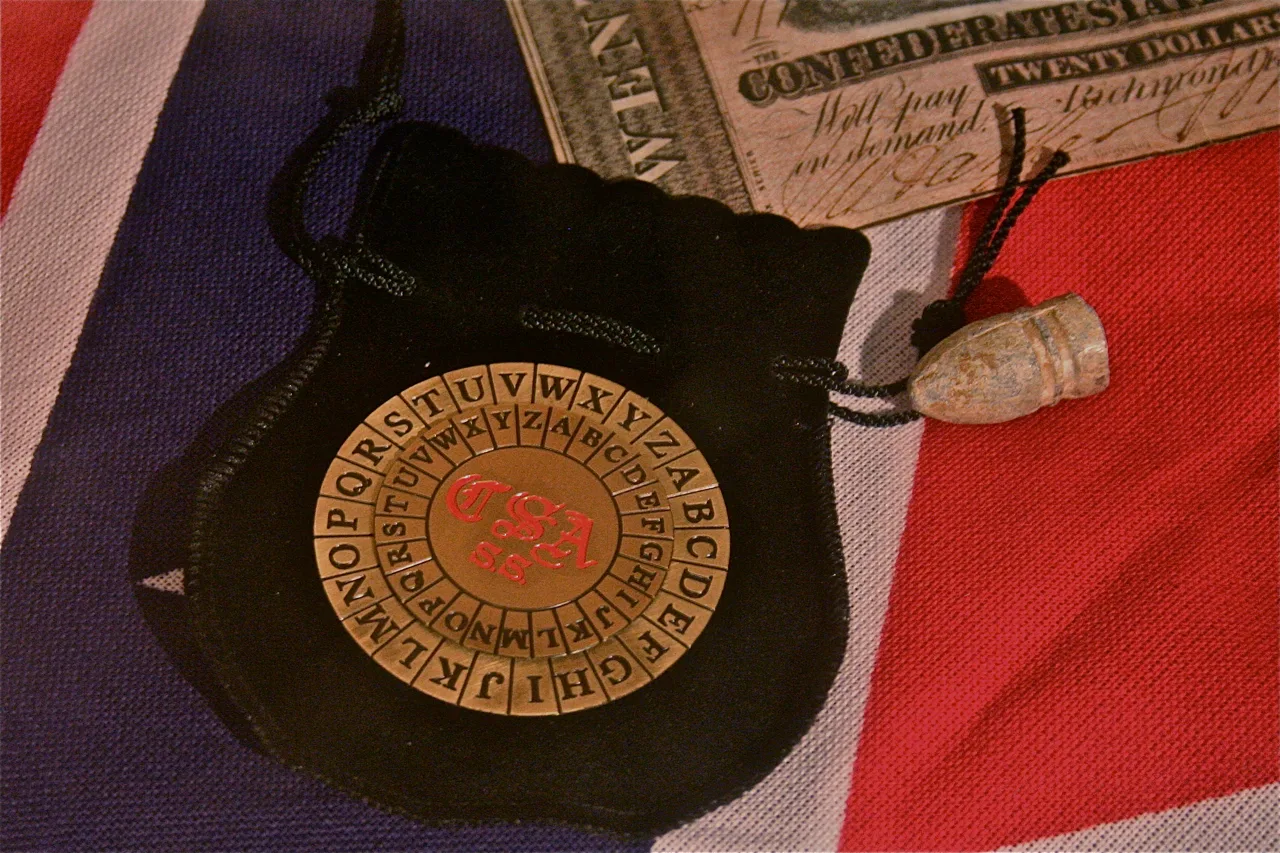
A reproduction of the Confederacy's cipher disk used in the American Civil War on display in the National Cryptologic Museum
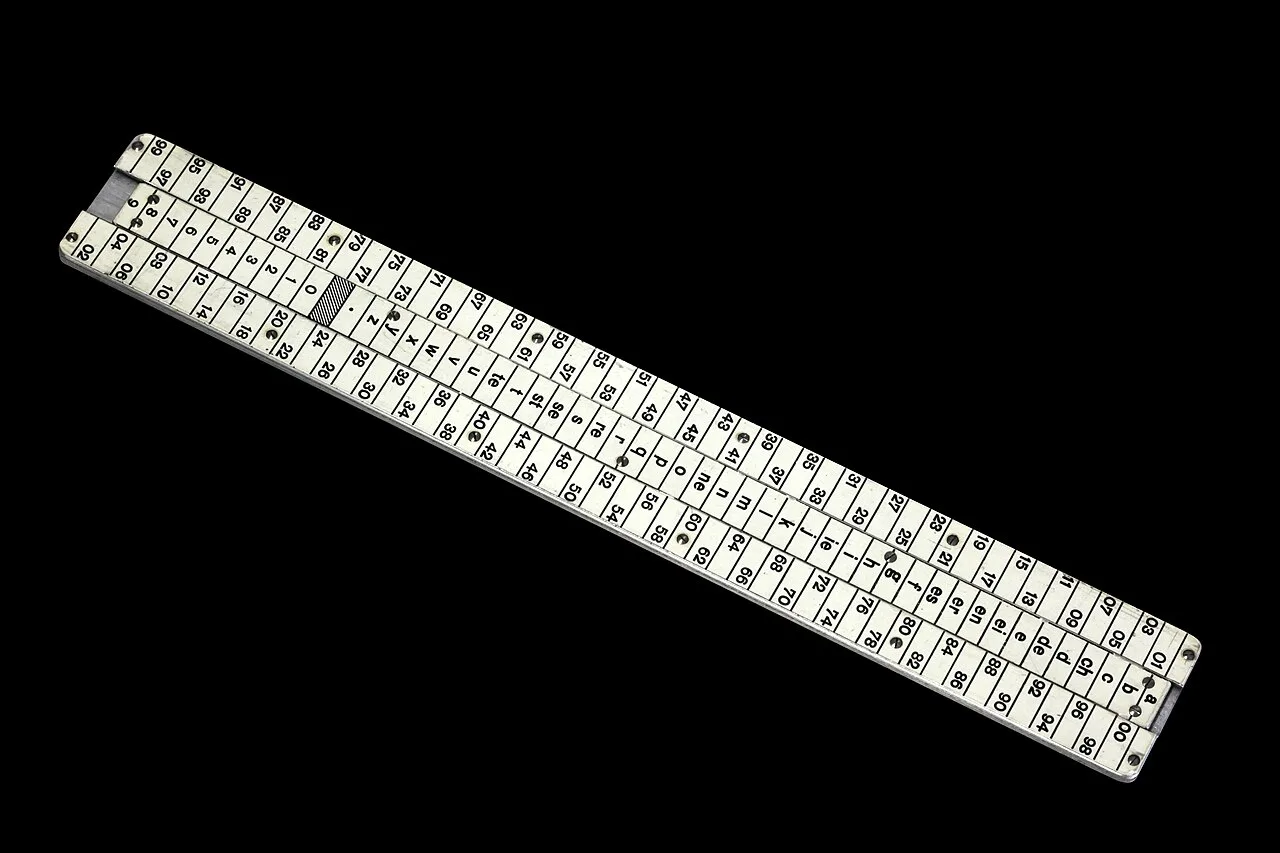
Cryptographic slide rule used as a calculation aid by the Swiss Army between 1914 and 1940
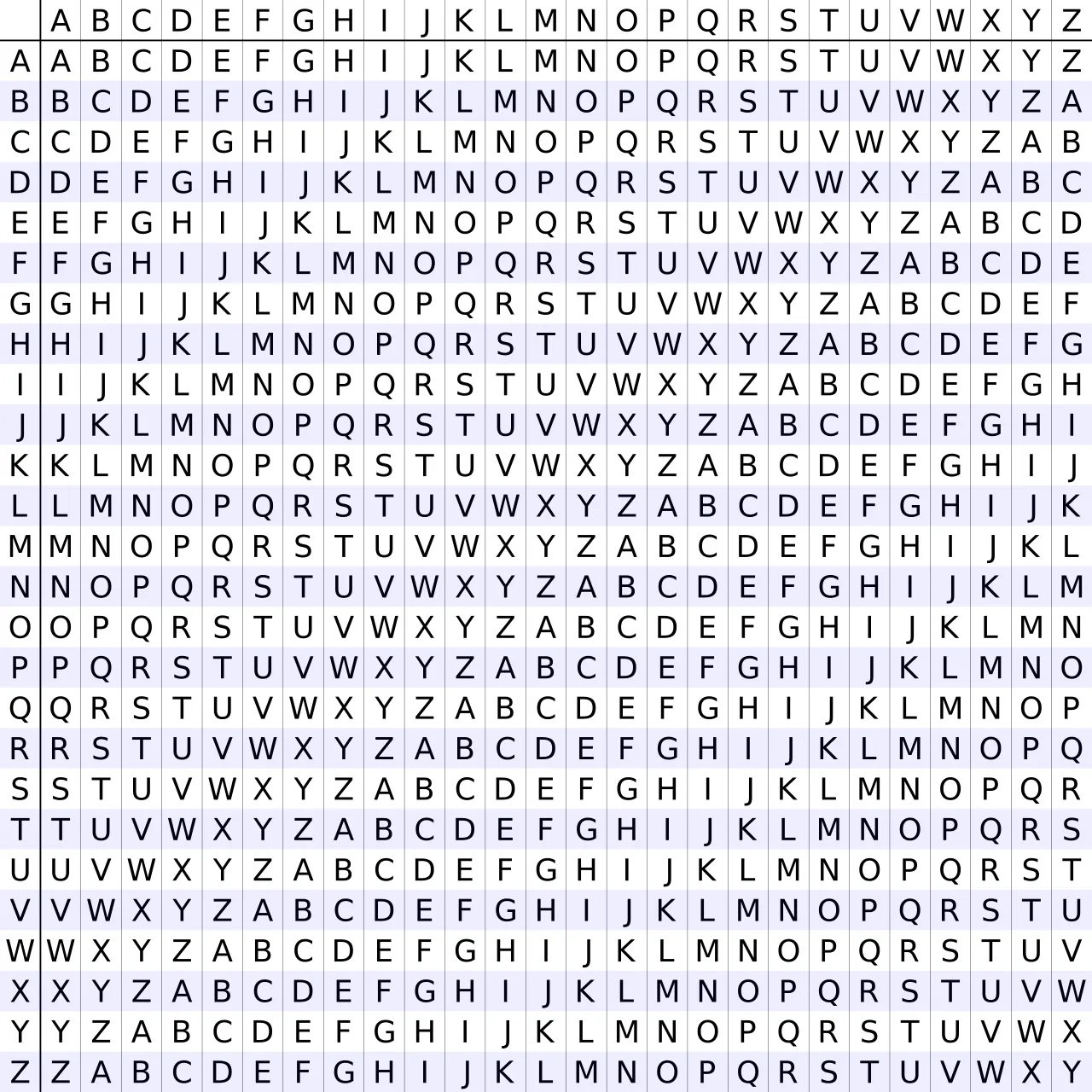
The Vigenère square or Vigenère table, also known as the tabula recta, can be used for encryption and decryption.
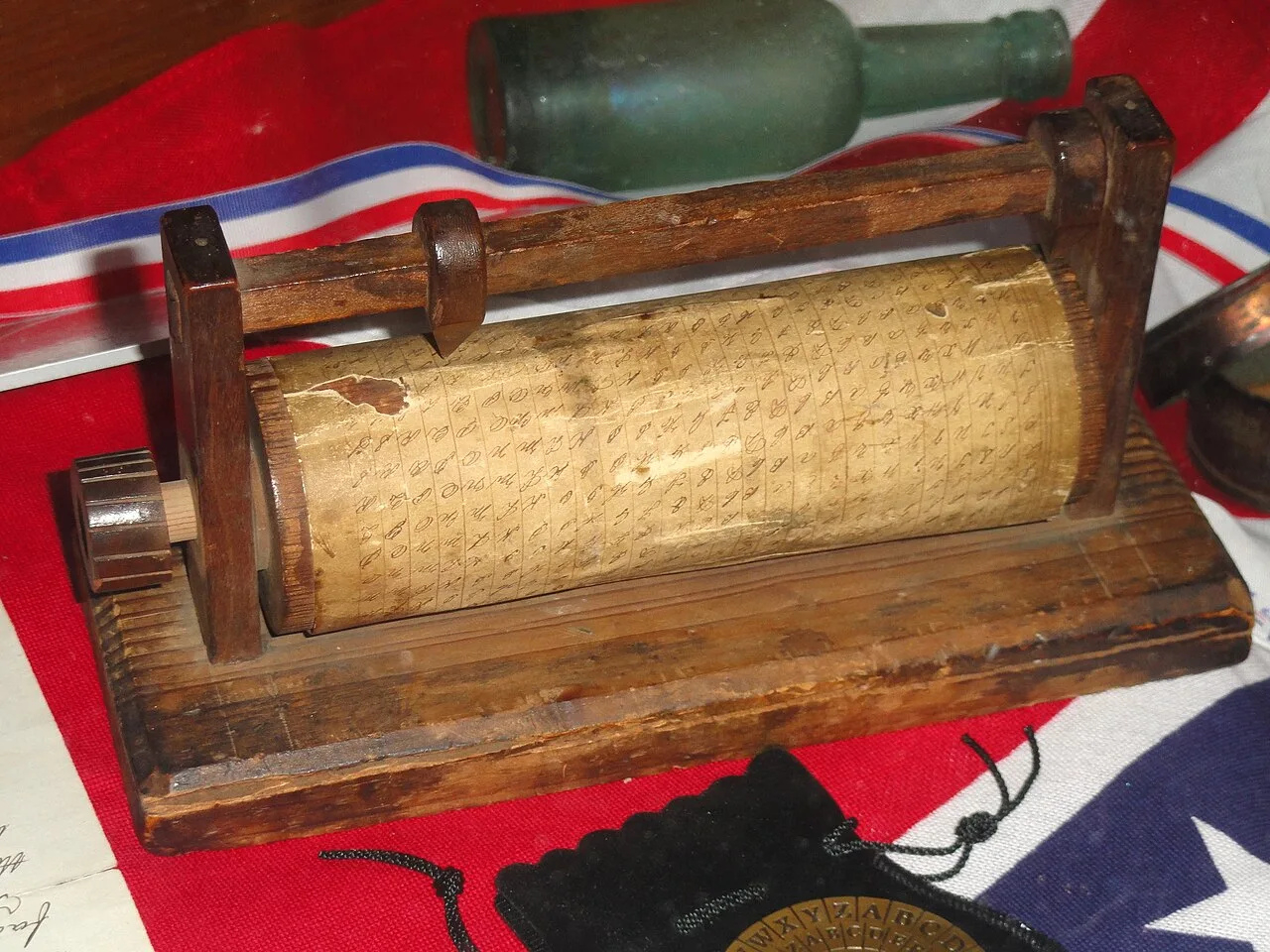
Confederate cipher wheel, captured at the surrender of Mobile, Alabama, in May 1865 – National Cryptologic Museum
Vigenère cipher
The Vigenère cipher is a method of encrypting alphabetic text where each letter is encoded using a Caesar cipher determined by the corresponding letter of a key.
Bellaso's Stolen Invention and the 1586 Autokey Mix-Up
Giovan Battista Bellaso first described this polyalphabetic encryption method in his 1553 book La cifra del Sig. Giovan Battista Bellaso. Years later, Blaise de Vigenère published a completely different system called an autokey cipher in 1586. Despite Bellaso's foundational work, nineteenth-century commentators misattributed the design to Vigenère, forever attaching his name to a system he did not actually create.
From Wikipedia · CC BY-SA 4.0
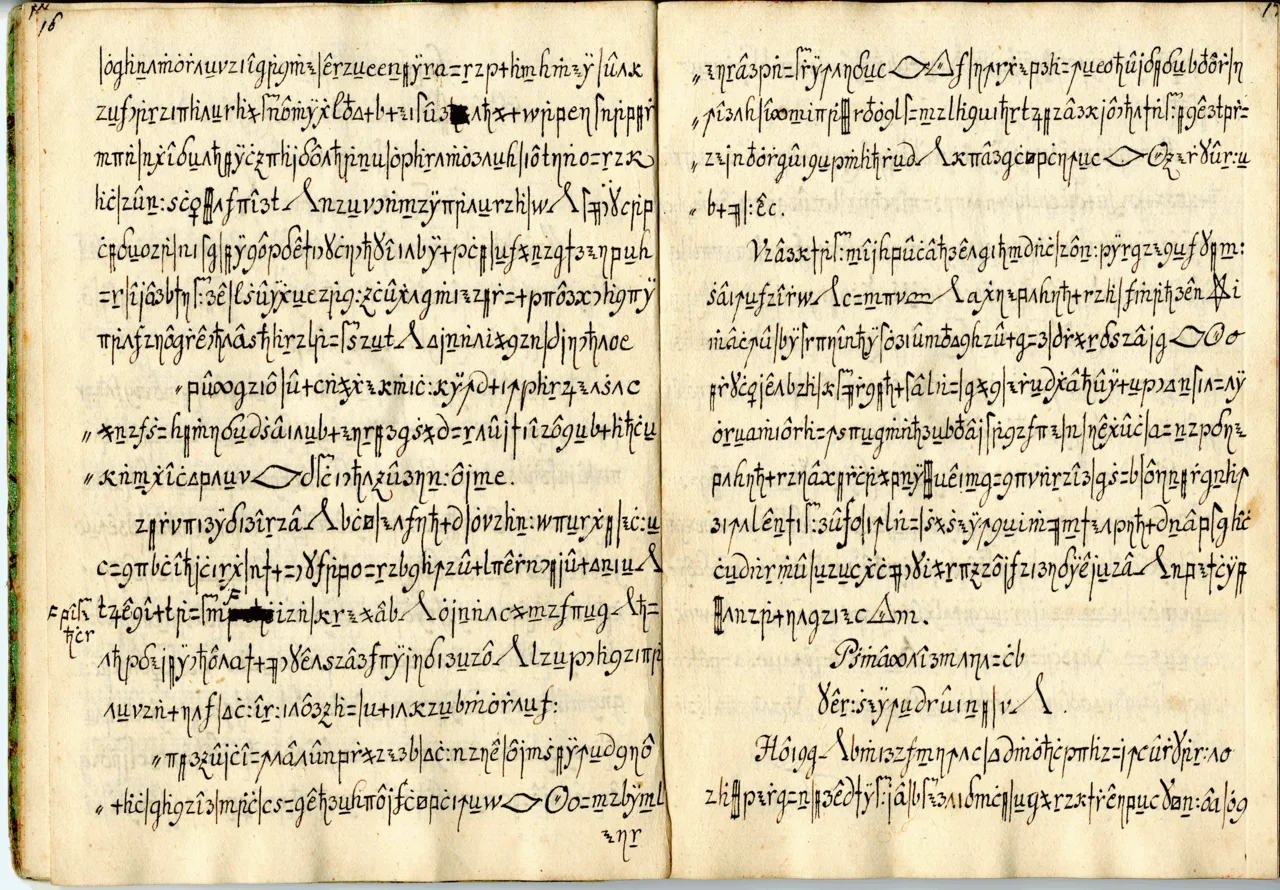
Copiale-cipher09s
Copiale cipher
The Copiale cipher is an encrypted German manuscript of 75,000 characters filling 105 pages, undeciphered for more than 260 years until computer-assisted decryption in 2011.
Familiar Letters Reduced to Blank Spaces
The cipher inverted standard cryptographic assumptions by turning familiar Latin characters into deceptive filler. While unaccented Roman letters served only to represent spaces, Greek letters, accented characters, and symbols concealed the authentic message. Furthermore, the system functioned as a homophonic cipher, assigning seven distinct ciphertext characters to encode the single letter "e" alongside specialized symbols representing entire words.
From Wikipedia · CC BY-SA 4.0
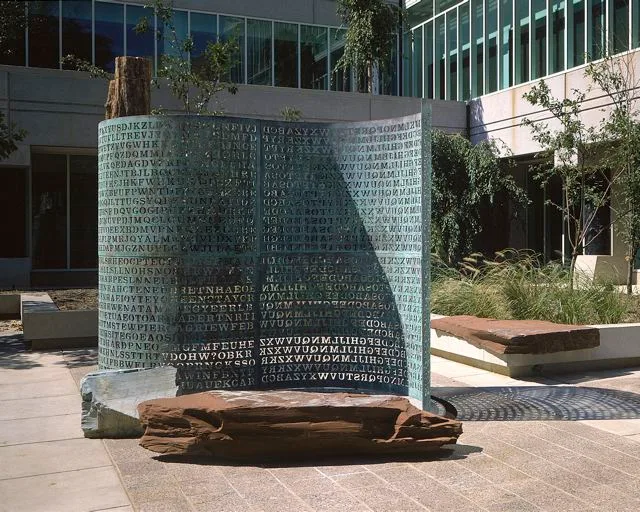
Kryptos sculptor
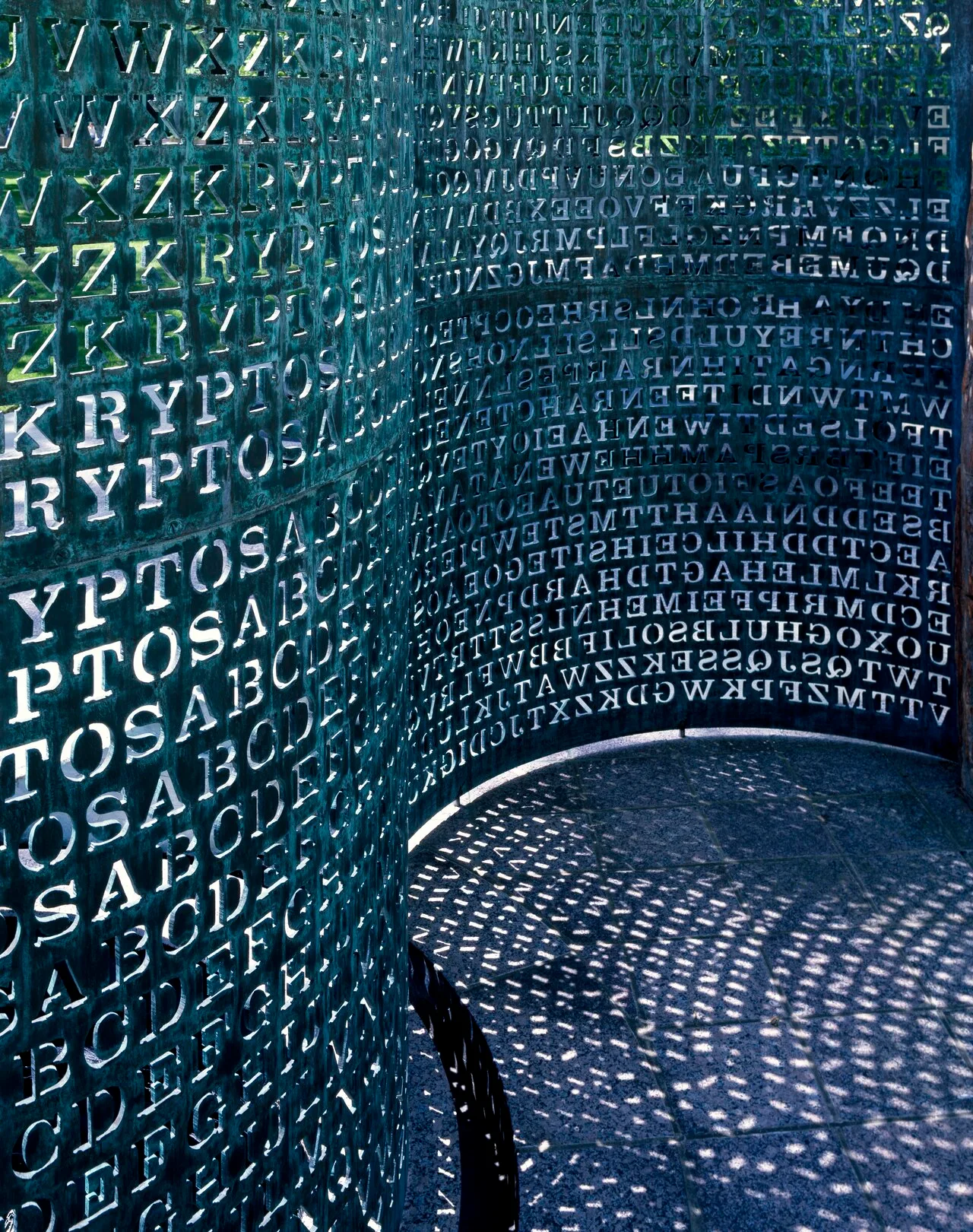
Close-up view of part of the text
Kryptos
Kryptos is a sculpture by American artist Jim Sanborn located on the grounds of the Central Intelligence Agency headquarters in Langley, Virginia.
An S-Shaped Screen in the Intelligence Courtyard
Kryptos is a sculpture created by American artist Jim Sanborn on the grounds of the Central Intelligence Agency in Langley, Virginia. The installation combines large copper plates with white quartz, red and green granite, water, and petrified wood. Its most prominent element is an S-shaped copper screen displaying cut-out cipher characters.
From Wikipedia · CC BY-SA 4.0
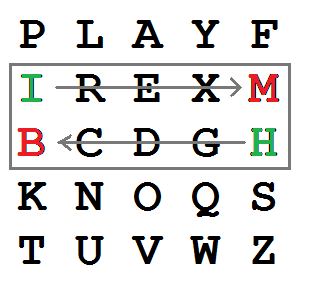
The Playfair cipher uses a 5×5 grid of letters, and encrypts a message by breaking the text into pairs of letters and swapping them according to their positions in a rectangle within that grid: "HI" becomes "BM".
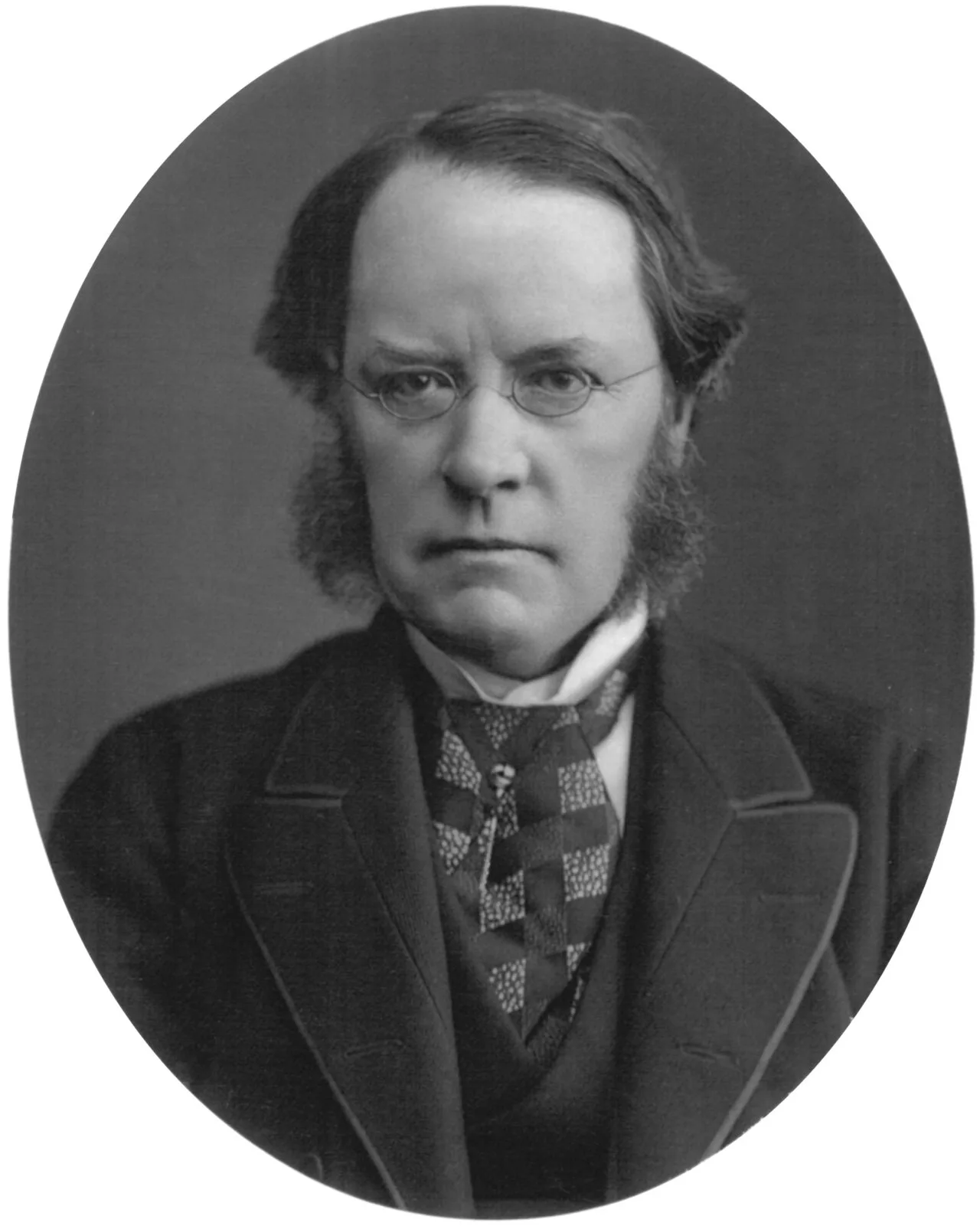
Lord Playfair, who heavily promoted its use.
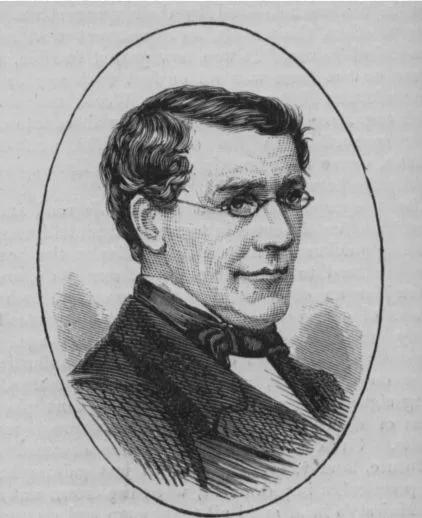
The Playfair system was invented by Charles Wheatstone, who first described it in 1854.
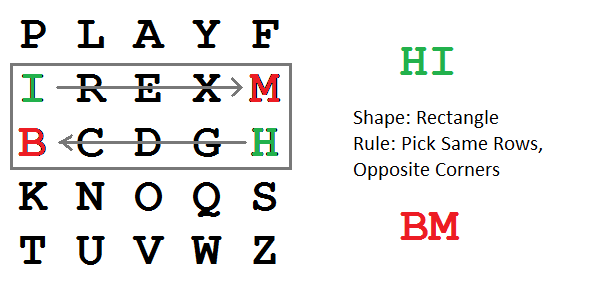
Playfair Cipher 01 HI to BM
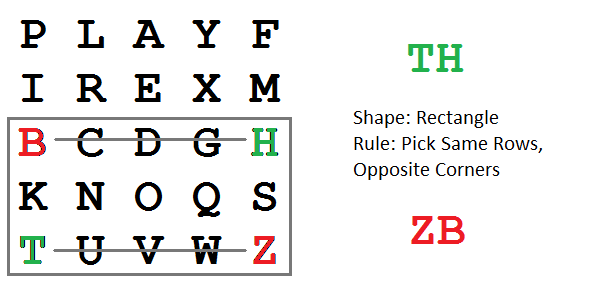
Playfair Cipher 03 TH to ZB
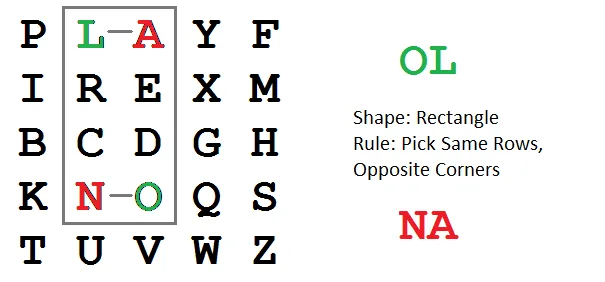
Playfair Cipher 05 OL to NA
Playfair cipher
The Playfair cipher is a manual symmetric encryption technique invented by Charles Wheatstone in 1854 and the first literal digram substitution cipher.
Diplomatic Skepticism and Schoolboy Competence
Charles Wheatstone created the encryption scheme in 1854, but it came to bear the name of Lord Playfair. Despite its utility, the British Foreign Office initially rejected the system because of its perceived complexity. When Wheatstone offered to demonstrate that three out of four schoolboys could learn it in 15 minutes, the Under Secretary dismissively insisted that diplomatic attachés could never master it.
From Wikipedia · CC BY-SA 4.0