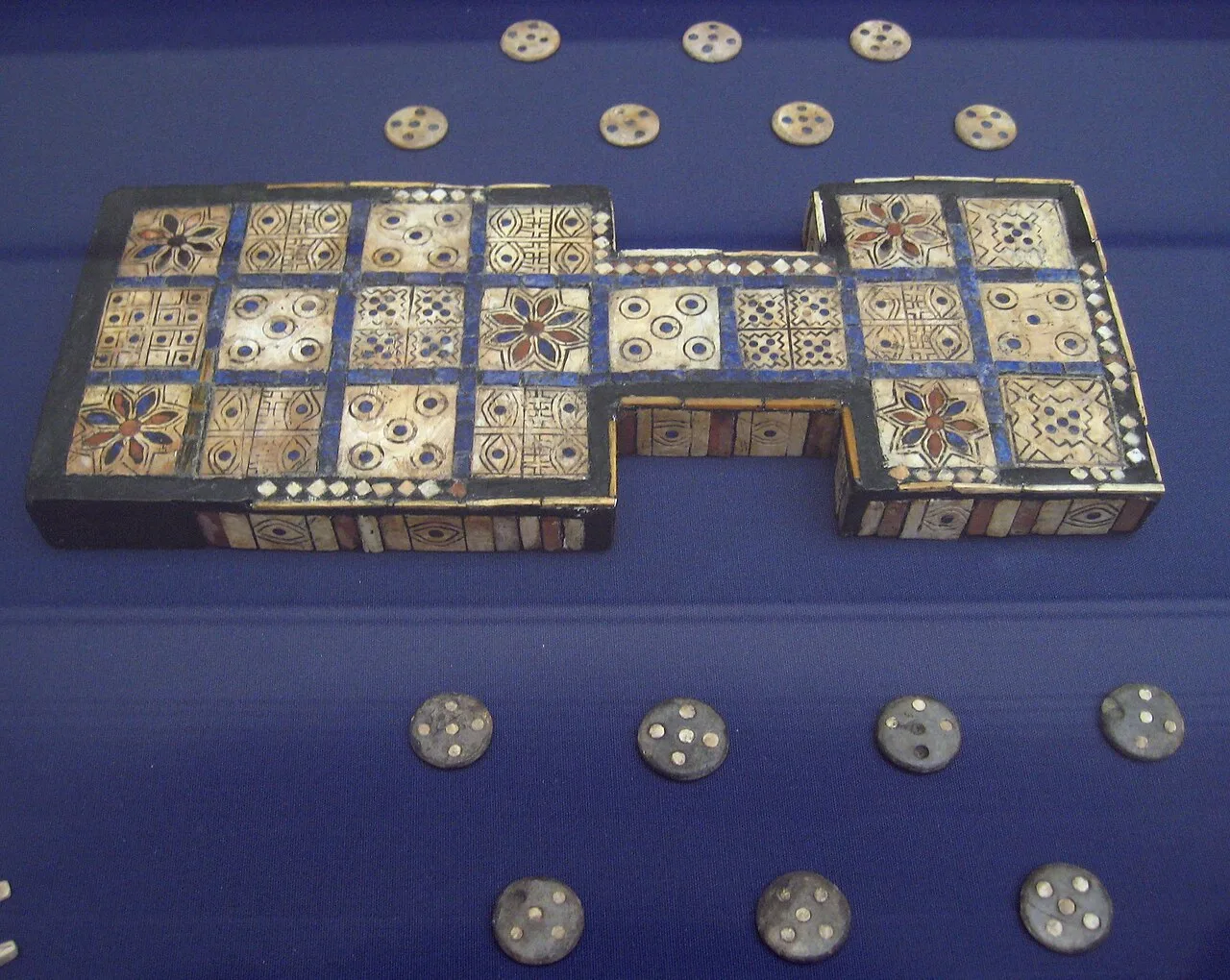
British Museum Royal Game of Ur
![A graffito version of the game from the palace of Sargon II (British Museum in London)[4][5] Museum number 118809,b](https://upload.wikimedia.org/wikipedia/commons/6/61/Bm-royalgame.jpg?utm_source=en.wikipedia.org&utm_campaign=imageinfo&utm_content=thumbnail_unscaled)
A graffito version of the game from the palace of Sargon II (British Museum in London)[4][5] Museum number 118809,b

A game box for playing senet and Twenty Squares, 1635–1458 BC

Fragment BM.33333.B, the oldest surviving ruleset of The Royal Game of Ur, primarily used by Irving Finkel in reconstructing the rules[12]

The possible direction in which the players race to move their pieces off the board, with "safe" spaces shown in blue and "combat" spaces shown in green.[8][13]

The James Masters proposed path through the Royal Game of Ur. This version creates a head-to-head joust near the end of the playing area, uses the same number of "battle squares" as the Game of 20 Squares, and creates rosettes every fourth space.
Royal Game of Ur
The Royal Game of Ur is an ancient Mesopotamian two-player strategy race board game first played during the early third millennium BC.
Carving Gameboards into Royal Palace Gate Sentinels
Ancient gameplay crossed all social classes rather than remaining confined to the elite. In Khorsabad, a casual version of the game was scratched with a sharp object, possibly a dagger, directly into monumental palace architecture. The human-headed winged bull gate sentinel from the palace of Sargon II (721–705 BC) carried this makeshift board, showing how guards or visitors passed the time.
From Wikipedia · CC BY-SA 4.0
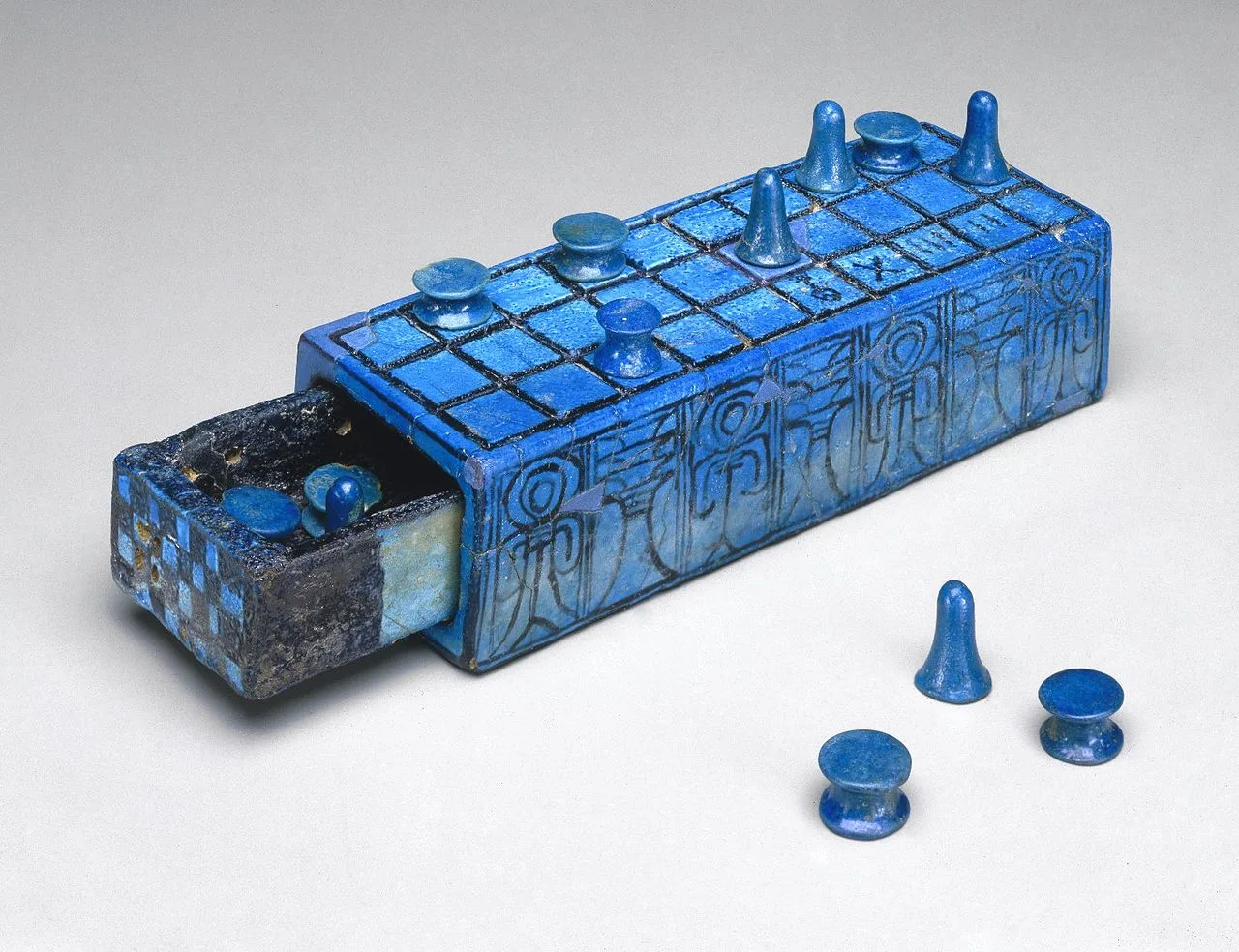
Gaming Board Inscribed for Amenhotep III with Separate Sliding Drawer, ca. 1390-1353 B.C.E.,49.56a-b
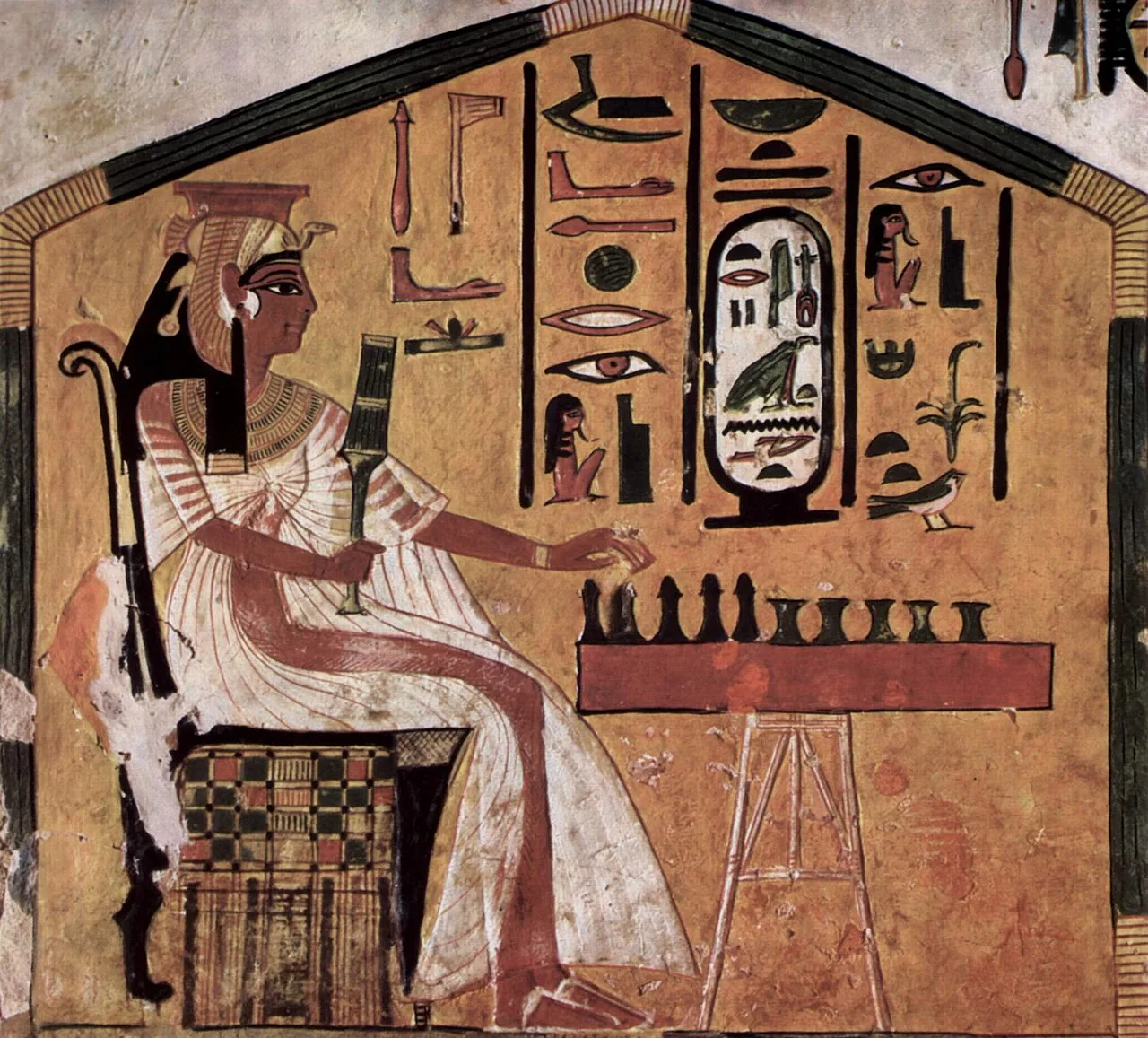
Maler der Grabkammer der Nefertari 003
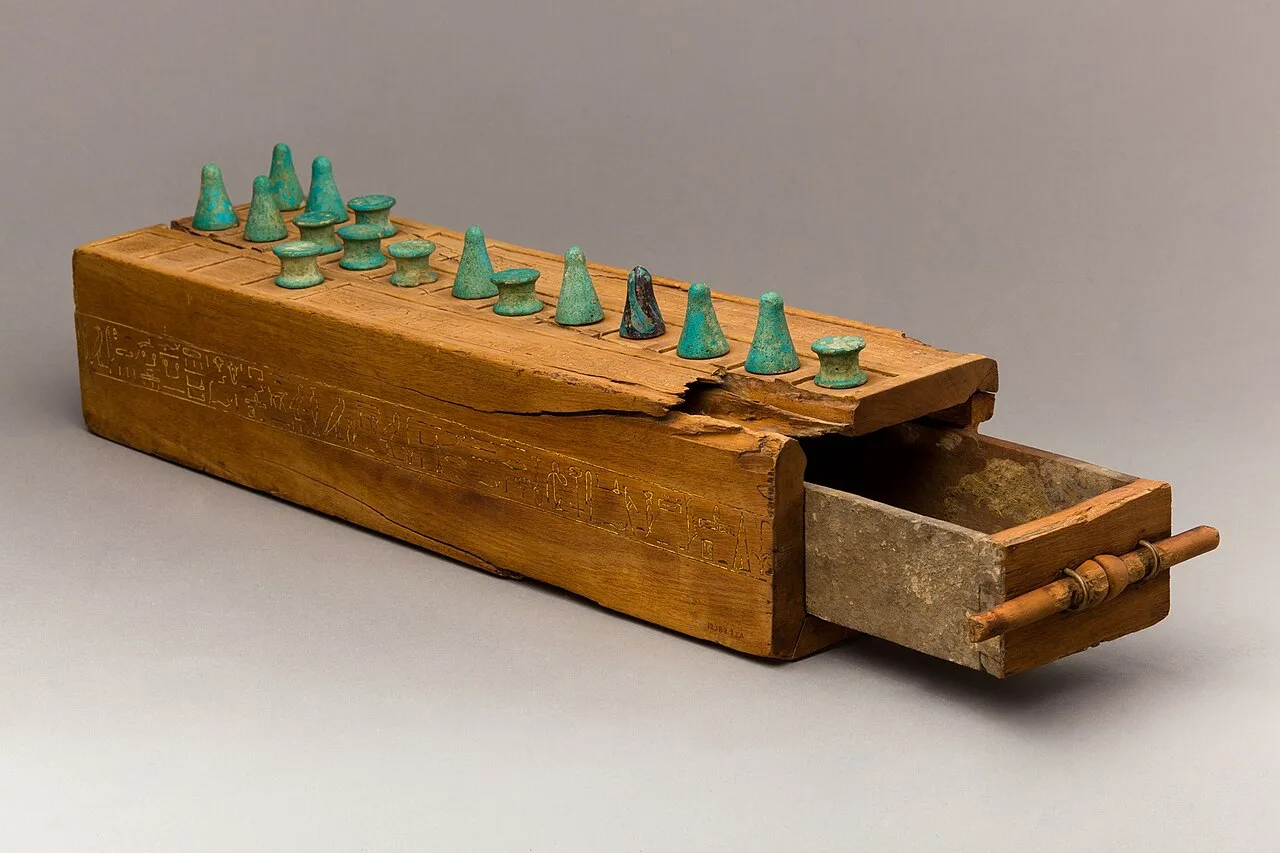
Game box with two games: Game of Twenty on top side of the box and Senet at the bottom, c. 1550–1295 BCE
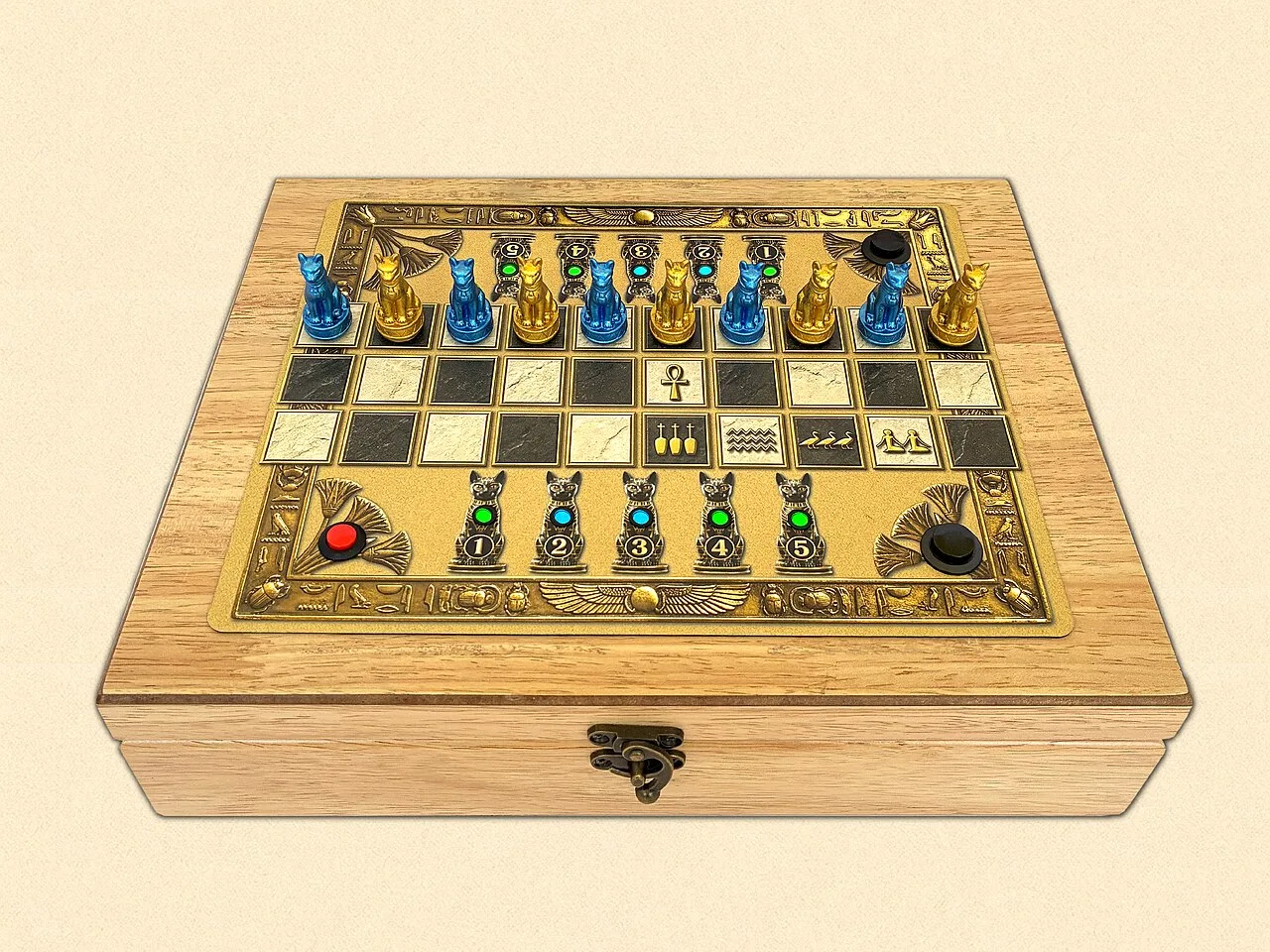
The world's first electronic Senet board game by Blue Ibis Designs
![The path of pieces through the 30 squares of the Senet board, as numbered by Peter Piccione[24]](https://nwjvzop1xgplmzvt.public.blob.vercel-storage.com/wikifeed/senet/4-25cabd816e.webp)
The path of pieces through the 30 squares of the Senet board, as numbered by Peter Piccione[24]
Senet
Senet is an ancient Egyptian board game consisting of ten or more pawns played on a 30-square board.
Depicted in Tombs but Absent from the Dirt
Although depictions of senet appear in Third Dynasty tombs like that of Hesy-Re and in graffiti from the Fifth and Sixth Dynasties, physical boards from the Old Kingdom have completely eluded archaeologists. The oldest intact boards only date to the Middle Kingdom. Consequently, researchers know the Fourth through Sixth Dynasty game purely through depictions in tombs rather than surviving physical artifacts.
From Wikipedia · CC BY-SA 4.0
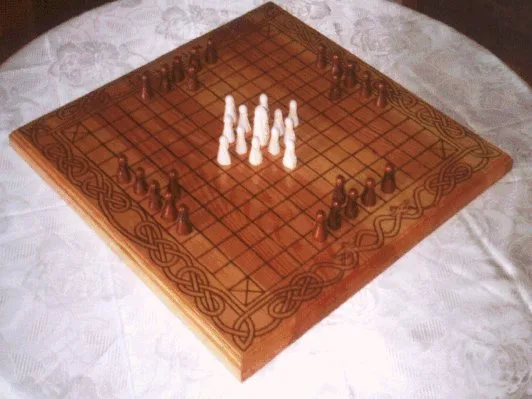
ZHNEFA
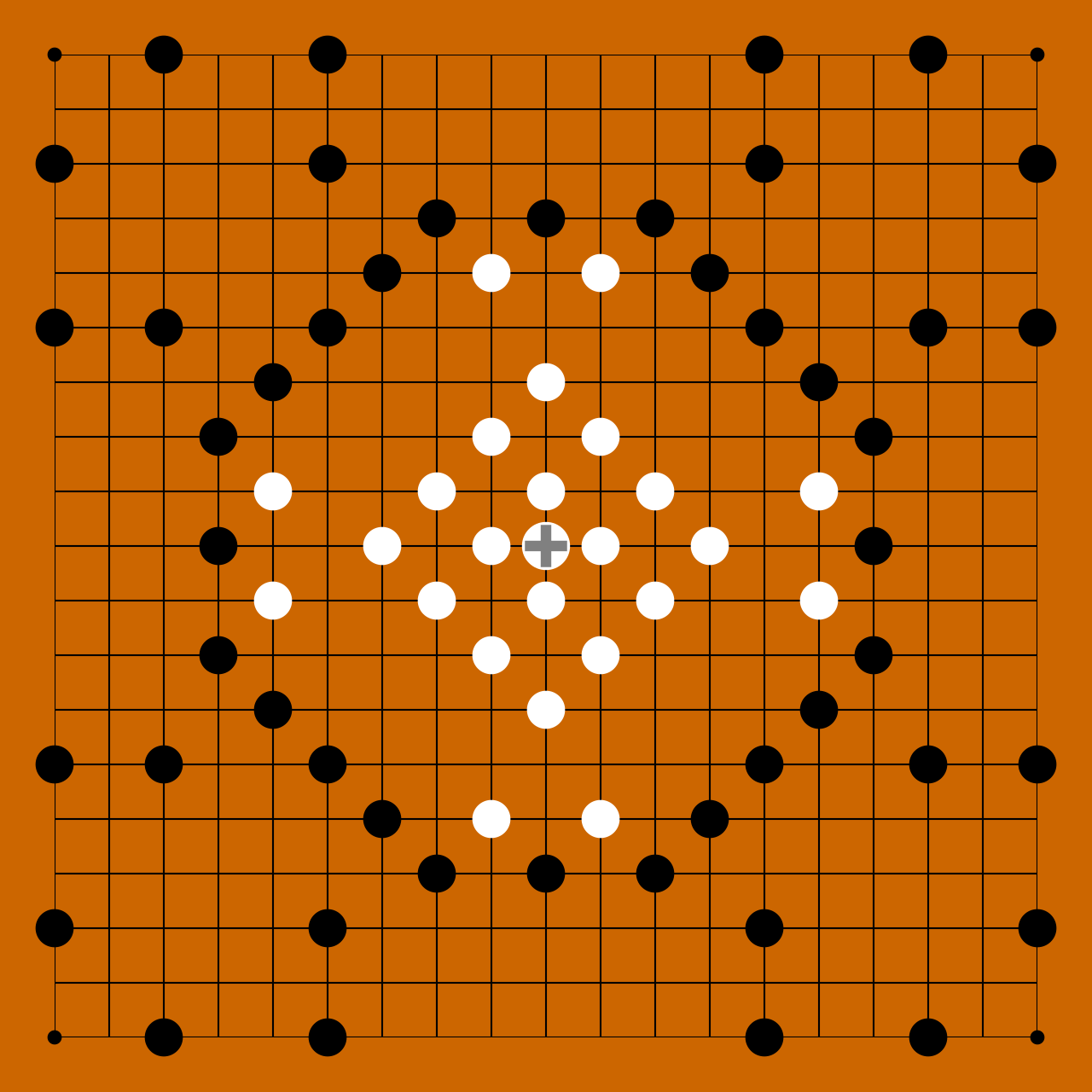
Alea Evangelii board
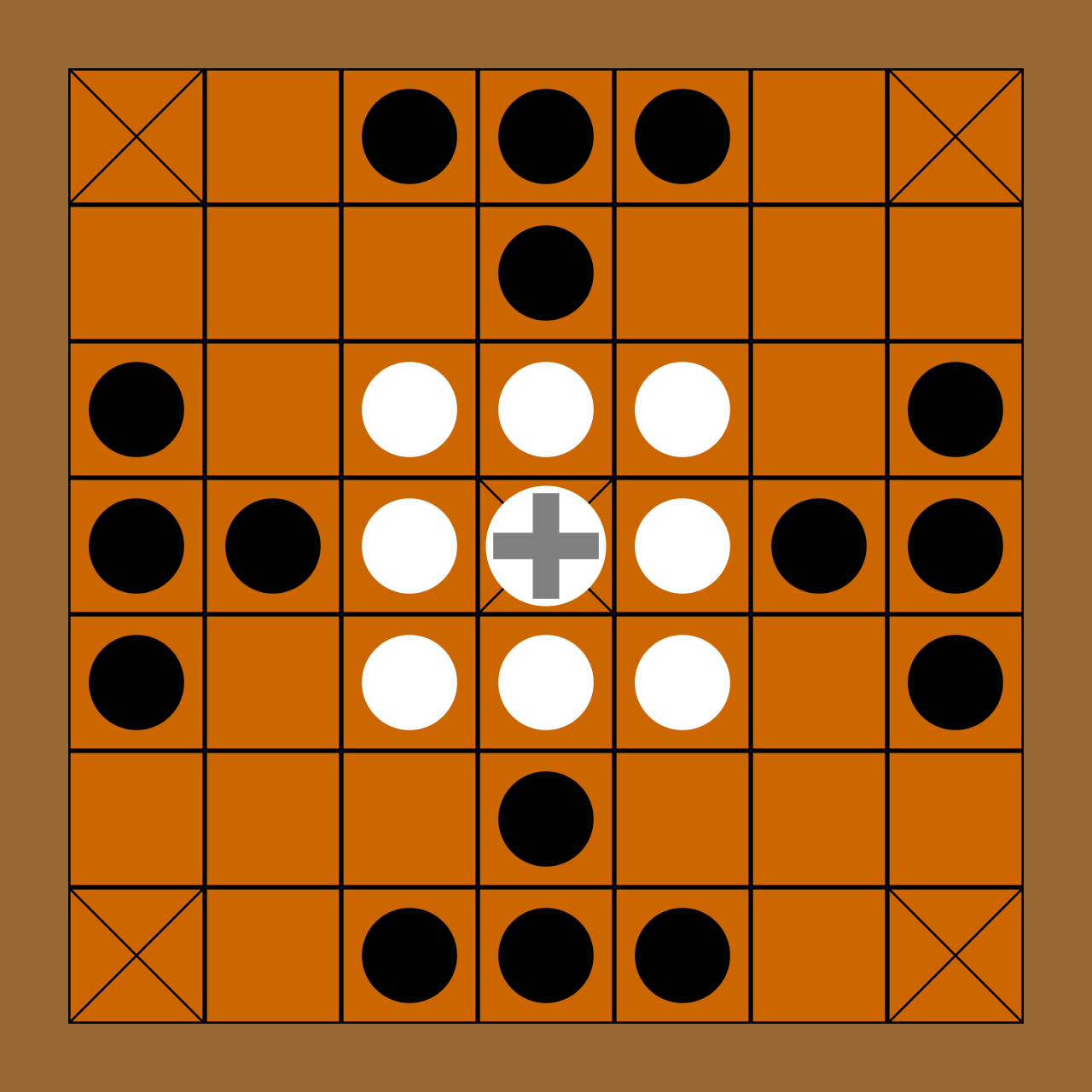
Ard Rí board
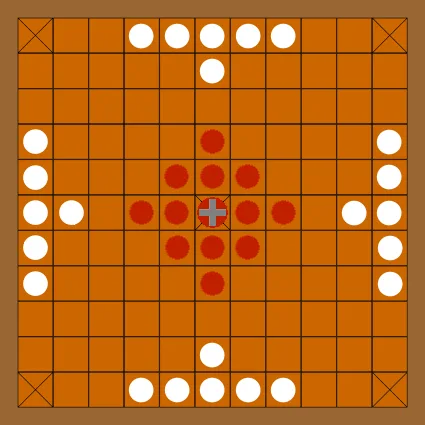
Hnefatafl board
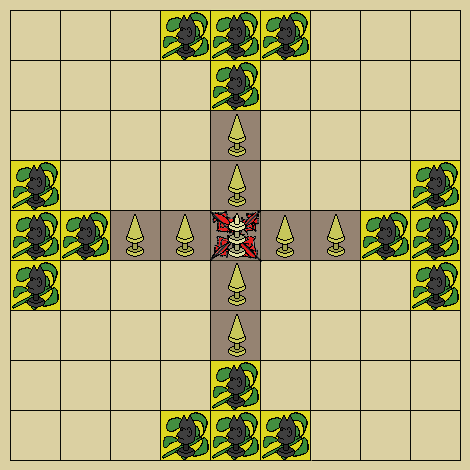
Tablut starting position: lighter "Swedes" start in centre; darker "Muscovites" start at the board's edges. Based on Linnaeus' sketches reproduced in Smith (1811).
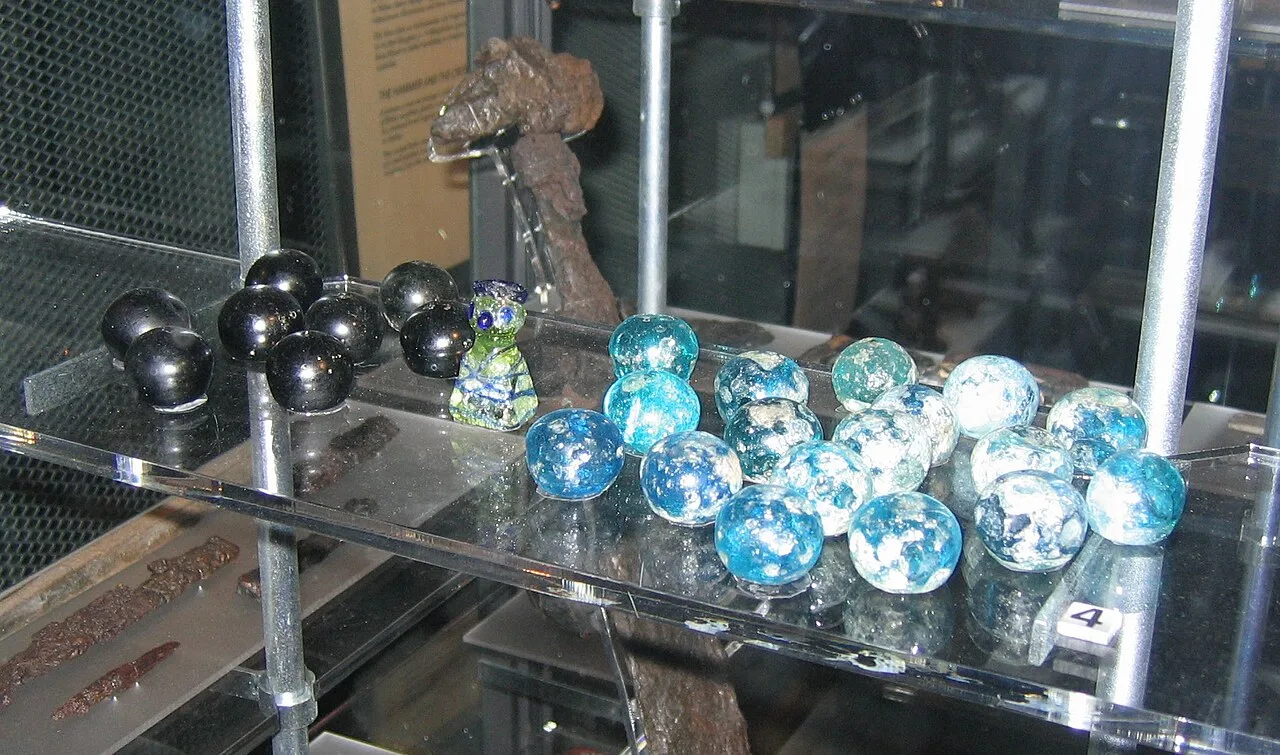
Tafl pieces from Birka in the Swedish Museum of National Antiquities in Stockholm
Tafl games
Tafl games, also known as hnefatafl games, are a family of ancient Northern European strategy board games played on a checkered or latticed board with two armies of uneven numbers.
Etymological Clues in Fist and Wood
The specific name hnefatafl arose as meaning "board game of the fist", where hnefi or "fist" referred to the central king-piece. While true tafl games featured unequal forces, another popular medieval game was played with equal forces on each side and was not a tafl variant. That balanced game may instead have been the medieval descendant of the Roman game latrunculi or ludus latrunculorum.
From Wikipedia · CC BY-SA 4.0
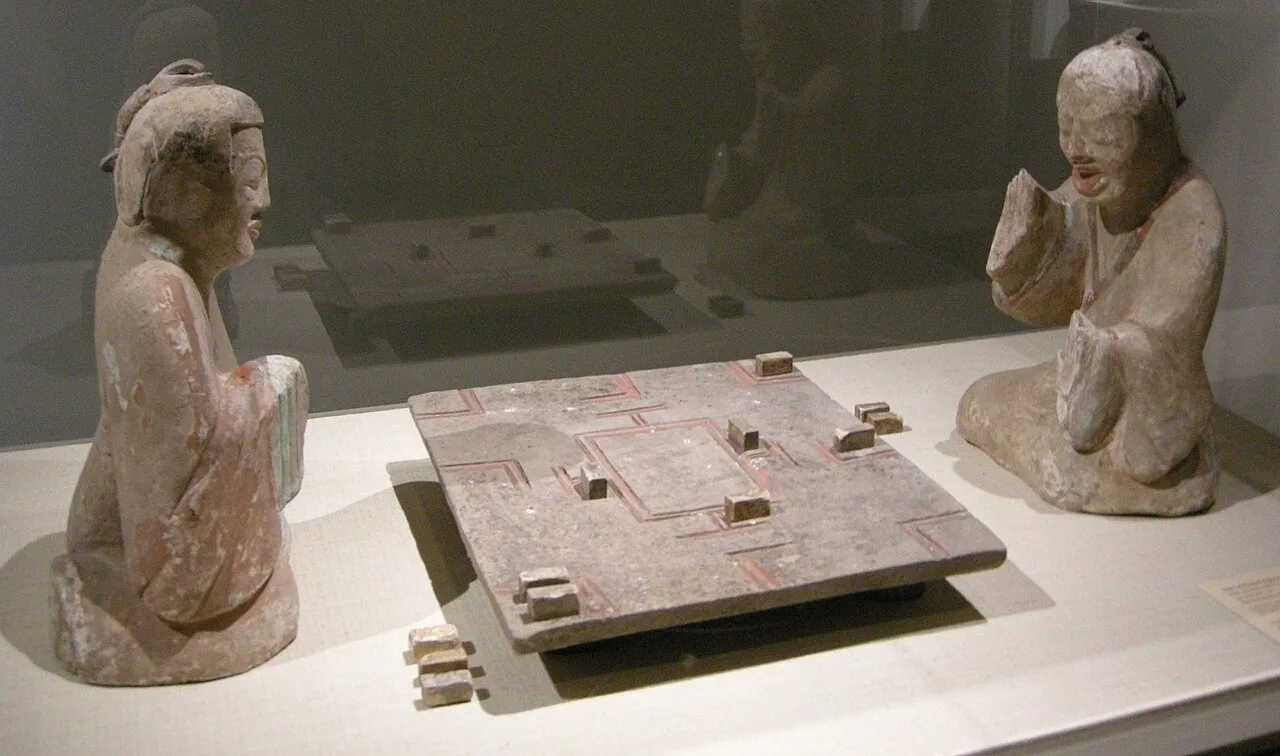
Met, Earthenware figures playing liubo, Han Dynasty
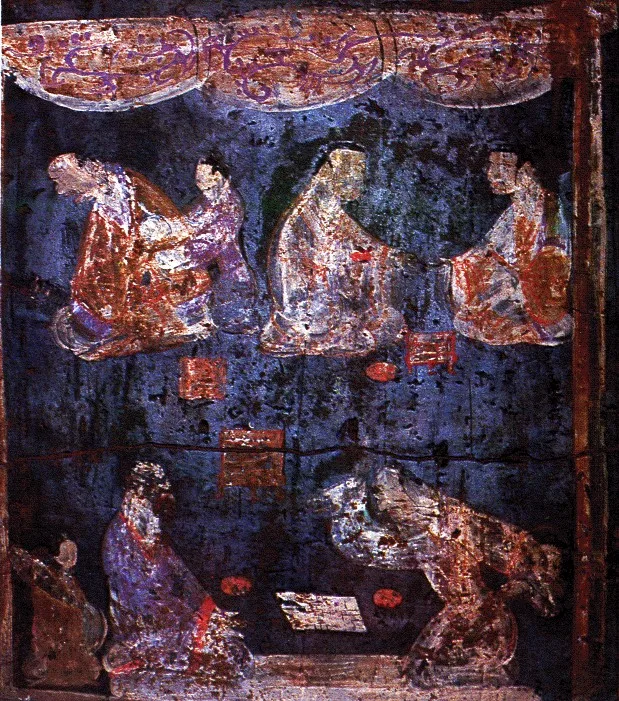
Mural from an Eastern Han dynasty tomb at Luoyang, Henan showing a pair of Liubo players in the foreground, the player on the right with his right hand raised up as if about to throw down the six throwing sticks
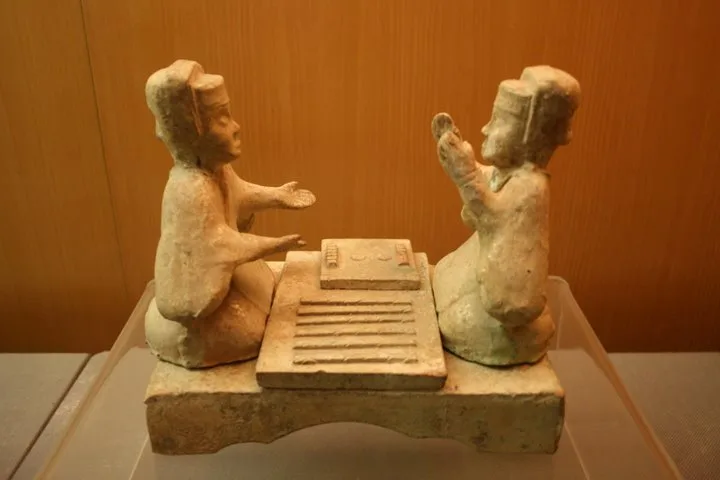
Eastern Han glazed pottery tomb figurines playing Liubo, with six sticks laid out to the side of the game board
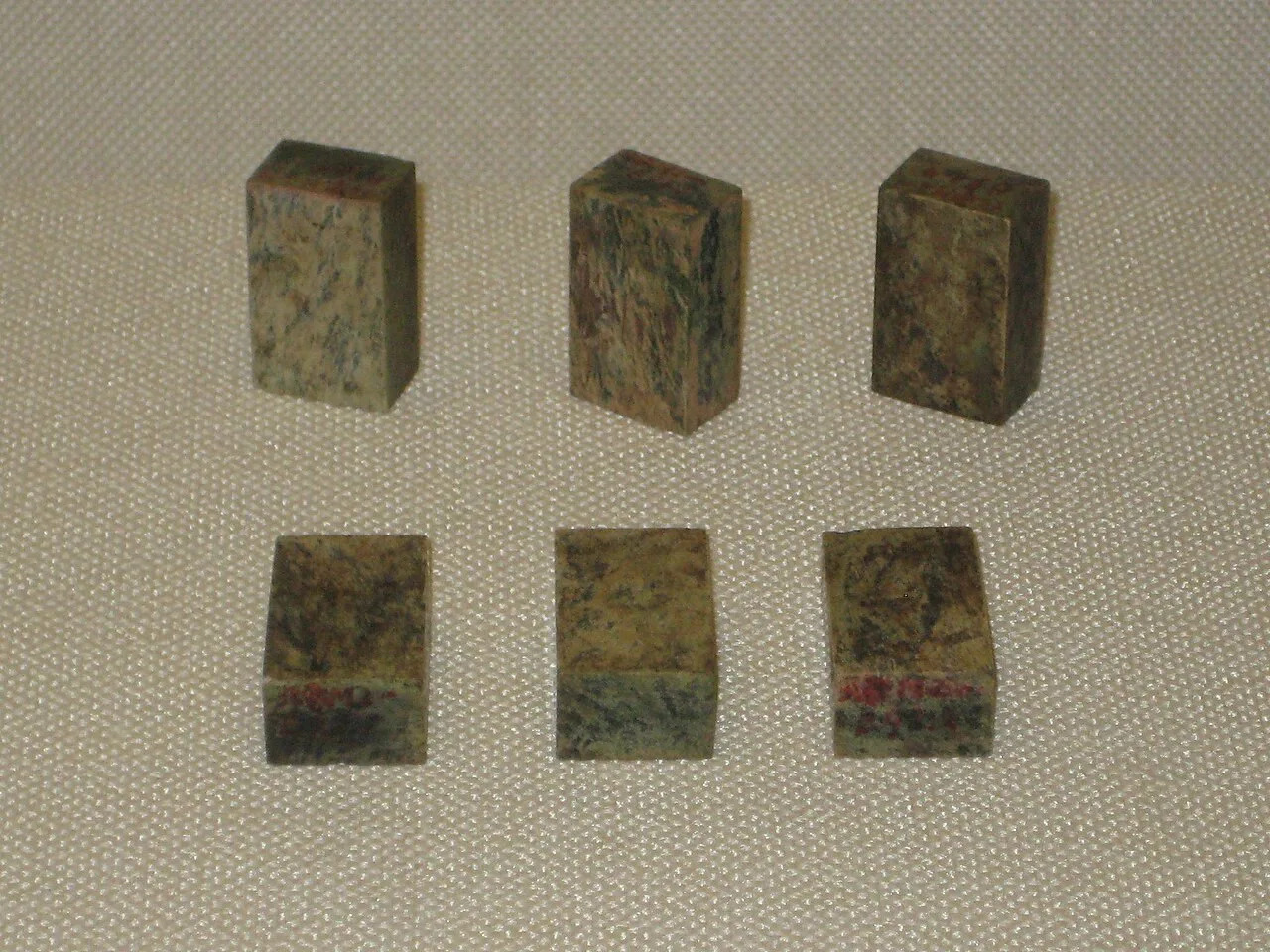
Six jadeite Liubo game pieces from the tomb of King Zhao Mo of Nanyue (reigned 137 BC – 122 BC)
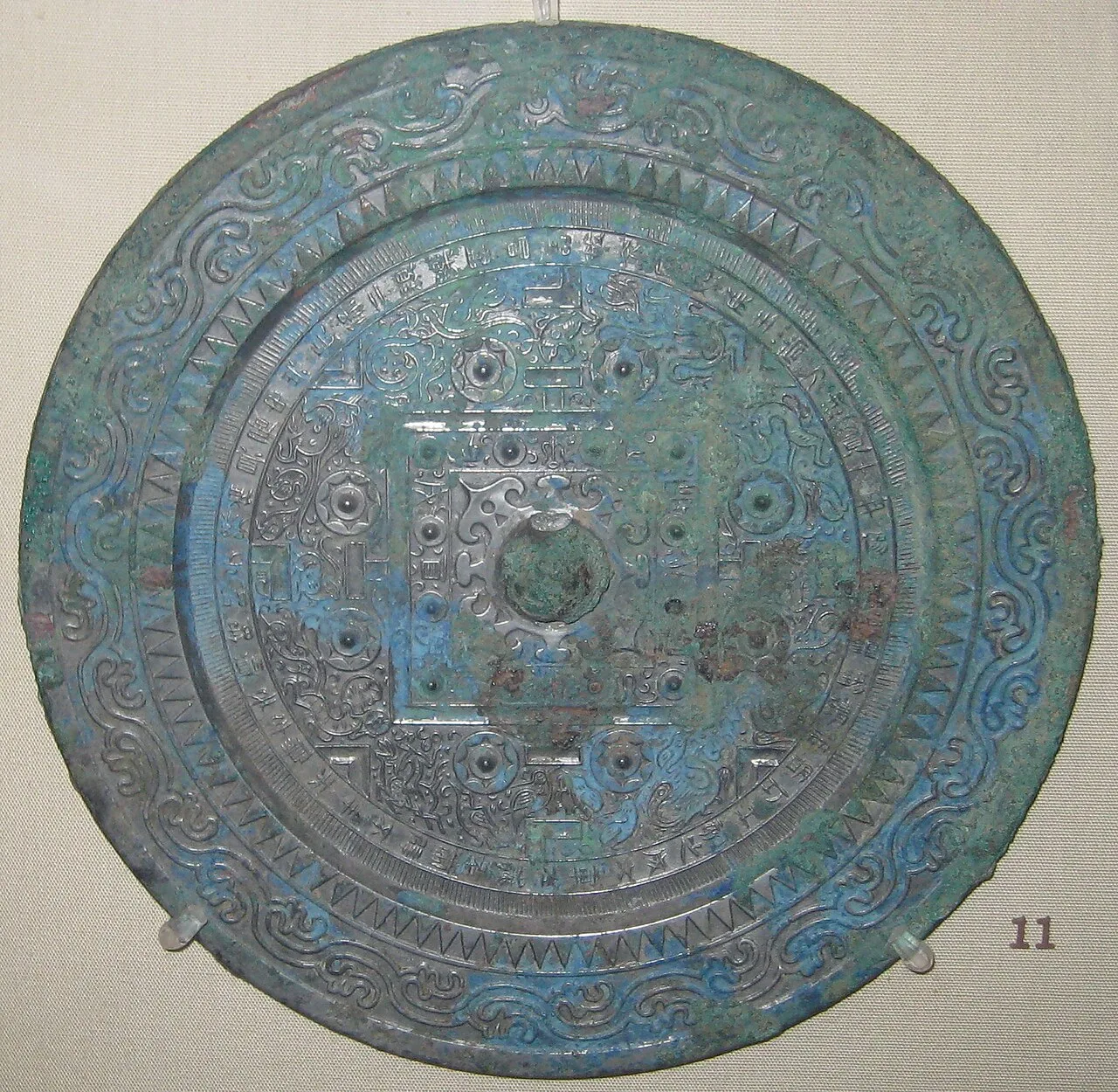
Han dynasty bronze mirror with TLV pattern

Schematic diagram of the Yinwan Han dynasty Liubo divination diagram, showing the positions of the sixty terms of the sexagenary cycle (following the corrections of Zeng Lanying) and examples of the nine board positions: A=fāng 方 "square"; B=lián 廉 (pàn 畔) "edge"; C=jié 楬 (jiē 揭) "lift"; D=dào 道 "path"; E=zhāng 張 "stretch"; F=qū 曲 (jiǔ 究) "bend"; G=qū 詘 (qū 屈) "curve"; H=cháng 長 (xuán 玄) "long"; I=gāo 高 "tall" (terms used in Xu Bochang's rhyme given in brackets if different).
Liubo
Liubo was an ancient Chinese board game for two players where movement on a symmetrical board was determined by throwing six sticks.
Prosperity and Pastimes in Ancient Linzi
Rather than being an obscure ritual pastime, Liubo flourished as a hallmark of urban wealth during China's Warring States era. The Records of the Grand Historian indicates that under King Xuan of Qi (reigned 319–301 BCE), the capital of Linzi grew so prosperous that citizens regularly indulged in matches alongside dog racing and kickball. The game formed an integral component of thriving civic leisure.
From Wikipedia · CC BY-SA 4.0
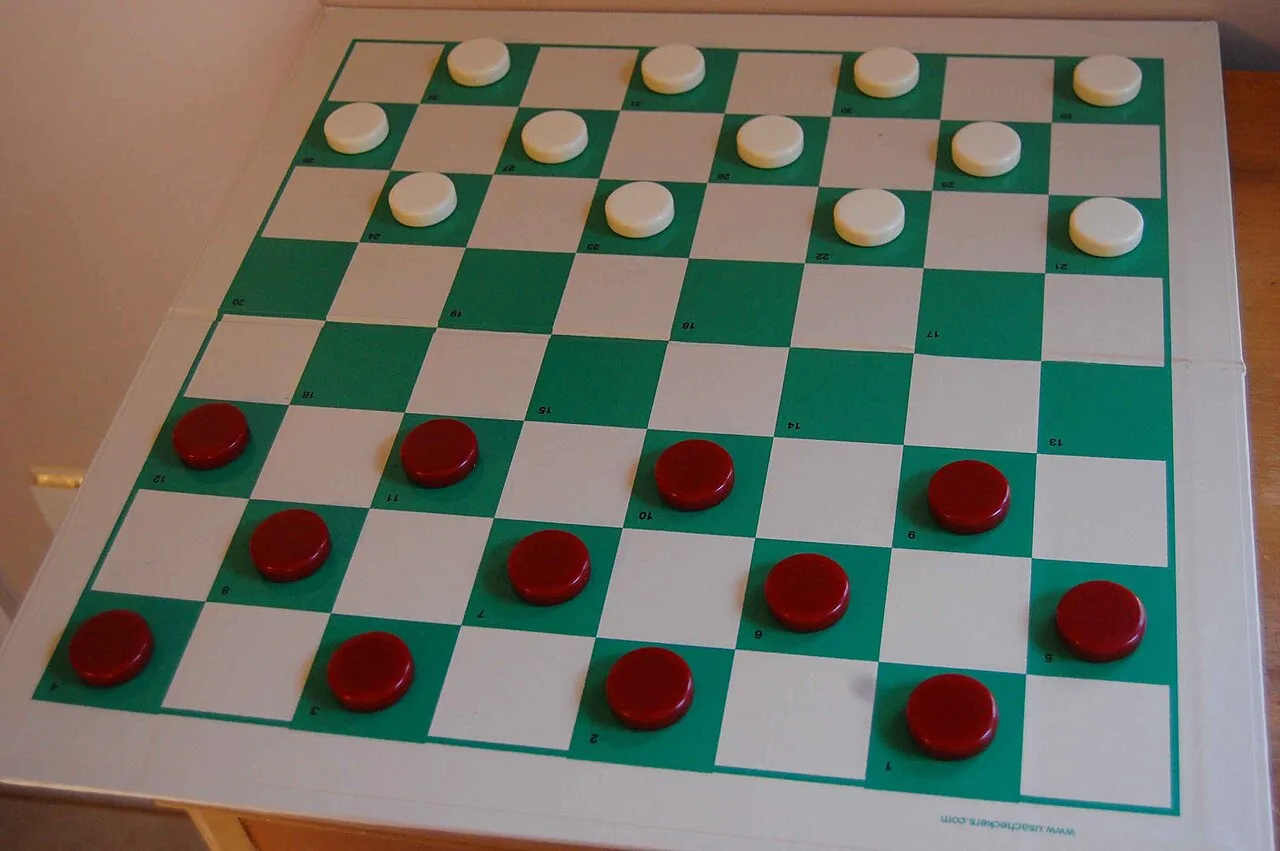
CheckersStandard
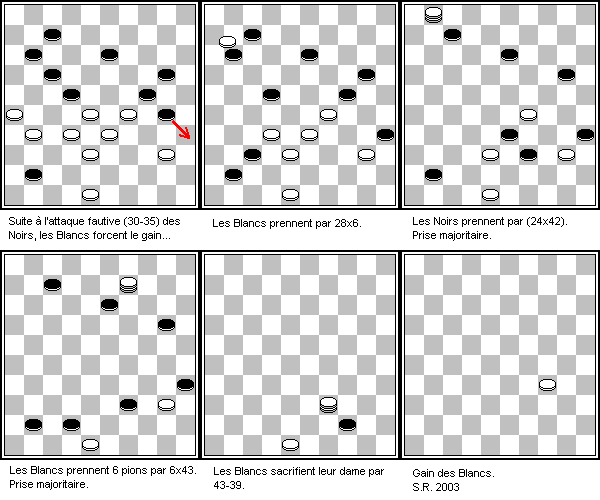
Example of a game of international draughts (10×10 board), showcasing the flying king (the move "Les Blancs prennent 6 pions...")
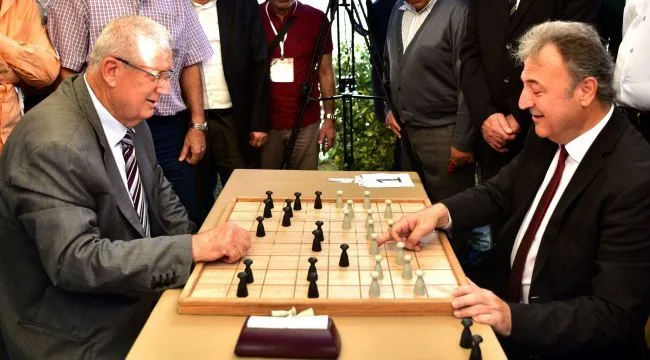
Opening of the Bornova International Turkish draughts Tournament
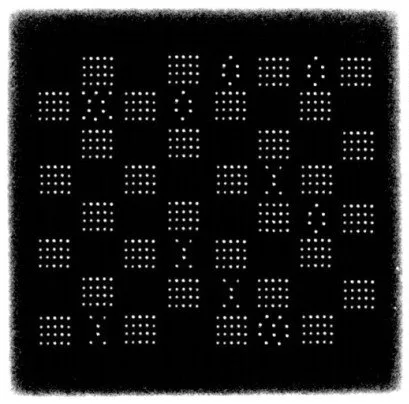
Christopher Strachey's Checkers (1952), an early video game
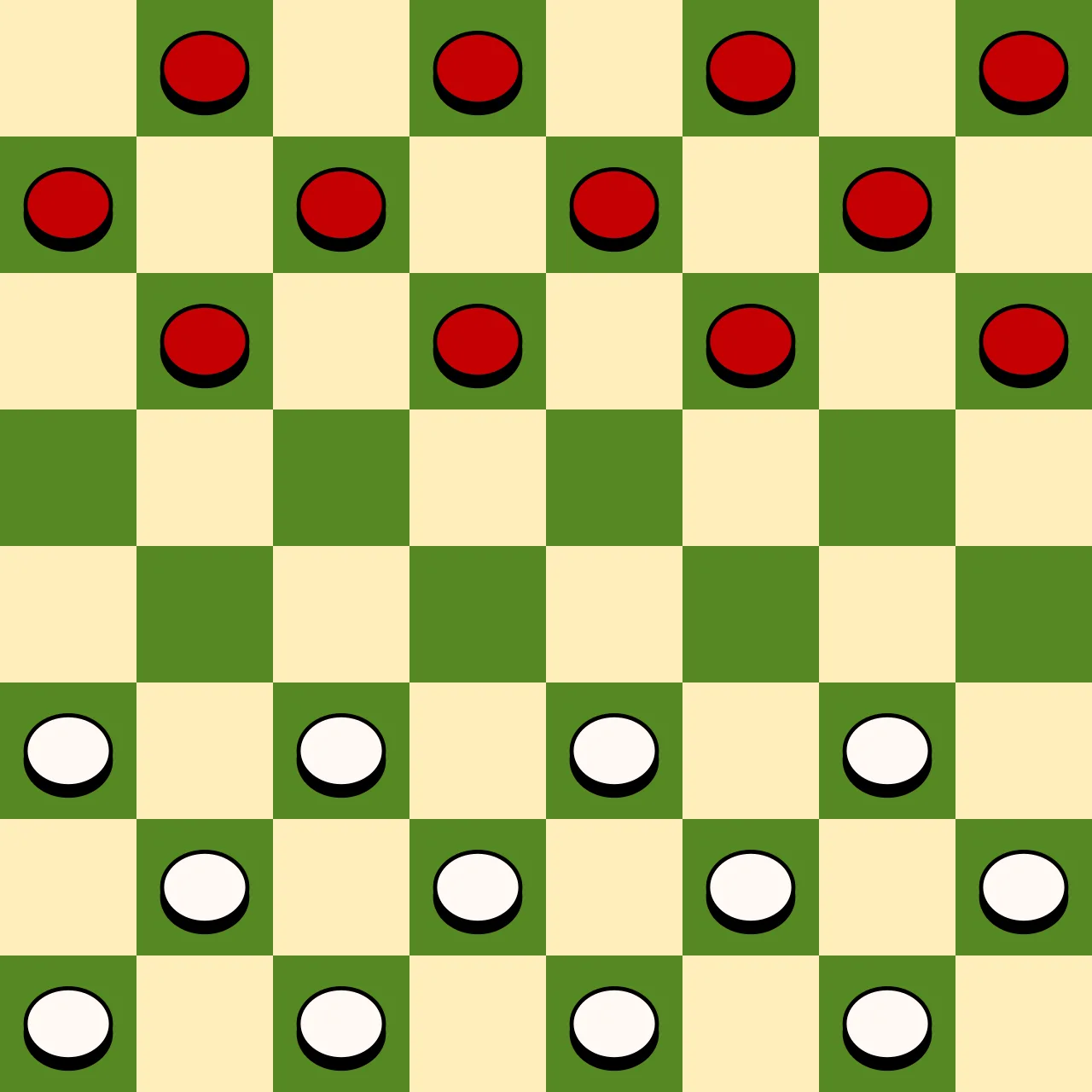
8×8 board, starting position in English, Brazilian, Czech, Tanzanian draughts and Russian draughts, as well as Pool checkers
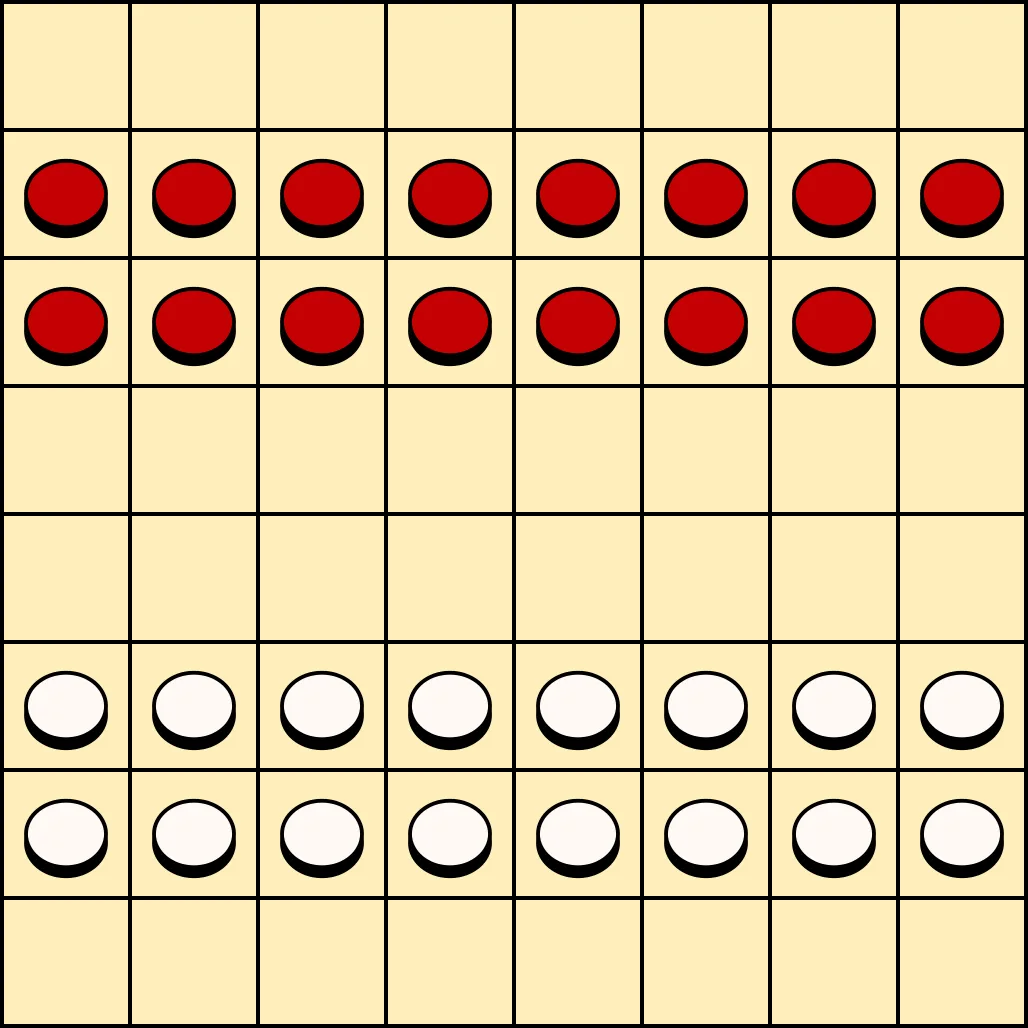
8×8 board, starting position in Turkish and Armenian draughts
Checkers
Checkers, also known as draughts, is a group of two-player strategy board games involving forward movements of uniform pieces and mandatory captures by jumping over opposing pieces.
Debunking the Ancient Mesopotamian Origin Myth
Popular histories often claim checkers dates back thousands of years to ancient Mesopotamia and Egypt, but archaeological scrutiny contradicts this idea. Game boards uncovered from approximately 3000 BCE in Ur actually functioned as race games reliant on dice and markers. Their backgammon-like mechanics lacked the mandatory jumping and piece captures that fundamentally define draughts.
From Wikipedia · CC BY-SA 4.0
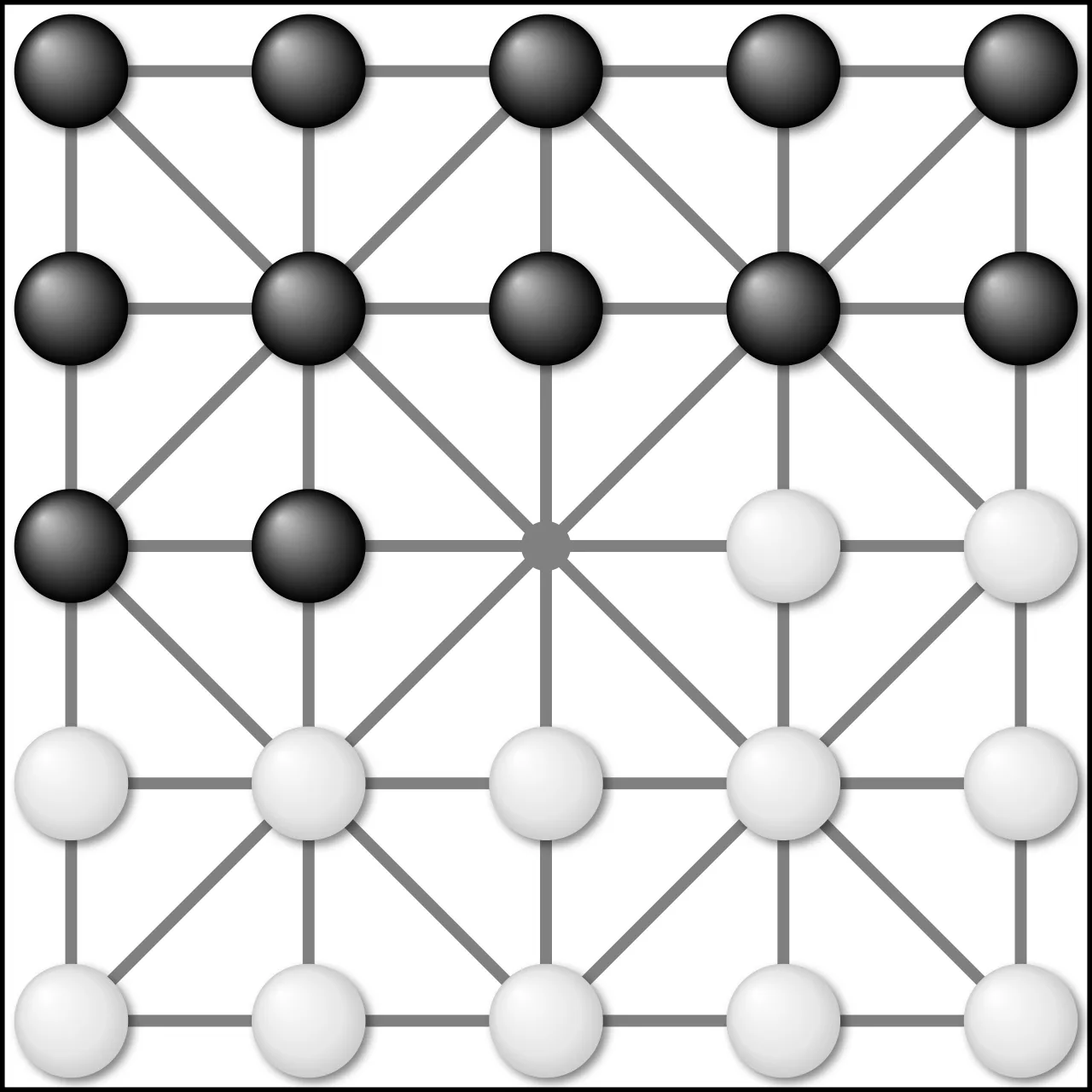
Alquerque board at starting position 2
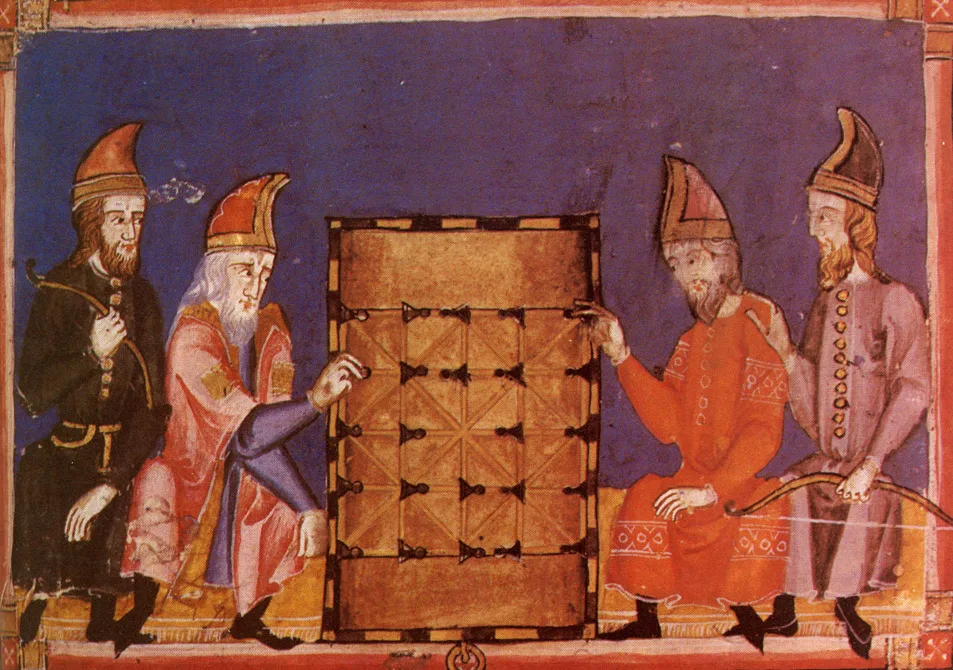
An illustration of the game in Libro de los juegos ('book of games')

An empty abstract alquerque board
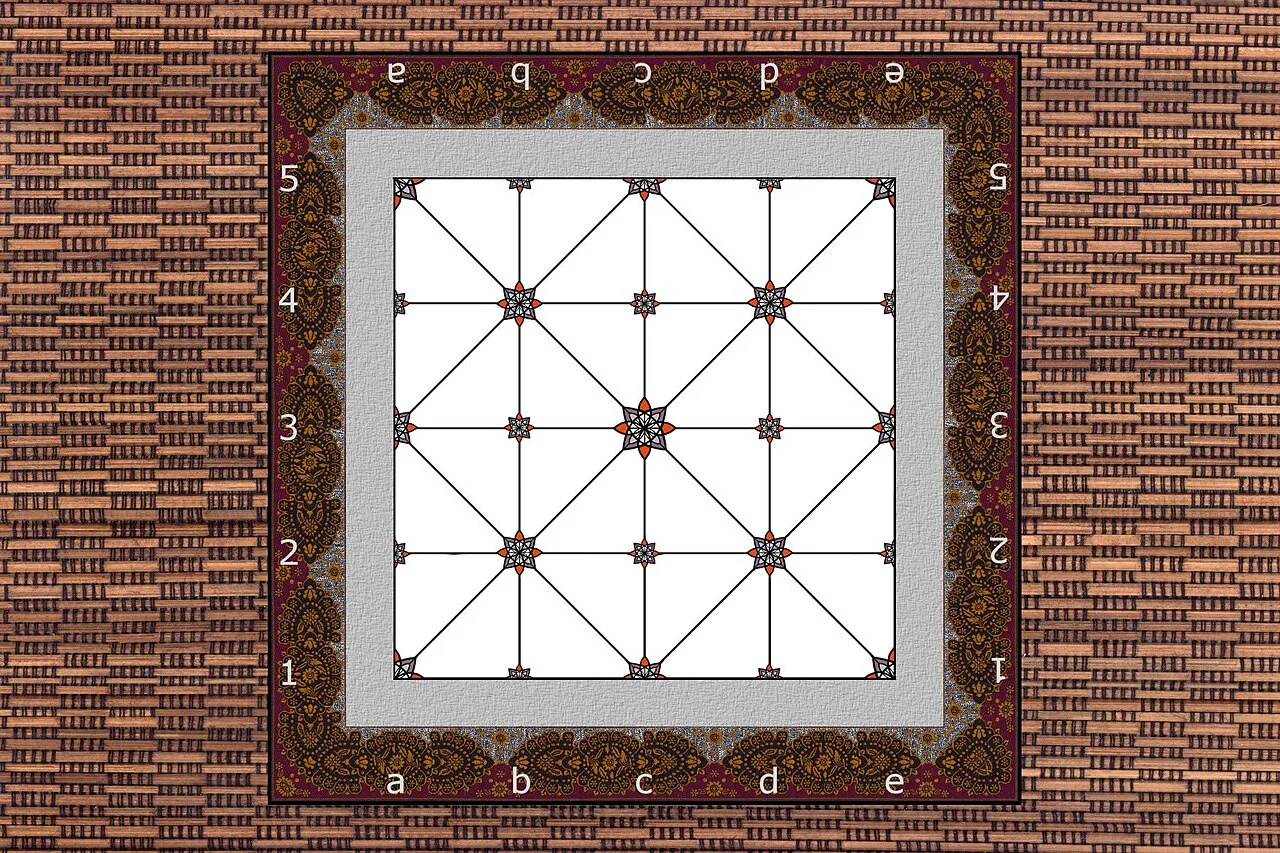
This board graphic displays Moorish design elements relating to the origin of Alquerque. The algebraic notation facilitates move annotation and gameplay discussion.
Alquerque
Alquerque is a Middle Eastern strategy board game considered to be the parent of draughts (checkers) and Fanorona.
The Middle Eastern Blueprint for Checkers
Alquerque originated in the Middle East and served as the direct ancestor to modern draughts and Fanorona. The diagonal grid lines connecting its positions established the foundation for the checkered patterns seen in contemporary checkers boards. Starting with twelve pieces each, players maneuver across this intersecting layout to wipe out all opposing units.
From Wikipedia · CC BY-SA 4.0
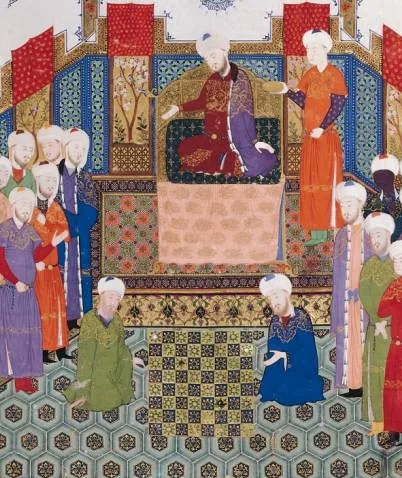
Two shatranj players in a detail from a Persian miniature painting of Bayasanghori Shahname made in 1430
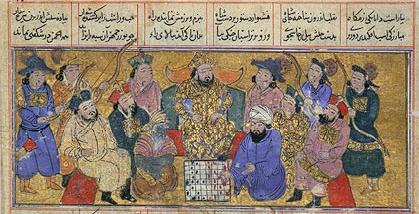
Persian manuscript from the 14th century describing how an ambassador from India brought chess to the Persian court
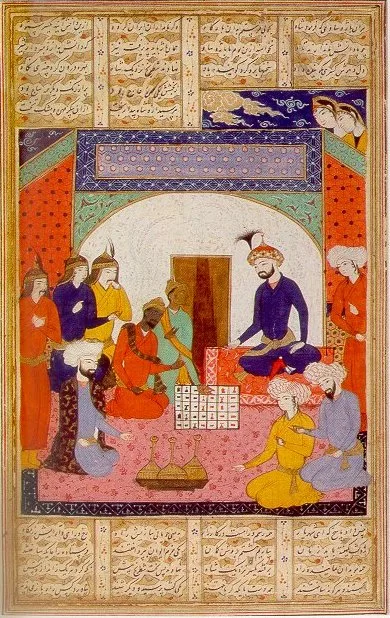
Indian ambassador, probably sent by the Maukhari King Śarvavarman of Kannauj, introducing chess to the Persian court of Khosrow I[3][4]
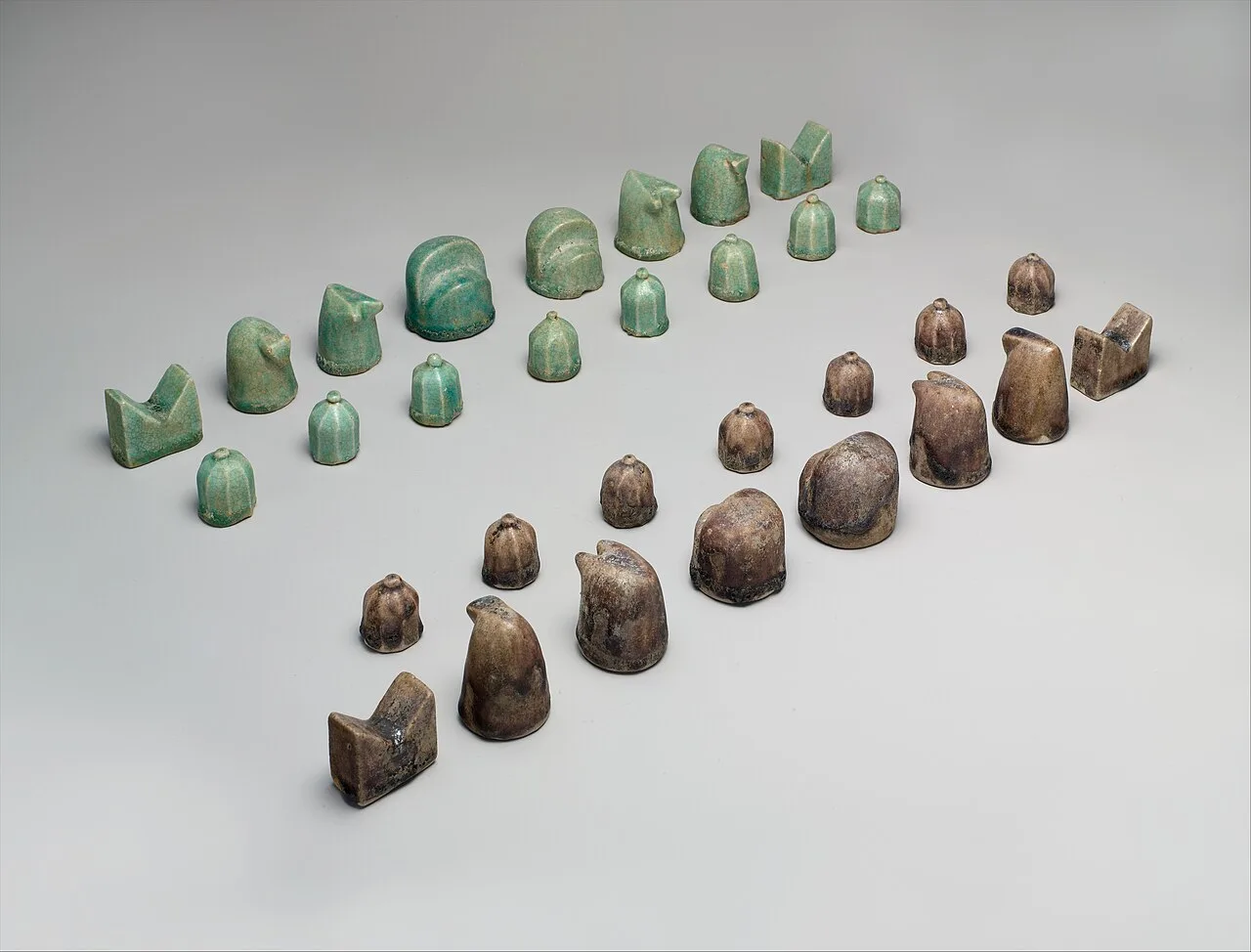
Iranian shatranj set, glazed fritware, 12th century Nishapur (New York Metropolitan Museum of Art)
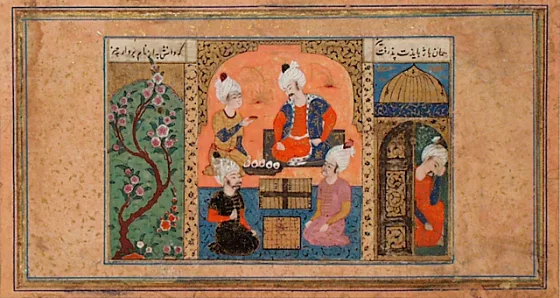
Early shatranj
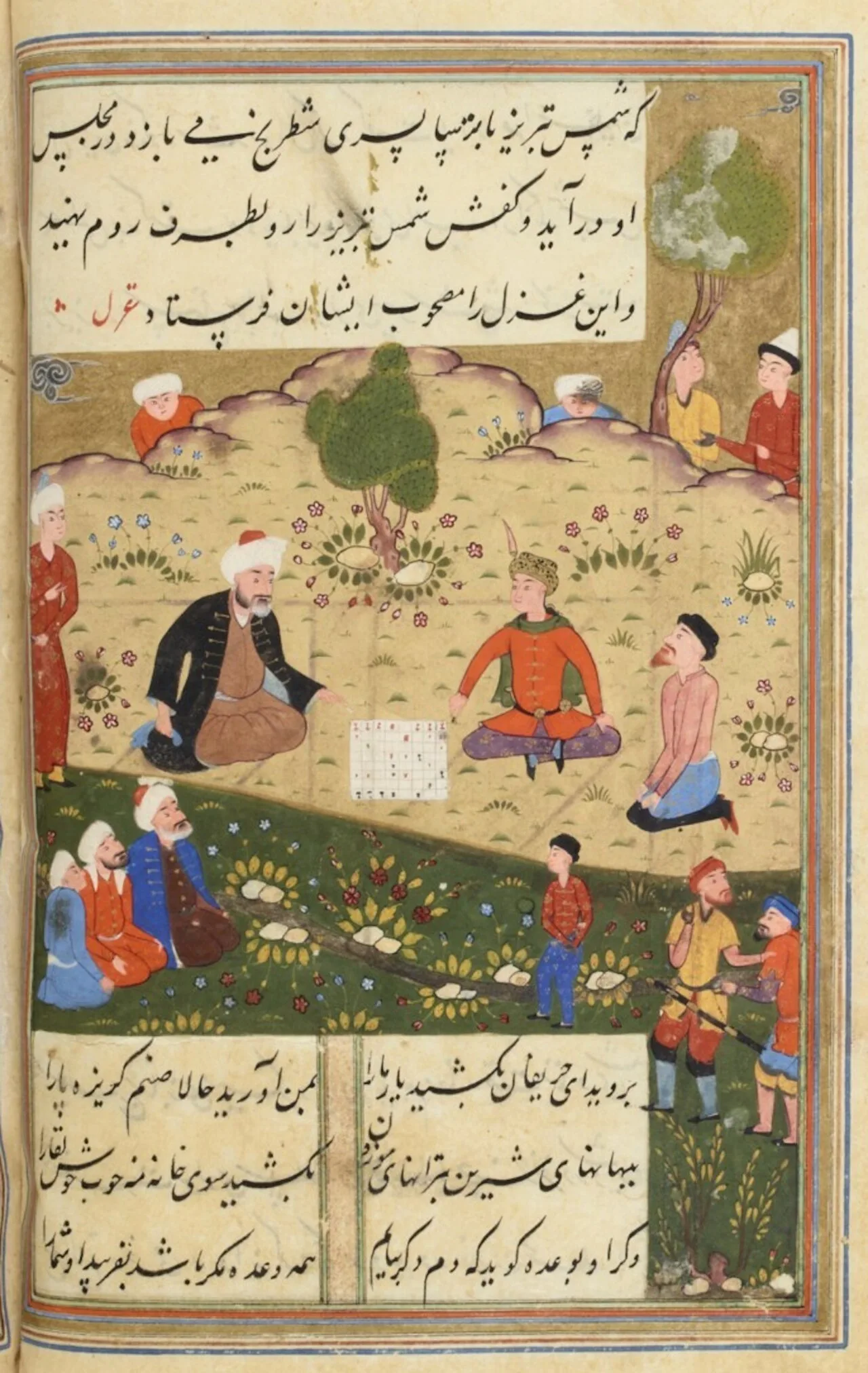
Shams-e-Tabrīzī as portrayed in a 1500 painting in a page of a copy of Rumi's poem dedicated to Shams.
Shatranj
Shatranj is an ancient form of chess originating from the Indian game chaturanga and played in the Sasanian Empire, from which modern chess developed.
Eliminating Accidental Regicide
In early Indian chaturanga (c. 500–700), players could simply capture the opposing king to win the game immediately. Persian shatranj (c. 700–800) fundamentally transformed the game's logic by requiring players to warn their opponent when the king was under attack. This innovation was introduced specifically to prevent sudden, accidental ends to matches. By outlawing direct king capture and mandating checkmate, Persian players established the preservation of the sovereign as the supreme strategic objective.
From Wikipedia · CC BY-SA 4.0
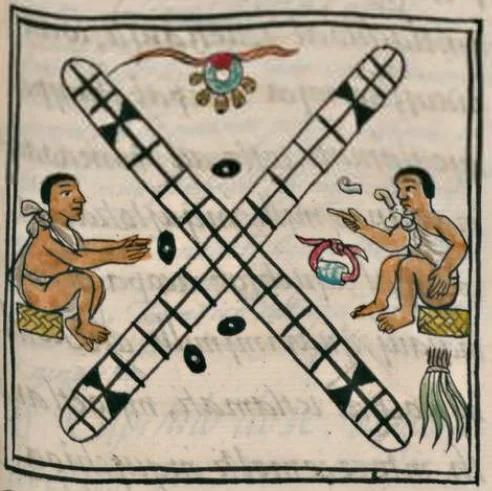
Patolli as depicted in Bernardino de Sahagún's General History of the Things of New Spain. Skilled players had their own game mats and their own playing pieces that they brought in tied cloth bundles.[1]
![Patolli game being watched by Macuilxochitl as depicted on page 048 of the Codex Magliabechiano.[2][3]](https://nwjvzop1xgplmzvt.public.blob.vercel-storage.com/wikifeed/patolli/1-0c7780f8fc.webp)
Patolli game being watched by Macuilxochitl as depicted on page 048 of the Codex Magliabechiano.[2][3]
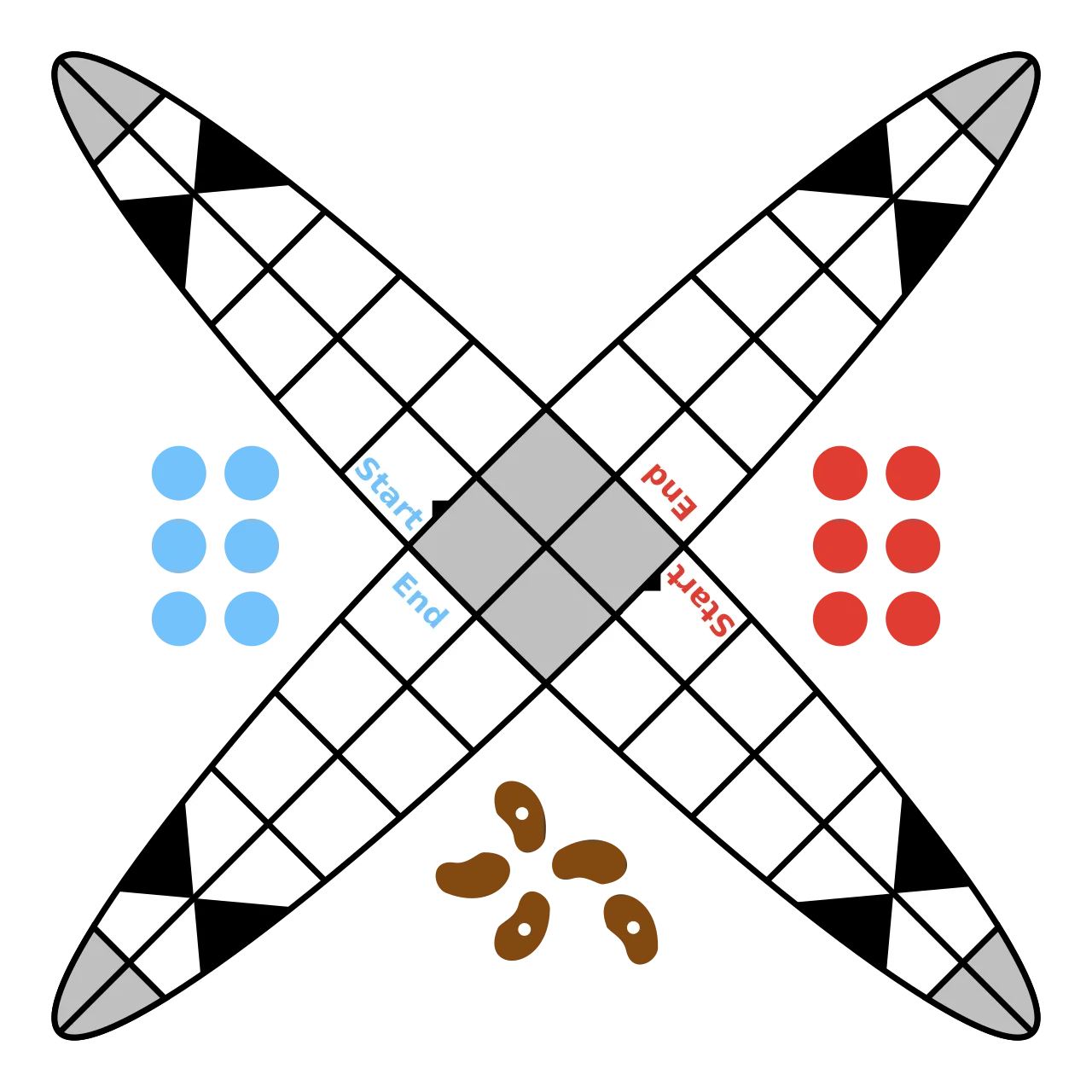
Patolli board and pieces
Patolli
Patolli is a pre-Columbian Mesoamerican board game attested in Central Mexico and the Maya region, dating back to at least the Early Classic period.
Royal Spectacles Across Millennia
Patolli spanned far beyond a casual pastime, captivating both common folk and sovereign rulers throughout ancient Mesoamerica. Conquistadors recorded that Emperor Moctezuma Xocoyotzin regularly spent hours watching his nobles compete at court. This endurance reflected a deep cultural heritage that united early civilisations and imperial elites alike across centuries.
From Wikipedia · CC BY-SA 4.0
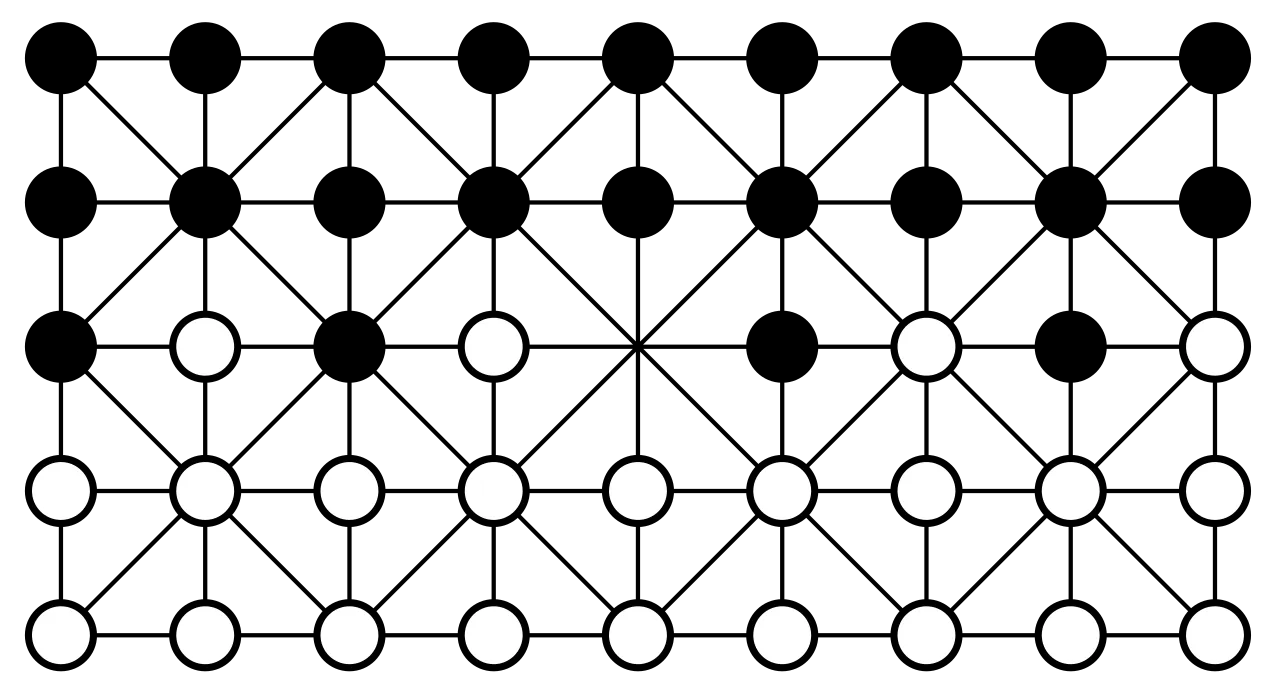
Fanorona-1
Fanorona
Fanorona is a two-player strategy board game indigenous to Madagascar.
Tetrakis Grid Geometry Across Three Board Scales
Fanorona exists in three traditional sizes: Fanoron-Telo on a 3×3 grid, Fanoron-Dimy on a 5×5 grid, and Fanoron-Sivy on a 9×5 grid. In the popular Sivy version, diagonal subdivisions create a tetrakis square tiling of the plane. This layout determines whether an intersection is weak or strong, allowing either orthogonal or diagonal movements.
From Wikipedia · CC BY-SA 4.0
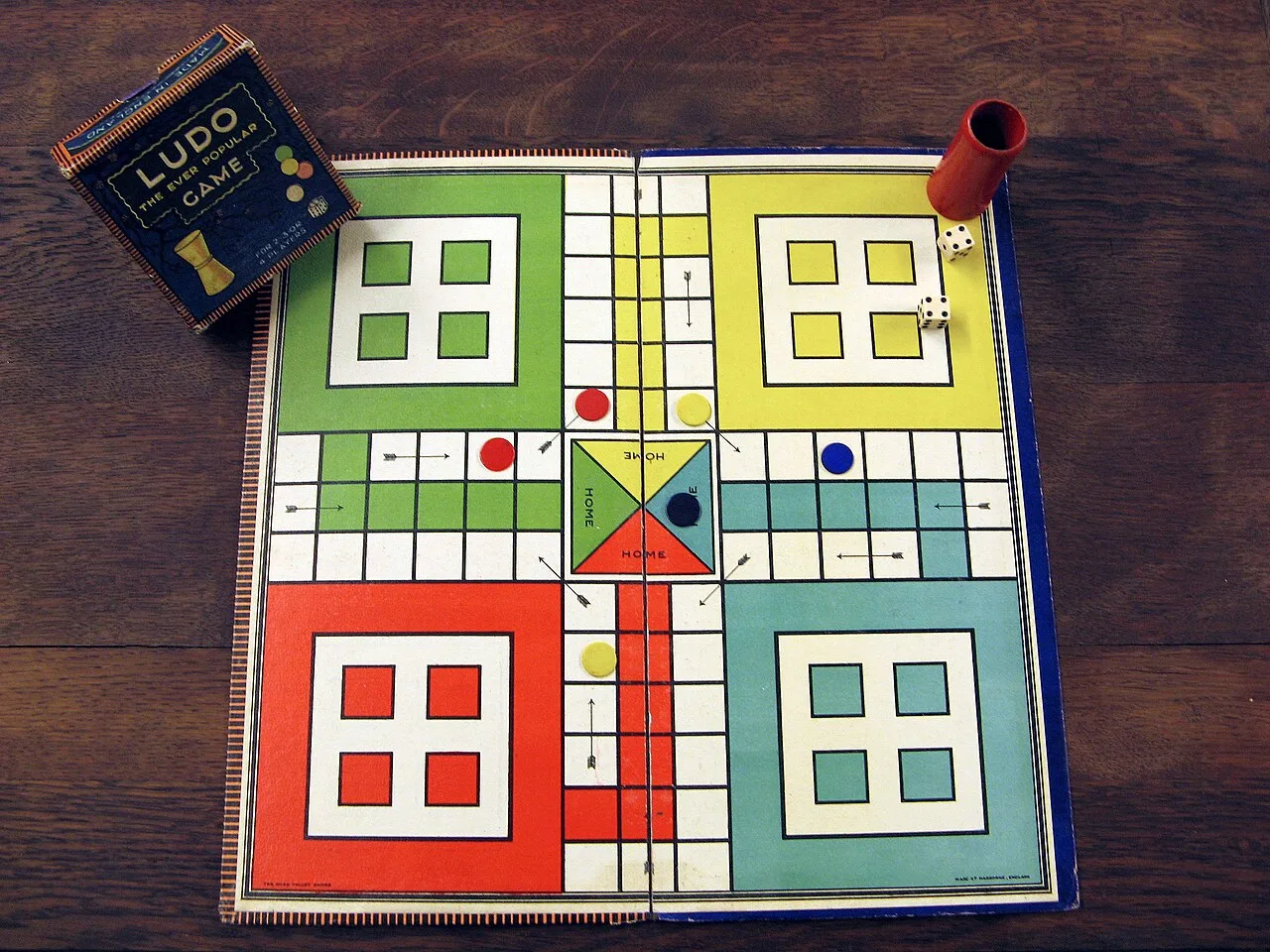
Ludo-3
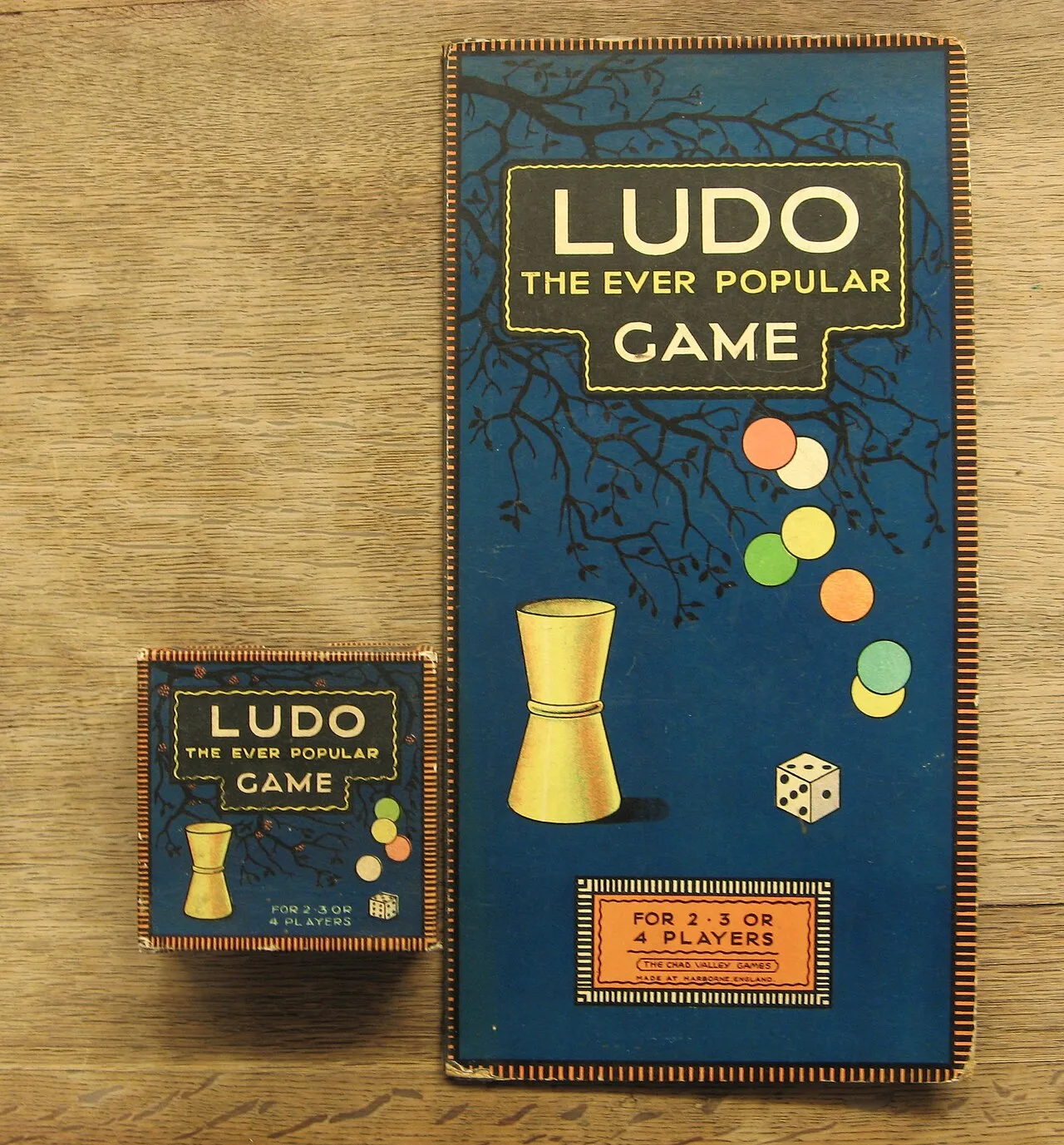
An early commercially printed edition of Ludo by Chad Valley
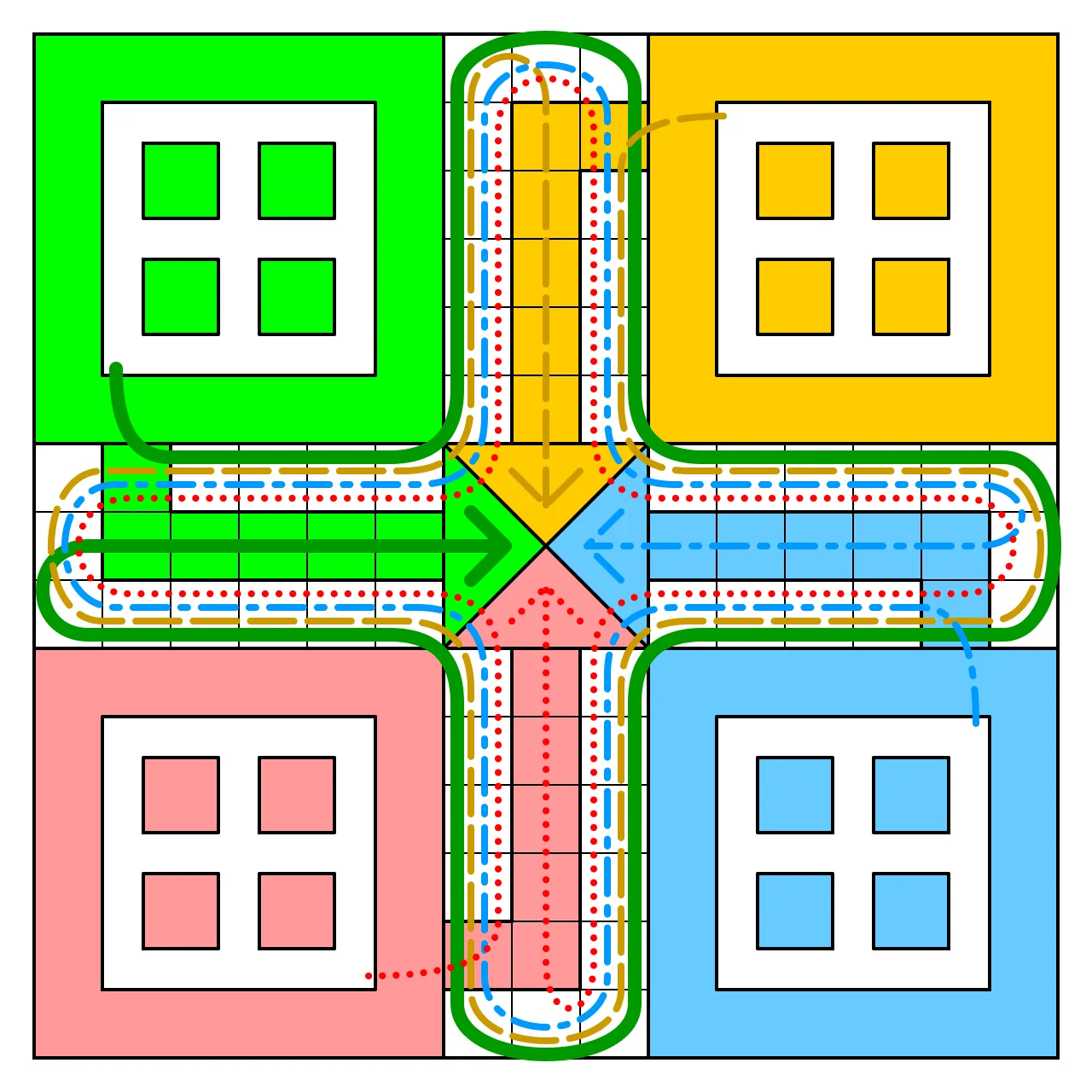
Trajectory of tokens of each colour on the original Ludo board
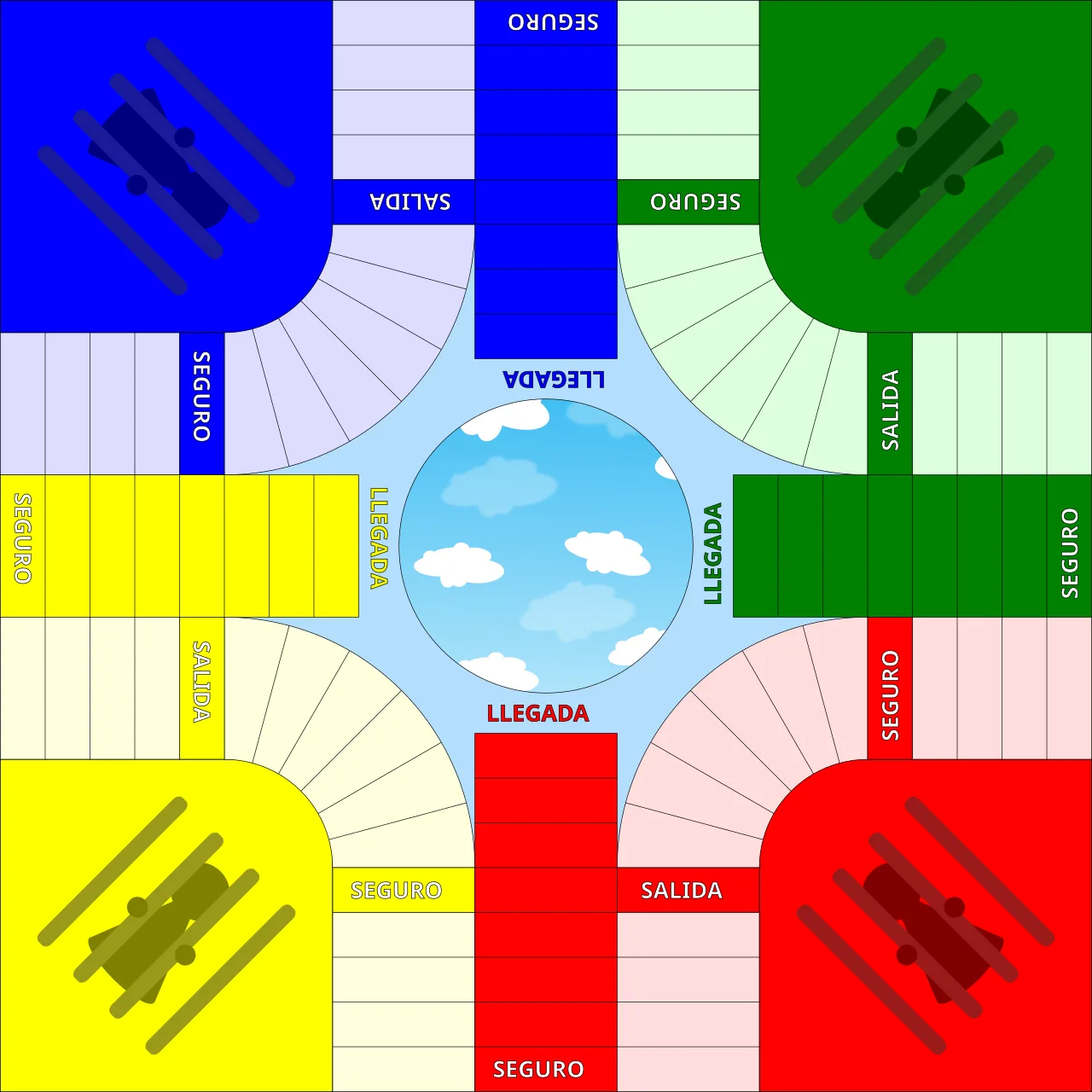
Regular parqués board for four players
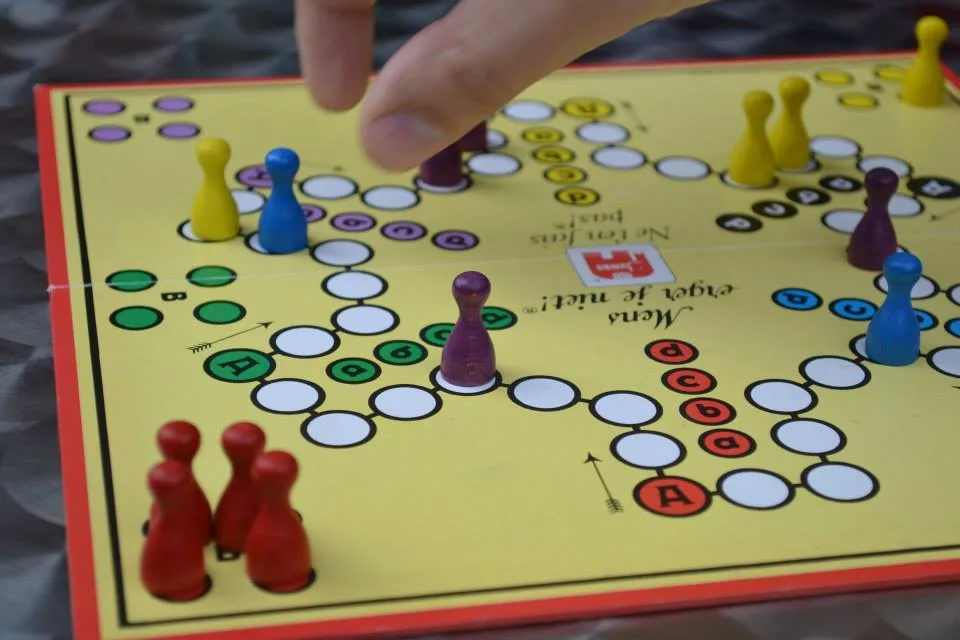
Mens erger je niet, Dutch version for six players
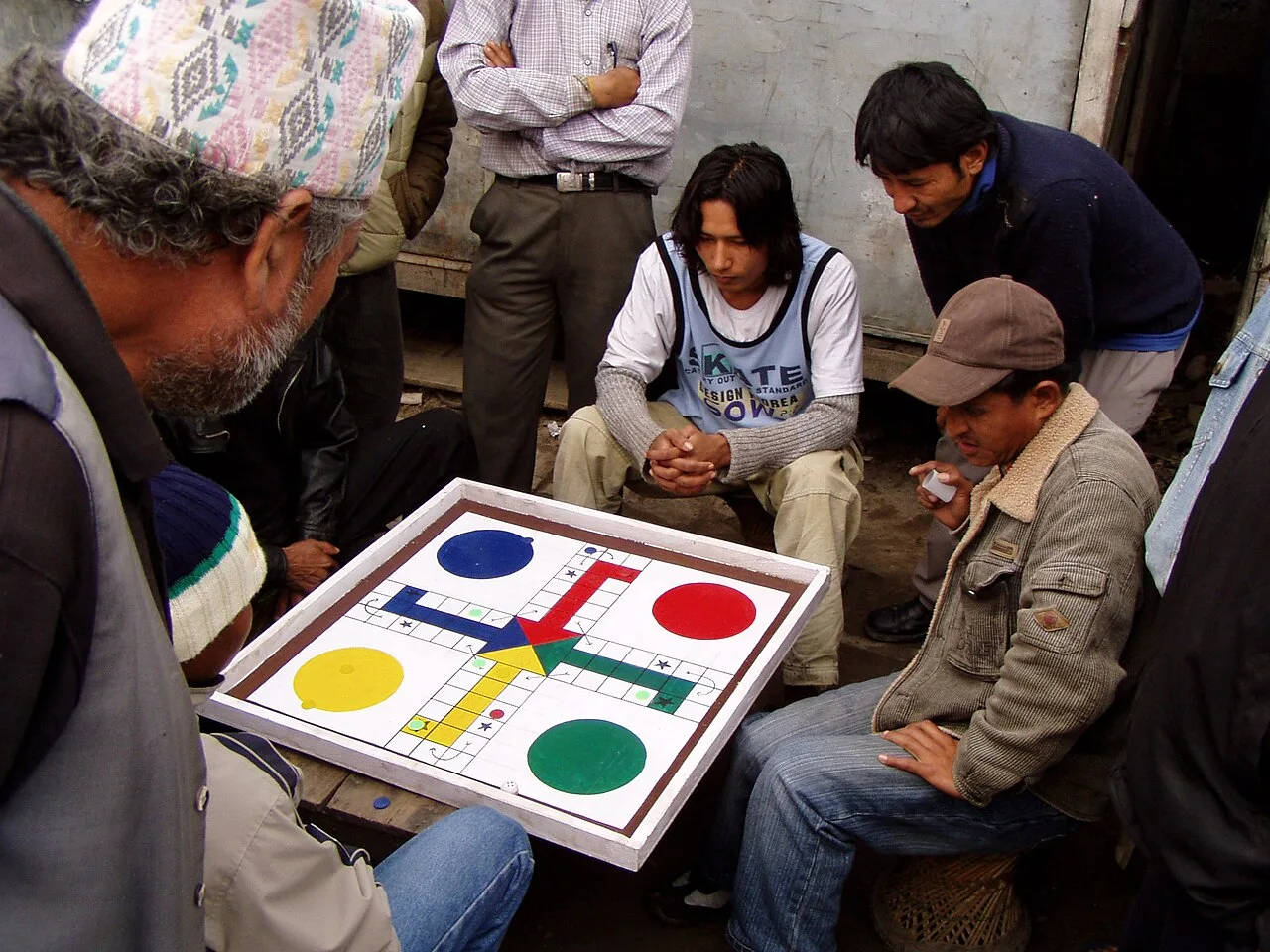
Pachisi variant being played on a Ludo board in Nepal
Ludo (board game)
Ludo is a strategy-based board game for two to four players, who race four tokens from start to finish according to die rolls.
Victorian Patents and Naval Quarterdecks
In 1896, Alfred Coller introduced the cubic-die board game to England under the name Ludo. Coller eventually patented the game and sold it under the title "Royal Ludo". The design proved adaptable enough to cross over into military culture, inspiring the Royal Navy variant known as Uckers.
From Wikipedia · CC BY-SA 4.0
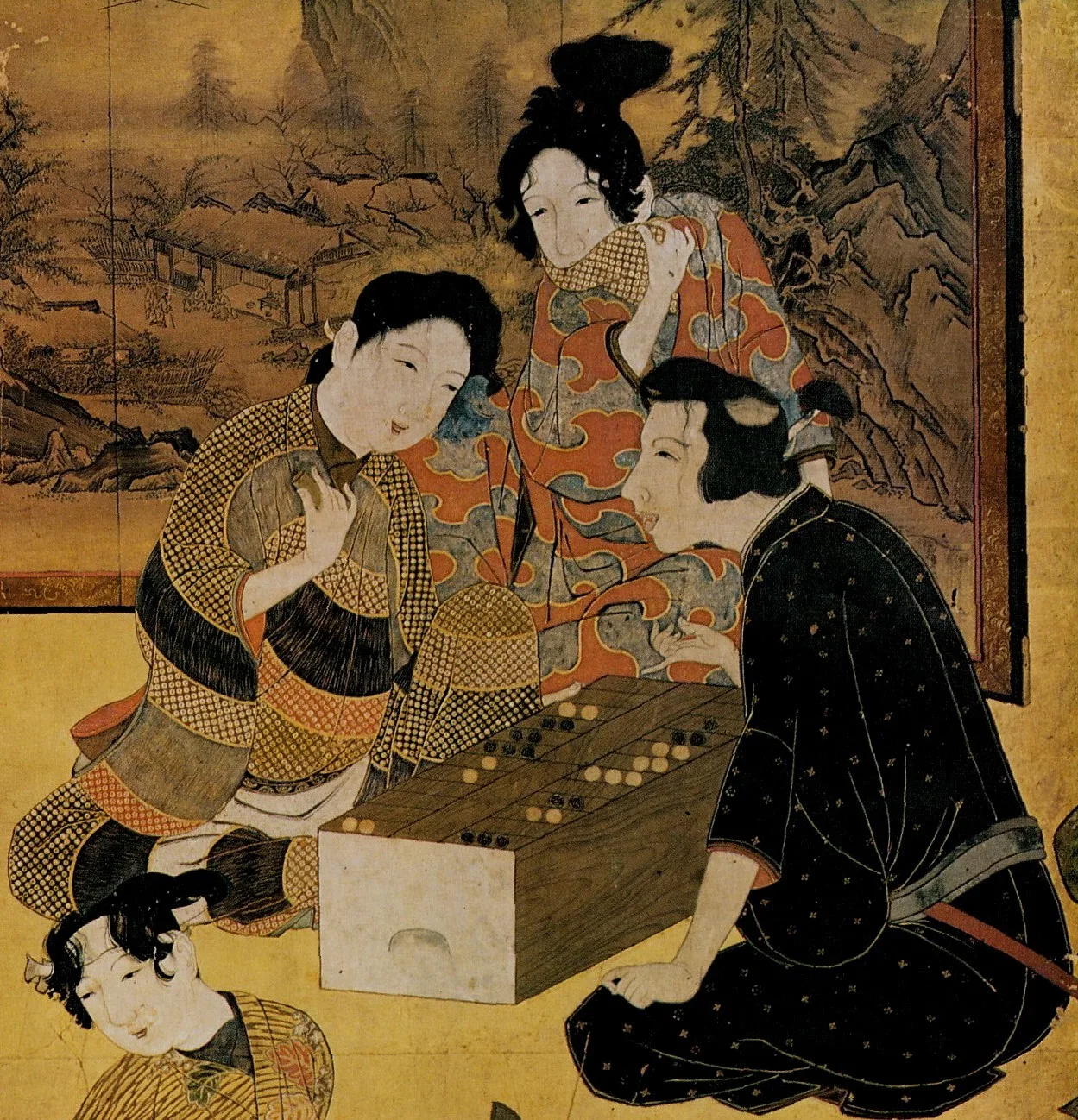
Man and woman playing ban-sugoroku (from Hikone Screen)
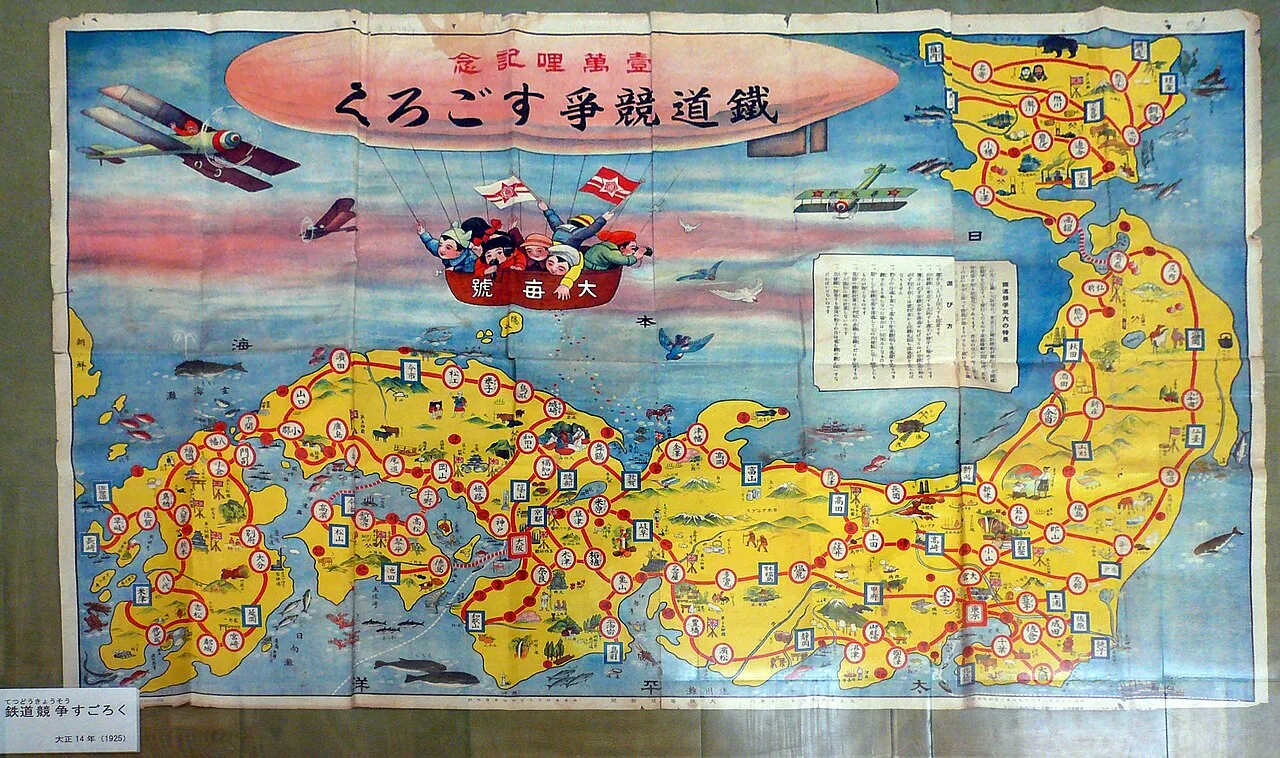
E-Sugoroku (1925)
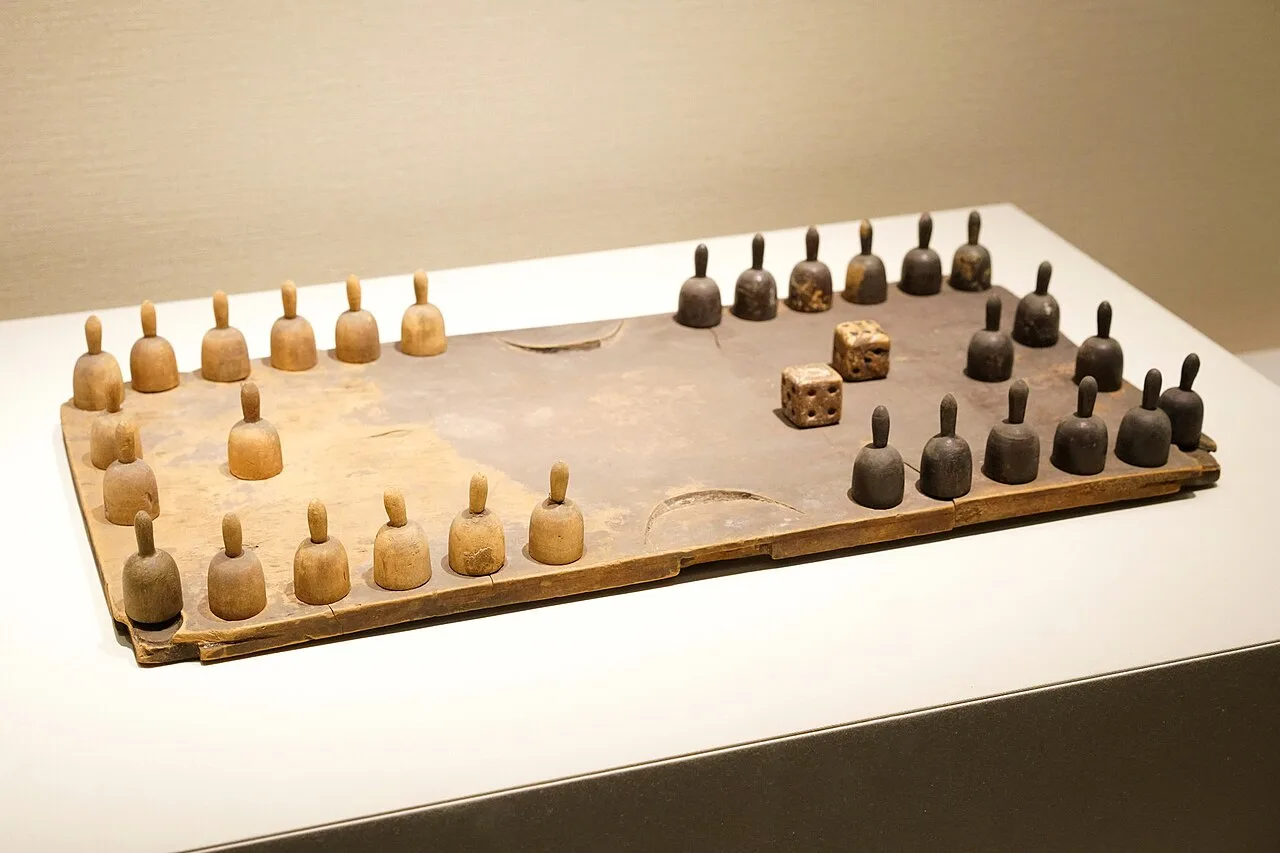
A board and pieces for playing "double six", Liao dynasty
Sugoroku
Sugoroku refers to two forms of Japanese board games, most commonly a picture-based game similar to snakes and ladders, as well as an obsolete backgammon-like tables game.
From Ancient Persian Courts to Sixth-Century Japan
Ban-sugoroku traces its historical lineage across continents, originating from the Persian game Nard before developing into Chinese Shuanglu. This ancient ancestor of backgammon was introduced to Japan during the sixth century. While modern Western backgammon survived and retained avid players, the traditional Japanese ban-sugoroku variant eventually died out and fell into complete obsolescence.
From Wikipedia · CC BY-SA 4.0
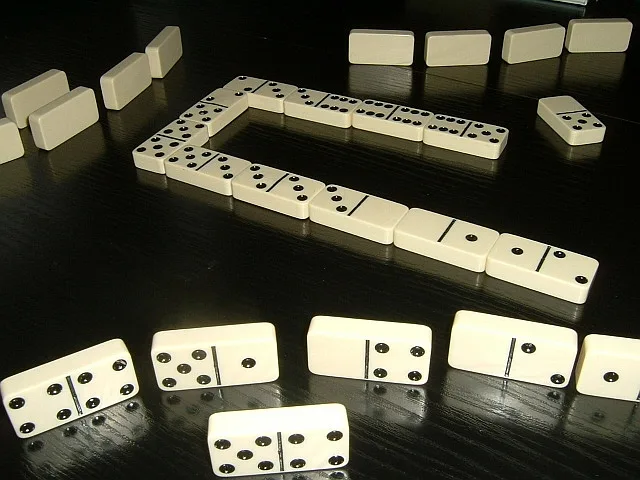
Dominospiel
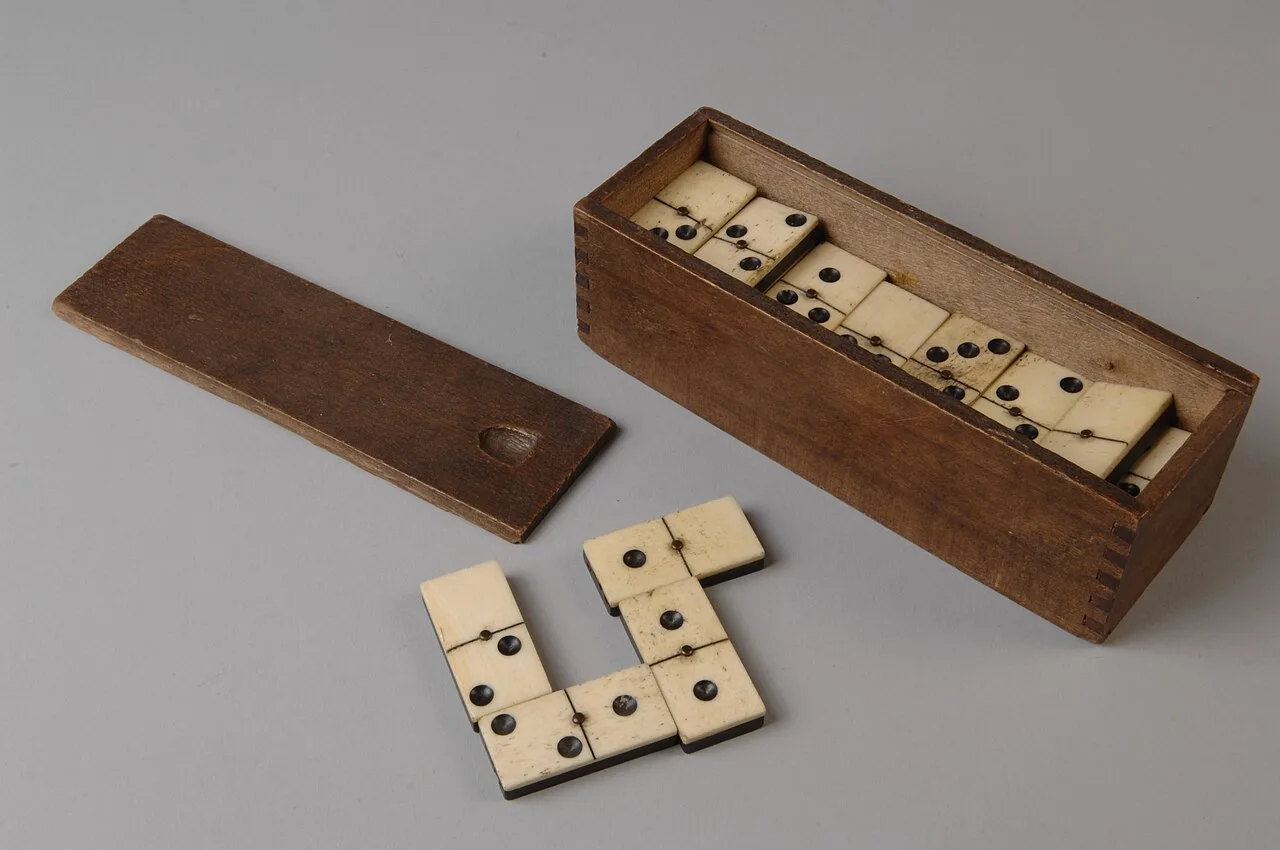
A boxed domino set dating from the late 19th or early 20th century
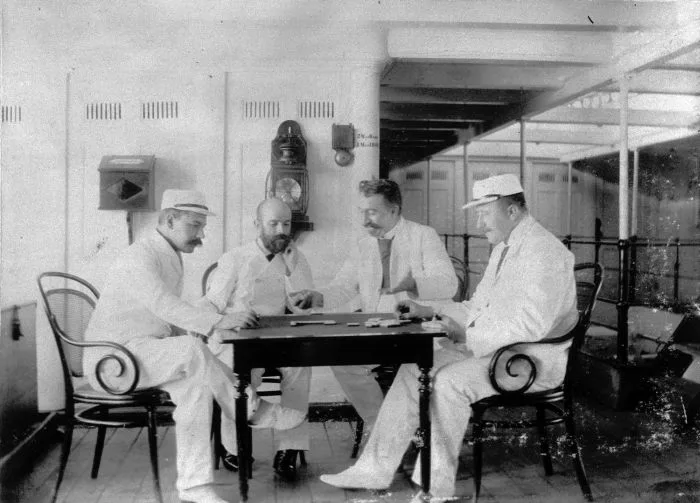
Dutch sailors playing dominoes, 1890s
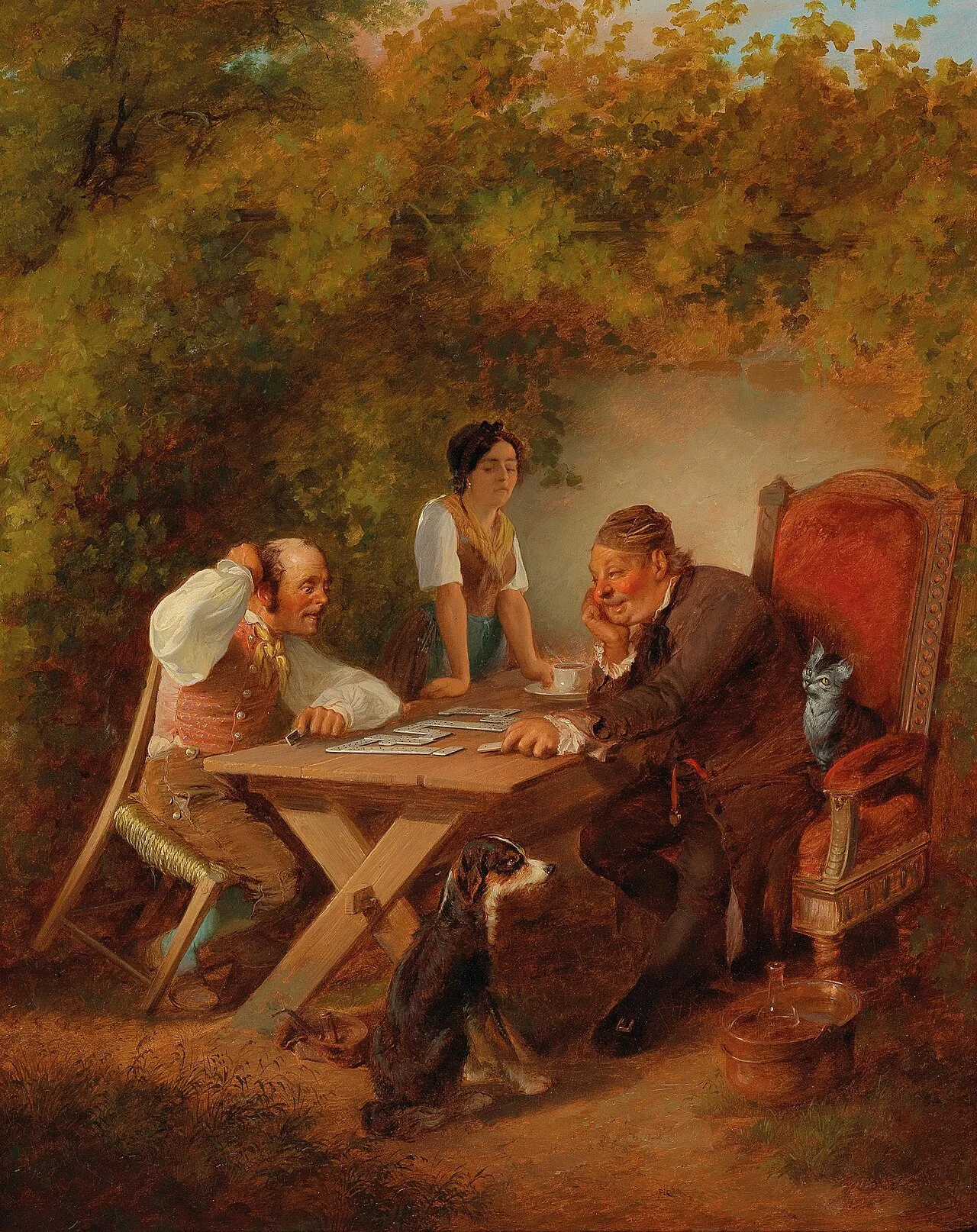
The domino players by Friedrich Sturm
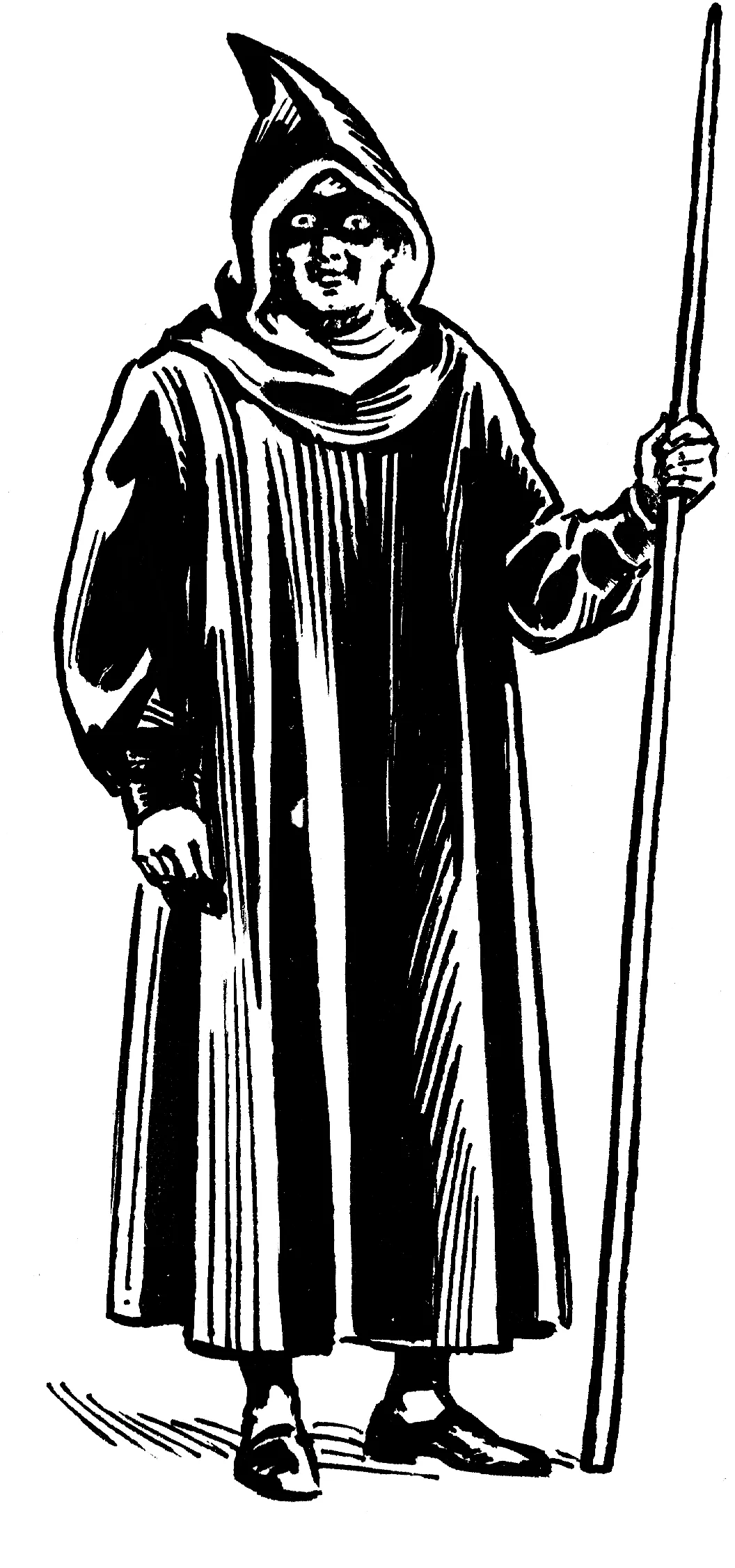
Domino costume
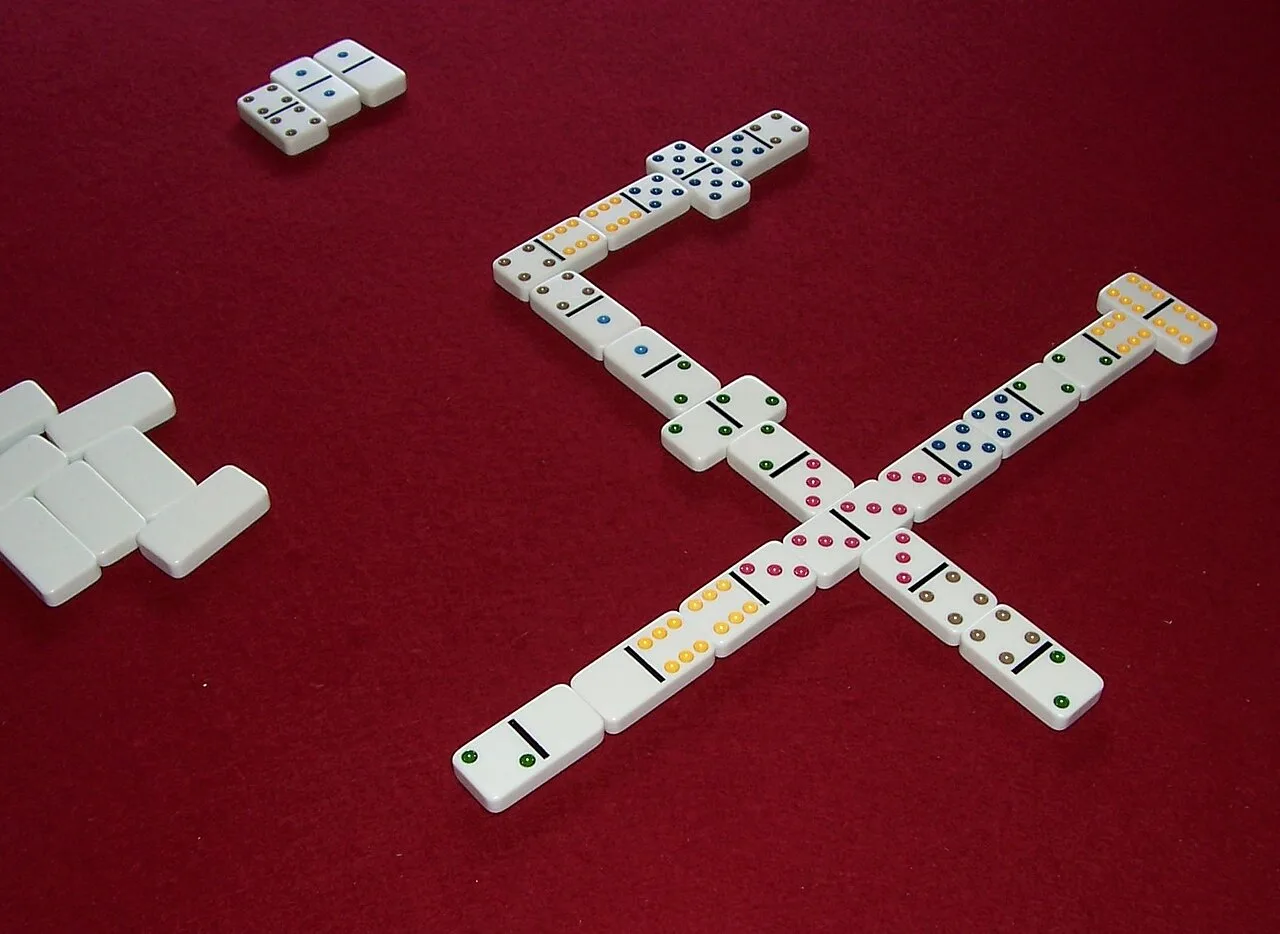
Five-Up played with multicolored tiles: the doubles serve as spinners, allowing the line of play to branch.
Dominoes
Dominoes is a family of tile-based games played with rectangular gaming pieces, each divided into two square ends marked with spots or left blank.
Venetian Masquerades and the Double-One
Popular culture often assumes the word domino relates mathematically to the prefix for two. Instead, the name likely stems from a Venetian Carnival costume featuring a black-hooded robe and a white mask. The visual arrangement of the double-one tile distinctly resembles this masquerade disguise. Linguistic terms like polyomino falsely suggest a numerical root, though no language connects the word domino to the number two.
From Wikipedia · CC BY-SA 4.0