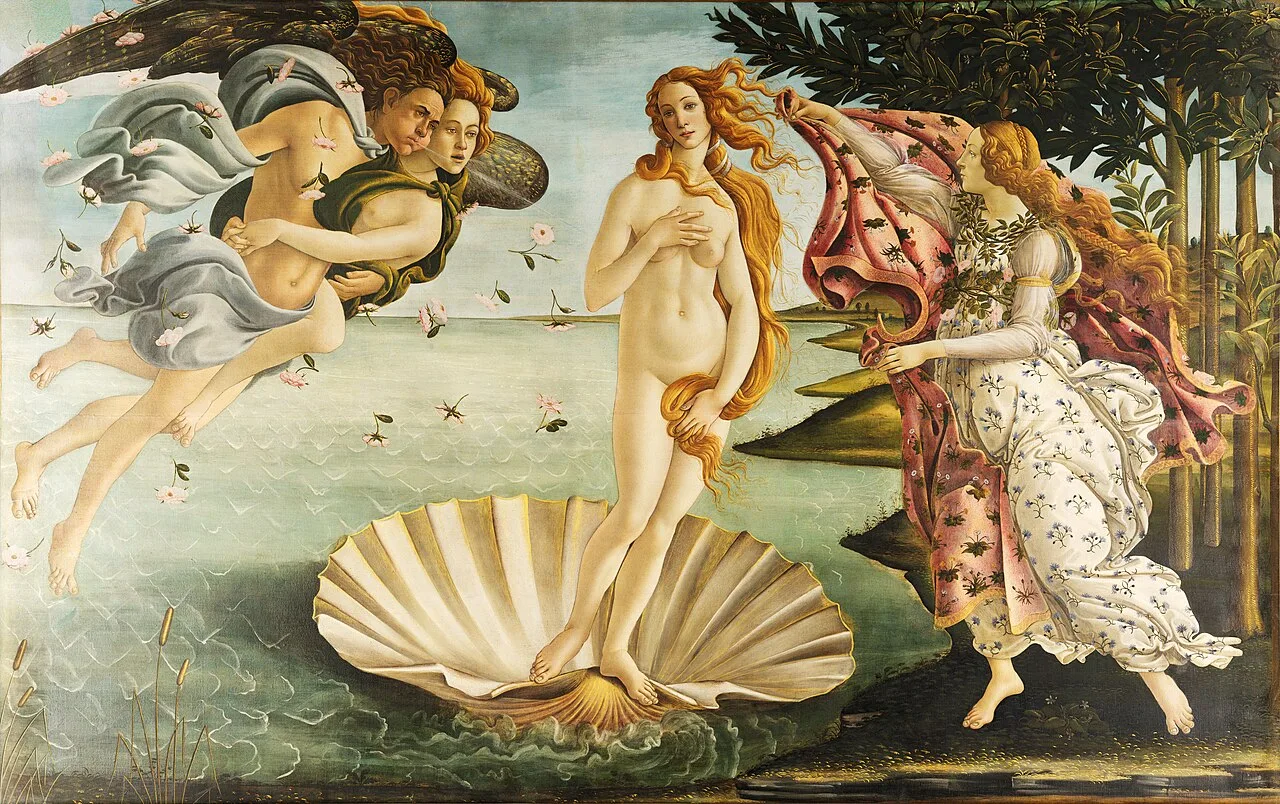
Sandro Botticelli, The Birth of Venus (c. 1484–1486). Tempera on canvas. 172.5 cm × 278.9 cm (67.9 in × 109.6 in). Uffizi, Florence
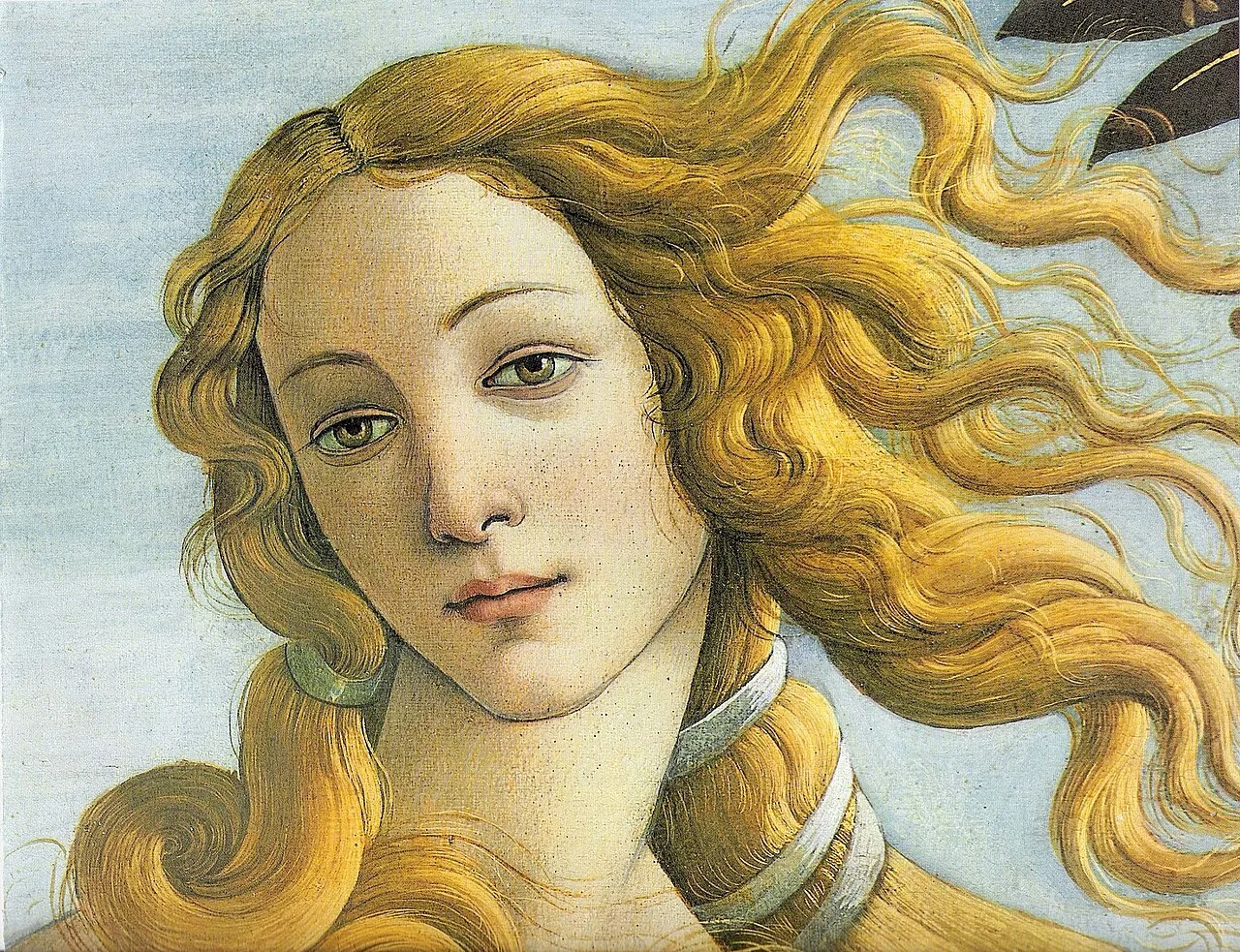
Detail: the face of Venus
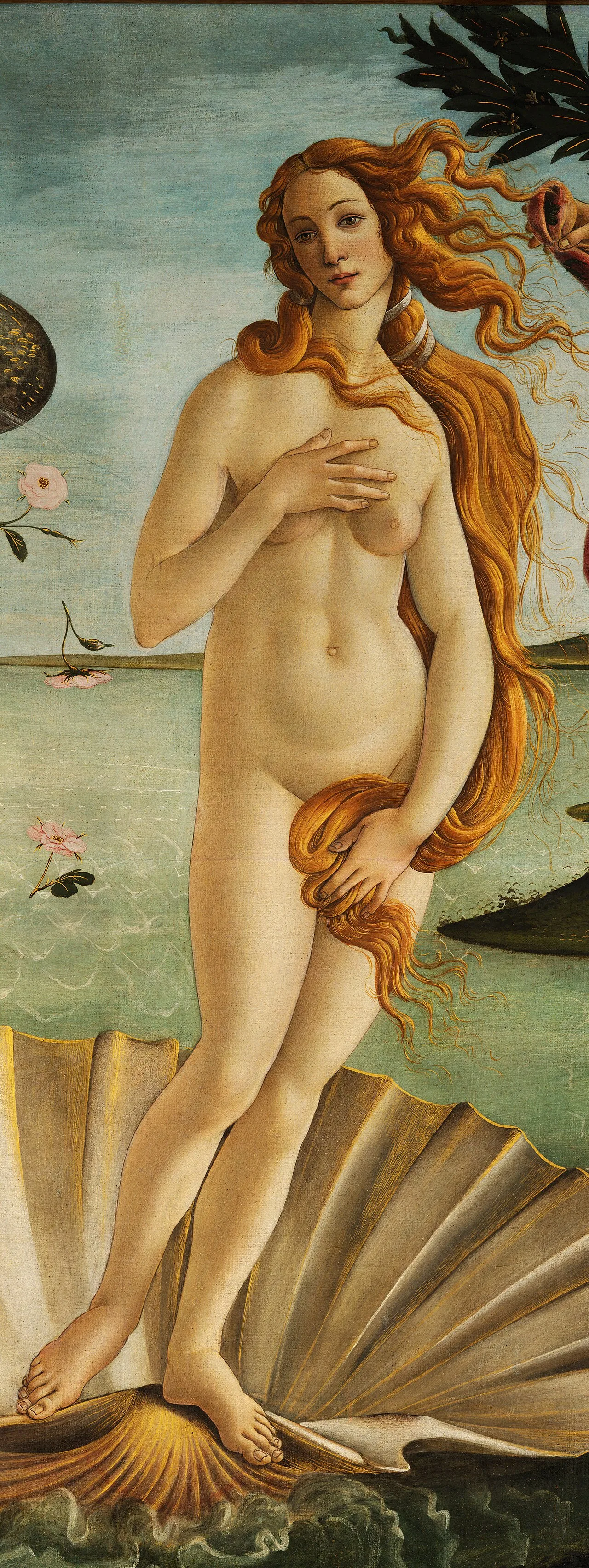
Venus
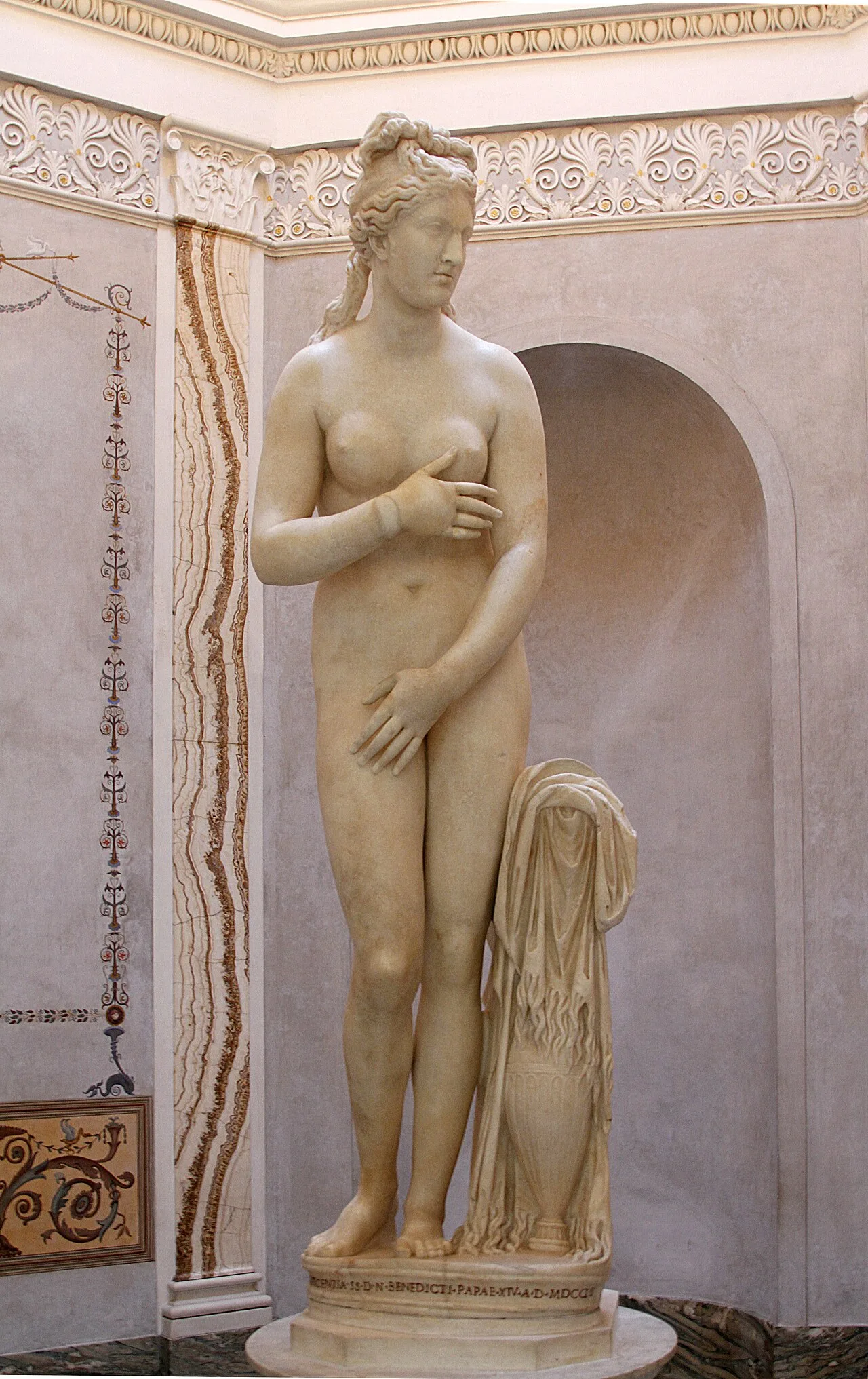
Capitoline Venus, derived from Aphrodite of Cnidus

Greco-Roman bronze statuette
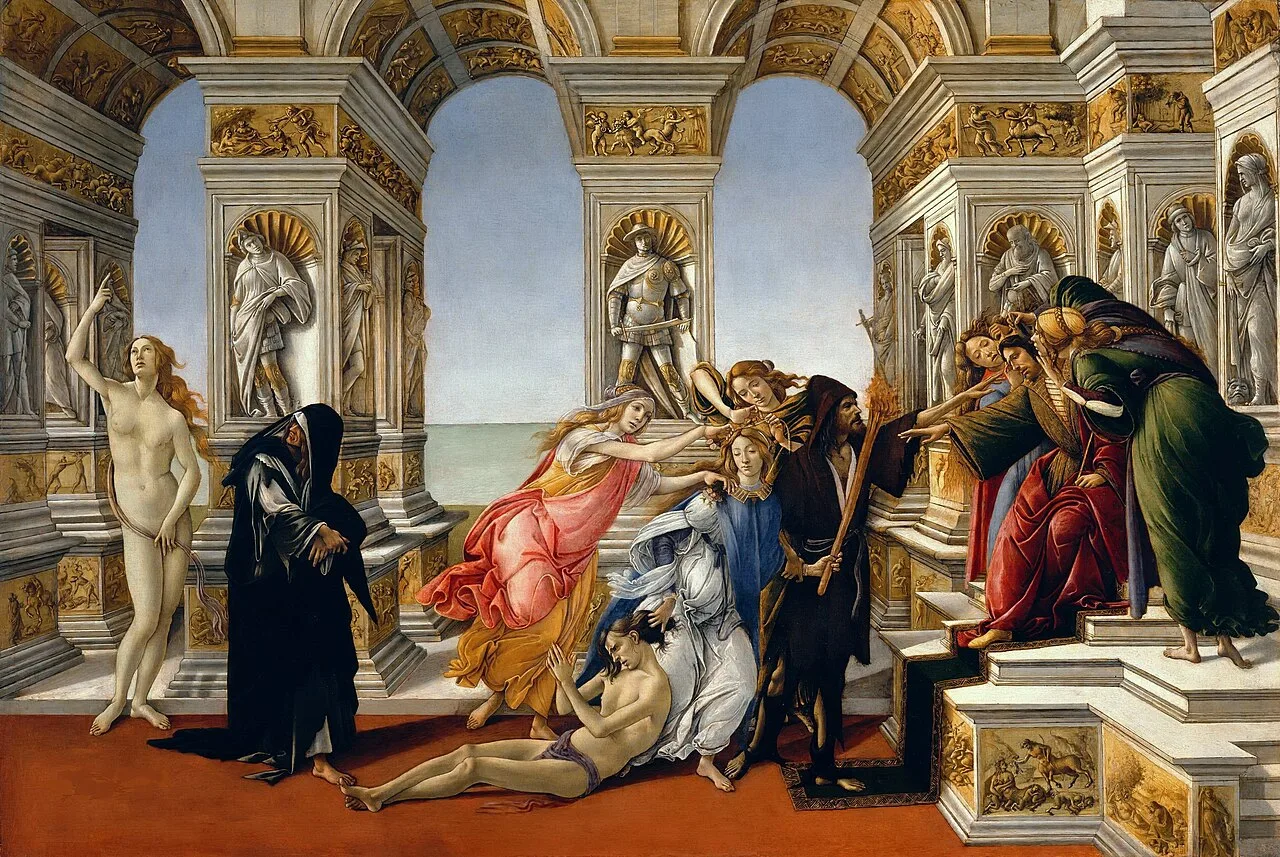
Calumny of Apelles, 1494–95, with "Truth" at left. Uffizi, Florence.
The Birth of Venus
The Birth of Venus is a painting by the Italian artist Sandro Botticelli, probably executed in the mid-1480s, depicting the goddess Venus arriving at the shore after her birth.
Nineteenth-Century Naming of an Island Arrival
Botticelli's canvas does not portray the physical emergence of the goddess, but rather her subsequent landfall. The commonly recognized title was only assigned in the nineteenth century, though Giorgio Vasari had recorded the general subject earlier. Propelled across the sea by the wind, Venus approaches either Cythera or Cyprus, both Mediterranean islands regarded as her sacred domains.
From Wikipedia · CC BY-SA 4.0
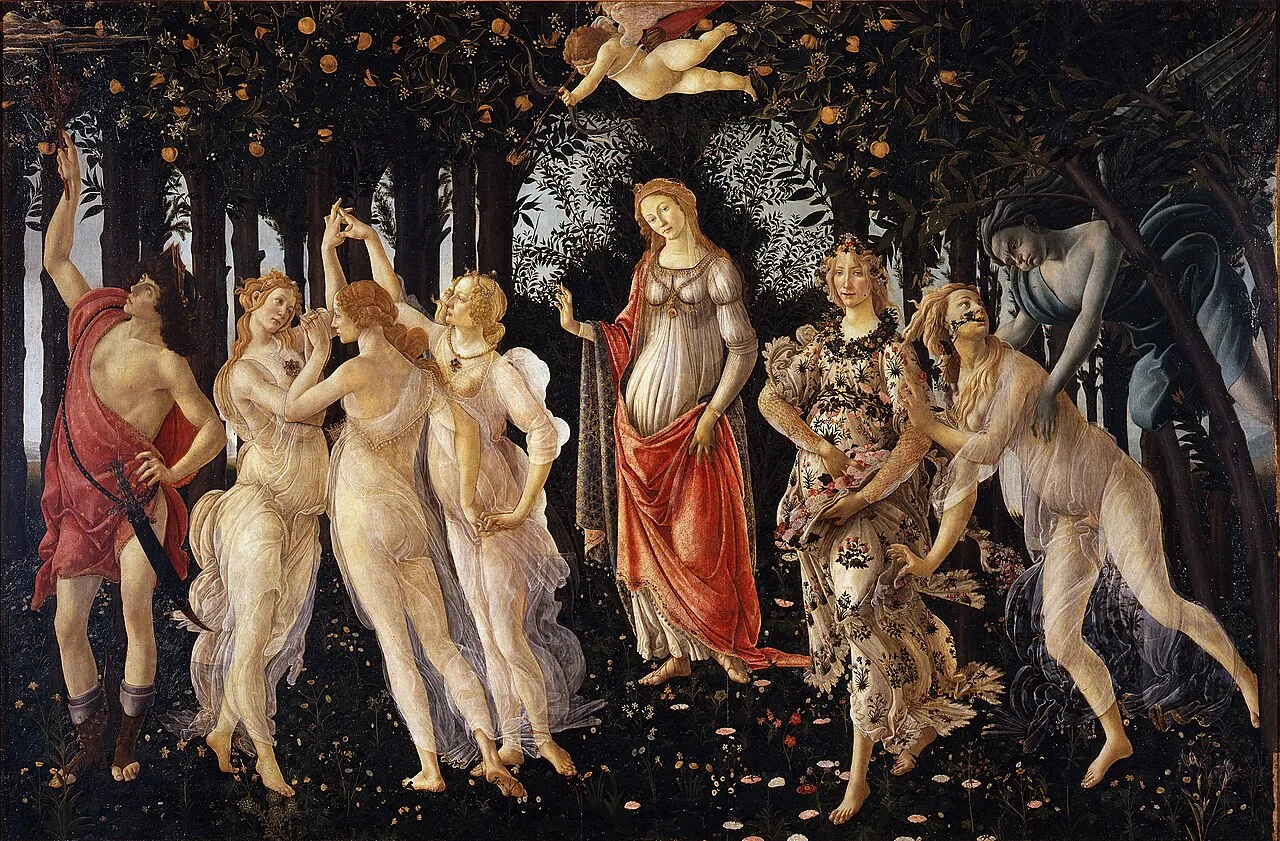
Botticelli-primavera
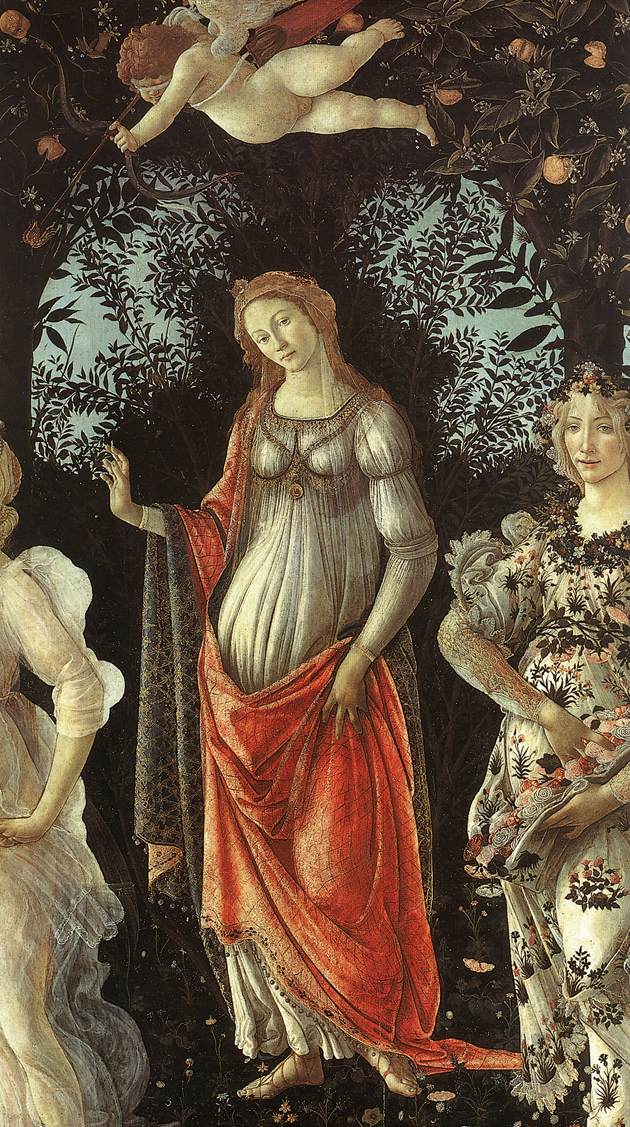
Venus standing in her arch.
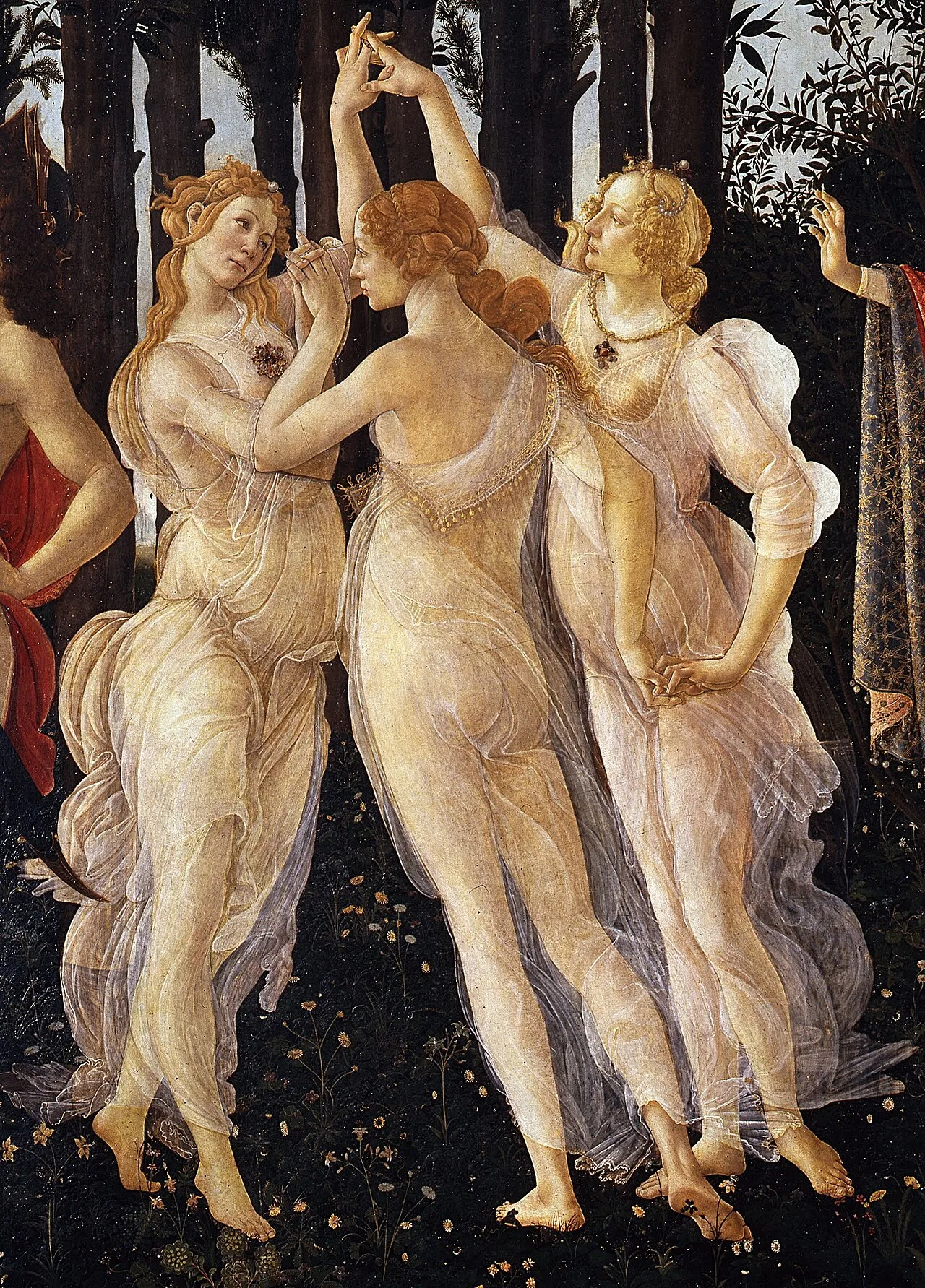
The Three Graces
![Botticelli's Pallas and the Centaur (1482) has been proposed as the companion piece to Primavera.[30]](https://nwjvzop1xgplmzvt.public.blob.vercel-storage.com/wikifeed/primavera-botticelli/3-d1275ea82b.webp)
Botticelli's Pallas and the Centaur (1482) has been proposed as the companion piece to Primavera.[30]
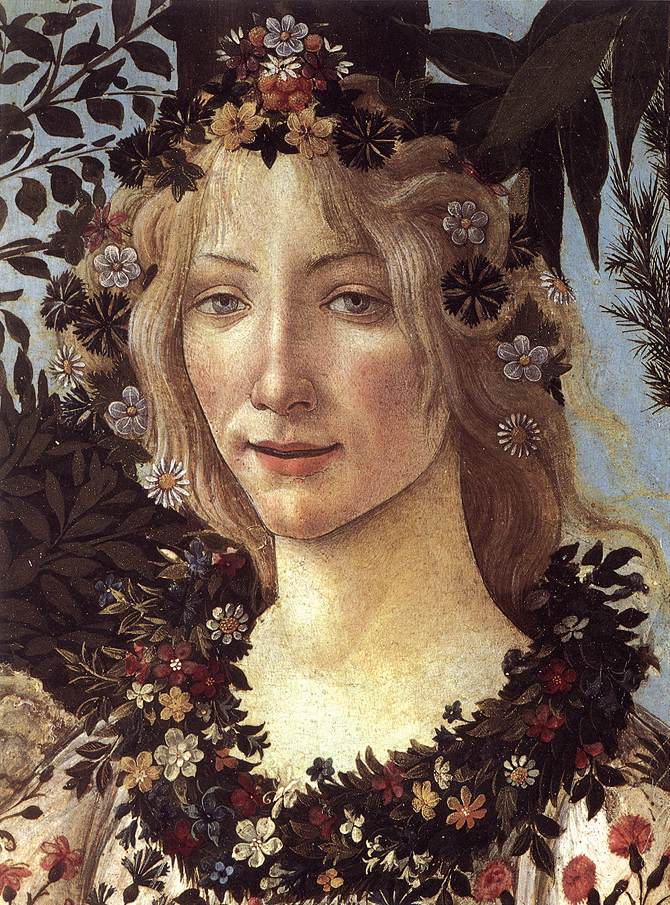
Flora, the goddess of flowers and the season of spring.
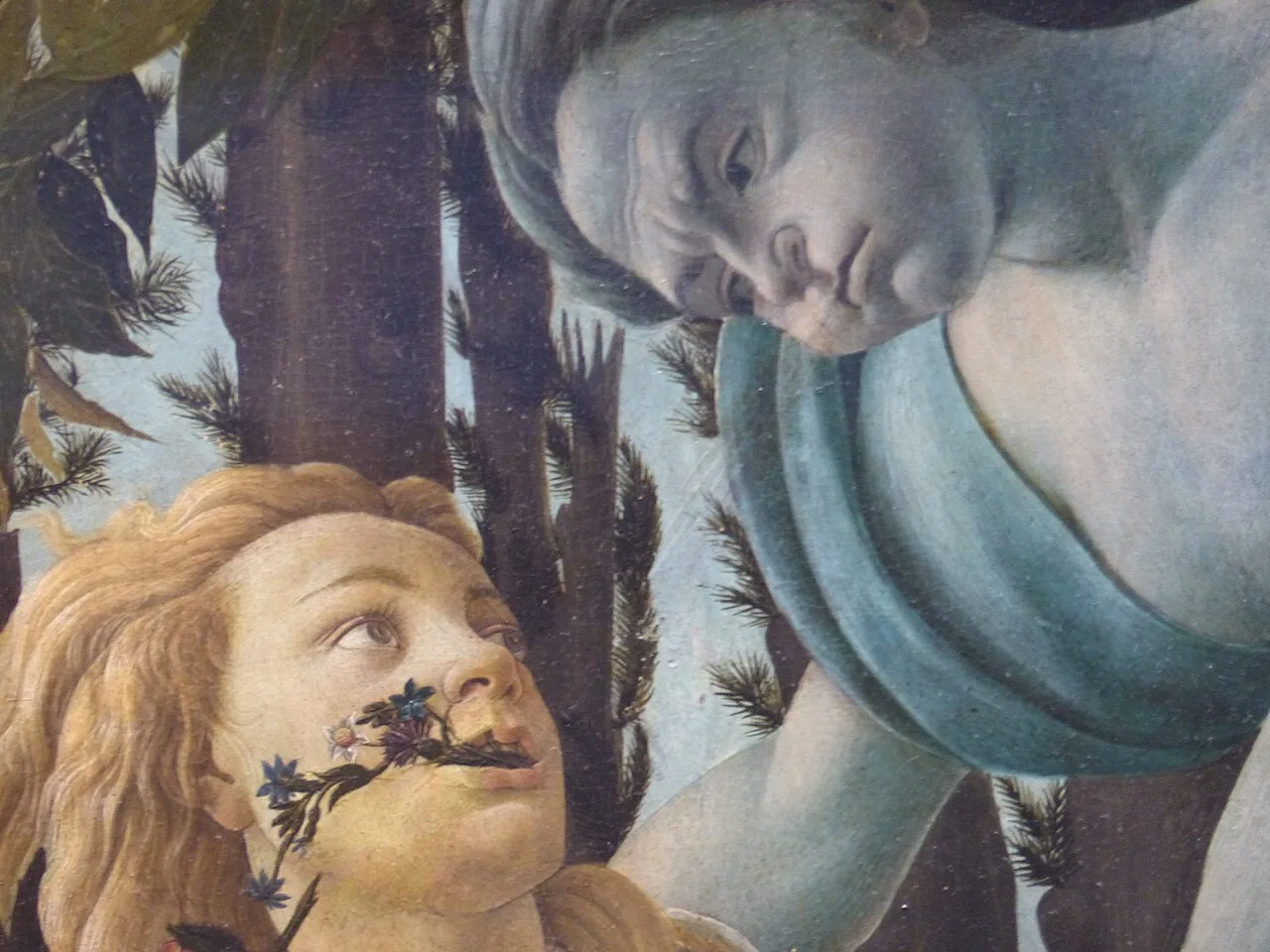
Chloris and Zephyrus.
Primavera (Botticelli)
Primavera is a large tempera panel painting by the Italian Renaissance painter Sandro Botticelli, created in the late 1470s or early 1480s, depicting figures from classical mythology in a garden.
Renaissance Masterpiece Retaining Gothic Composition
Despite standing as a defining icon of the Italian Renaissance, Primavera preserves several archaic artistic conventions. Its overall structure closely mirrors the millefleur Flemish tapestries that were popular across European palaces. Botticelli lined his figures side by side across a shallow plane rather than embedding them in deep linear perspective, avoiding standard Renaissance spatial depth.
From Wikipedia · CC BY-SA 4.0
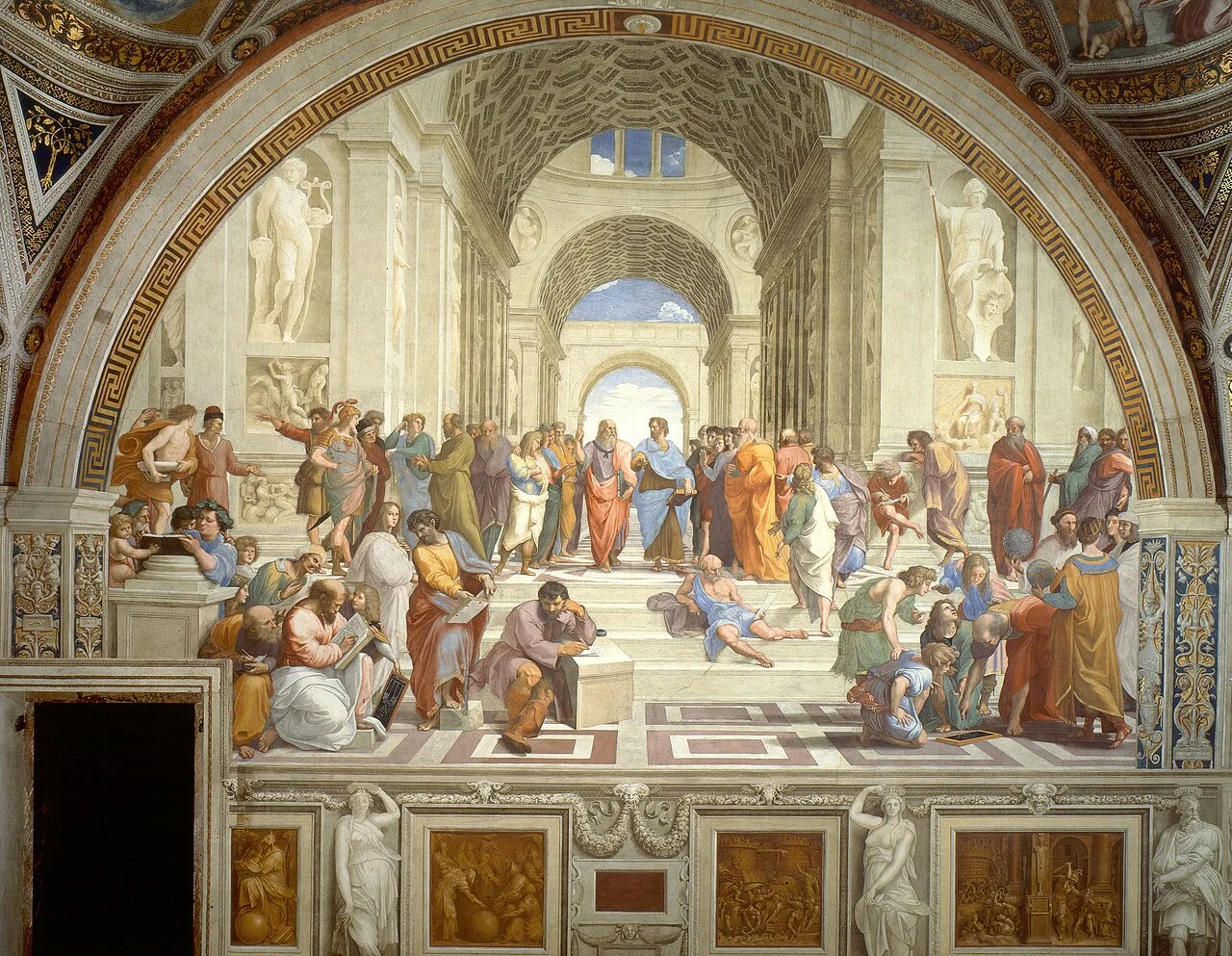
"The School of Athens" by Raffaello Sanzio da Urbino
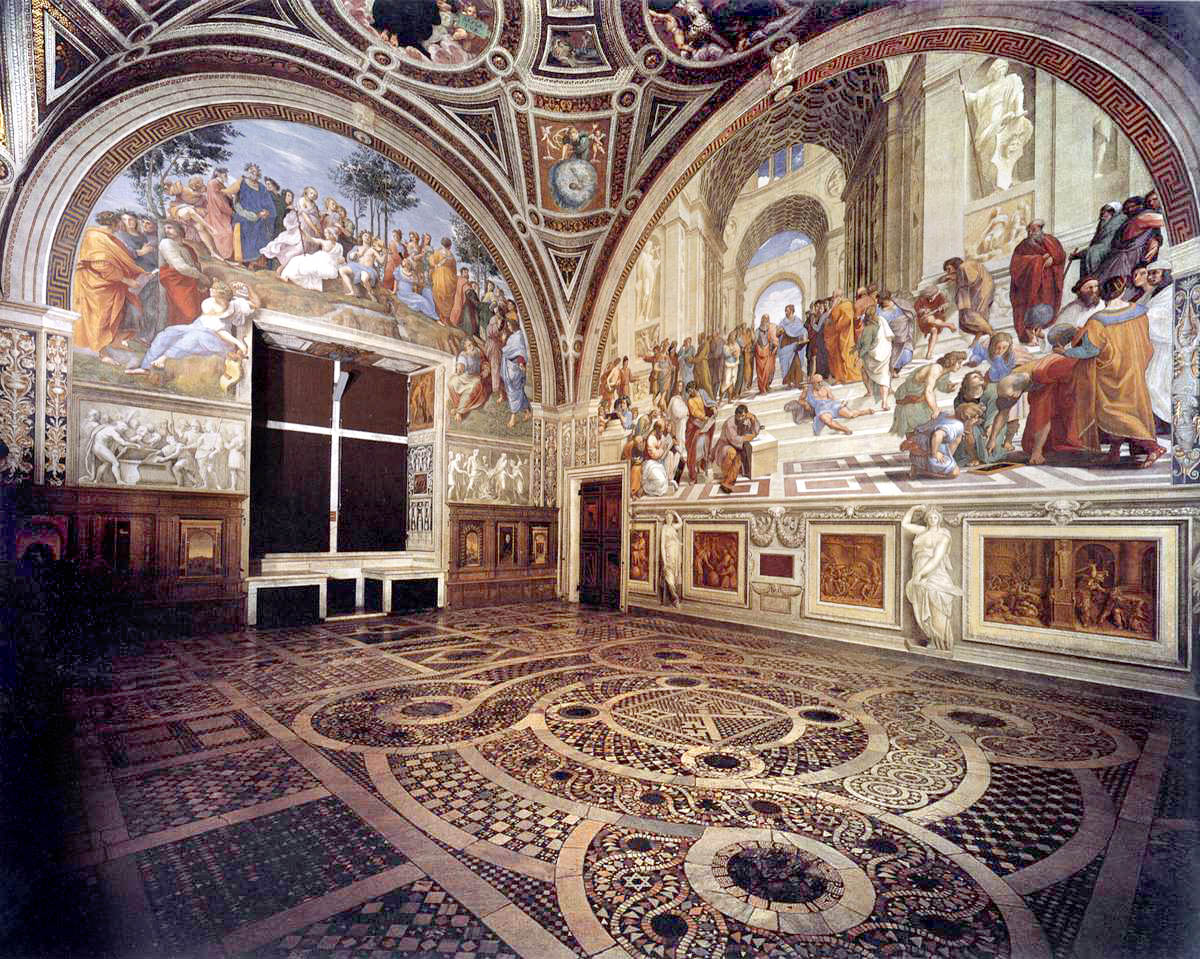
The Stanza della Segnatura
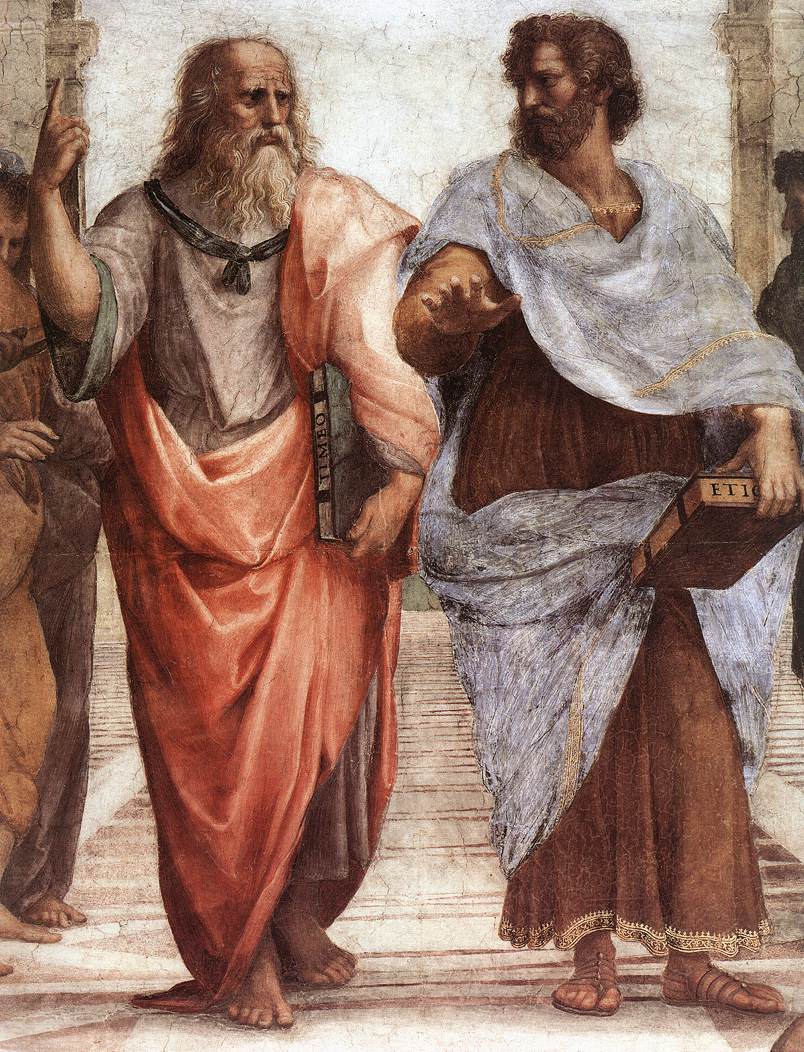
An elder Plato walks alongside a younger Aristotle.
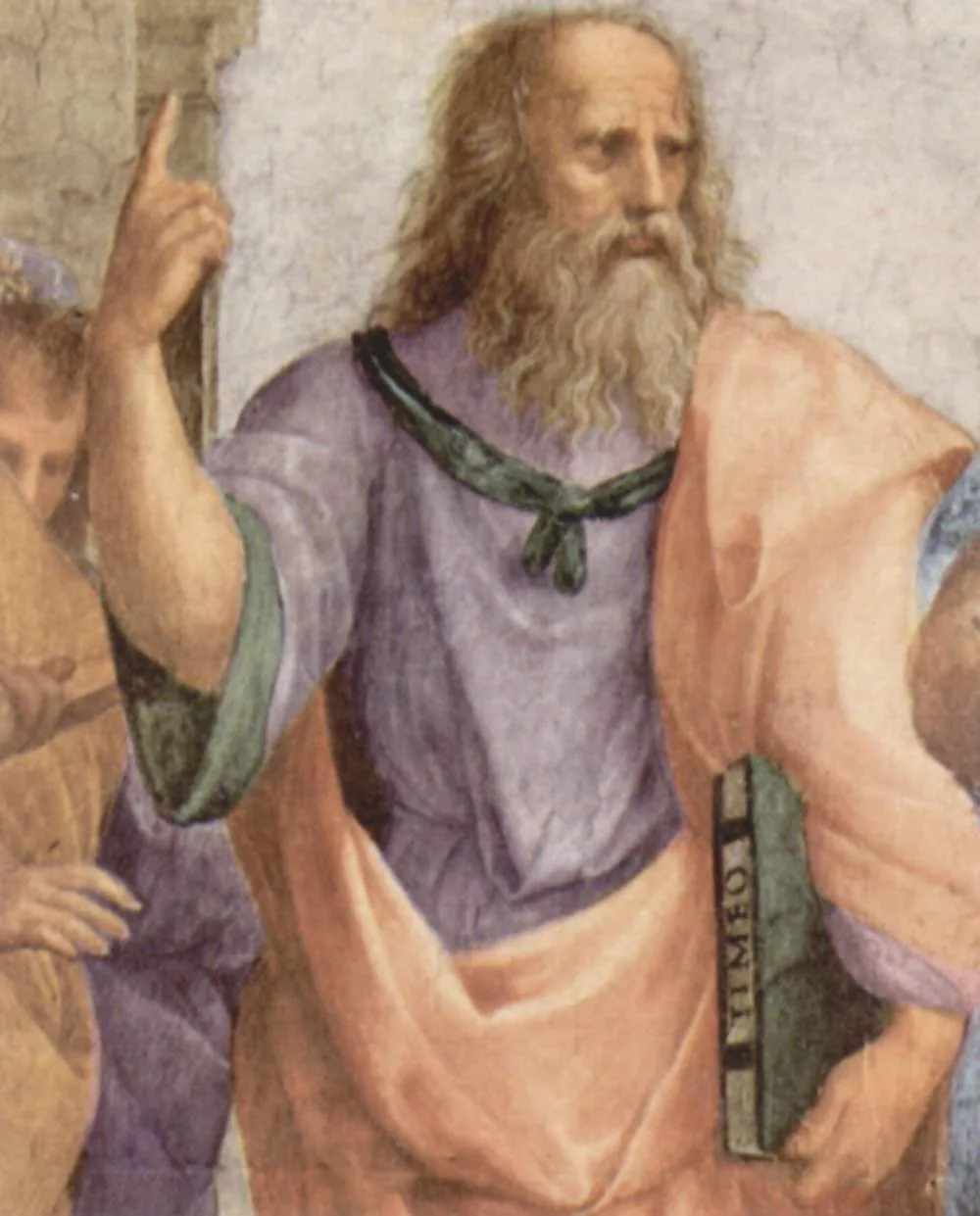
Leonardo da Vinci as Plato
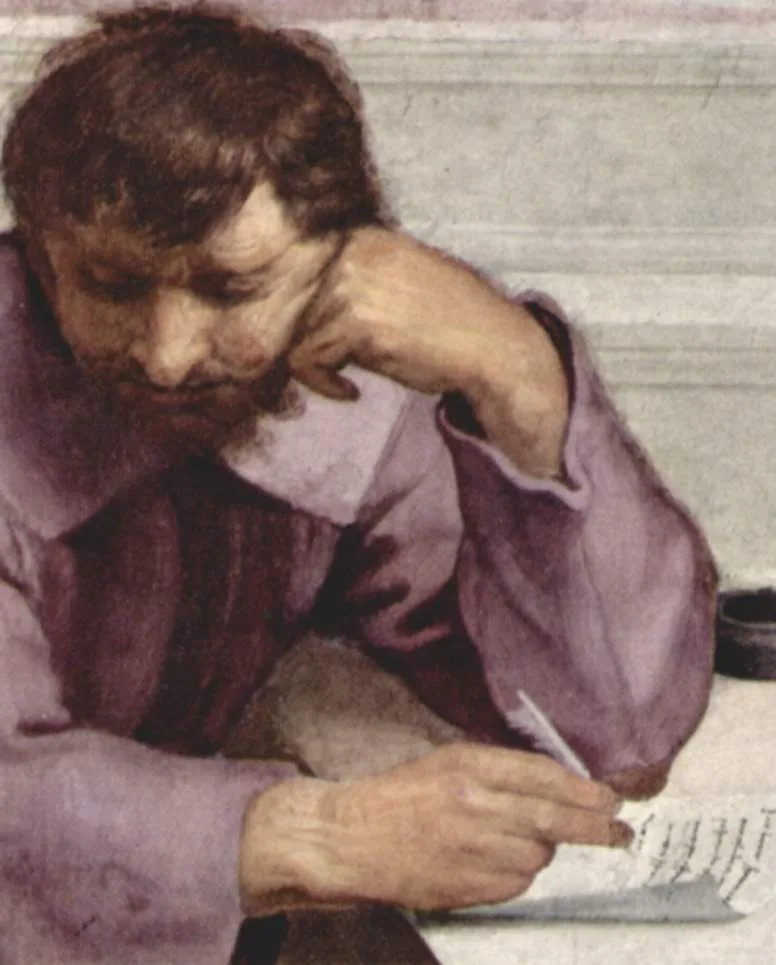
Michelangelo as Heraclitus
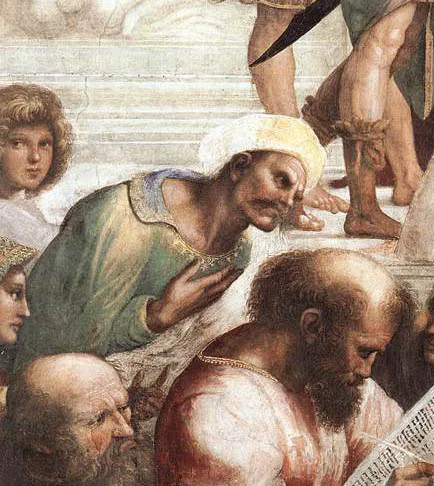
Ibn Rushd (Averroes) and Pythagoras
The School of Athens
The School of Athens is a fresco by the Italian Renaissance artist Raphael, painted between 1509 and 1511 to decorate rooms in the Apostolic Palace in Vatican City.
Non-Athenians Under an Unofficial Title
Popular convention labels the fresco as depicting an Athenian academy, yet this traditional title was never assigned by Raphael. The setting undermines its common geographic designation because hardly a third of the assembled thinkers were actually Athenians. Furthermore, many of the philosophers gathered around Plato and Aristotle lived well before them, uniting distinct eras rather than a single historical moment.
From Wikipedia · CC BY-SA 4.0
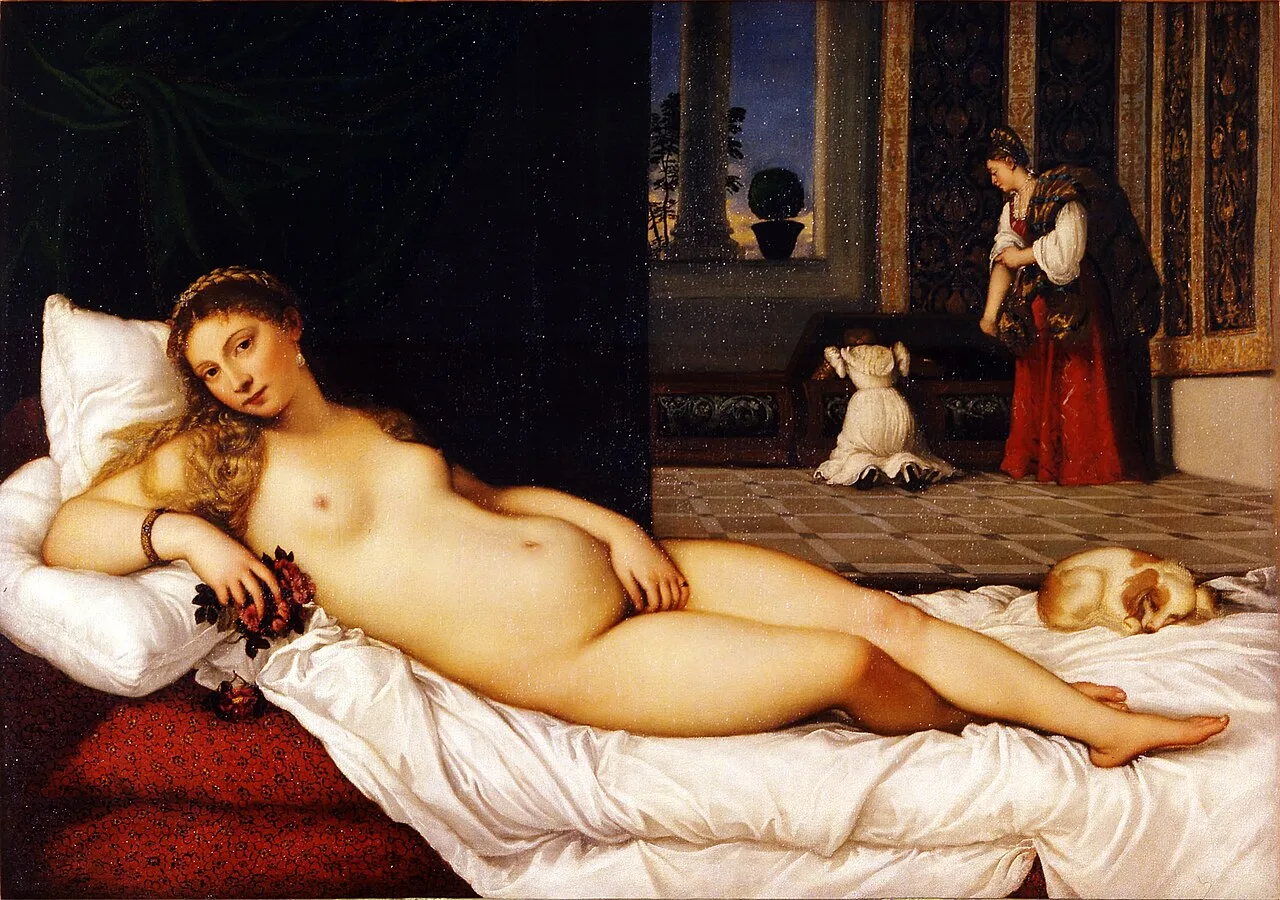
Tiziano - Venere di Urbino - Google Art Project
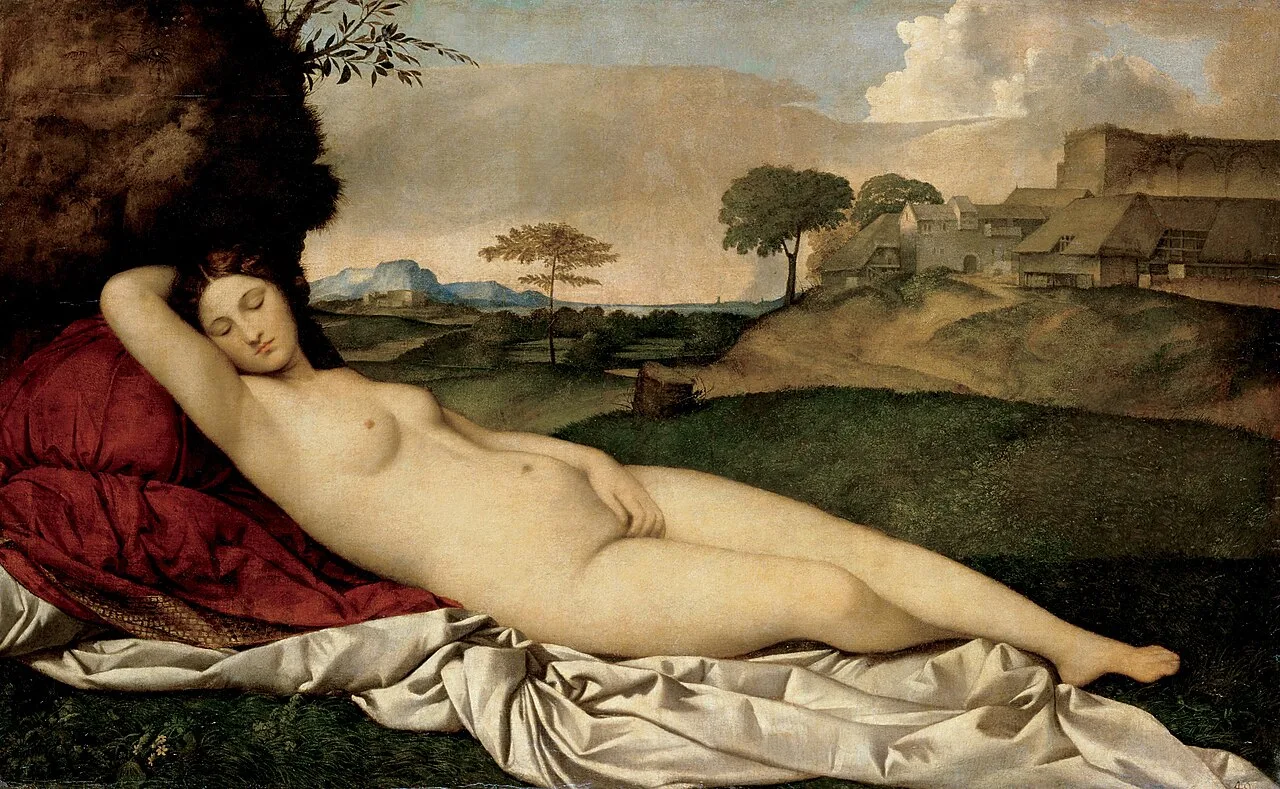
Dresden Venus (c. 1510–11), traditionally attributed to Giorgione but for which Titian completed at least the landscape.
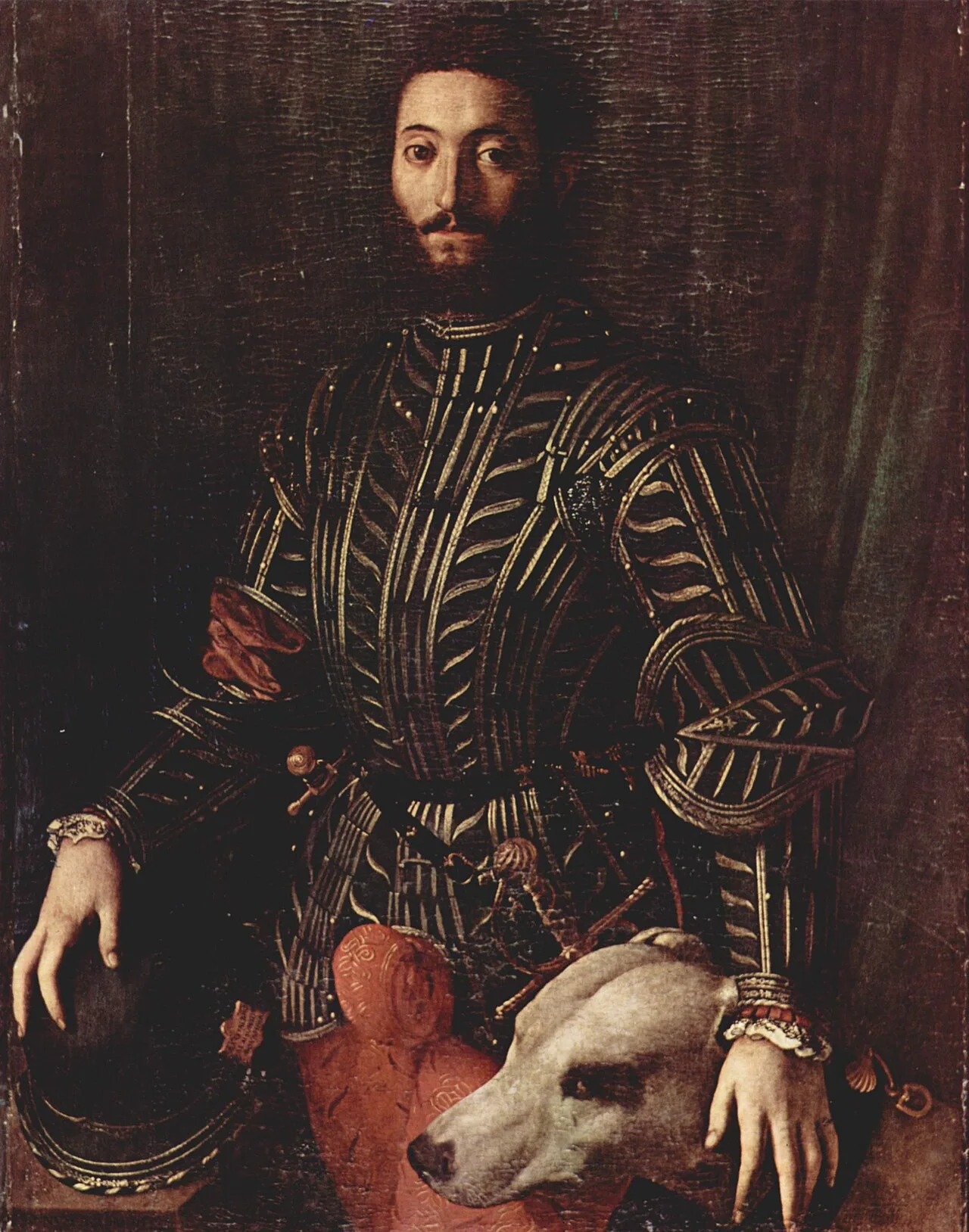
Guidobaldo II della Rovere, Duke of Urbino, after whose duchy the painting gets its most common title.
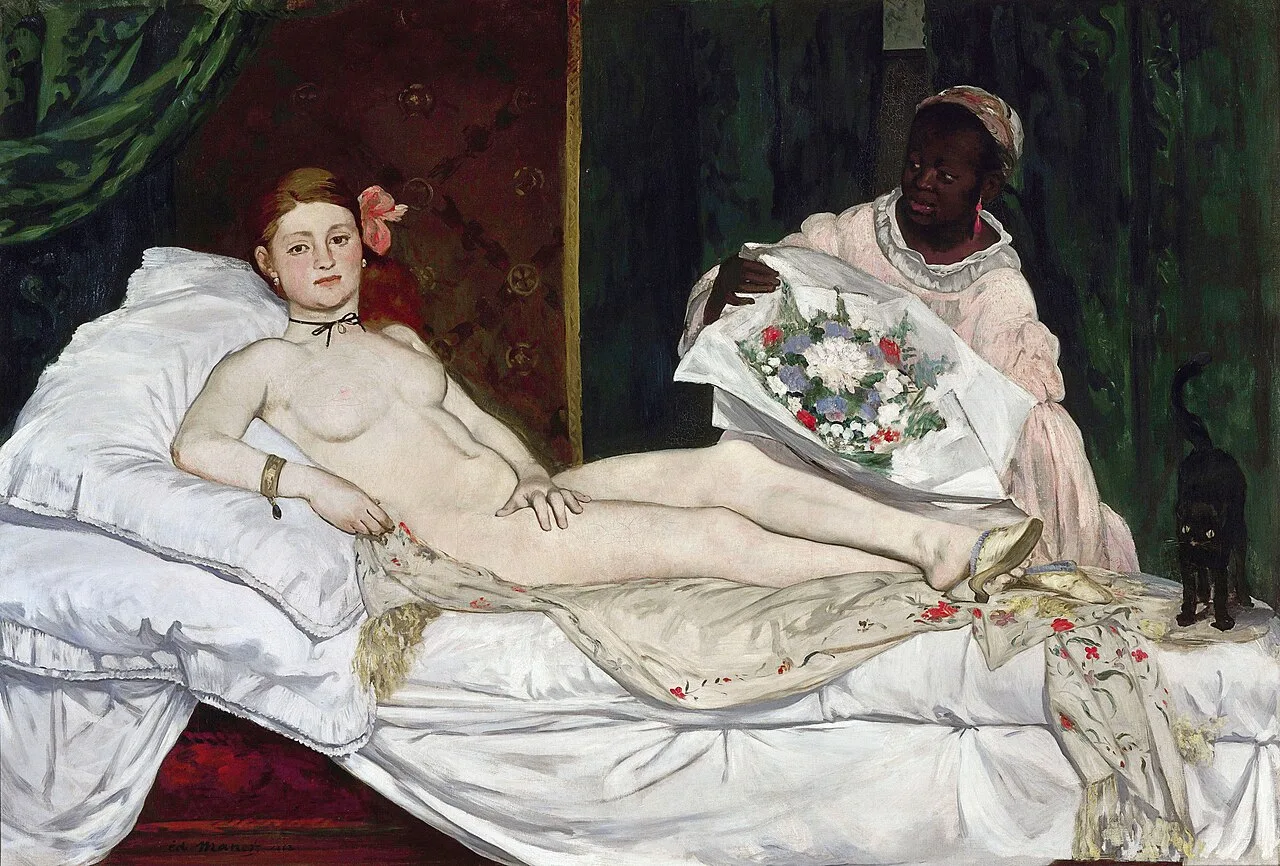
Édouard Manet's Olympia, 1863
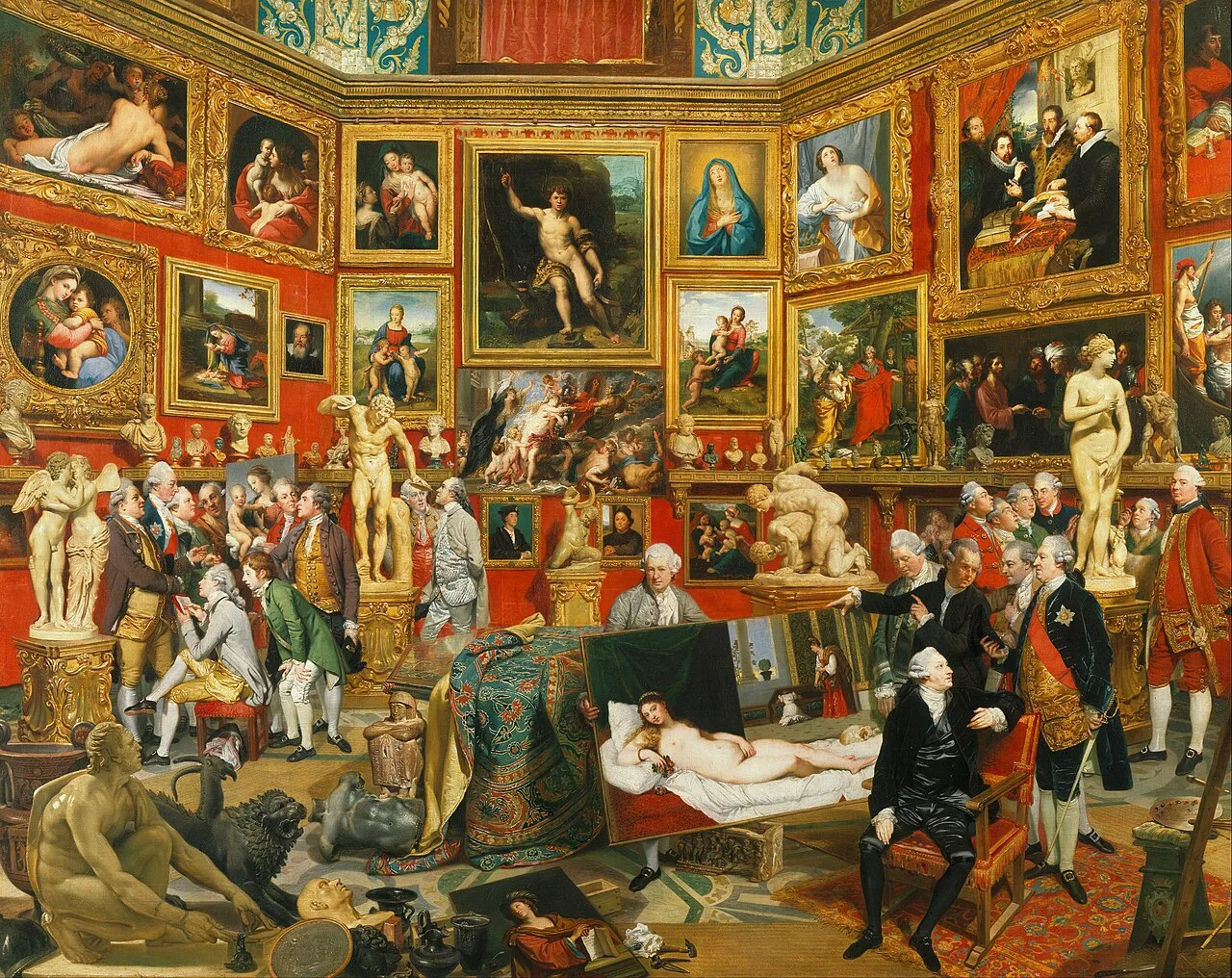
Johan Zoffany, The Tribuna of the Uffizi, 1770s

Lorenzo Bartolini, Lying Vénus, 1820–1830, Musée Fabre, Montpellier.
Venus of Urbino
The Venus of Urbino is an oil painting by Italian painter Titian, depicting a nude young woman traditionally identified with the goddess Venus reclining on a couch or bed in a Renaissance palace.
A Cardinal's Uncollected Courtesan Portrait
A young cardinal may have originally inspired the sensual canvas rather than a duke. Titian began working on a female portrait for the 21-year-old Ippolito de' Medici, who had spent a night with the Venetian courtesan Angela Zaffetta. However, Ippolito died in August 1535 without ever seeing the completed canvas, leaving it stranded in Titian's studio for years.
From Wikipedia · CC BY-SA 4.0
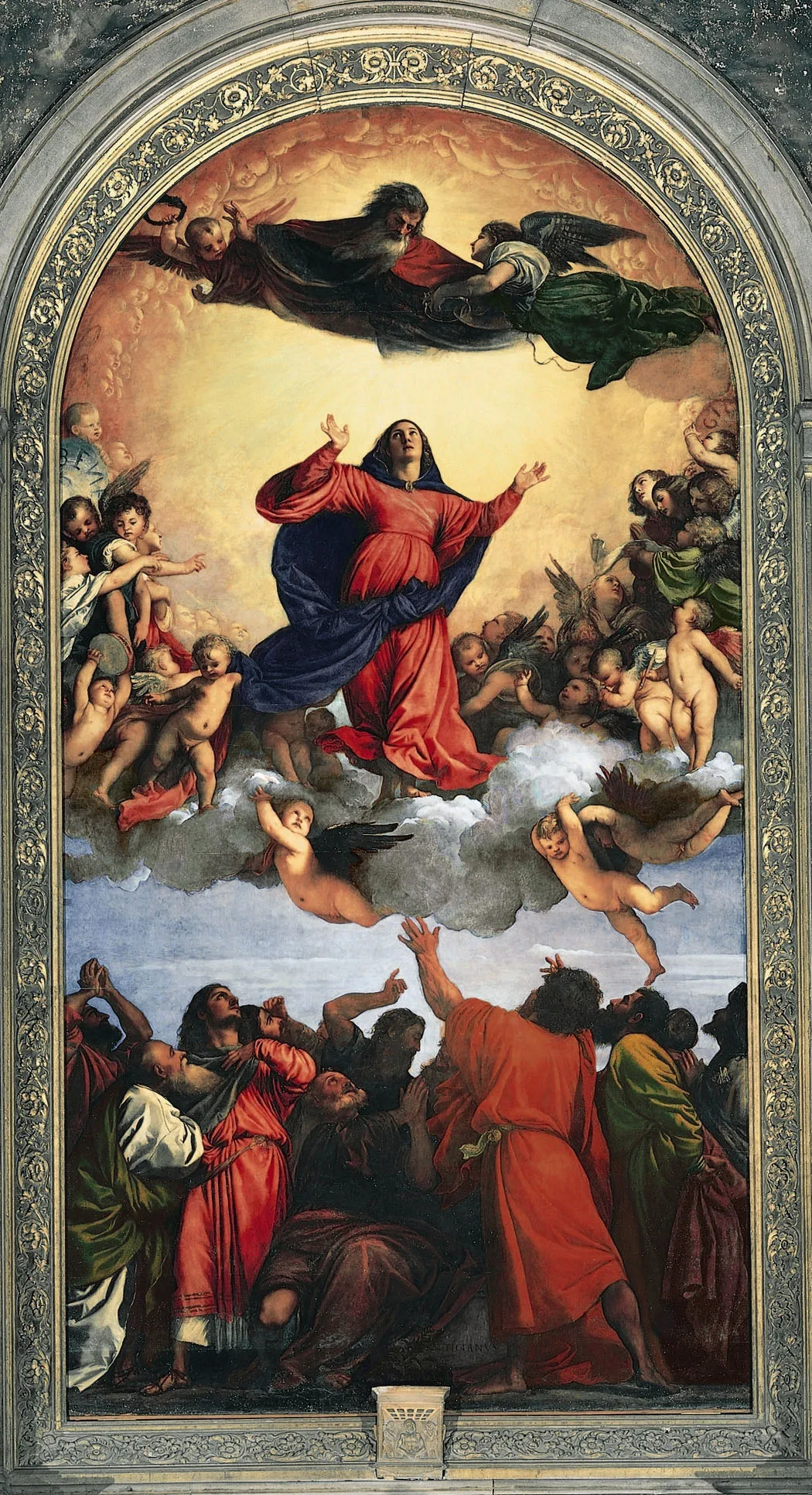
Tizian 041
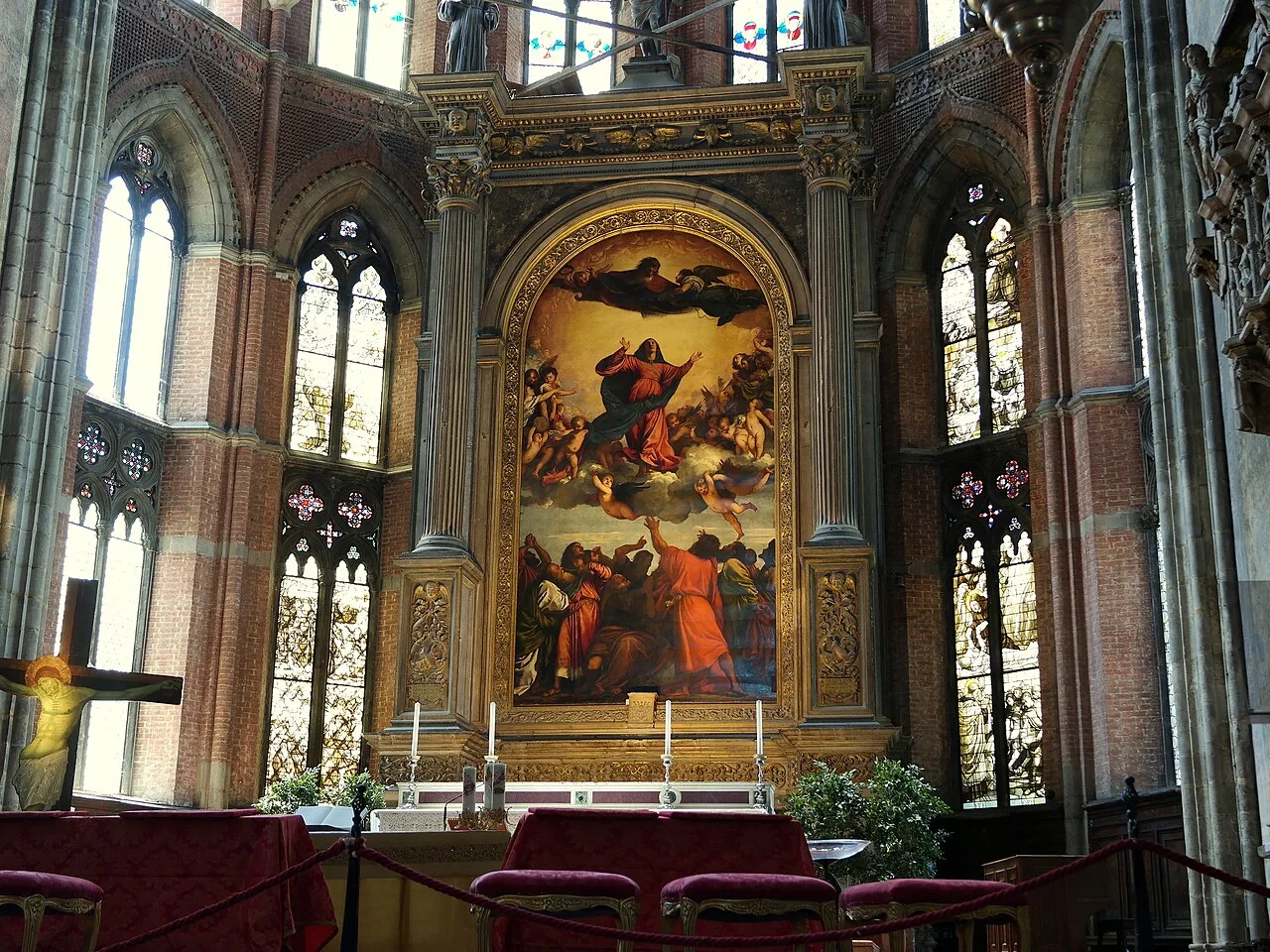
The full framing reredos

The painting seen through the arch in the choir-screen

The apse from beyond the screen

The Assumption in the Accademia in 1822
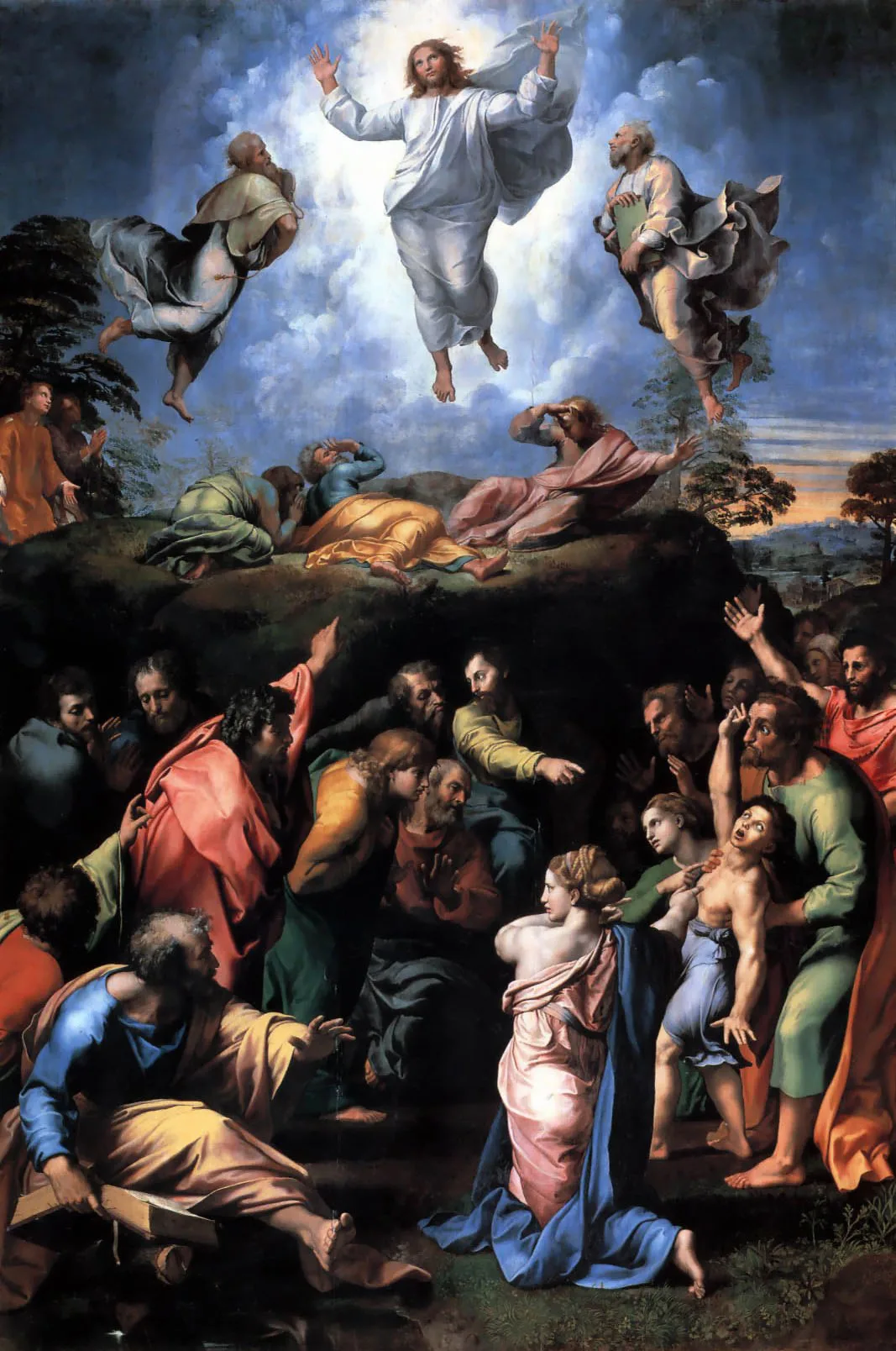
Transfiguration by Raphael, 1517–1520, with which Titian's painting is often compared.
Assumption of the Virgin (Titian)
The Assumption of the Virgin is a 1515–1518 altarpiece oil painting by Italian Renaissance artist Titian, located on the high altar of the Basilica di Santa Maria Gloriosa dei Frari in Venice.
Engineering an Altarpiece on Horizontal Cedar Planks
Titian opted for horizontal wooden supports rather than the emerging medium of canvas for his monumental commission. The altarpiece was constructed from 21 wide cedar planks measuring 3 cm thick. These massive proportions were essential because the painting had to project across the cavernous church interior to worshippers viewing it from a distance.
From Wikipedia · CC BY-SA 4.0
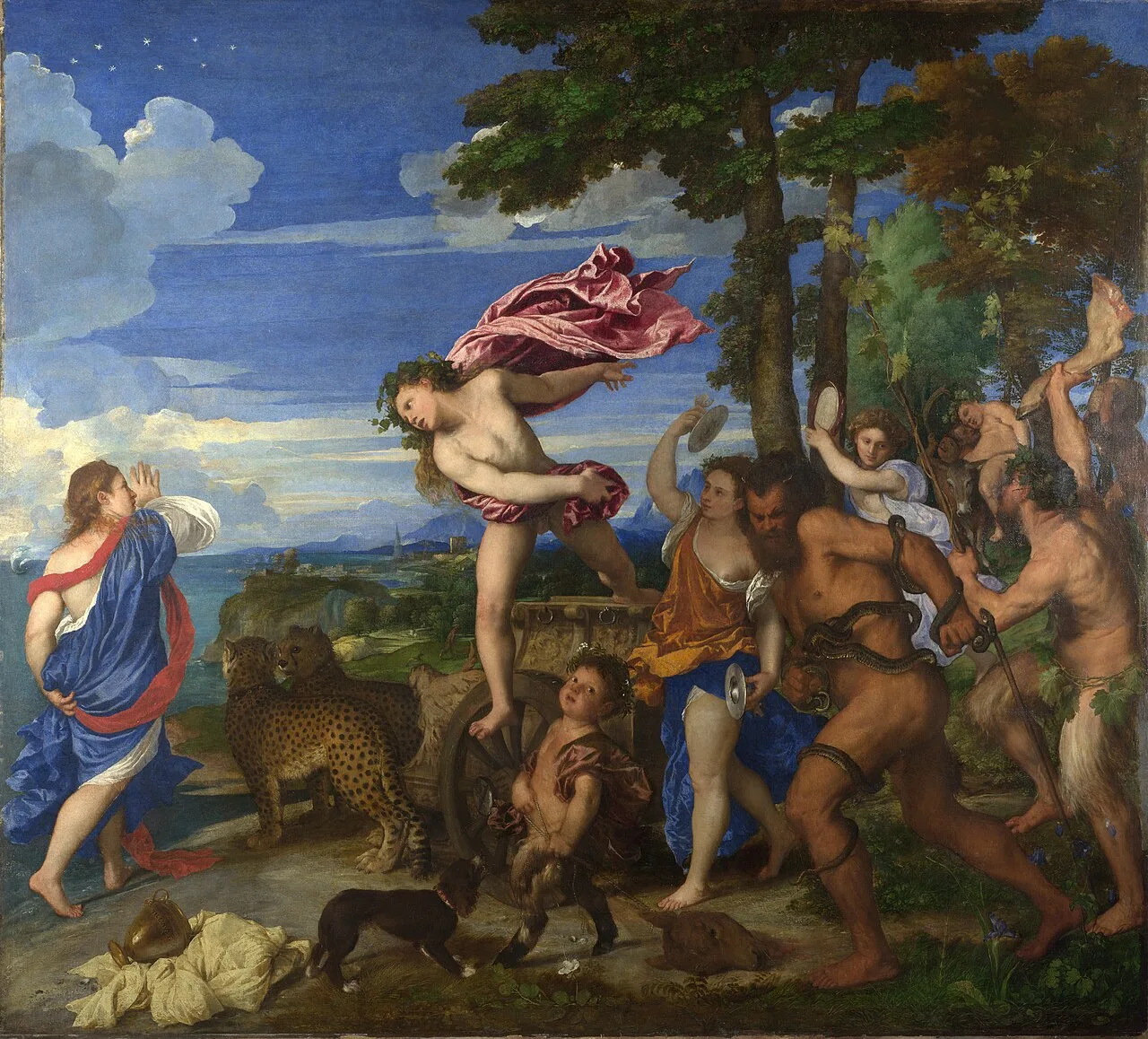
Titian Bacchus and Ariadne
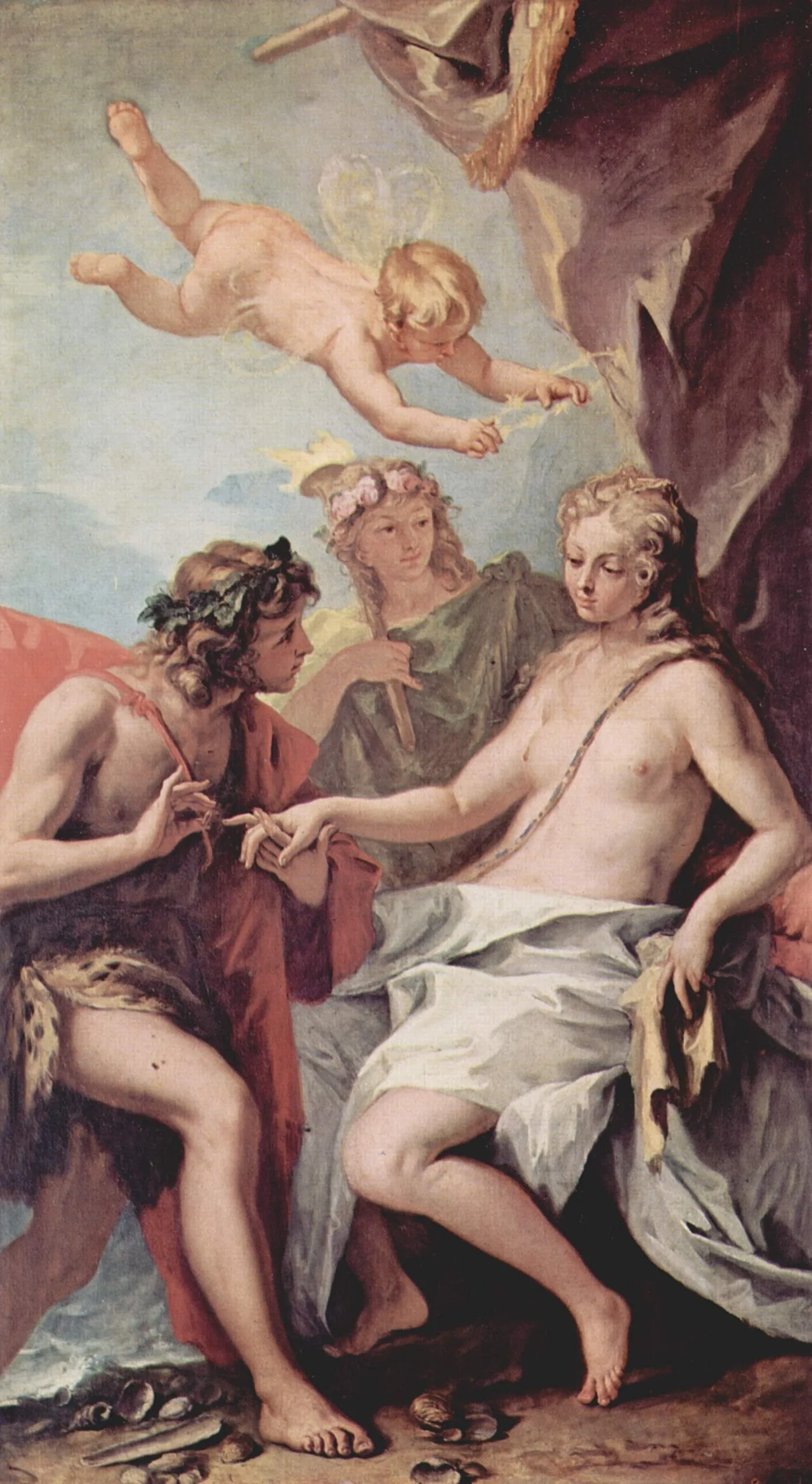
Ariadne being discovered by Dionysus (Bacchus)
Bacchus and Ariadne
Bacchus and Ariadne (1520–1523) is an oil painting by Titian. It is one of a cycle of paintings on mythological subjects produced for Alfonso I d'Este, Duke of Ferrara, for the Camerino d'Alabastro.
An Unfinished Commission Inherited from Raphael
The prestigious mythological painting was not originally conceived by Titian, but began as a project for Raphael. When Raphael died suddenly in 1520, he had managed to finish only a preliminary drawing for the patron. The unfinished commission was subsequently transferred to Titian, who developed it into an iconic Renaissance masterpiece.
From Wikipedia · CC BY-SA 4.0
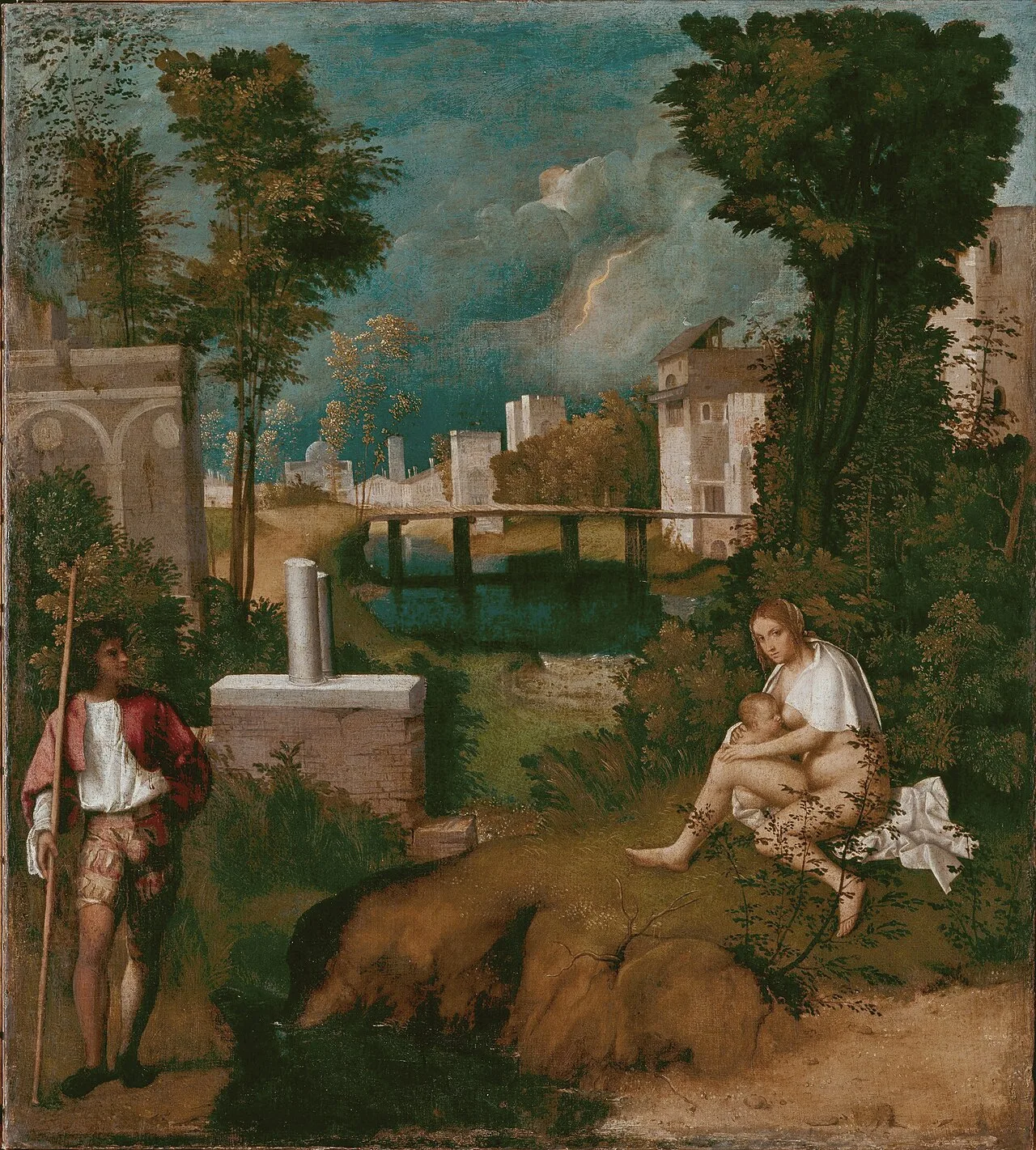
Giorgione - Das Gewitter
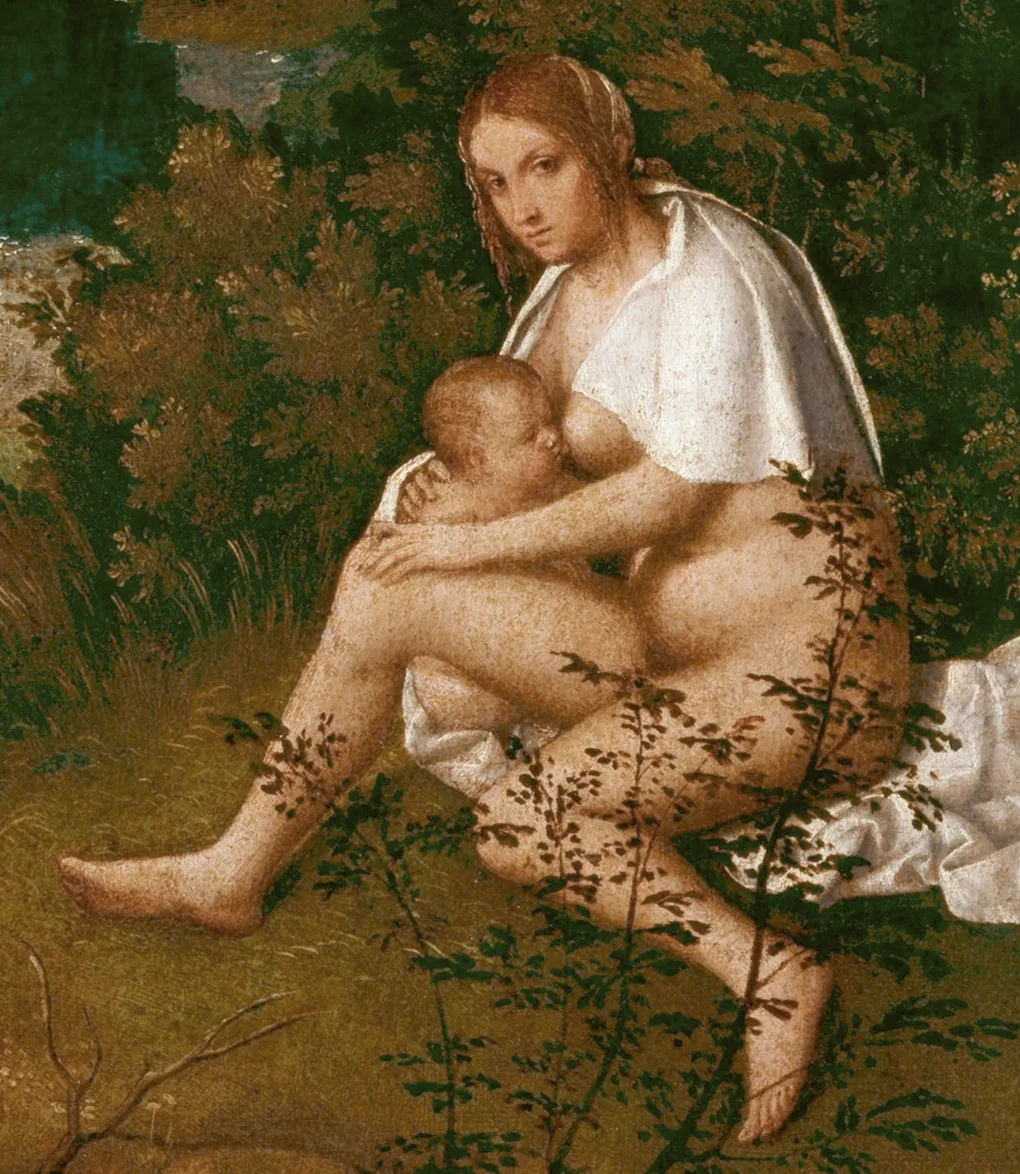
Giorgione - The Tempest (Detail 2)
The Tempest (Giorgione)
The Tempest is a Renaissance painting by the Italian master Giorgione dated between 1506 and 1508, now in the Gallerie dell'Accademia of Venice, Italy.
The Ghostly Figure Beneath the Soldier
Beneath the standing male figure on the left lies a drastically different composition that was later abandoned. Radiographic X-rays revealed that Giorgione originally painted another female nude in that exact spot before replacing her with the soldier. This unexpected underlying figure challenges assumptions of a fixed narrative program, suggesting the composition evolved spontaneously on the canvas.
From Wikipedia · CC BY-SA 4.0
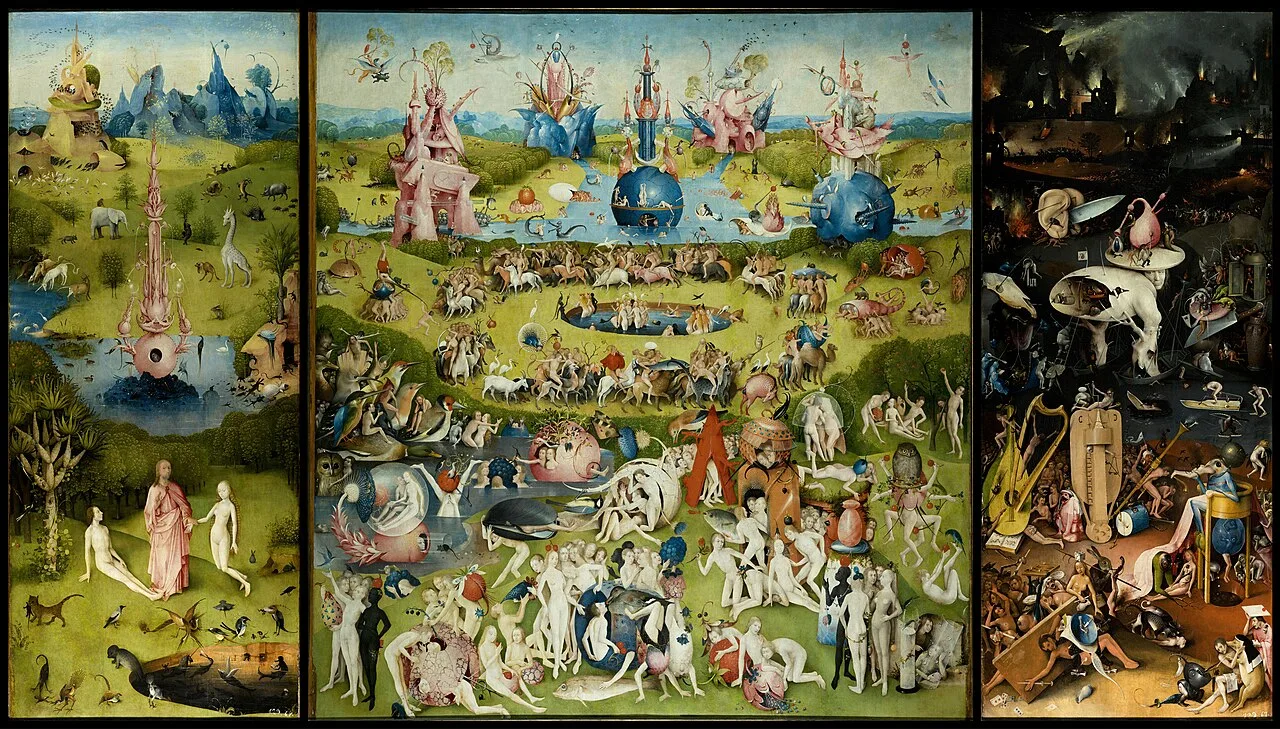
Hieronymus Bosch, The Garden of Earthly Delights, oil on oak panels, 205.5 cm × 384.9 cm (81 in × 152 in), Museo del Prado, Madrid
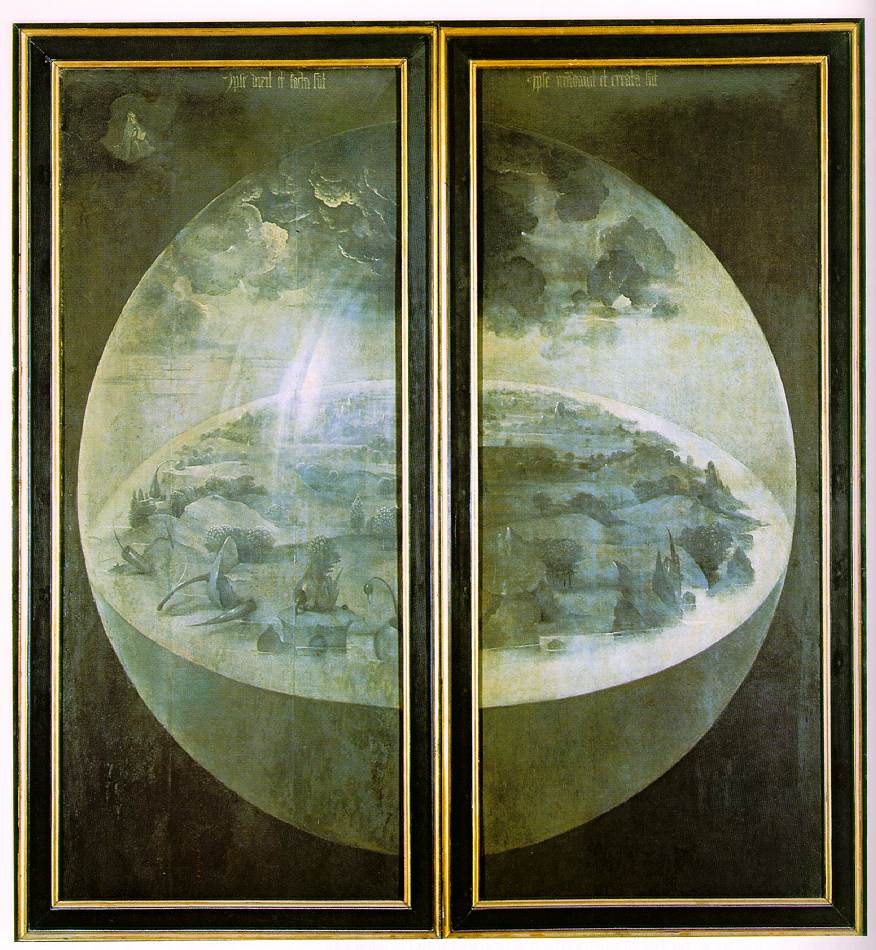
The exterior panels show the world during creation, probably on the Third Day, after the addition of plant life but before the appearance of animals and humans.[4]
![Detail from the left hand panel, showing the pre-incarnate Christ blessing Eve before she is presented to Adam[16]](https://nwjvzop1xgplmzvt.public.blob.vercel-storage.com/wikifeed/the-garden-of-earthly-delights/2-458c9613c7.jpg)
Detail from the left hand panel, showing the pre-incarnate Christ blessing Eve before she is presented to Adam[16]
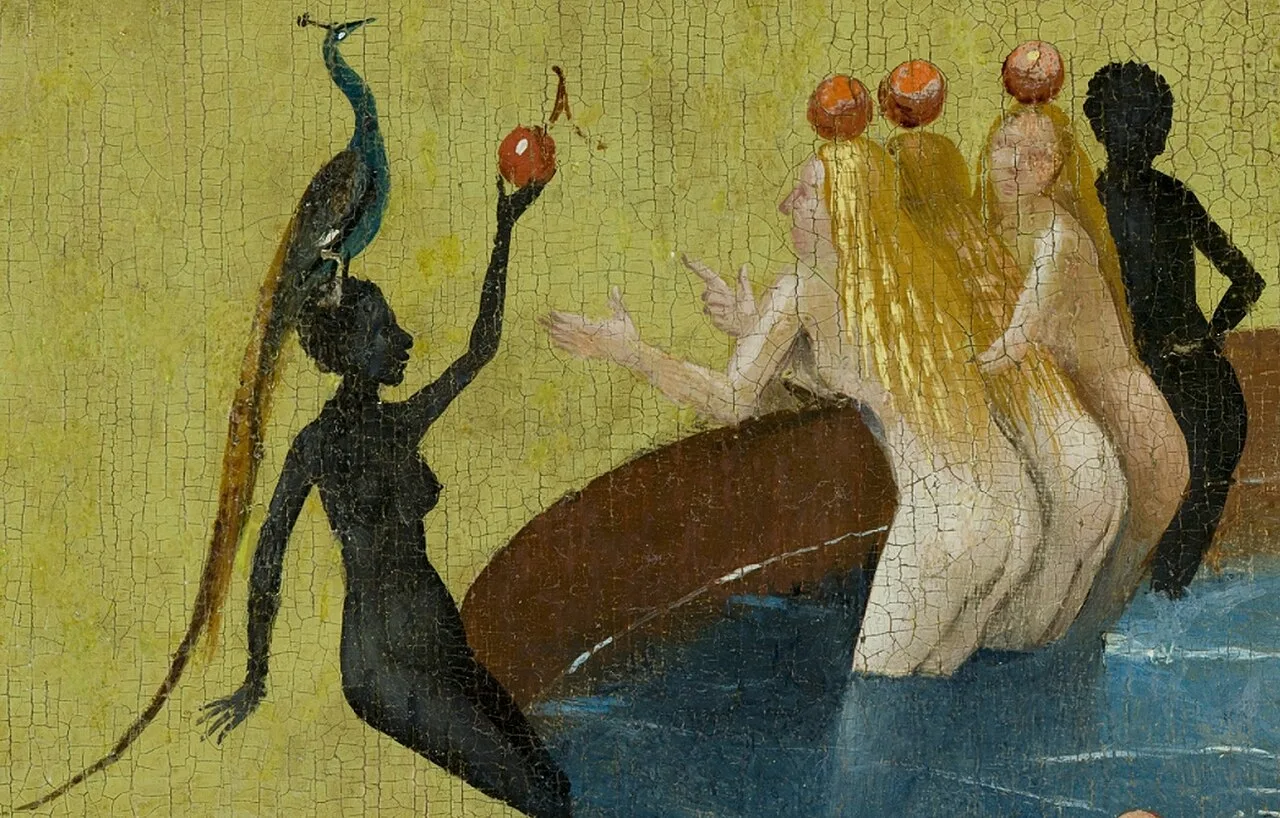
Naked figures seek pleasure in various ways.
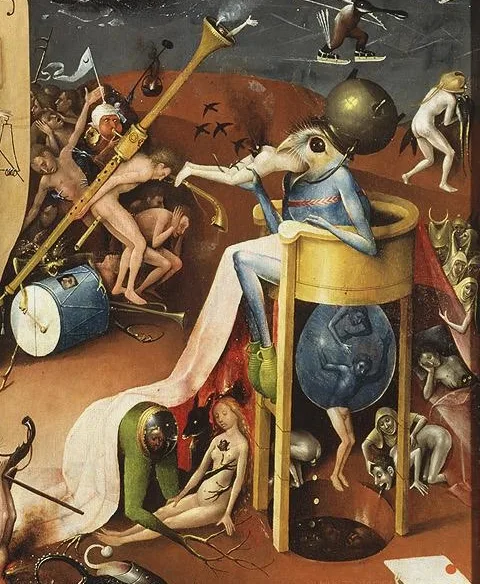
Gibson compares this "Prince of Hell" to a figure in the 12th-century Irish religious text Vision of Tundale, who feeds on the souls of corrupt and lecherous clergy.[47]
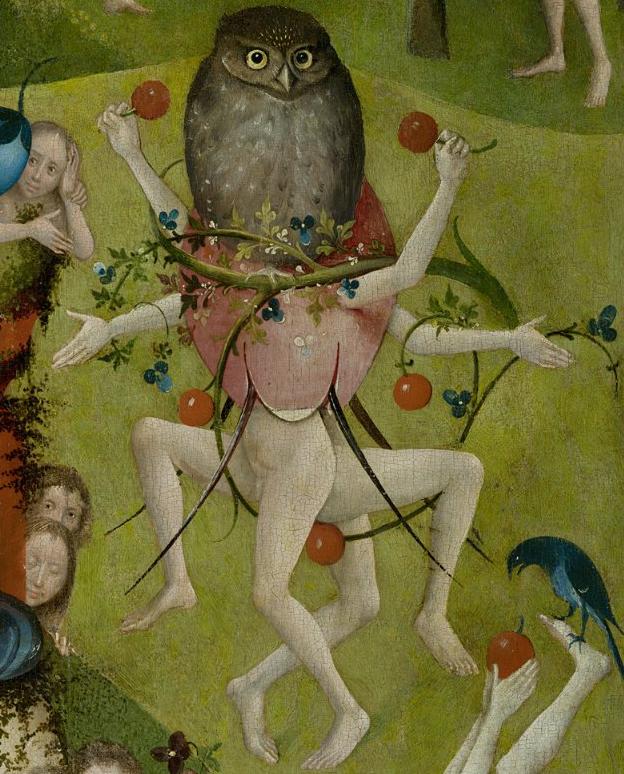
Detail from the center panel showing two cherry-adorned dancing figures who carry a surface on which an owl is perched. In the front right corner, a bird standing on a reclining human's foot is about to eat from a cherry offered to it.
The Garden of Earthly Delights
The Garden of Earthly Delights is a triptych painted between 1490 and 1510 by the Early Netherlandish master Hieronymus Bosch, typically interpreted as a warning against the perils of temptation.
The Monochrome Silence of the Third Day
When closed, the triptych presents an unpopulated world rendered in green-gray grisaille, representing the biblical Third Day of Creation before the creation of the sun and moon. Bosch paints God as a tiny seated figure suspended in darkness, commanding the nascent cosmos by divine fiat beneath an inscription of Psalm 33:9. This deliberate lack of color serves as a calculated prelude, establishing a stark visual contrast with the explosion of hues inside.
From Wikipedia · CC BY-SA 4.0
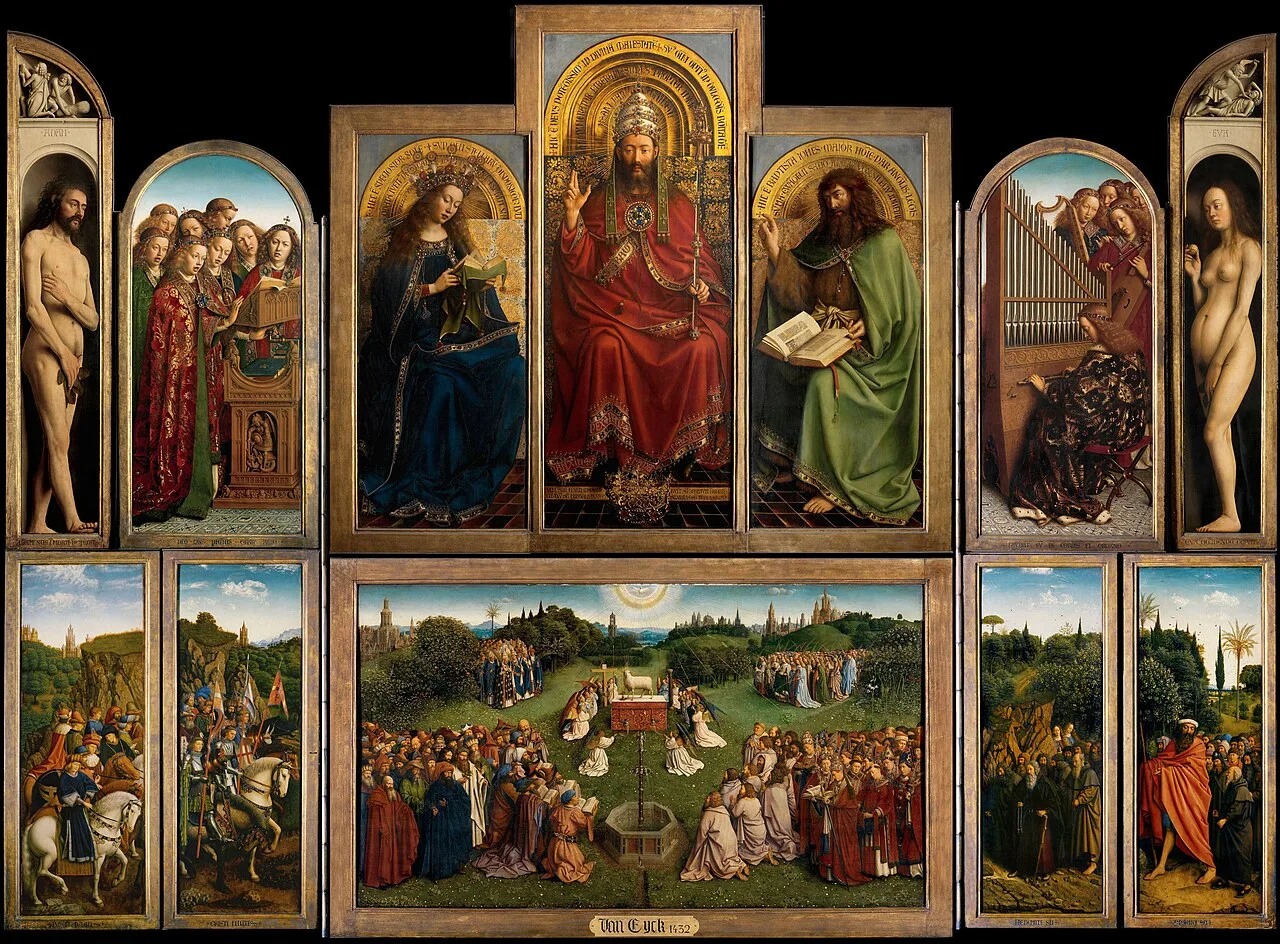
The twelve interior panels, Open View of the altarpiece
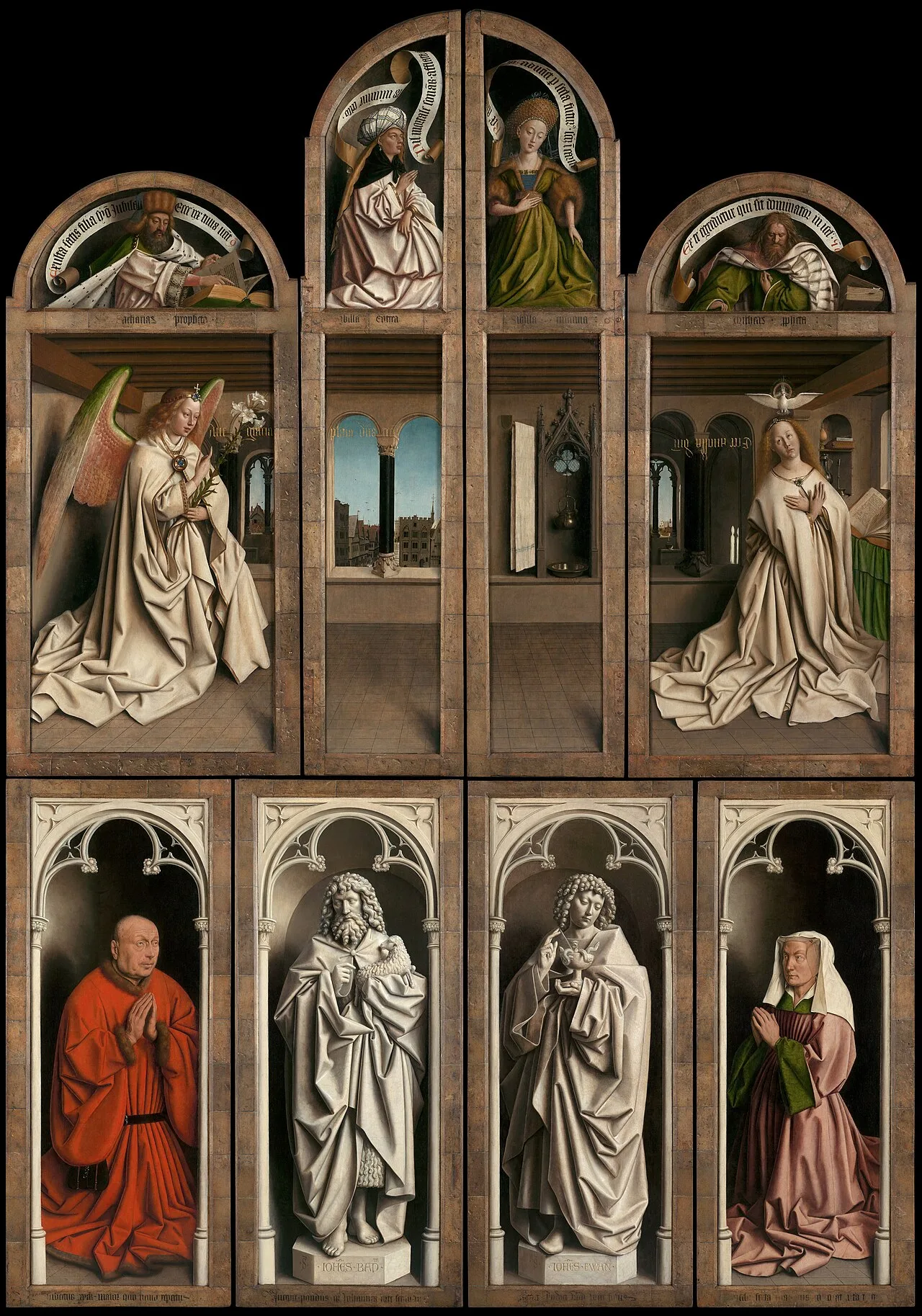
Closed view, back panels of the Altarpiece
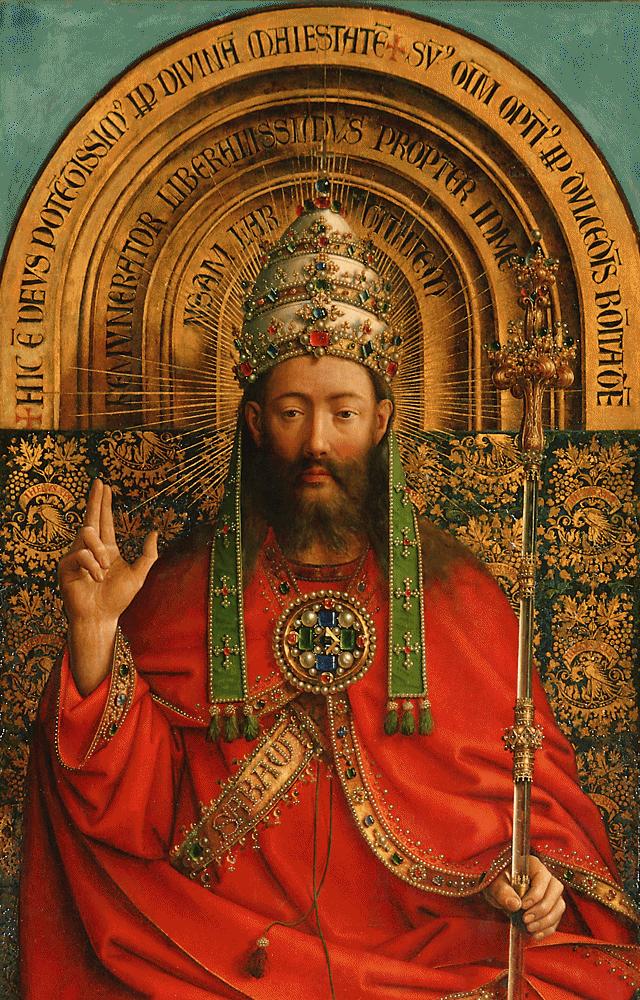
The central figure, usually referred to as "The Almighty"

Eve: contemporary ideal for female figure
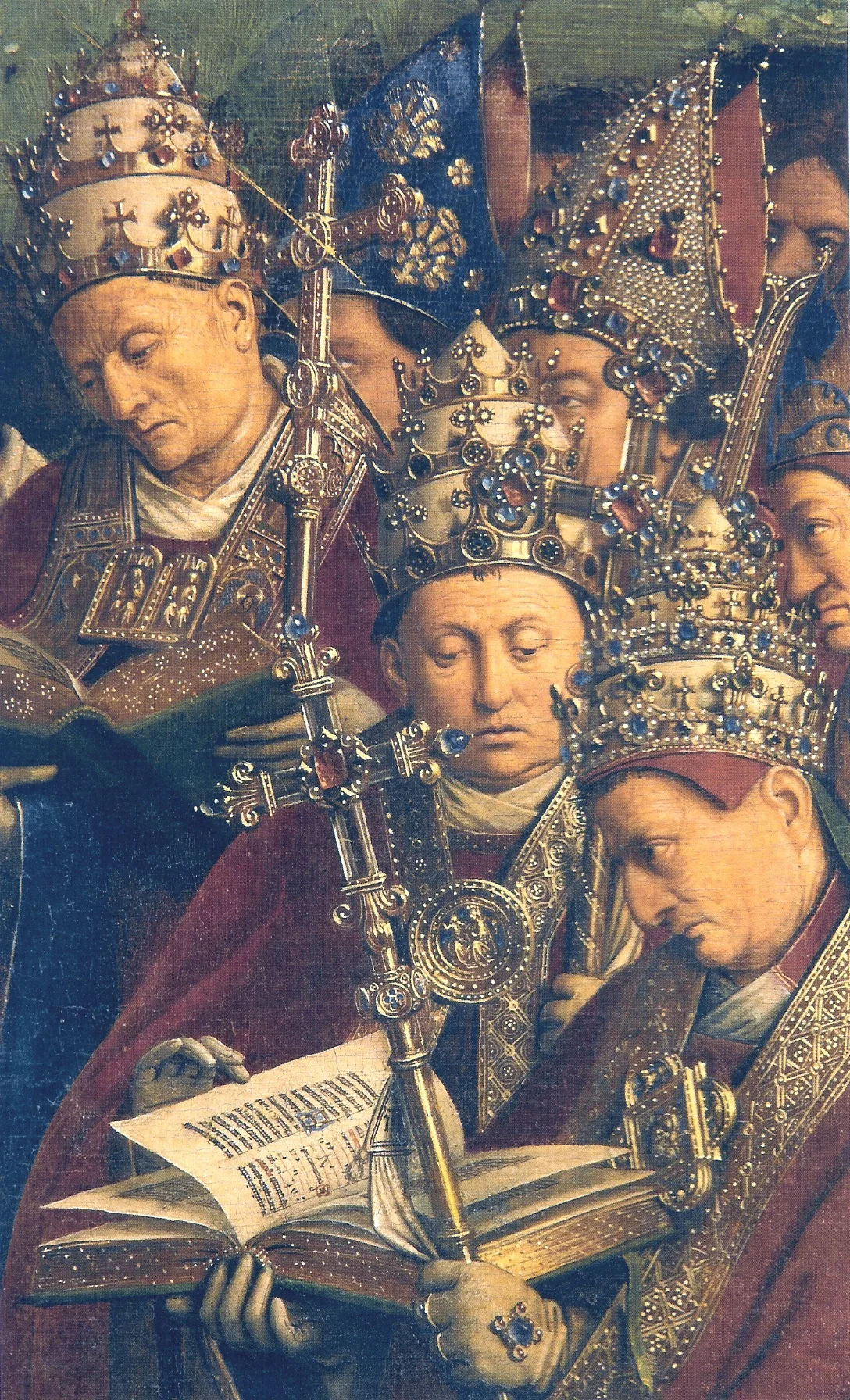
Three of the figures in the grouping to the right of the fountain can be identified as Martin V, Gregory VII and Antipope Alexander V.[53]
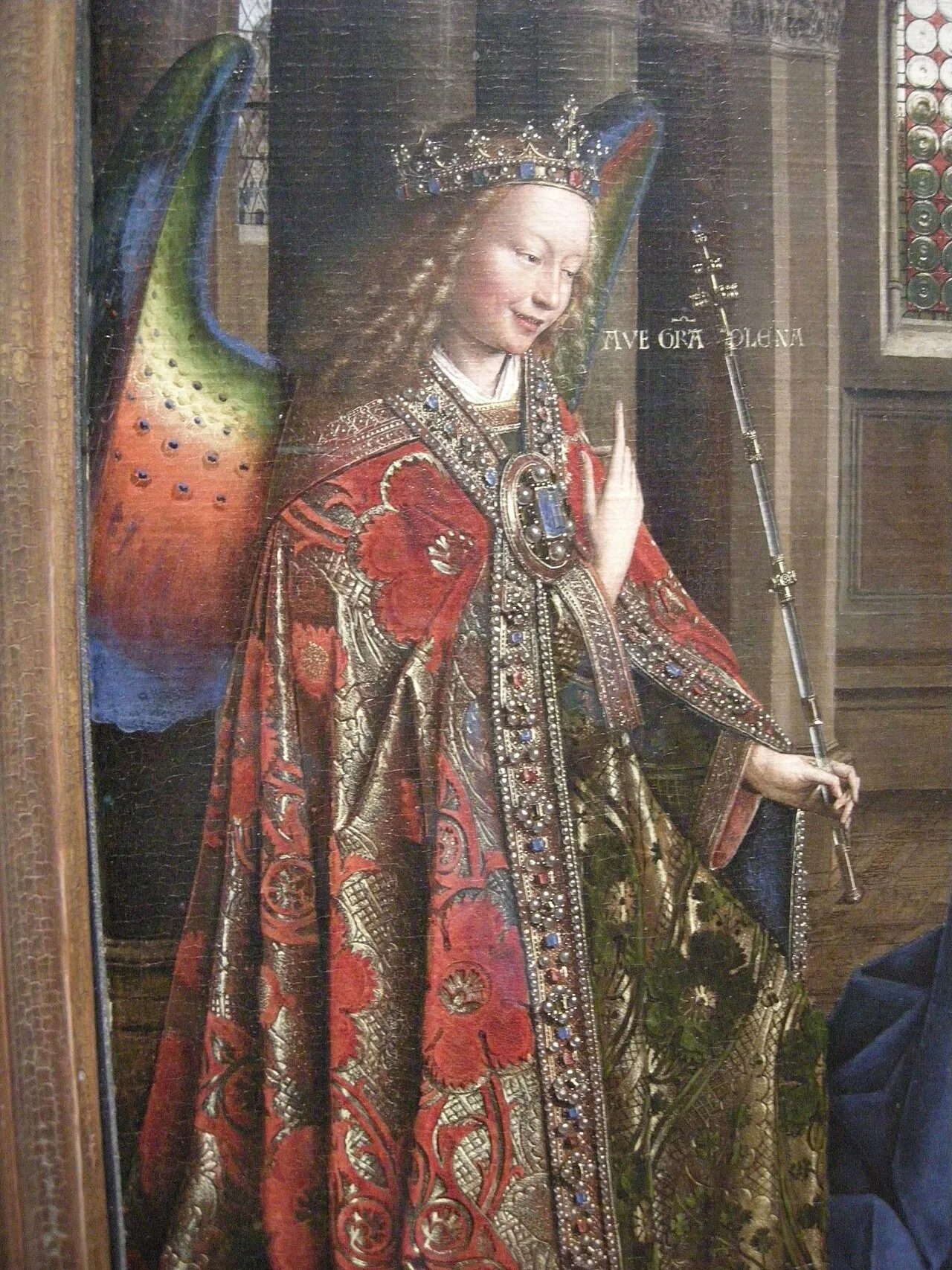
The Archangel Gabriel in a cope with a jewelled morse (clasp) in Jan van Eyck's Annunciation, 1434–36
Ghent Altarpiece
The Ghent Altarpiece is a 15th-century polyptych altarpiece in St Bavo's Cathedral, Ghent, Belgium, attributed to the Early Netherlandish painters Hubert and Jan van Eyck.
Dendrochronological Timelines and the Elder Brother's Ghost
Scientific analysis has challenged the traditional belief that both brothers worked concurrently on the altarpiece. Advances in dendrochronology revealed that parts of the wooden wing panels were felled around 1421. Accounting for a necessary seasoning time of at least 10 years, art historians assume the completion occurred well after Hubert's death in 1426. This timeline definitively rules out his hand from large portions of the wings.
From Wikipedia · CC BY-SA 4.0
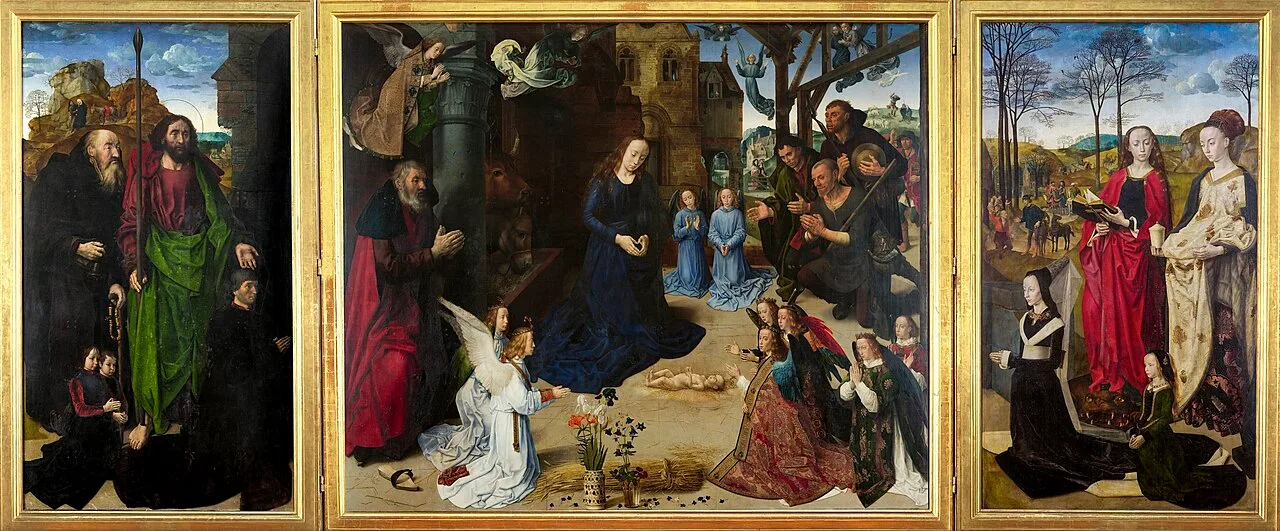
Hugo van der Goes - Portinari Triptych (c. 1477)
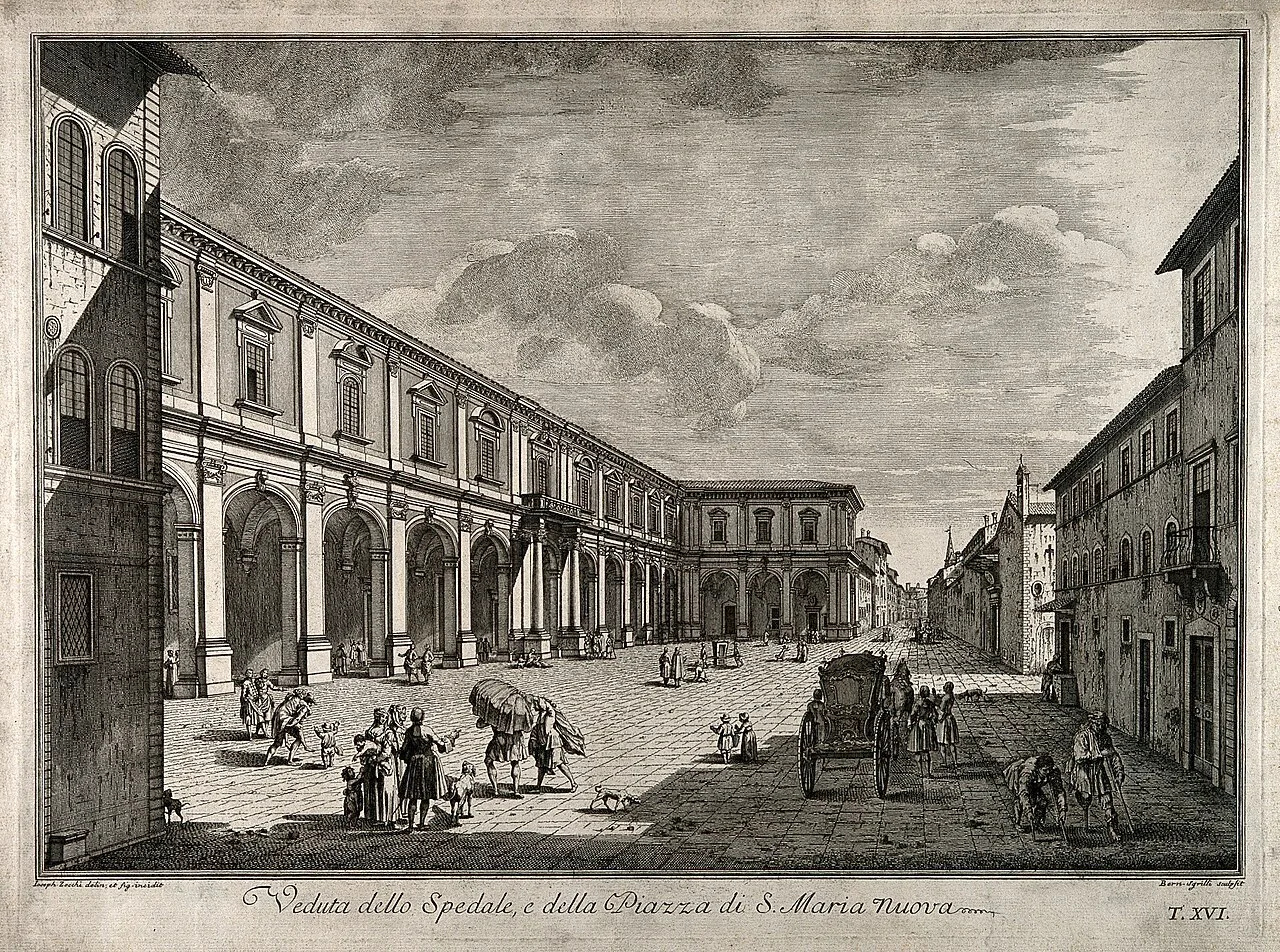
Hospital of Santa Maria Nuova, Florence, Italy. Etching by B Wellcome V0014713
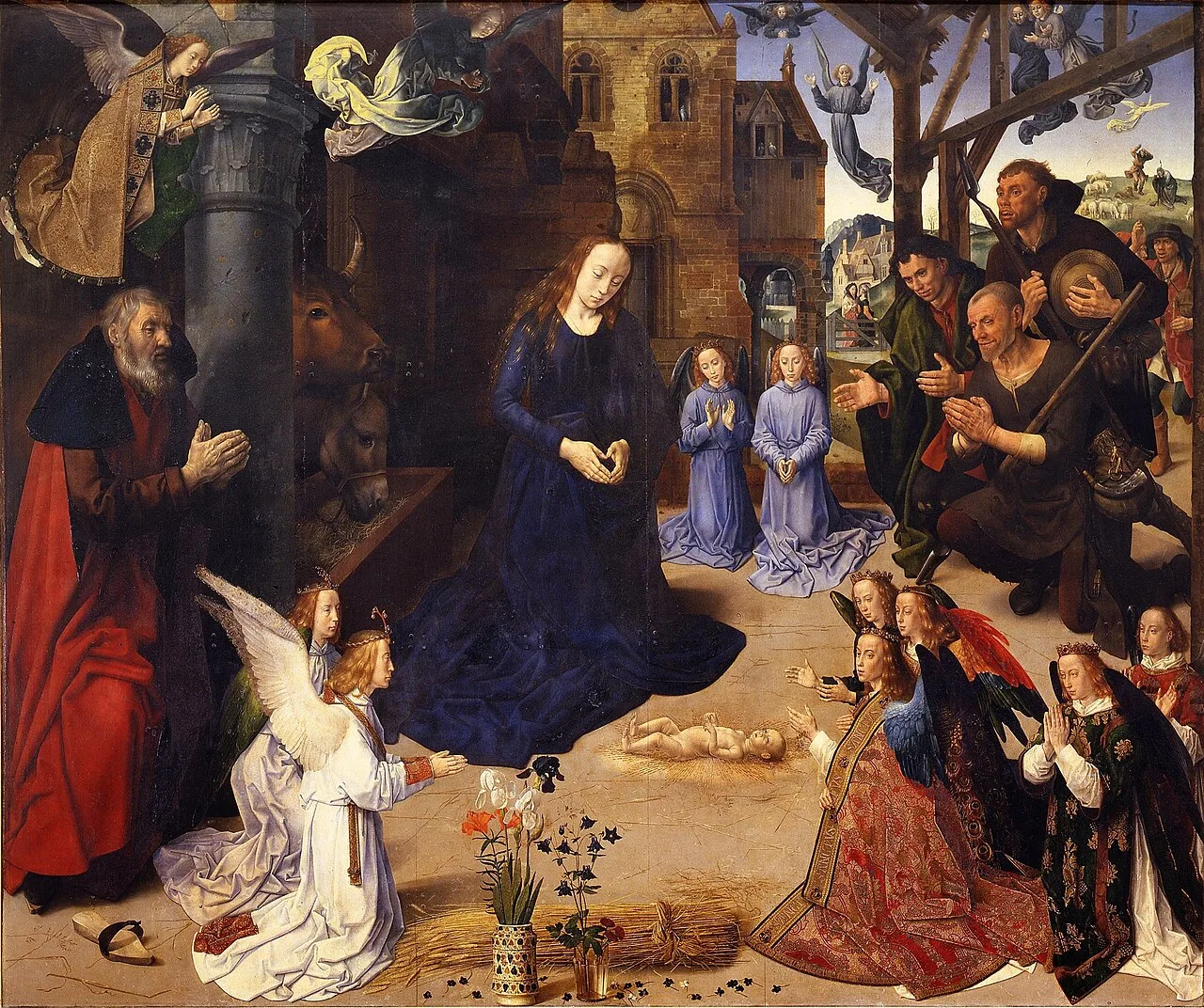
The central panel

The Annunciation in grisaille on the closed wings

The Annunciation of the Shepherds in the top right corner of the central panel

Details of the flowers within the arbarello lusterware ceramic
Portinari Altarpiece
The Portinari Altarpiece is an oil-on-wood triptych painting (c. 1475) by the Flemish painter Hugo van der Goes, representing the Adoration of the Shepherds.
Simulating Stone to Consolidate Craft Commissions
When closed, the triptych displays the Annunciation rendered in grisaille, using monochrome paint to imitate carved stone within shallow niches. While devotional traditions in regions like Germany considered physical sculpture superior, painting simulated statues directly onto wood was far more economical. This technique allowed Portinari to contract a single master rather than paying multiple specialized craftsmen, securing the entire commission for Van der Goes and his assistants.
From Wikipedia · CC BY-SA 4.0