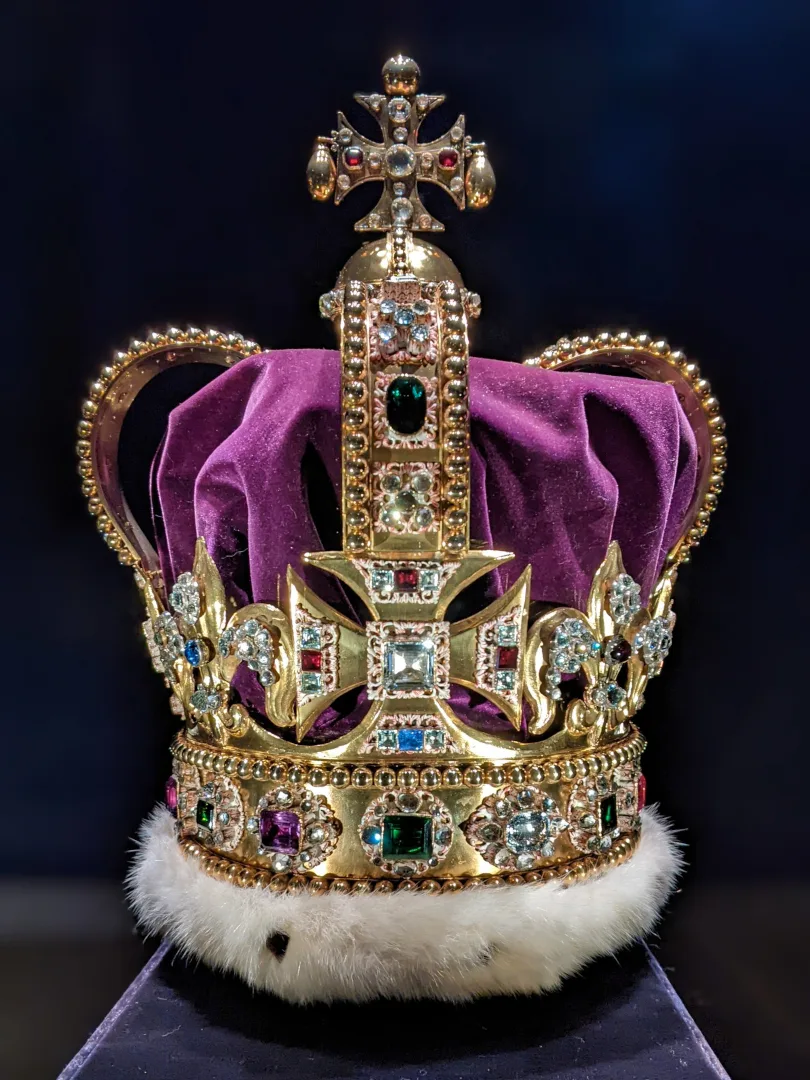
Saint Edward's Crown

St Edward's Crown (plain) 3D
![An early 12th-century portrait of Edmund the Martyr,[13] wearing a crown similar in appearance to St Edward's, which was](https://upload.wikimedia.org/wikipedia/commons/thumb/8/8f/St_Edmund_the_Martyr_crowned_by_angels.jpg/1280px-St_Edmund_the_Martyr_crowned_by_angels.jpg?utm_source=en.wikipedia.org&utm_campaign=imageinfo&utm_content=thumbnail)
An early 12th-century portrait of Edmund the Martyr,[13] wearing a crown similar in appearance to St Edward's, which was not surmounted by a cross.[11]
![St Edward's Crown as it looked at the English coronation of James II in 1685, by the engraver William Sherwin[30]](https://upload.wikimedia.org/wikipedia/commons/3/34/St_Edward%27s_Crown_by_Francis_Sandford.png?utm_source=en.wikipedia.org&utm_campaign=imageinfo&utm_content=thumbnail_unscaled)
St Edward's Crown as it looked at the English coronation of James II in 1685, by the engraver William Sherwin[30]
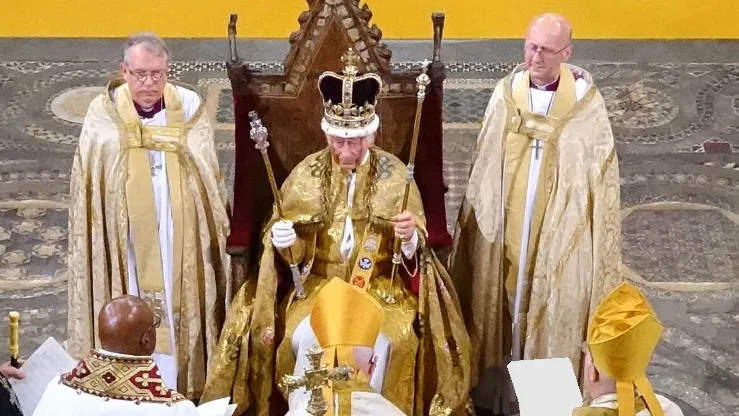
Coronation of Charles III with St Edward's Crown

Royal cypher of Elizabeth II
St Edward's Crown
St Edward's Crown is the coronation crown of the Crown Jewels of the United Kingdom, traditionally used to crown English and British monarchs since the 13th century.
A Consular Investiture Mistaken for a Coronation
For centuries, antiquarians believed St Edward's Crown originated when Pope Leo IV crowned five-year-old Alfred in 853. A 19th century discovery of a papal letter dismantled this legend by showing the pontiff had merely confirmed the boy and invested him with the insignia of a Roman consul. Since Alfred was only fourth in line to the throne at the time, the grand coronation narrative was an invented tradition.
From Wikipedia · CC BY-SA 4.0

Hungarian Parliament 002 - Flickr - granada turnier

Back of the Holy Crown

The Holy Crown of Hungary, 1857
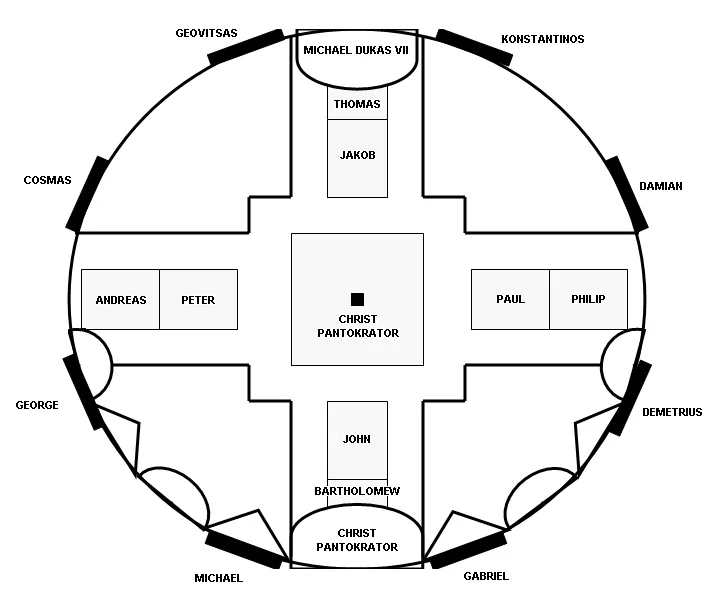
A sketch of the enamel icons of the Saints on the Holy Crown (top view, the crown's front side is on the bottom of the image)
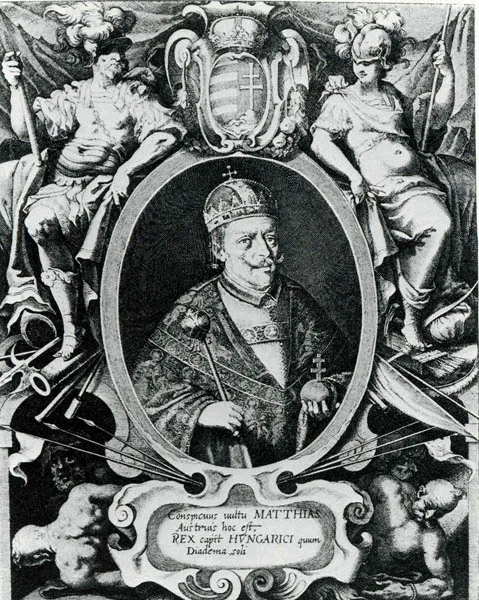
An engraving of Matthias II of Hungary, showing the cross in vertical position

King Charles IV, taking his coronation oath at Holy Trinity Column outside Matthias Church (1916). To date, he is the last monarch to be crowned with St. Stephen's Crown. Notice the size difference between the crown and the king's head.
Holy Crown of Hungary
The Holy Crown of Hungary, also known as the Crown of Saint Stephen, was the coronation crown used by the Kingdom of Hungary for most of its existence.
The Crown as a Sovereign Legal Entity
Under the Doctrine of the Holy Crown, the artifact was defined as a legal person identical to the state of Hungary rather than a mere royal ornament. Crown Guard Péter Révay articulated this legal supremacy in Augsburg in 1613 and Frankfurt in 1659. The doctrine positioned the physical object as superior to any ruling monarch, transforming royal governance into an authority exercised solely in the crown's name.
From Wikipedia · CC BY-SA 4.0
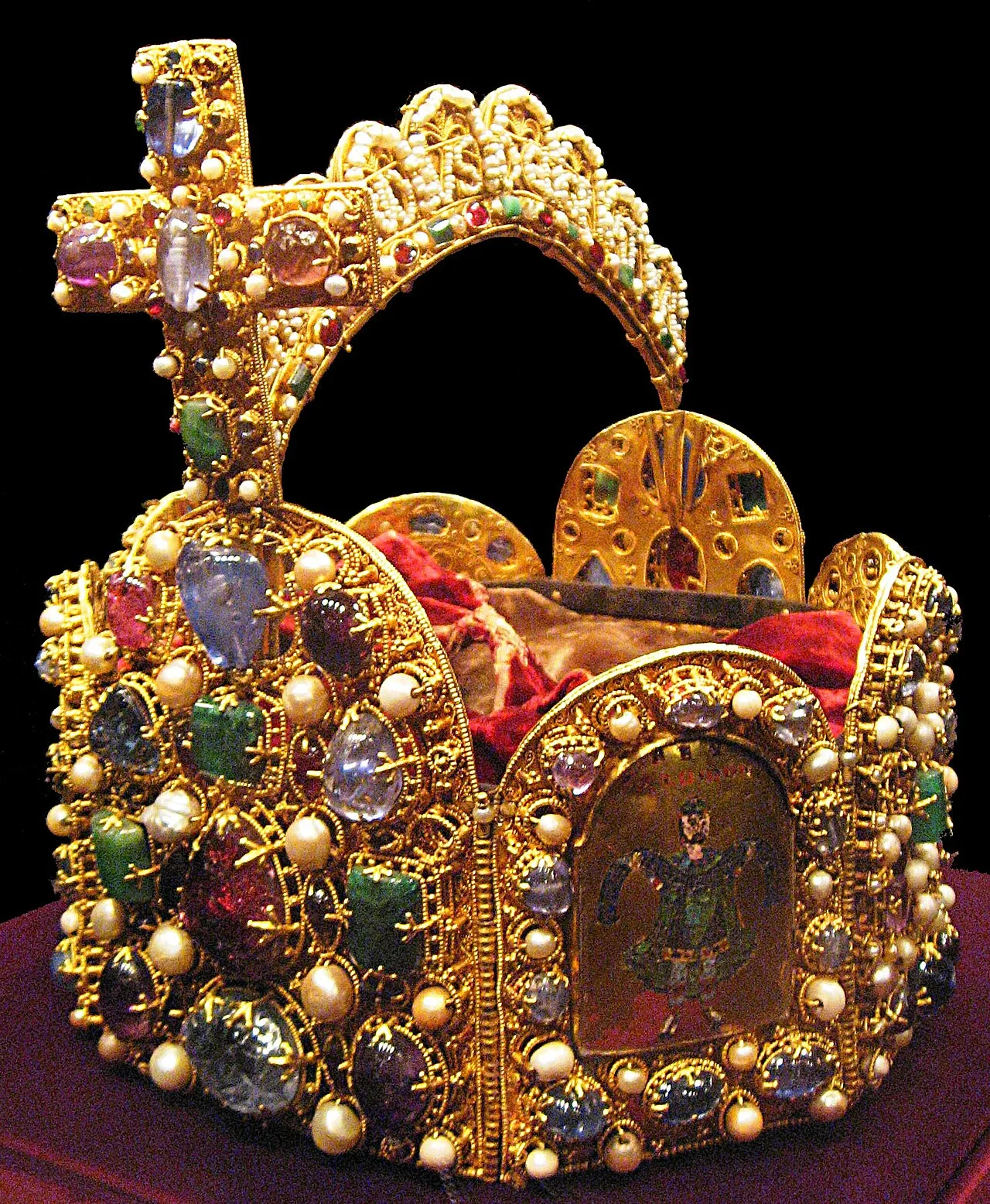
Holy Roman Empire
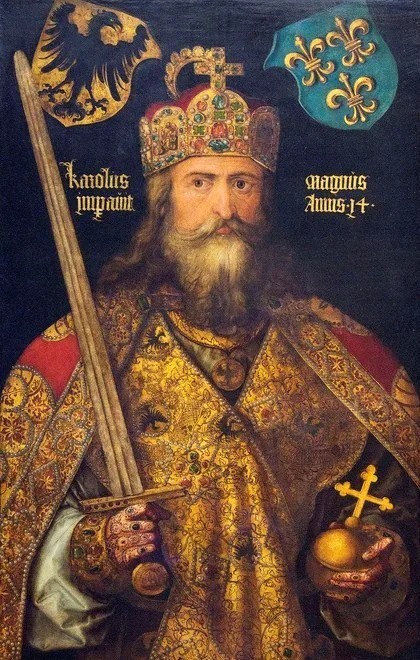
Charlemagne wearing the Imperial Crown, by Albrecht Dürer, c. 1512, Germanisches Nationalmuseum in Nuremberg. The picture is anachronistic, since the crown was made at least a century and a half after Charlemagne's death, and originally had a simpler form.
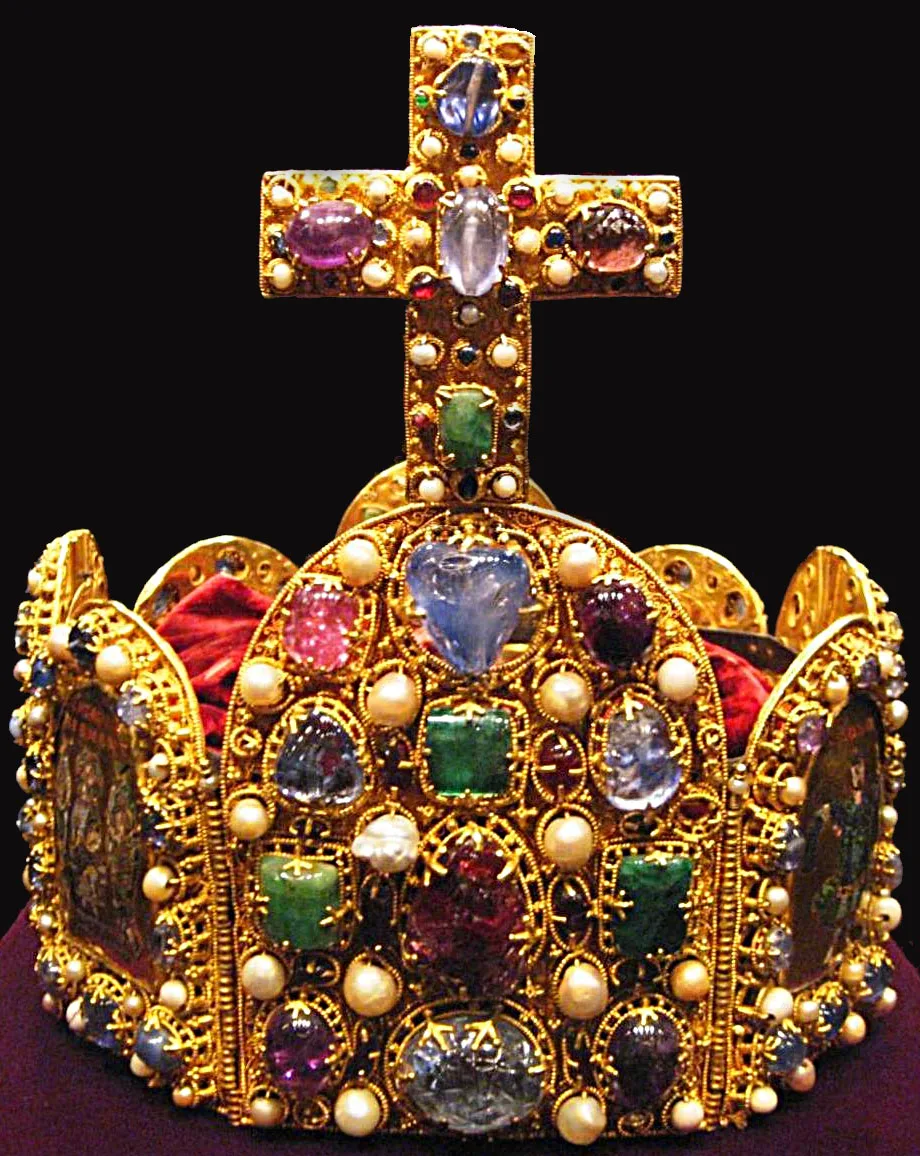
Front view

Rear

The Reichskanzleitrakt with the monument to Francis II in the foreground

Replica displayed in Trifels Castle
Imperial Crown of the Holy Roman Empire
The Imperial Crown of the Holy Roman Empire was the coronation crown of the Holy Roman Emperor from the late 10th century until 1806.
Modular Pinning for Itinerant Rule
Rather than forming a continuous circular band, the crown was constructed with an octagonal shape composed of eight hinged golden plates. Before later modifications with permanent rivets, long golden pins held the entire assembly together. This modular design allowed the plates and the arch to be separated easily for safe transport across the empire.
From Wikipedia · CC BY-SA 4.0
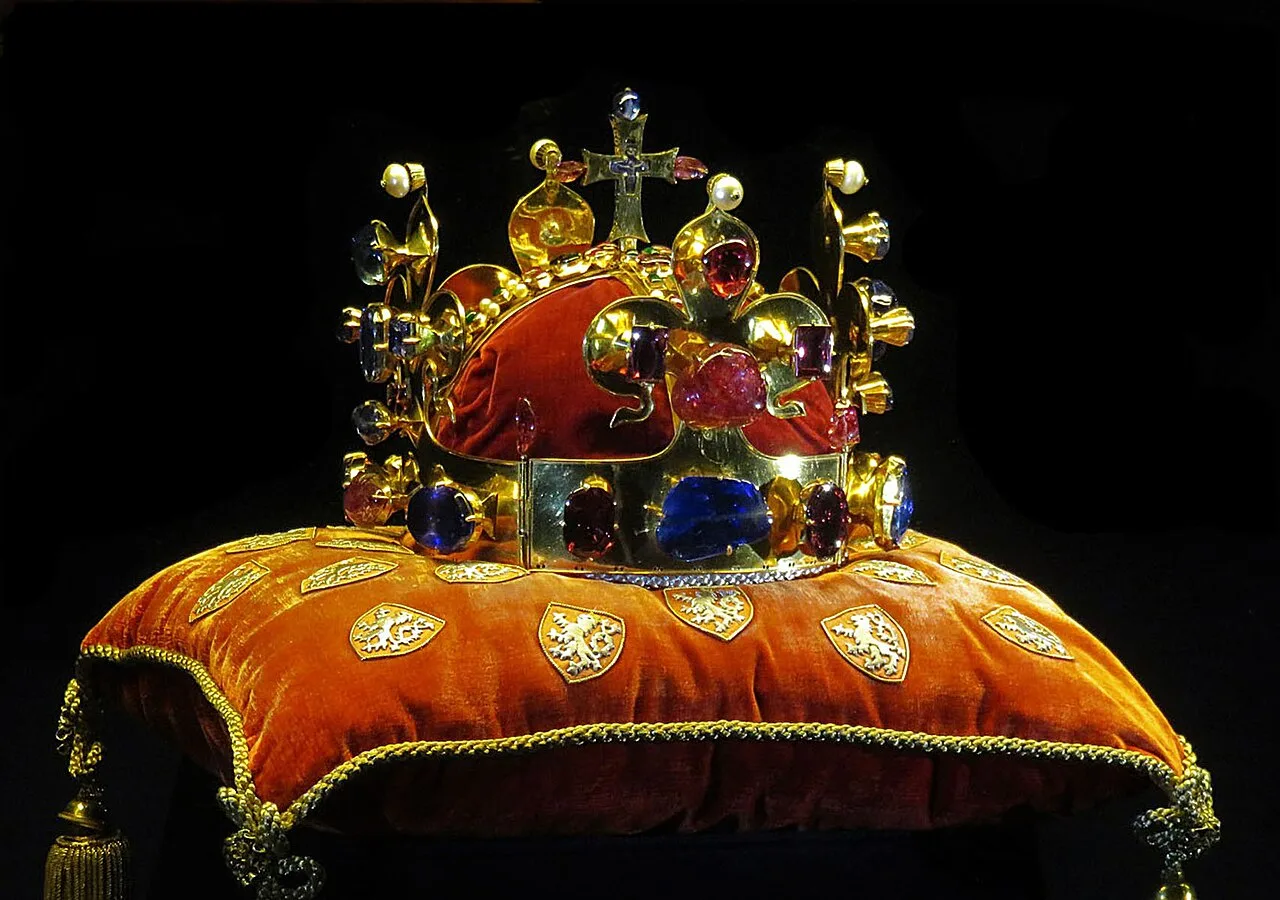
CrownBohemia2
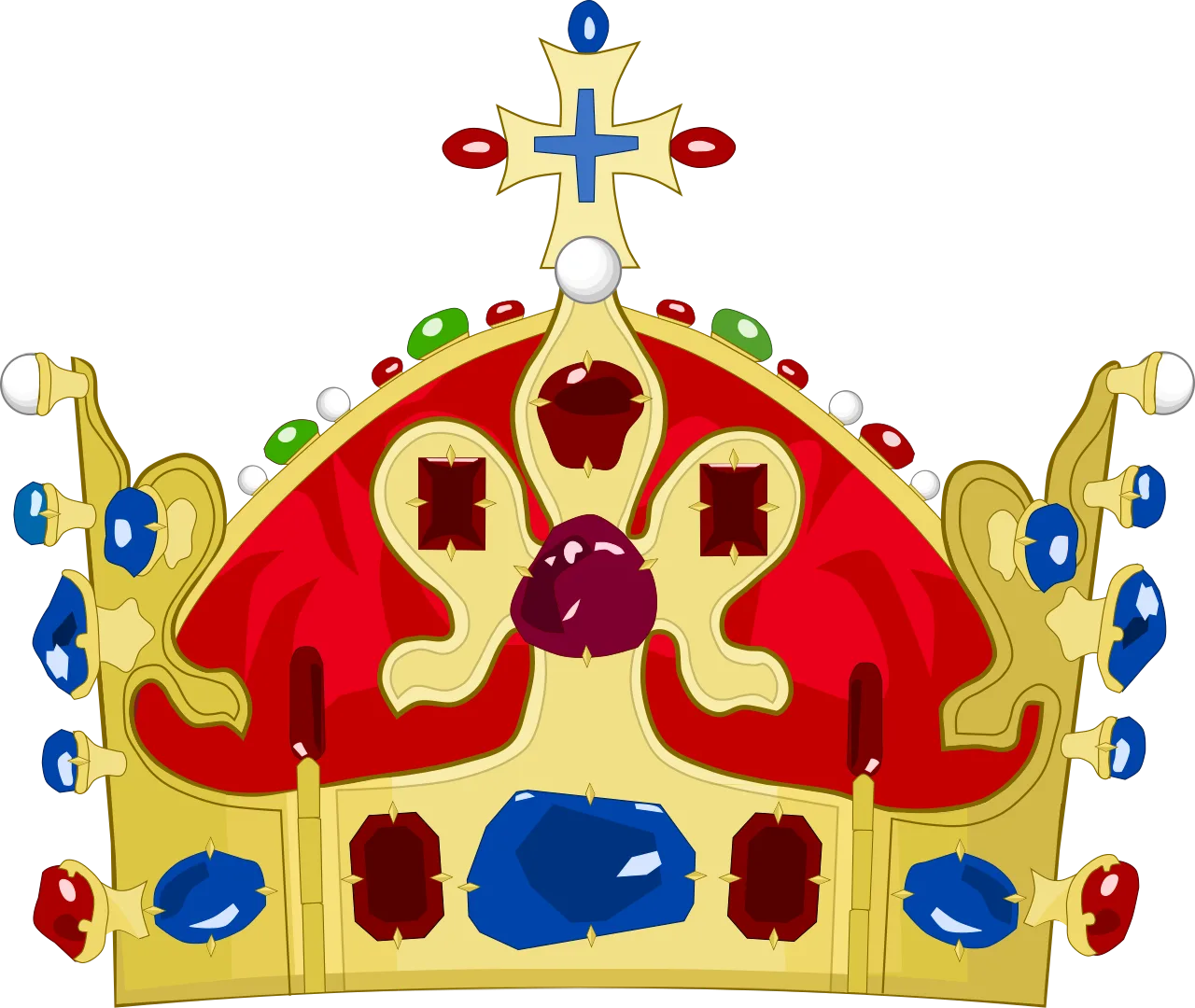
Crown of St. Wenceslas

Replica of the crown in the Old Royal Palace of Prague Castle
Crown of Saint Wenceslas
The Crown of Saint Wenceslas is a crown made in 1346 that forms part of the Bohemian crown jewels.
The Rubellite Mistaken for a Ruby
Although the crown is adorned with gold and a radiant assortment of gems, its prominent red stone is frequently misidentified. Alongside 19 sapphires, 44 spinels, and 30 emeralds, the crown features a single red elbaite rather than a genuine ruby. Formed from 21 to 22 carat gold, the relic integrates 91 precious stones and 20 pearls into its medieval structure.
From Wikipedia · CC BY-SA 4.0
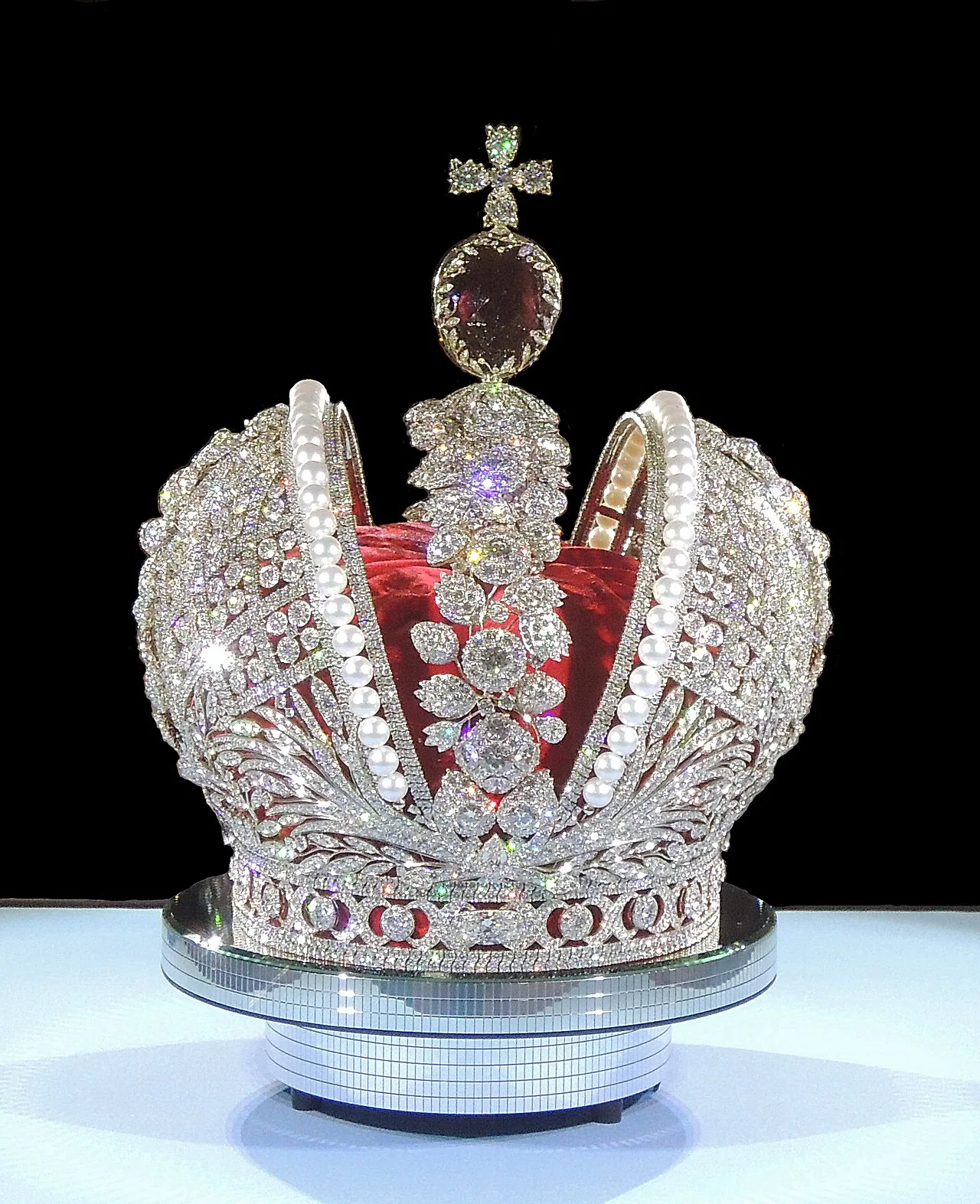
Imperial Crown of Russia (copy by Smolensk Diamonds company, 2012) - photo by Shakko 01
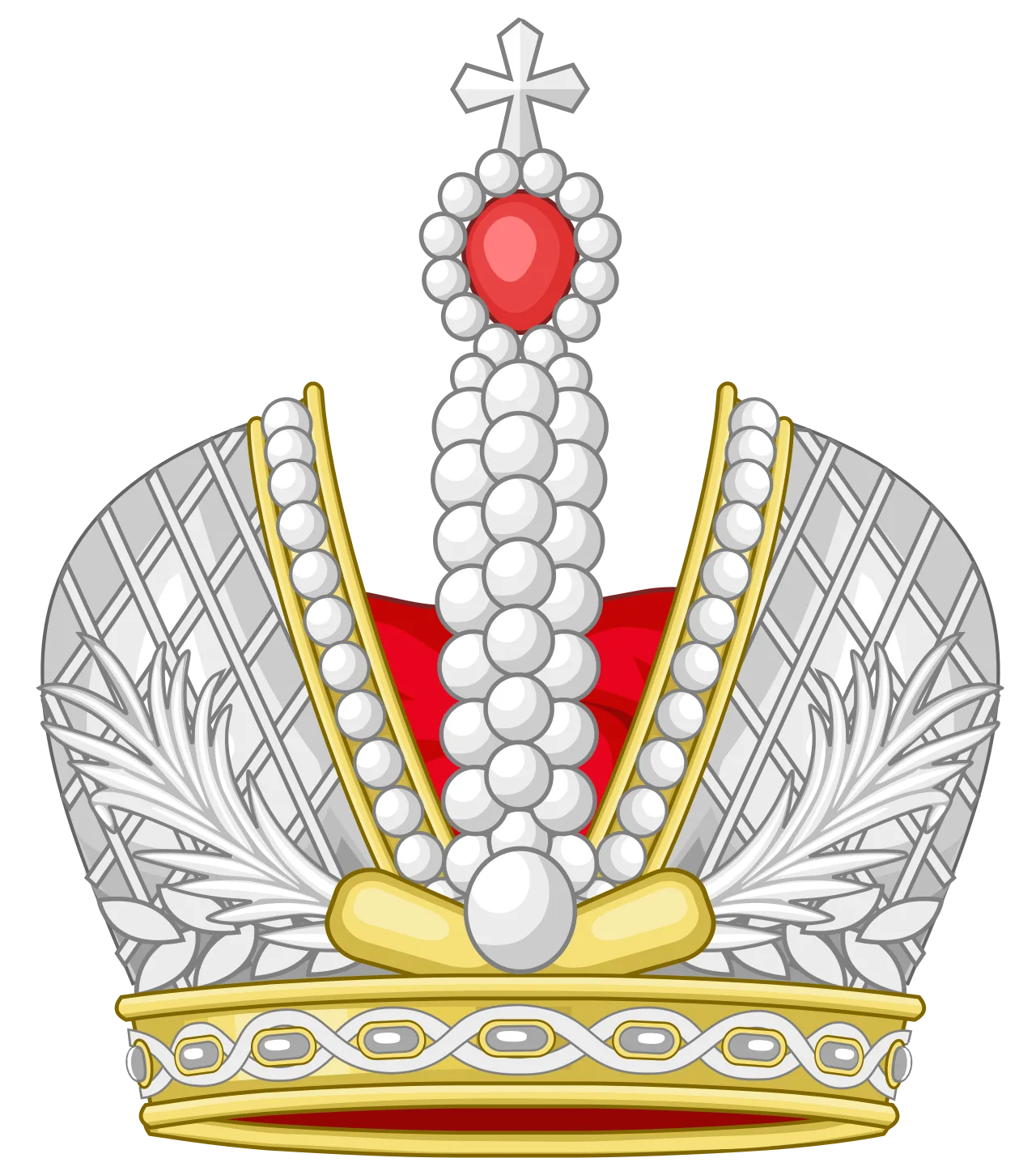
Heraldic Imperial Crown of Russia
![Russian regalia used prior to the creation of the great imperial crown[1]](https://nwjvzop1xgplmzvt.public.blob.vercel-storage.com/wikifeed/imperial-crown-of-russia/2-d9058c4f5f.webp)
Russian regalia used prior to the creation of the great imperial crown[1]
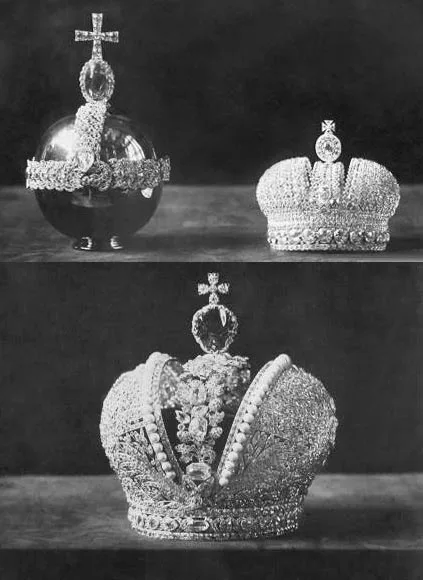
1896 image of the crown (at bottom)
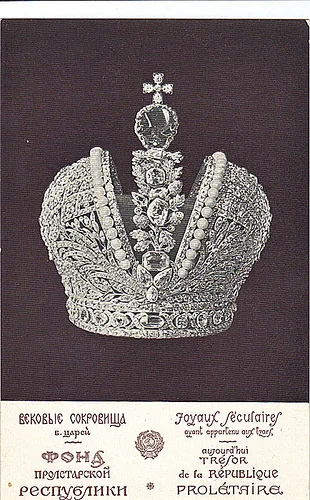
Postcard with the crown, c. 1924
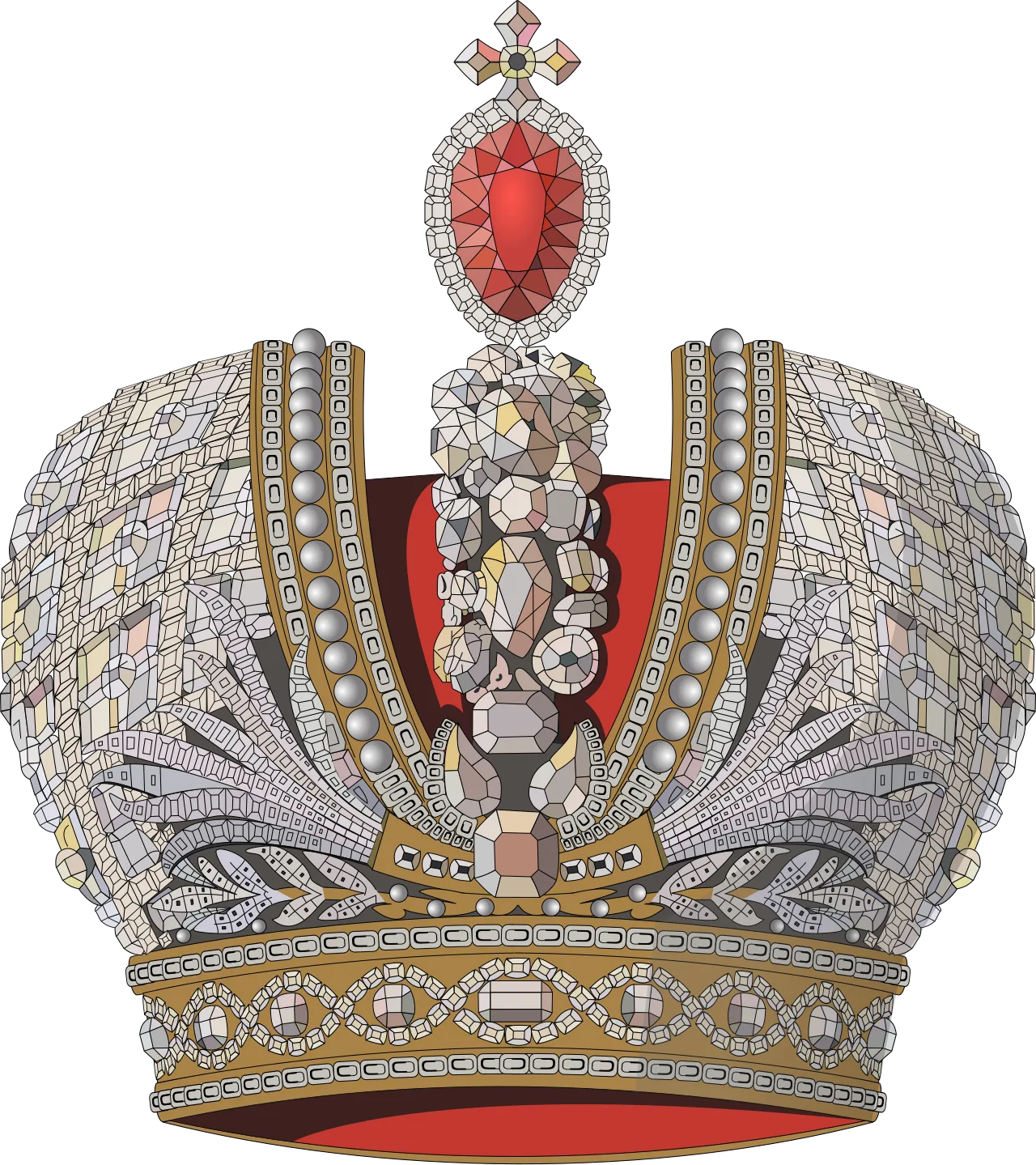
Heraldic illustration
Imperial Crown of Russia
The Imperial Crown of Russia was used for the coronation of the monarchs of Russia from 1762 until the monarchy's abolition in 1917.
State Ownership Over Dynastic Property
Peter the Great fundamentally transformed the concept of monarchical wealth in 1719 by establishing the precursor to the State Diamond Fund. Rather than treating regal treasures as the private property of the Romanov family, he placed them in a permanent collection belonging to the Russian State. Under his decree, these crown holdings became legally inviolate and could not be sold.
From Wikipedia · CC BY-SA 4.0
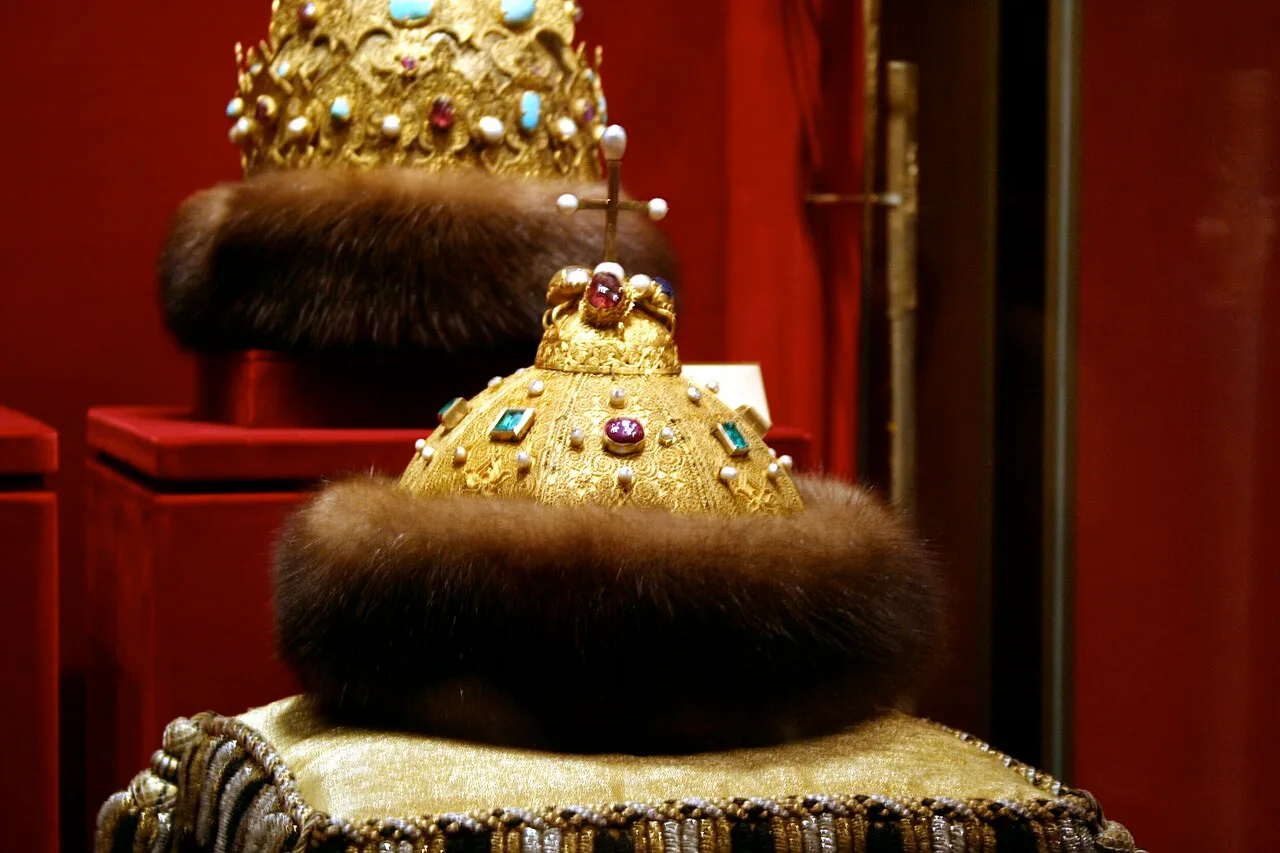
Monomakh's Cap in the foreground and Kazan Cap in the background
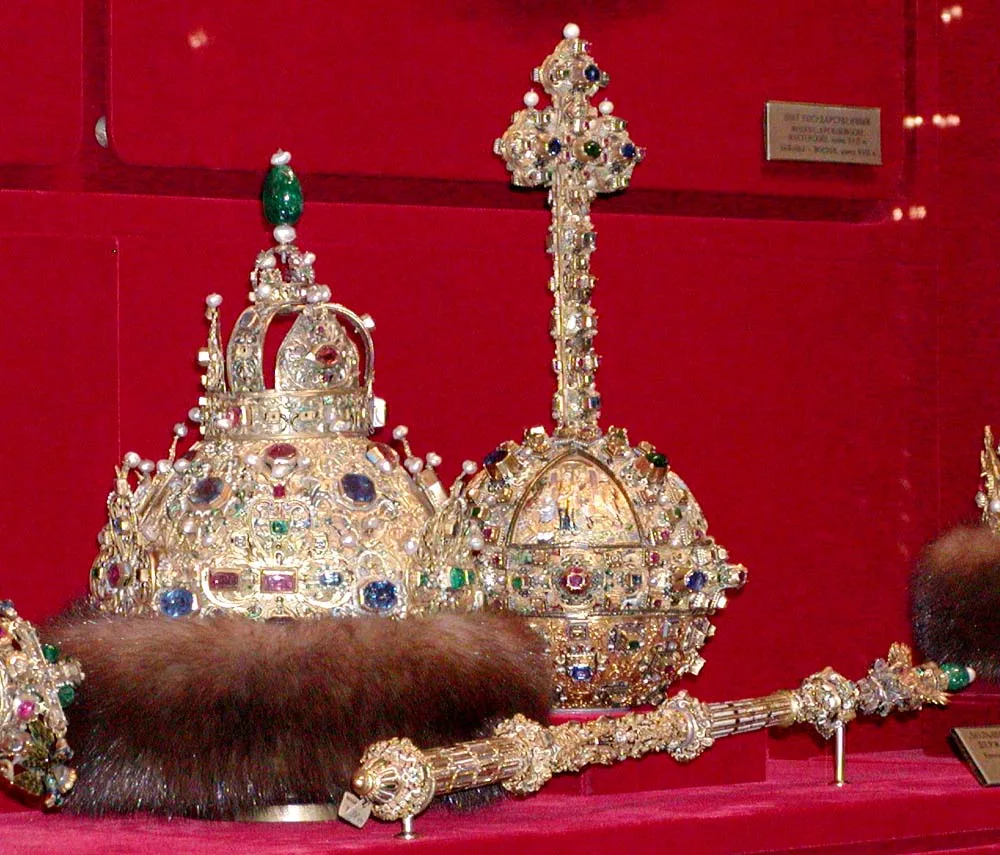
Russian regalia used prior to the Great Imperial Crown. The crown is styled after the Monomakh Cap, and was made for Tsar Michael Fyodorovich by Kremlin masters in 1627. The orb and sceptre are of Western-European origin[citation needed] and may have been given to Tsar Boris Godunov in 1604.
Monomakh's Cap
Monomakh's Cap, also called the Golden Cap, is an early 14th-century crown and chief relic of the Muscovite Grand Princes and Russian Tsars exhibited at the Kremlin Armoury.
Sable Trim and Eight Gold Filigree Sectors
Monomakh's Cap serves as the primary relic of Russian autocracy and remains the oldest crown exhibited within the Kremlin Armoury. Crafted as an early fourteenth-century skullcap, the headpiece features eight distinct sectors made of gold filigree. Elaborate scrolled gold overlays, precious ruby and emerald stones, and delicate pearls cover the surface. A simple gold cross with pearl-tipped extremities rests atop its sable-trimmed base.
From Wikipedia · CC BY-SA 4.0

The Queen at the Scottish Parliament - crop

James III depicted wearing the "open" style Crown of Scotland in the Trinity Altarpiece by Hugo van der Goes (c. 1478–1482) (left), and James IV depicted wearing the "imperial" style Crown of Scotland in the Hours of James IV of Scotland (c. 1503) (right)

The Crown of Scotland in 2023

Crest of the (historic) Royal Arms of Scotland and of the Royal Arms of the UK used in Scotland; the lion of the King of Scots atop the Crown of Scotland, bearing the Honours of Scotland. Motto: IN DEFENS

Carved version of the Honours of Scotland by which the Church of Scotland denotes the Royal Pew at the Kirk of the Canongate, Edinburgh.

Elizabeth II era Royal Mail wall box in Edinburgh, showing the Crown of Scotland
Crown of Scotland
The Crown of Scotland is the centrepiece of the Honours of Scotland, used at the coronation of Scottish monarchs and the oldest surviving crown in the British Isles.
Forty-One Ounces of Leadhills Gold
In January 1540, James V commissioned royal goldsmith John Mosman to remodel the Crown of Scotland. Mosman dismantled the existing piece, melted down its old circlet, and incorporated 41 ounces of Scottish gold mined at Leadhills in Lanarkshire. He then mounted the original gemstones and pearls onto the newly cast gold circlet alongside the four preserved arches, monde, and cross.
From Wikipedia · CC BY-SA 4.0
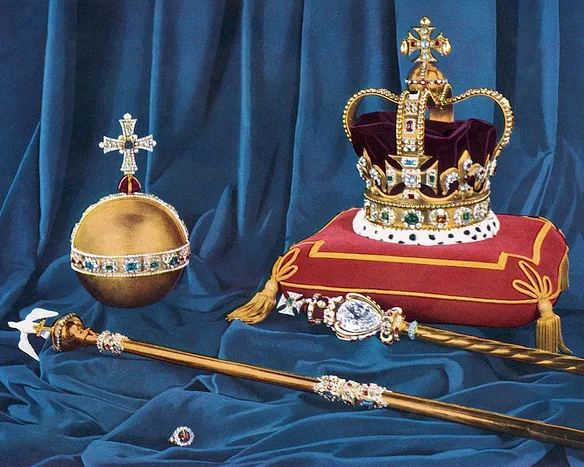
Crown Jewels of the United Kingdom 1952-12-13
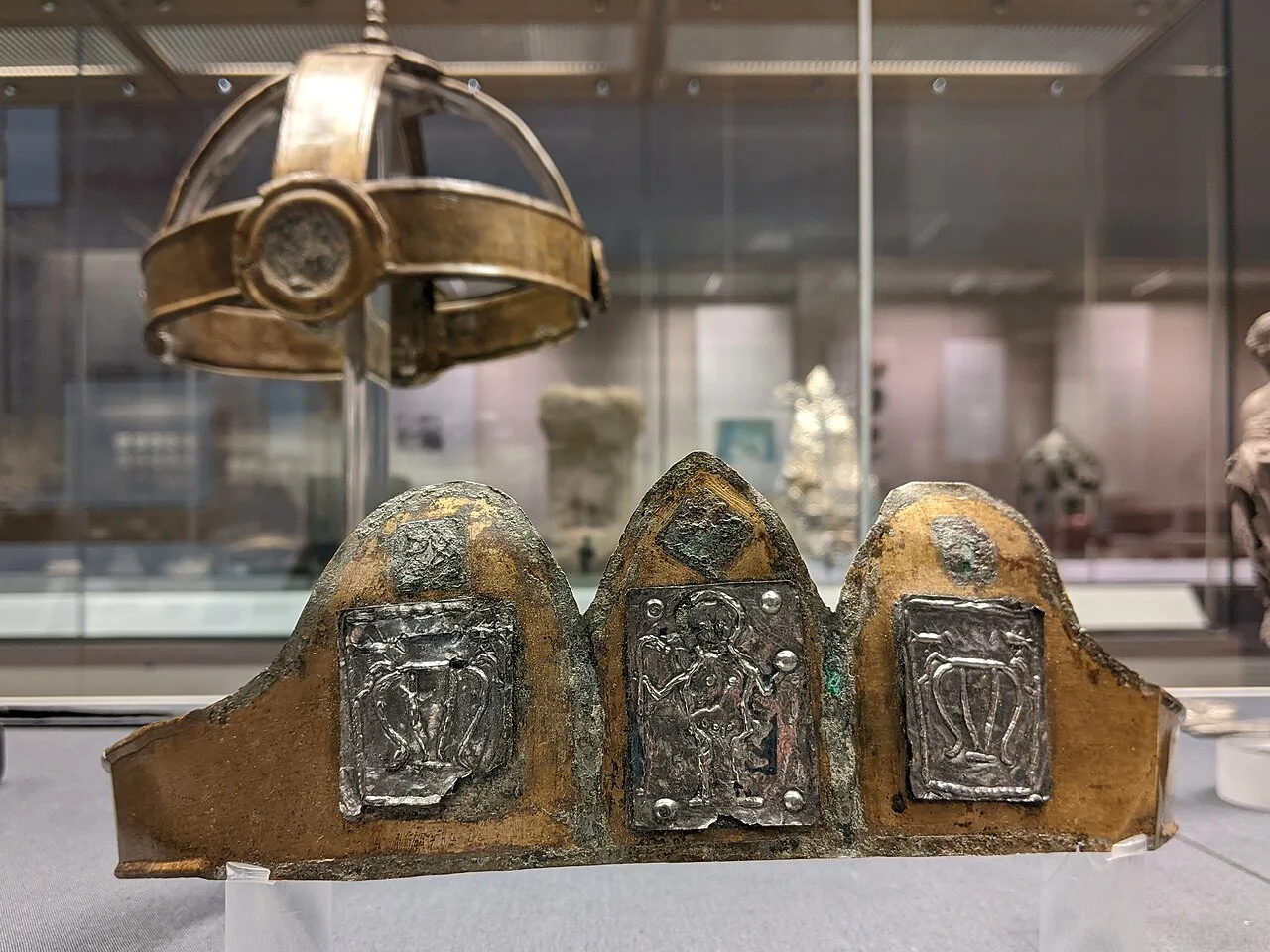
The Holkwold crown (upper left) and diadem in the British Museum
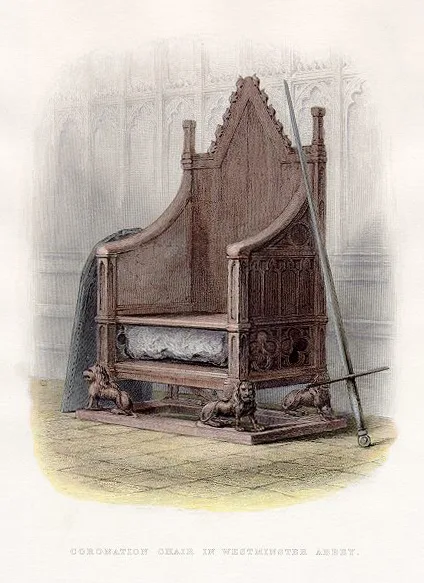
The Stone of Scone in the Coronation Chair at Westminster Abbey, 1859
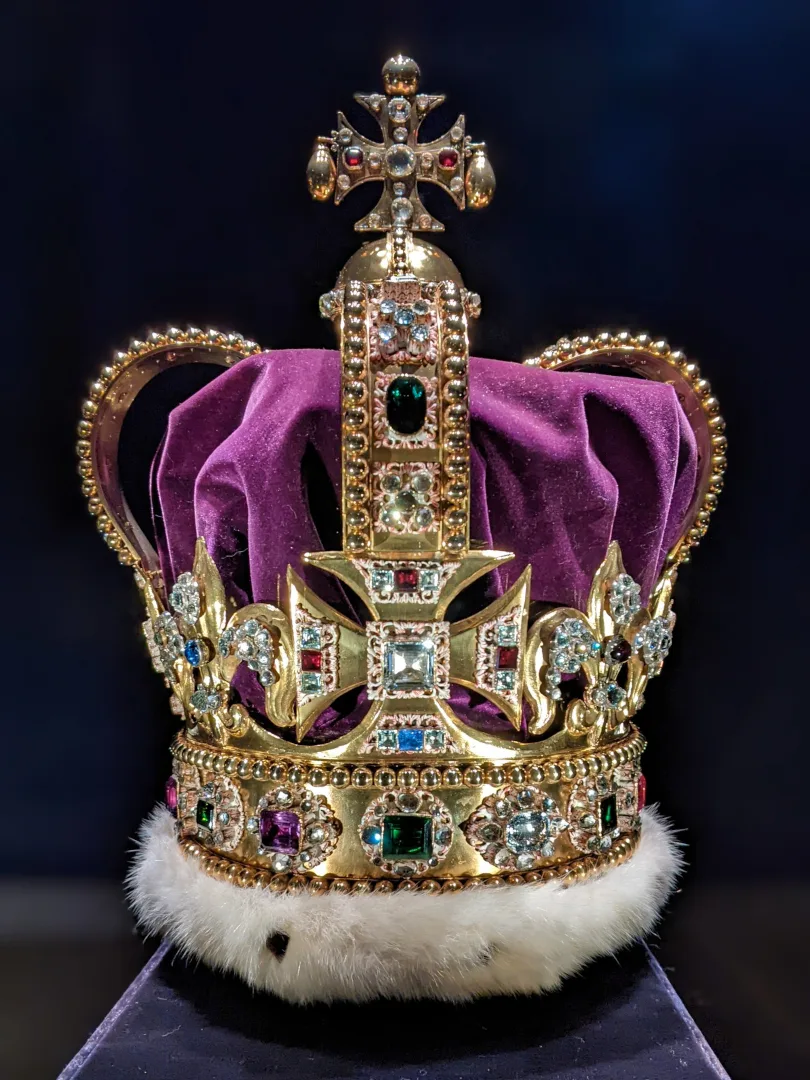
St Edward's Crown is the centrepiece of the British coronation regalia.
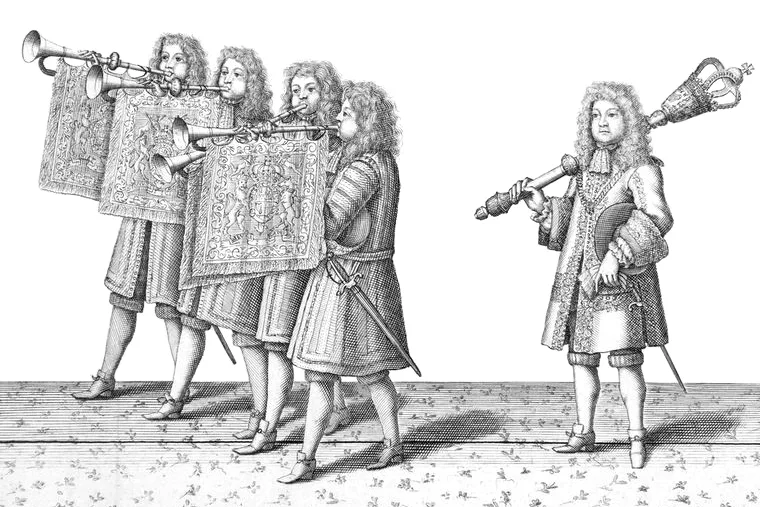
Trumpeters and a mace bearer at the English coronation of James II
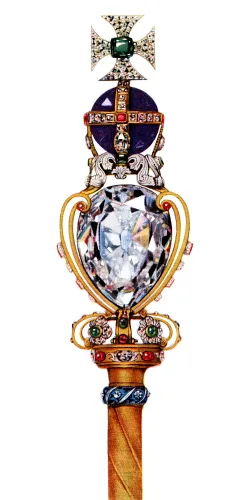
The head of the Sovereign's Sceptre with Cross
Coronation Spoon
The Crown Jewels of the United Kingdom are a collection of royal ceremonial objects, coronation regalia, and vestments kept in the Tower of London.
Pawning the Magna Corona for Continental War Funds
While crowns are popularly viewed as inalienable sacred heirlooms, medieval English rulers routinely treated state regalia as financial collateral. Edward III pawned his magna corona to Baldwin of Luxembourg in 1339 for more than £16,650, equivalent to £22,572,528 in 2025. Wealthy subjects, bishops, and continental bankers frequently held these royal treasures as security for substantial loans during military campaigns.
From Wikipedia · CC BY-SA 4.0
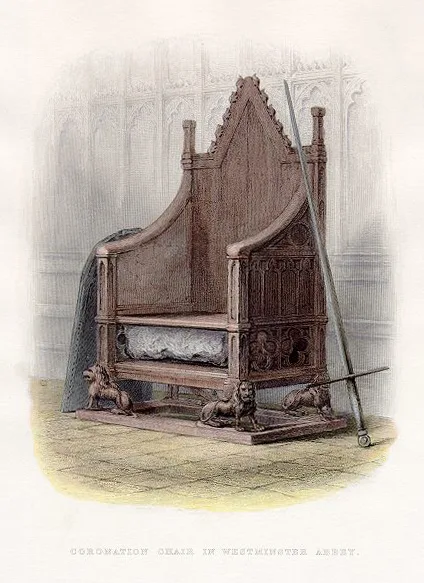
The Stone of Scone in the Coronation Chair at Westminster Abbey, 1859

A replica of the Stone of Scone in front of a much later chapel

The Stone of Scone in the Coronation Chair at Westminster Abbey, photo c. 1875 – c. 1885. In 1914, the stone was broken in half by a suffragette bombing.

The Stone of Scone being carried out from Edinburgh Castle in preparation for its use at the coronation in 2023 of Charles III
Stone of Scone
The Stone of Scone is an oblong block of red sandstone historically used in the coronations of Scottish, English, and British monarchs.
Local Quarrying Shatters Biblical Origin Myths
Centuries of folklore asserted that the Scottish coronation artefact was the biblical Stone of Jacob brought from ancient Ireland. Modern geological analysis overturned these venerable origin stories by confirming the rock is lower Old Red Sandstone quarried in the vicinity of Scone. This physical reality exposes the tension between romantic national mythmaking and mundane local geological origins.
From Wikipedia · CC BY-SA 4.0
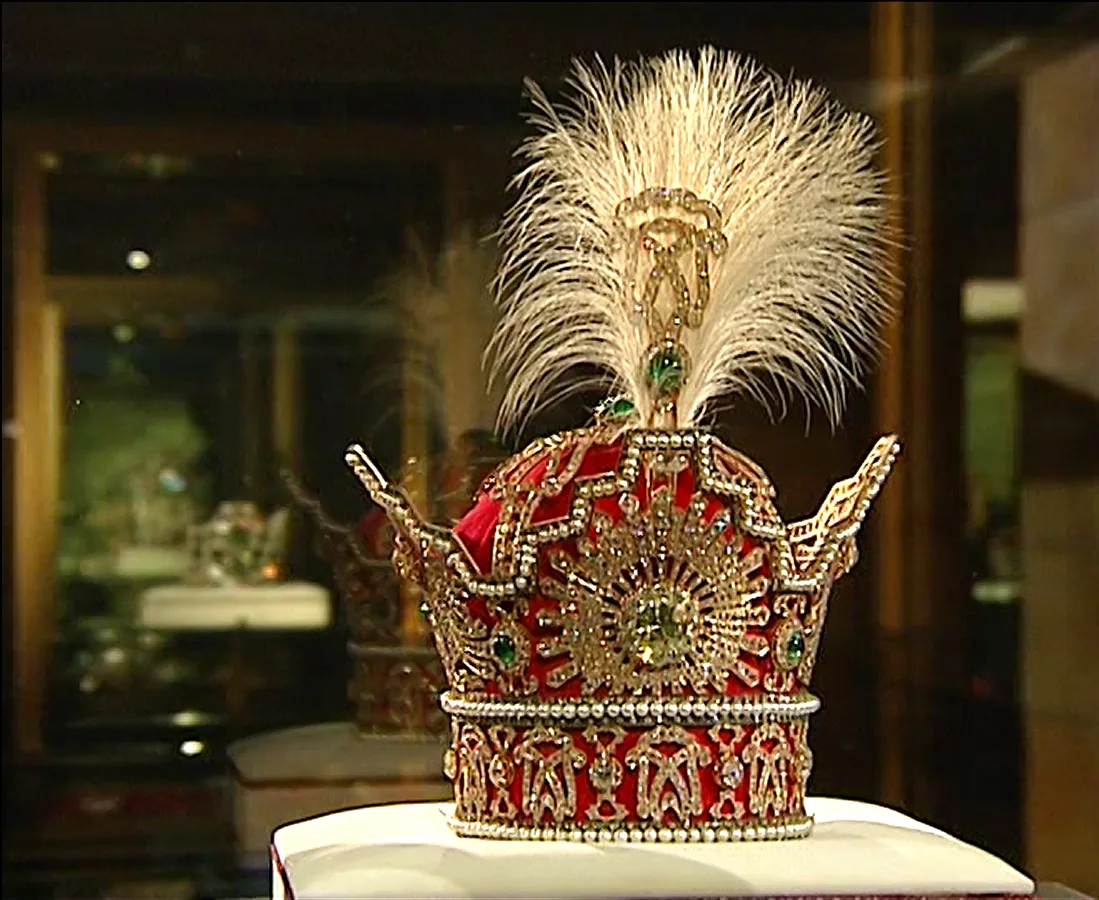
Pahlavi Crown
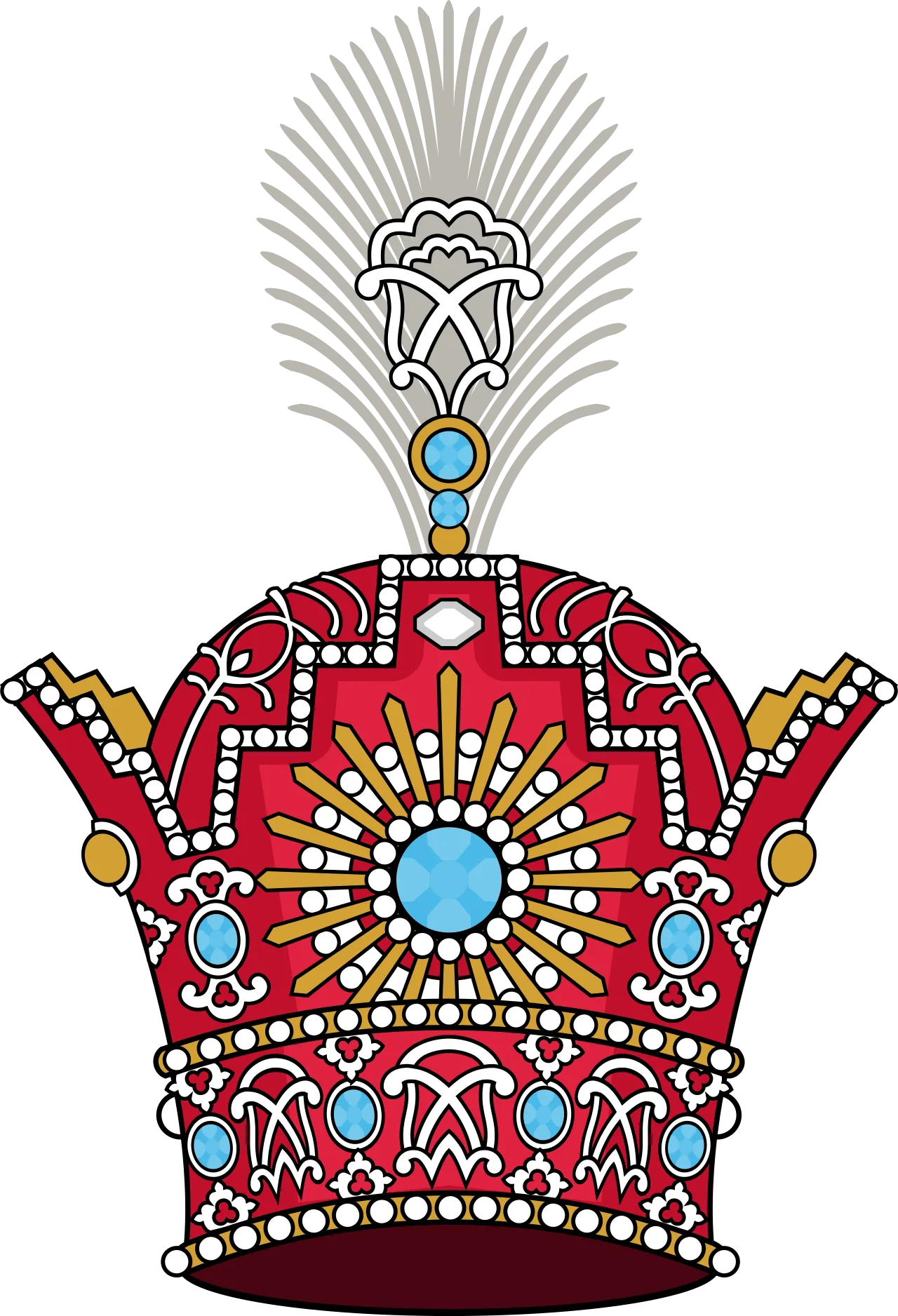
Pahlavi Crown of Imperial Iran (heraldry)
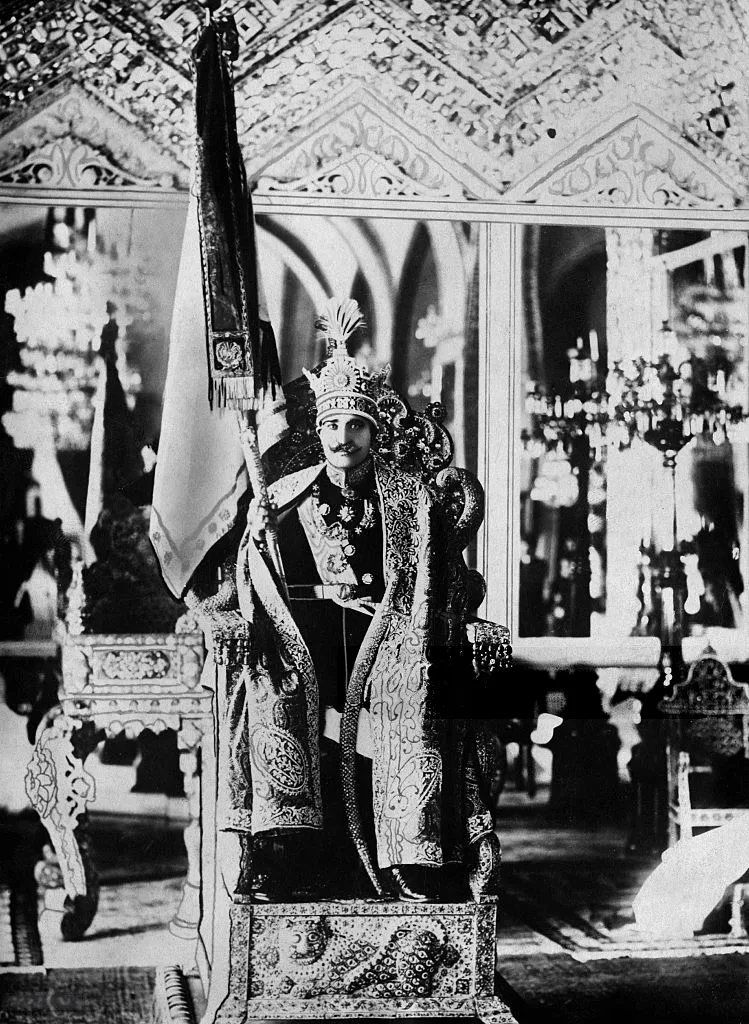
Reza Shah wearing the crown at his coronation, 1926
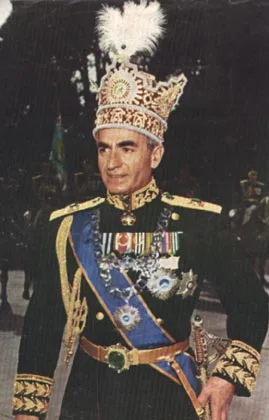
Mohammad Reza Shah wearing the crown at his coronation, 1967
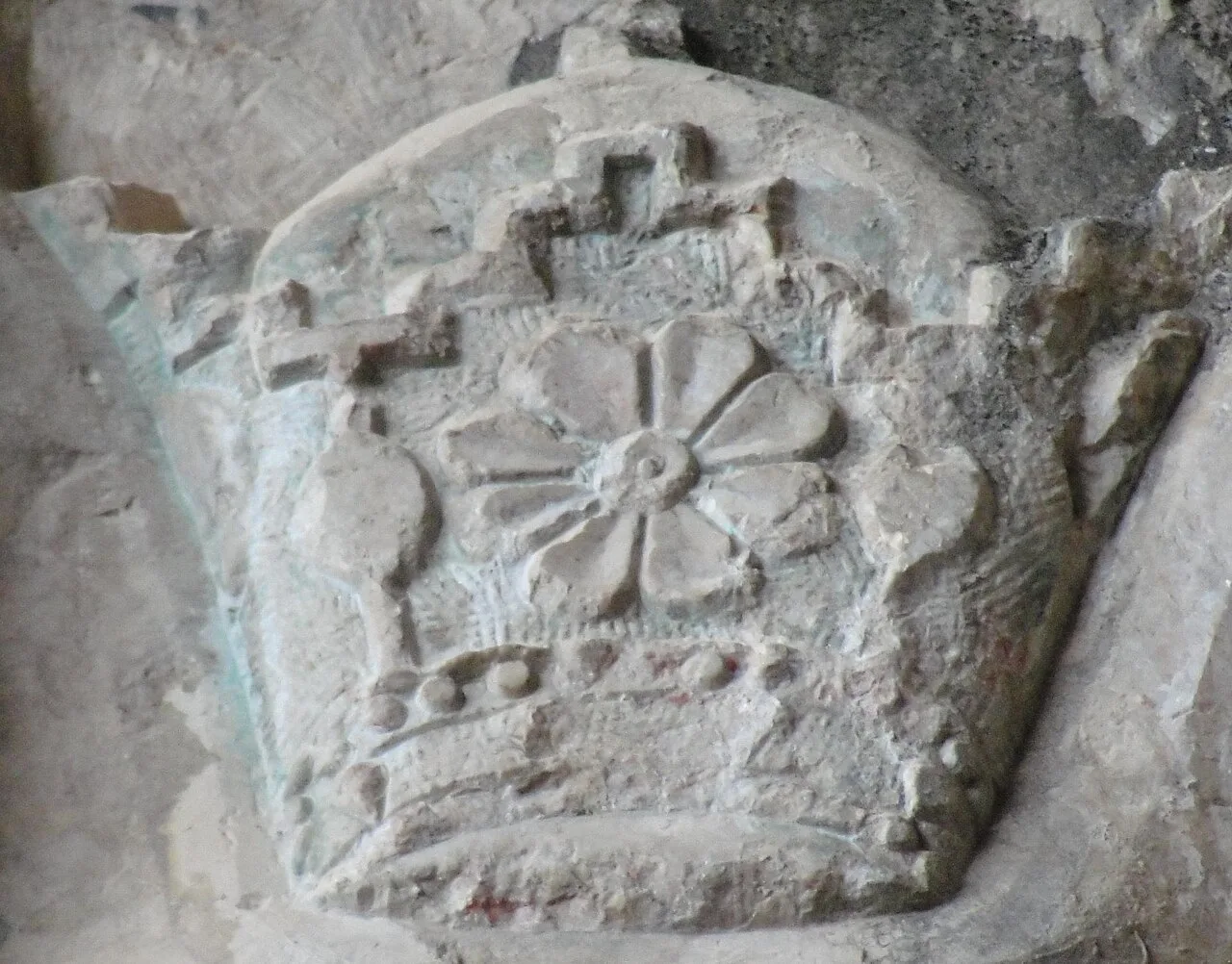
The crown engraved above a 1957 inscription at Shapur Cave
Pahlavi Crown
The Pahlavi Crown was the Iranian coronation crown used during the Pahlavi era (1925–1979). It is held amongst the Iranian National Jewels by the government of Iran.
Resurrecting Sasanian Motifs to Displace Qajar Rule
When the Pahlavi dynasty rose to power in 1925, Reza Shah sought to visually sever ties with the preceding Qajar dynasty. He ordered Iranian jewelers under Haj Serajeddin Javaheri to craft a new crown that would replace the older Kiani Crown. Rather than following recent traditions, the designers looked back to paintings and historical records of Sasanian era crowns from 224 to 651 AD.
From Wikipedia · CC BY-SA 4.0